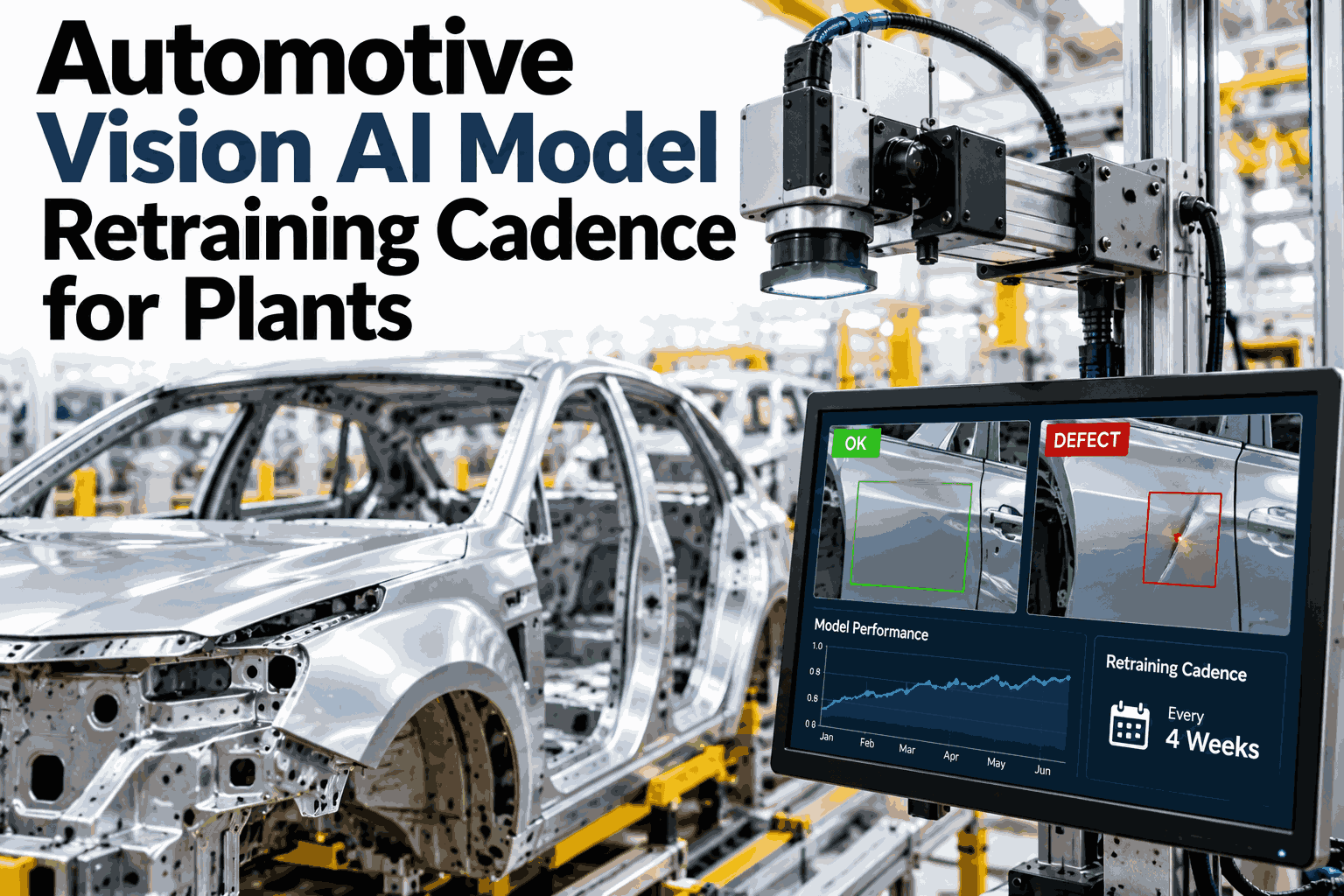
A vision model is sharpest on its first day live and gets quietly worse after that unless someone is watching the trend. Production vision systems typically launch at 90 to 92 percent accuracy and lose another 2 to 5 percent a quarter as the line's parts, lighting and shifts drift away from the training set, with no error message to mark the moment it happened. This guide sets the triggers, the sample-collection steps and the champion-versus-challenger check that keep a retraining cadence on schedule, outlined further in a model health review.
Automotive Vision AI Model Retraining Cadence for Plants
Catch drift on a planned schedule, not after a defect escape finds it for you, with triggers, sample collection and a challenger model that has to earn its promotion.
- Seven drift triggers with starting limits
- How to collect samples without flooding the label queue
- Why a new model should never replace the old one untested
Why a Good Vision Model Gets Worse
The model does not change. Everything around it does.
A trim level shifts, a supplier swaps a fastener, a bracket moves two millimetres on a fixture rebuild. None of it shows up as an error, and all of it moves the images the model sees further from the ones it was trained on. Roughly six in ten vision deployments run with no automated drift detection at all, which is why the first sign is usually a defect escape rather than a dashboard. Our vision team can check what your current setup is actually watching.
New variant or trim
A body style or trim shares the general geometry the model knows, but enough visual difference to drop accuracy.
Camera or lighting drift
A dimming fixture or a shifted bracket changes what the camera sees, not what the part actually is.
Label drift
A part marking or text label moves a few pixels after a tooling change, and the model starts misreading it.
Seasonal and shift patterns
Ambient light near a loading dock, or a supplier batch that only runs certain weeks, each nudge the input distribution.
A large share of what looks like drift is a dirty lens, a failed light or a bracket that has moved. Retraining on bad images makes a model worse, not better. Fix the capture standard first, then decide whether the model itself needs new data.
What looks like drift
- A sudden accuracy drop. Often a camera or lighting fault, not the model.
- More operator overrides. Can mean the model is right and the standard changed.
- One station underperforming. Usually local to that fixture, not the whole model.
What usually is drift
- A slow, steady decline across several weeks
- Accuracy falling only on a specific part number or shift
- Confidence scores clustering closer to the threshold over time
Drift Triggers: When to Start a Retrain
Retraining every month wastes effort. Waiting for an escape is far too slow.
A sensible cadence runs on triggers, not the calendar. Each trigger below has a starting limit that fits most automotive vision stations; your own numbers should move as you learn your line's normal range. To set your starting limits properly, book a drift calibration session.
Not every signal deserves the same response
Monitor
Signal within normal range. Logged, no action taken.
Minor drift
Handled on the normal scheduled retraining cadence, no manual step needed.
Moderate drift
Sample collection accelerates, a retrain is scheduled ahead of the normal cadence.
Severe drift
Immediate retrain, and a temporary rollback to the prior stable model if needed.
Write the starting limits down and review them quarterly. A limit nobody revisits becomes noise within a year.
What an Overdue Retrain Costs One Station
A door-seal station tracked for twelve weeks without a scheduled retrain, against the same station once a cadence was in place.
Building a Retraining Pipeline
A new model earns its place. It is never swapped in on trust.
Retraining is not a single event, it is a short pipeline that runs the same way every time a trigger fires. Collecting the wrong samples, or skipping the comparison against the model already running, is how plants end up worse off after a retrain than before it. Ask our vision specialists how collection would work at your stations.
Collect targeted samples
Pull images from the stations and classes the trigger pointed at, not a random plant-wide sample.
Label and review
Have quality engineering confirm labels; mislabeled data is a known source of error in even well-known training sets.
Train the challenger
Build a new candidate model from the enriched dataset, kept entirely separate from the running champion.
Shadow mode
Run the challenger alongside the champion on live data for 24 to 72 hours without it making any decisions.
Statistical gating
Promote the challenger only if it matches or beats the champion on accuracy, recall and precision together.
Canary rollout
Move a small share of live traffic to the new model before it takes over the station fully.
Keep a fallback
The prior model stays ready to restore in minutes if the new one underperforms once fully live.
How is a challenger validated against the champion before promotion? What counts as a passing score, and who signs off? How fast can a rollback happen if the new model underperforms? Who owns sample collection when a trigger fires? What happens to training data if we change vendors?
Three ways plants handle retraining
Quarterly, by request
Retraining happens when someone notices a problem and escalates it to data science, usually weeks after drift started.
Scheduled vendor cycles
A fixed calendar cadence from the camera or model vendor, with limited visibility into what triggered each run.
Continuous, trigger-based
Drift monitored constantly, retraining started by a trigger, every challenger gated before promotion. This is where iFactory sits.
Running a Model Health Audit
Twelve weeks of accuracy history tells you more than a single confidence score.
A model health audit lines up accuracy, override rate and confidence score history against the dates of any known change, part variant, fixture move or supplier swap. Most audits find the decline traces back to one identifiable event, not a mysterious slow fade. To run one on your current stations, book an audit kick-off.
The audit, step by step
- Pull twelve weeks of history. Accuracy, confidence and overrides, by station.
- Mark known changes. Variants, fixture moves, supplier swaps, camera work.
- Line them up. Find which change dates match the decline.
- Set a trigger. Turn the finding into a limit for next time.
- Schedule the first retrain. On the cadence the audit points to.
Accuracy by station and class
Not a single plant-wide number. Tracked per station, per defect class, per shift.
Days since last validated retrain
A simple counter that makes an overdue cadence visible before it becomes a problem.
Challenger pass rate
The guard rail. A challenger that keeps failing gating says the pipeline, not just the model, needs a look.
How iFactory Keeps Automotive Vision Models Current
Drift watched continuously, retraining started by a trigger, never by surprise.
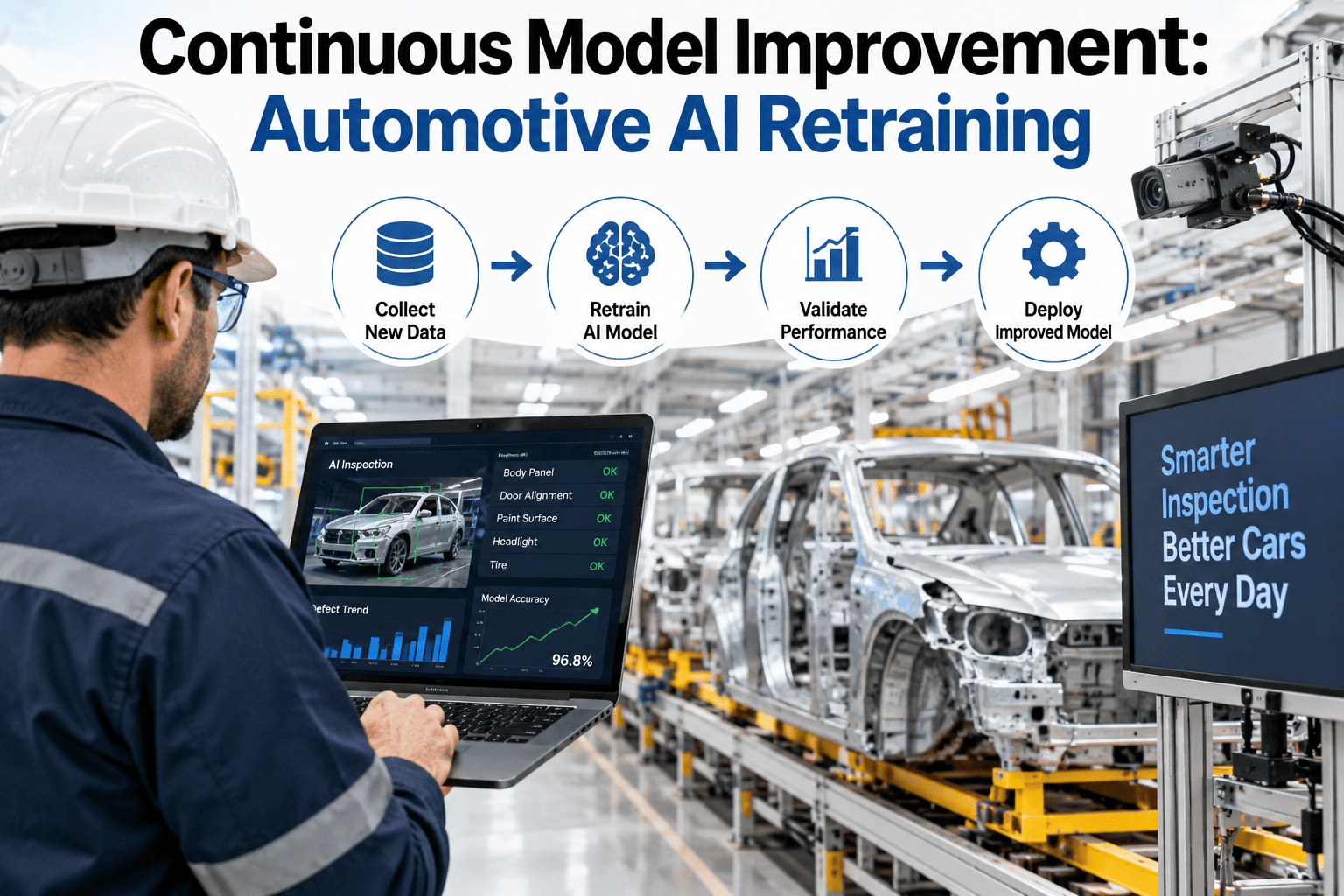
iFactory tracks accuracy, confidence and override rate for every deployed vision model, flags drift against tiered limits, and builds challenger models from targeted sample collection rather than a blanket data pull. Every challenger runs in shadow mode and must beat the current champion on accuracy, recall and precision before it goes live. Questions on fit go to our support desk.
Monitor
Accuracy, confidence and override rate tracked continuously against tiered drift limits.
Collect
Samples pulled from exactly the station and class a trigger flagged, then labeled for review.
Validate
Challenger run in shadow mode against the champion, promoted only if it earns the swap.
Roll out
Canary rollout with a fallback ready, so a weak model never stays live by default.
Plants that move from quarterly, request-driven retraining to a continuous, trigger-based cadence typically hold accuracy within a few points of launch-day levels, instead of the 2 to 5 percent quarterly decline seen on static models.
Turnkey AI: Delivered, Connected and Live in 6–12 Weeks
You do not staff a data science team for this. It arrives managed.
iFactory ships as a pre-configured NVIDIA AI server, racked and ready, with drift monitoring and the retraining pipeline pre-loaded. Rack it, connect it to your camera network, and baseline tracking begins immediately.
Our team handles camera integration, trigger calibration for your part mix, operator training on the override workflow, and 24×7 remote monitoring. The server runs inside your own network, so training images never leave your plant. For a scope matched to your lines, request a turnkey quote.
Connect and baseline
Server installed. Cameras connected. Current model accuracy baselined by station, shift and defect class.
Calibrate and pilot
Drift triggers set for your part mix. First challenger model trained and validated in shadow mode.
Go-live and train
Continuous monitoring live on every station. Teams trained on the trigger and rollback workflow.
Frequently Asked Questions
How often should an automotive vision model be retrained?
There is no single number that fits every plant. A sensible cadence combines a baseline schedule, often monthly or quarterly, with trigger-based retrains whenever accuracy, confidence or override rate crosses a set limit, so a fast-moving problem never waits for the calendar.
What is the difference between model drift and a camera fault?
A camera fault, such as a dirty lens or a failed light, usually causes a sudden drop tied to one station. Drift is slower and broader, showing up as a steady decline across weeks, often tied to a part change rather than hardware. Check the camera first.
Why does a new model need to run in shadow mode first?
Shadow mode lets a challenger model make predictions on live data without any of them affecting the line, so its accuracy, recall and precision can be compared fairly against the current model before anything changes for operators.
What happens if a retrained model performs worse?
If the challenger fails to match the champion in shadow mode, it is never promoted, and the champion keeps running. A well-built pipeline also keeps the prior stable model ready as a fallback for minutes-fast rollback if a live issue appears.
Who should own model retraining on the plant floor?
Someone needs to be accountable for watching drift and approving retrains, even if the work itself is managed by a vendor. Many plants without a named owner find retraining never gets staffed or budgeted after go-live. Contact our team to see how a managed cadence fits your structure.
See Where Your Vision Models Actually Stand
In thirty minutes we go through your deployed models' accuracy history, your current drift limits and your last retrain date, and point to what is overdue. You keep the findings whether or not you go further with iFactory.
- 1Accuracy history since each model's launch date
- 2Known part, fixture or camera changes and their dates
- 3Operator override counts, if tracked
- 4Date of the last validated retrain
- 5Any recent escapes tied to a specific station