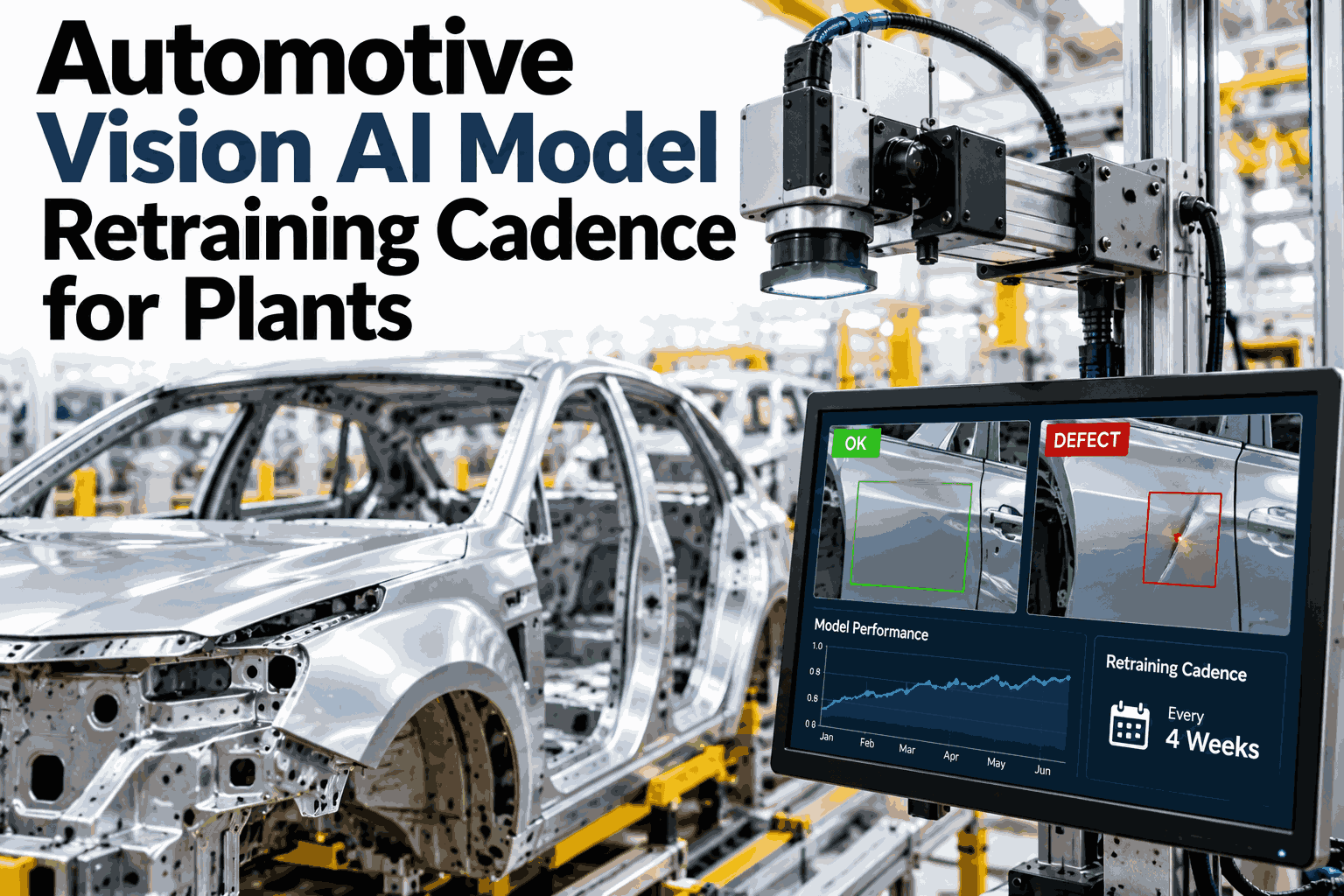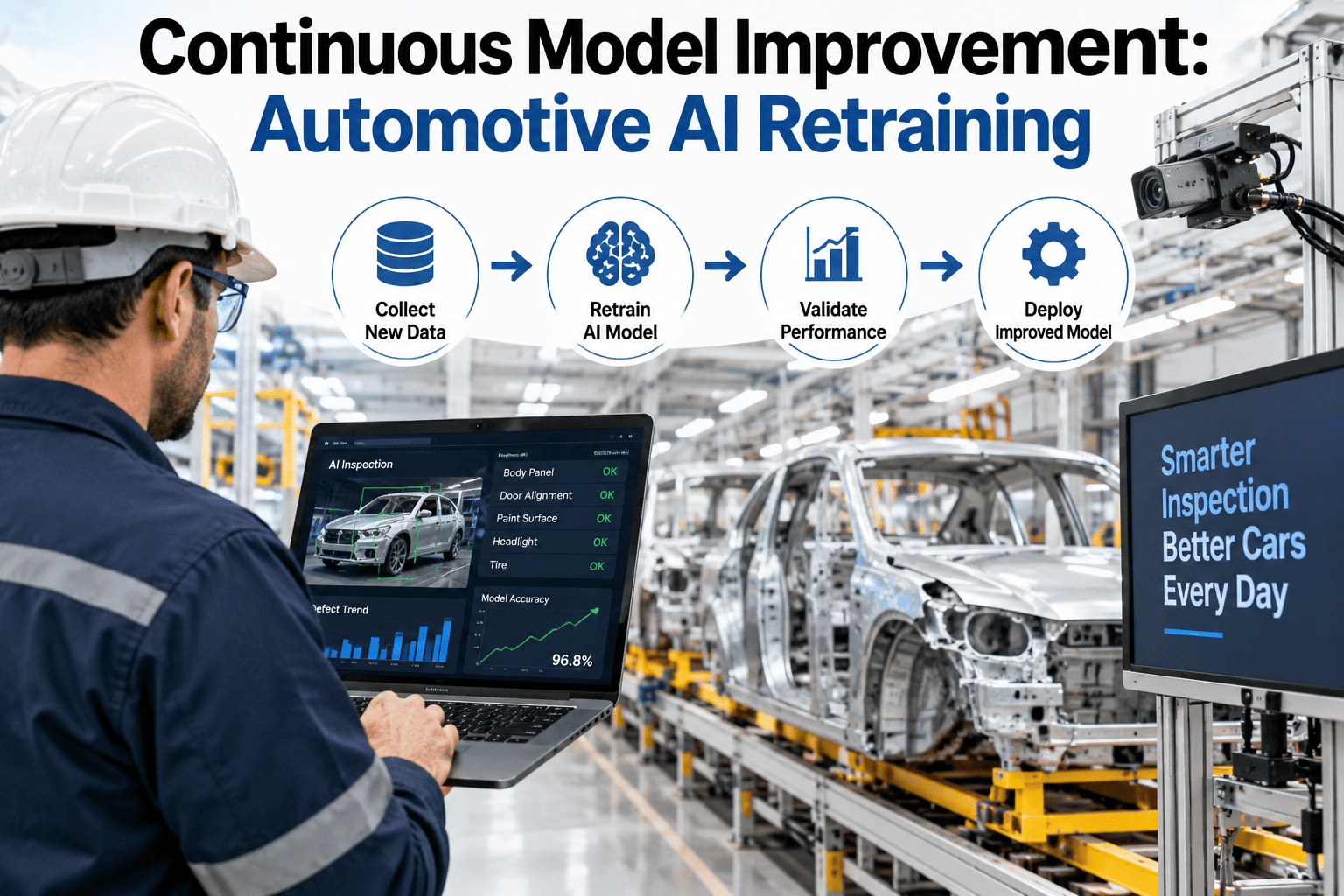
An AI vision model that performs beautifully on day one of deployment is not the same thing as a model that will still be performing well eighteen months later, and treating model deployment as a one-time event rather than an ongoing responsibility is one of the most common reasons vision inspection accuracy quietly degrades over time. Lighting conditions shift as bulbs age, part finishes change with a supplier material update, and entirely new model variants get introduced with geometries the original training data never saw. Each of these can erode accuracy gradually enough that no single day looks alarming, until the cumulative drift shows up as a rising false accept or false reject rate that no one connected back to the model itself. This page covers how to detect that kind of drift early, what a sustainable retraining pipeline actually looks like, and how to handle the specific challenge of extending an existing model to a new vehicle variant. You can talk to support about setting up a retraining cadence for your current vision inspection deployments.
Vision Model Accuracy Decays Quietly Unless Someone Is Watching the Trend
iFactory tracks vision model accuracy continuously and flags drift early, so retraining happens on a planned schedule instead of after a defect escape reveals the problem.
Illustrative accuracy decay pattern for a vision model with no retraining cadence in place
The Environment Around a Model Keeps Moving Even When the Model Doesn't
A vision model is trained on a snapshot of conditions, specific lighting, specific part finishes, a specific set of defect types and part geometries, at a specific point in time. The plant floor around that model doesn't stay frozen at that snapshot. Lighting fixtures age and dim gradually. A supplier changes a coating process slightly. A new defect type appears that the original training data never included. None of these individually feels like a dramatic change, but cumulatively they shift the input distribution the model sees further and further from what it was trained on.
LED and fluorescent fixtures gradually dim and shift color temperature over their service life, subtly changing how parts appear to the camera compared to when the model was trained.
A coating, surface treatment, or material substitution at a supplier can change part appearance enough to affect model accuracy without any formal notification reaching the vision system.
Production changes can introduce failure modes the model was never trained to recognize, which it will either miss entirely or misclassify inconsistently.
Physical camera position, focus, or fixture wear can shift gradually over months of continuous operation, changing the effective field of view the model was calibrated against.
Signals Worth Monitoring Before Accuracy Becomes a Visible Problem
Waiting for a defect escape to reveal that a model has drifted means the drift has already been happening for some time, potentially long enough to have let real defects through undetected. Several leading indicators tend to show up before accuracy degrades to the point of an obvious failure, and monitoring them proactively is what separates a planned retraining cadence from a reactive scramble after something goes wrong.
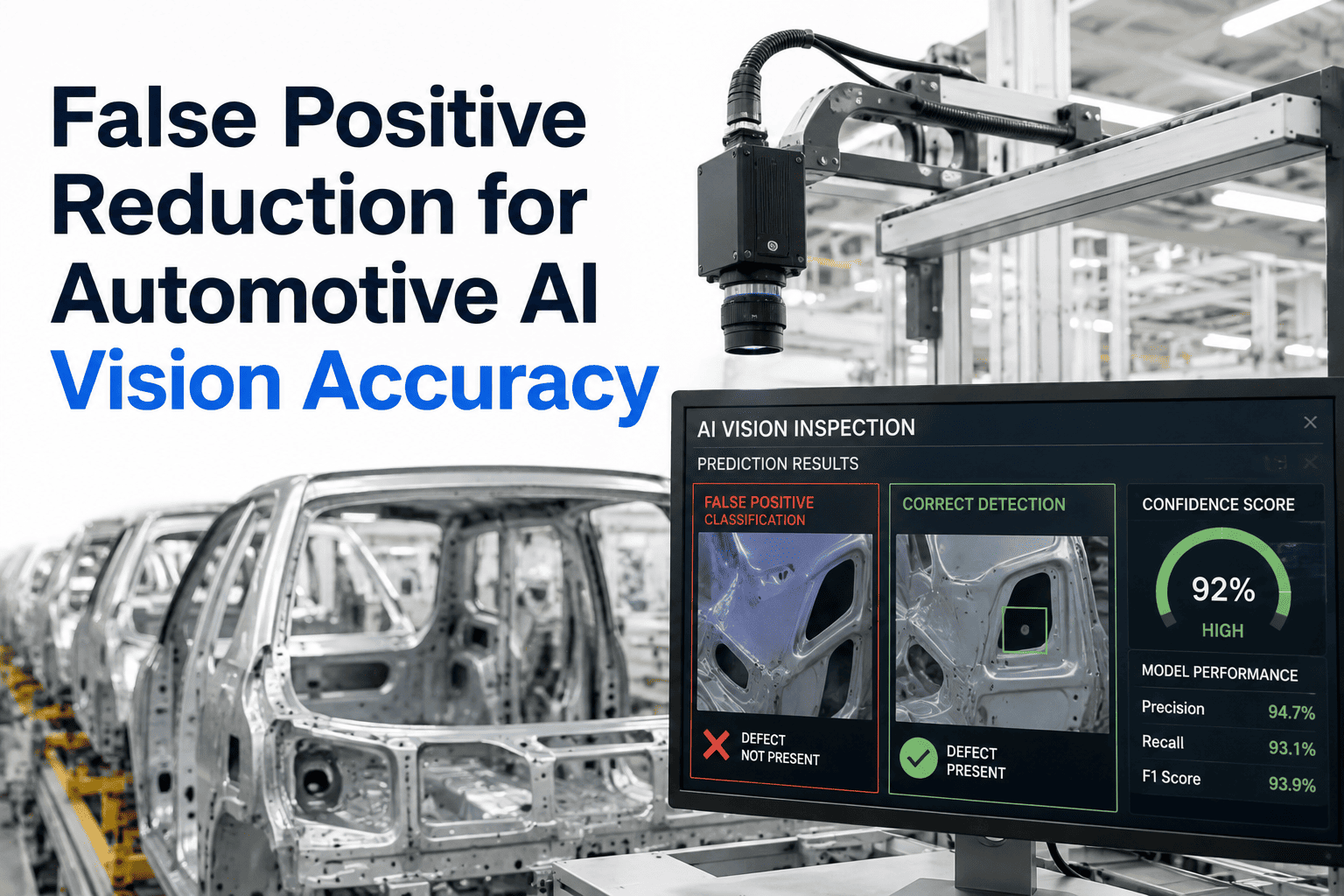
An increasing rate of good parts being flagged as defective is often the earliest visible sign of drift, since it directly affects throughput and tends to get noticed by dock personnel quickly.
A model's own confidence scores drifting toward the uncertain middle range more often than usual suggests it's encountering input further from what it was trained on.
If human reviewers are overriding the model's decisions more frequently than the historical baseline, that's a direct signal the model's judgment is diverging from ground truth.
Defects found later in the process that trace back to a station the vision system should have caught are a lagging but important signal that the model may have drifted.
What Sustainable Model Maintenance Actually Requires
A one-time model deployment without an ongoing maintenance plan is effectively a depreciating asset from day one. Building a sustainable retraining pipeline means establishing a repeatable process for collecting new training examples, particularly from cases the model got wrong or was uncertain about, and periodically retraining and revalidating the model against that expanded dataset before it goes back into production.
Automatically flag and store images where the model's confidence was low or where a human override occurred, building a growing pool of edge cases for future retraining.
Set a regular cadence, such as quarterly, to formally revalidate model accuracy against a fresh sample of recent production, not just to react when a problem is already suspected.
Maintain a clear version history of deployed models, what data trained each version, and when it was deployed, so any accuracy issue can be traced to a specific model version.
Run a newly retrained model alongside the current production model for a validation period before fully switching over, to confirm the update actually improves performance.
Extending a Trained Model to a New Vehicle Variant
A particularly common retraining trigger in automotive is the introduction of a new trim level, body style, or model year variant that shares a general geometry with what the model already knows but introduces enough visual difference to affect accuracy. Rather than starting from scratch, most teams find it more efficient to extend the existing model with additional training examples specific to the new variant, validating carefully that performance on the original variants hasn't degraded in the process.
This validation step matters because retraining a model to handle a new variant can sometimes cause it to perform slightly worse on the variants it already handled well, a phenomenon worth explicitly testing for rather than assuming. Maintaining a standing validation dataset that spans every variant the model needs to handle, and rerunning that full validation set after every retraining cycle, is the most reliable way to catch this kind of regression before it reaches production.
Who Should Actually Own Model Maintenance
A common gap in vision inspection programs is that the team responsible for deploying a model isn't necessarily the same team responsible for maintaining it months or years later, and without explicit ownership, model maintenance tends to fall through the cracks between quality engineering, IT, and whichever vendor originally implemented the system. Establishing clear ownership for the ongoing model lifecycle, separate from the initial deployment project, is one of the most important organizational decisions a program can make early on.
This doesn't necessarily mean building a large dedicated team; for many plants, a designated role within quality engineering, responsible for monitoring drift signals, coordinating retraining cycles, and maintaining the validation dataset, is sufficient. What matters most is that this responsibility is explicit and doesn't default to "whoever notices a problem first," which tends to mean problems are caught later and less systematically than they would be under an owned, proactive process.
Documenting the retraining process itself, what triggers a retraining cycle, who approves a new model version before deployment, and how shadow testing results are reviewed, also matters for consistency, particularly in larger organizations where the person handling this responsibility may change over time. A documented process outlives any single person's institutional knowledge and makes the program resilient to staff turnover.
How Much of the Retraining Process Should Be Automated
Some parts of a retraining pipeline lend themselves well to automation, such as automatically flagging low-confidence images for review or automatically running a revalidation suite against a new model version. Other parts benefit from deliberate human judgment, particularly the decision to actually deploy a retrained model into production, which carries real consequences if the retraining introduced an unexpected regression.
Flagging low-confidence images, tracking drift metrics over time, and running standardized validation test suites against candidate model versions.
Final approval to deploy a retrained model, judgment calls on ambiguous edge cases during training data curation, and interpreting whether a drift signal reflects a real problem or benign seasonal variation.
Getting this balance right means automating the repetitive, well-defined parts of the pipeline while keeping a person in the loop for decisions that carry meaningful downside risk if handled incorrectly, which keeps the process efficient without removing the judgment that catches problems automation alone would miss.
Catching a Coating Change Before It Became a False Reject Spike
A supplier updated a coating formulation for a stamped bracket without notifying the receiving plant, subtly changing surface reflectance in a way that gradually pushed confidence scores toward the uncertain range on the vision inspection station checking that part.
Rising confidence score variance was flagged before false reject rate climbed high enough to affect throughput noticeably. A quick retraining cycle incorporating new samples of the updated coating restored model accuracy within days, avoiding what would have otherwise become a disruptive false reject spike once the drift crossed a more obvious threshold.
A Realistic First Step Toward a Retraining Cadence
Document when each currently deployed model was trained and whether it has been revalidated or retrained since deployment.
Begin capturing confidence scores and human override events if not already tracked, since this data is the foundation for drift detection.
Designate a specific role responsible for monitoring drift signals and coordinating retraining, rather than leaving it as an informal shared responsibility.
Build a standing set of test images spanning every variant and defect type the model needs to handle, to rerun after every future retraining cycle.