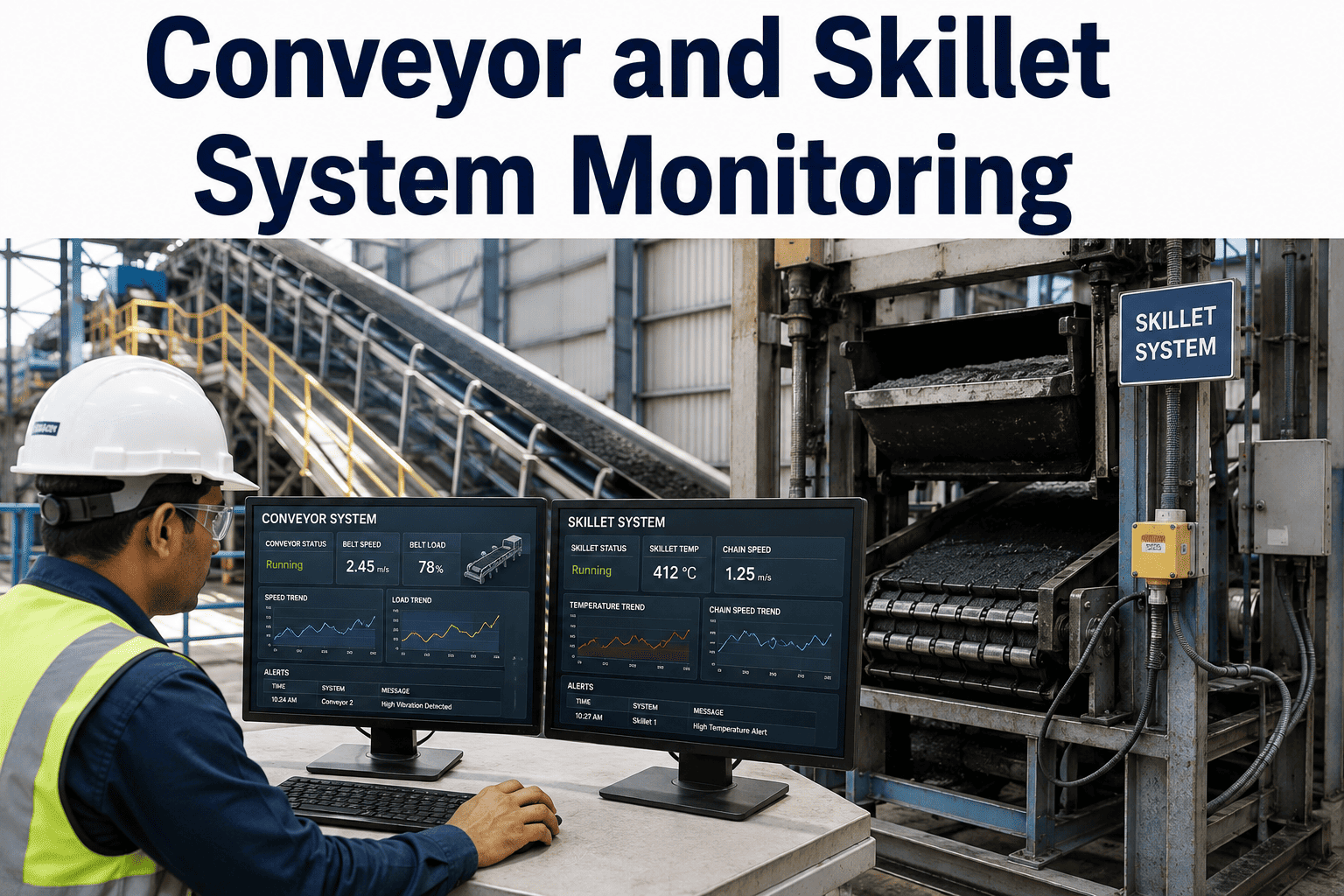
When a stamping press goes down, the plant loses that press's output — a serious problem, but a contained one, absorbed by buffer inventory downstream while a repair crew responds. When the main body conveyor goes down, the plant loses everything: every station on that line stops simultaneously, because the conveyor is not one piece of equipment among many, it is the physical path every vehicle body has to travel to reach the next operation. Automotive assembly line downtime is commonly cited in the range of tens of thousands of dollars per minute once a stopped conveyor backs up the full plant, which is why a conveyor lead's job carries a different weight than most other maintenance roles on the floor — the margin for reactive firefighting on this specific asset class is thinner than almost anywhere else in the plant. See how iFactory's conveyor and skillet monitoring analyzes drive current and chain condition data to flag degradation before it reaches the point of a line stop.
Predictive Maintenance for Auto Equipment · Conveyor & Skillet Systems
Conveyor and Skillet System Monitoring: Predicting Failures Before They Stop the Line
The conveyor system is the spine of every assembly plant. AI analysis of drive current, chain condition, and skillet synchronization data catches degradation weeks before it becomes a line-stopping failure — not just another sensor dashboard, but the specific failure modes a conveyor lead actually deals with.
Commonly cited cost per minute when a stopped conveyor backs up a full assembly line
1 assetStops the entire line — not just one station
WeeksTypical lead time between early degradation signal and failure
3 signalsDrive current, vibration, and multi-drive sync data
Skillet-specificFailure modes standard PdM templates don't cover
Why This Asset Is Different
The Conveyor Isn't One Machine Among Many — It's the Line Itself
Most predictive maintenance programs prioritize assets by criticality score, and conveyor and skillet systems usually top that list for a structural reason most other equipment doesn't share: there is no downstream buffer that absorbs a conveyor failure the way there is for a single robot cell or a single press. That structural difference should change how a conveyor lead thinks about monitoring priority, not just which specific sensors get installed.
01
No Buffer Absorbs the Failure
A robot welder going down stalls one station while WIP buffers absorb the gap. A main conveyor going down stops every station simultaneously, because every vehicle body on the line depends on the same physical transport path to move forward.
02
Failure Modes Are Progressive, Not Sudden
Chain elongation, drive motor bearing wear, and skillet misalignment develop gradually over weeks, which means the warning signs exist well before failure — but only if something is actually watching the right signals continuously rather than during periodic manual inspection rounds.
03
Multi-Drive Synchronization Adds a Failure Mode Other Equipment Doesn't Have
Long conveyor runs use multiple drive motors working in synchronized coordination. A single drive drifting out of sync with the others creates chain tension irregularities and skillet tracking problems that a single-drive vibration analysis template was never designed to catch.
04
Calendar-Based PM Both Wastes Money and Misses Failures
Replacing chain on a fixed schedule regardless of actual wear condition means healthy chain gets replaced early some of the time and worn chain runs past its safe service life the rest of the time — calendar-based maintenance is simultaneously wasteful and insufficiently protective.
Taken together, these four characteristics explain why conveyor and skillet monitoring consistently ranks as one of the highest-value predictive maintenance investments a plant can make, even in facilities that have been cautious about broader PdM rollouts. The combination of catastrophic downside risk, genuinely predictable failure progression, and a specific gap in most generic PdM templates makes this asset class an unusually clear case where the investment case doesn't require optimistic assumptions to justify itself.
Failure Mode Taxonomy
The Specific Ways Conveyor and Skillet Systems Actually Fail
Generic conveyor PdM guidance tends to focus on belt-based material handling conveyors. Automotive body conveyors and skillet systems have their own distinct failure signature, and the taxonomy below reflects what a conveyor lead actually chases down on an assembly line specifically — not a generic list adapted loosely from warehouse or bulk-material conveyor contexts.
01
Chain Elongation
Progressive stretching of drive chain from normal wear at each pin and bushing joint. Elongation beyond tolerance causes chain to ride high on sprocket teeth, accelerating sprocket wear and eventually causing chain jump or skip under load — a sudden, line-stopping event that had weeks of gradual warning beforehand.
Bearing wear in conveyor drive motors follows a well-documented vibration and current signature progression — increasing high-frequency vibration at bearing defect frequencies, followed eventually by current draw irregularity as friction increases. Left unaddressed, it ends in a seized bearing that can damage the motor shaft and gearbox simultaneously.
Detected via: motor current signature analysis (MCSA) and vibration monitoring
03
Skillet Misalignment & Tracking Drift
Skillet carriers gradually drift out of proper alignment on the conveyor rail system due to guide wheel wear, rail wear, or chain tension irregularity. Undetected, this progresses to skillets binding, jamming, or derailing — a failure mode with no equivalent in standard belt-conveyor PdM programs.
Detected via: position sensor deviation tracking and skillet cycle-time consistency analysis
04
Multi-Drive Synchronization Loss
On long conveyor sections with multiple drive motors, gradual drift in synchronization between drives creates uneven chain tension distribution — one drive working harder than its counterparts, accelerating wear on that specific drive while creating slack or over-tension elsewhere along the run.
Detected via: cross-drive current comparison and synchronized speed deviation tracking
05
Gearbox Wear
Conveyor drive gearboxes experience progressive gear tooth wear and bearing degradation under continuous load. Vibration signature changes at gear mesh frequencies typically precede audible or visible symptoms by a meaningful margin, making this one of the more reliably predictable failure modes in the taxonomy.
Detected via: vibration analysis at gear mesh and shaft frequencies, oil analysis where applicable
06
Lubrication-Related Wear Acceleration
Inadequate or inconsistent chain lubrication accelerates every other failure mode on this list simultaneously — dry or under-lubricated chain wears faster, runs hotter, and elongates more quickly than properly lubricated chain under identical load conditions.
Detected via: chain temperature trending and correlation with lubrication schedule compliance
These six failure modes rarely progress in isolation — lubrication-related wear acceleration in particular tends to compound whichever other failure mode is already developing, which is why a monitoring program that only watches one signal type misses the interaction effects between them. A chain that's elongating slightly faster than expected combined with a slightly under-lubricated section produces a materially different wear trajectory than either factor alone, and catching that combination early is where continuous multi-signal monitoring earns its value over a periodic single-point inspection.
What Feeds the Trend Line
The Signal Sources Behind Early Detection
The trend chart above draws on three distinct data streams, each catching a different part of the failure progression that no single sensor type would see alone. Combining all three into a single trend line, rather than reviewing them as separate dashboards, is what allows a degradation pattern like the one shown to be flagged with confidence early enough to schedule the repair during a planned window instead of reacting to a line stop.
Motor Current Signature Analysis
Analyzes the electrical current waveform drawn by the drive motor for characteristic patterns associated with bearing wear, gear mesh irregularities, and mechanical load changes — often the earliest-available signal because electrical characteristics shift before vibration or audible symptoms become pronounced.
Vibration Monitoring
Captures vibration at specific frequencies associated with bearing defects, gear mesh irregularities, and chain-related mechanical looseness, providing a complementary signal to current analysis that's particularly effective for catching purely mechanical wear that doesn't yet show up electrically.
Cross-Drive and Position Data
For multi-drive sections and skillet systems specifically, comparing drives against each other and tracking skillet position deviation catches synchronization drift and tracking problems that single-point current or vibration analysis on an individual drive would never surface on its own.
See What's Developing Before It Stops the Line
Chain Elongation and Bearing Wear Both Give Weeks of Warning — If Something Is Watching
iFactory analyzes drive current, vibration, and multi-drive synchronization data continuously against your specific conveyor and skillet configuration, flagging degradation while there's still time to schedule the repair instead of reacting to a line stop.
What a Single Unplanned Conveyor Failure Actually Costs
Downtime cost figures for automotive assembly lines vary meaningfully by publication and methodology, but independent industry research consistently places automotive-specific downtime in a range measured in tens of thousands of dollars per minute once a stopped conveyor backs up the full plant — a materially higher figure than most other manufacturing sectors, reflecting how synchronized and interdependent a modern automotive line's stations are.
Illustrative Scenario: Unplanned Chain Failure, Main Body Conveyor
Estimated downtime cost per minute, full line stop$20,000–$35,000 (commonly cited automotive range)
Direct repair parts and laborTypically a small fraction of total incident cost
Estimated Total Incident Cost Range
Line stoppage cost (45–90 min × $20K–$35K/min)$900,000–$3.15M range
Versus planned chain replacement during scheduled downtimeParts + labor only, no production loss
The gap between planned and unplanned is the case for condition-based monitoringOrders of magnitude, not a marginal difference
These figures are presented as an illustrative range, not a precise prediction for any specific plant — actual downtime cost depends heavily on line rate, vehicle margin, and how much of the failure can be absorbed by buffer or overtime recovery. The purpose of the calculation is not to produce an exact number but to demonstrate the order of magnitude gap between a scheduled repair and an unplanned one, which is the number that justifies a condition-based monitoring investment far more persuasively than a generic OEE improvement pitch would.
The dollar figure also clarifies why conveyor monitoring frequently pays for itself on the strength of a single avoided incident, in a way that's harder to argue for lower-criticality equipment. A monitoring investment that costs a fraction of a single unplanned line stop, and that only needs to catch one such event over its service life to justify itself many times over, is a materially easier capital conversation than a program whose payback depends on accumulating many smaller efficiency gains across a full fiscal year.
Getting Started
Building a Conveyor Condition Monitoring Program
These four steps reflect the order that produces a program a conveyor lead actually trusts and uses daily, rather than a dashboard that gets checked once during rollout and ignored afterward — sequencing matters as much as the individual steps themselves.
01
Establish a Healthy Baseline Before Anything Else
Capture drive current, vibration, and cycle-time data during a period of known-good conveyor operation before rolling out anomaly detection — without a healthy baseline, the system has nothing reliable to measure deviation against, and early alerts will be noisy or missed entirely.
02
Prioritize the Main Line Conveyor and Multi-Drive Sections First
Not every conveyor on the floor carries the same downside risk — the main body conveyor and any long multi-drive run should be instrumented before secondary or buffer conveyors that have downstream slack to absorb a short stoppage.
03
Route Alerts to the Conveyor Lead, Not Just a Reliability Engineering Dashboard
Condition monitoring data that lives exclusively in a reliability engineering tool the conveyor lead doesn't check daily produces the same outcome as no monitoring at all — alerts need to land in the workflow the conveyor lead already uses to plan the shift.
04
Convert Calendar-Based Chain and Bearing PM to Condition-Based Where the Data Supports It
Once trend data confirms actual wear rates for a specific conveyor section, shift that section's replacement schedule from a fixed calendar interval to a condition-triggered one — this is where the program starts paying for itself in avoided premature replacement, not just avoided failures.
Field Perspective
“
Every conveyor lead I've ever worked with can tell you exactly how it feels when the line goes down — the radio call, the plant manager walking the floor within five minutes, the war-room energy of getting it back up. What most of them can't tell you, until they've had real condition data for a while, is how many of those events had a two- or three-week warning sitting in a current draw trend or a chain speed variance that nobody was watching. The chain doesn't fail on a Tuesday out of nowhere. It's been telling you for weeks. The job isn't predicting the unpredictable — it's finally listening to a signal that was always there, waiting for someone to build the system that pays attention to it consistently.
Dana Okafor-Mitchell
Conveyor Systems Reliability Lead · 13 years maintaining body-in-white and final assembly conveyor systems across multiple automotive OEM plants
Common Questions
Frequently Asked Questions
How much warning does condition monitoring typically give before a conveyor chain or bearing failure?
Progressive failure modes like chain elongation and drive motor bearing degradation typically develop over a period of weeks, with detectable signal changes — increasing vibration at specific defect frequencies, gradually shifting current draw patterns, or chain speed variance — appearing well before the failure would be noticeable through manual inspection or operator observation alone. The exact lead time varies by failure mode and by how aggressively the specific asset is loaded, but the consistent pattern across conveyor systems is that catastrophic-looking failures are almost never actually sudden at the physical level, only sudden in when someone finally noticed. Book a conveyor health review to establish what lead time is realistic for your specific conveyor configuration and load profile.
What's the difference between monitoring a single-drive conveyor and a multi-drive conveyor section?
A single-drive conveyor has one failure signature to watch — that drive's current, vibration, and speed consistency. A multi-drive conveyor section, common on longer automotive body conveyor runs, introduces synchronization as an additional failure mode entirely: the drives need to work in coordinated balance, and gradual drift between them creates uneven chain tension distribution that accelerates wear on whichever drive is compensating hardest, even while each individual drive's own vibration and current signature might still look acceptable in isolation. Multi-drive monitoring requires comparing drives against each other, not just against their own historical baseline.
Should we replace calendar-based chain replacement entirely once condition monitoring is in place?
Not immediately and not universally — the safest transition is running condition monitoring alongside the existing calendar-based schedule for a validation period, confirming that the trend data reliably predicts actual wear before removing the calendar-based safety net for a given conveyor section. Once confidence is established for a specific section's wear pattern, shifting that section to condition-triggered replacement typically extends component life meaningfully compared to a conservative calendar interval, while still replacing components before they reach a failure-risk condition — but this transition should happen section by section based on validated data, not as a plant-wide policy change on day one.
How is skillet misalignment detected before it causes a jam or derailment?
Skillet misalignment and tracking drift are typically detected through position sensor deviation tracking — comparing each skillet's actual position against its expected position along the rail system — combined with cycle-time consistency analysis, since a skillet beginning to bind or drag against guide rails will show subtle but measurable cycle-time variation before the problem becomes severe enough to jam or derail outright. This is a failure mode largely absent from generic belt-conveyor predictive maintenance templates, since it's specific to the rail-and-carrier mechanics of skillet-based body conveyor systems used in automotive assembly.
How should conveyor condition alerts be routed so the conveyor lead actually acts on them?
Alerts should integrate directly into the workflow and communication channel the conveyor lead already uses for daily shift planning — a dedicated reliability engineering dashboard that requires a separate login and a separate daily check-in habit is far less likely to drive action than an alert that shows up in the same work order system or shift handoff process already in use. The technical accuracy of the underlying prediction model matters far less than whether the resulting alert actually reaches someone positioned to act on it before the predicted failure window closes. Talk to solutions engineering about integrating conveyor health alerts into your existing maintenance workflow rather than adding a separate tool to check.
Protect the Asset That Stops Everything
Catch Chain Elongation, Bearing Wear, and Skillet Drift Weeks Before They Stop the Line
iFactory analyzes drive current, vibration, and multi-drive synchronization data against your specific conveyor and skillet configuration — routing alerts directly into the workflow your conveyor lead already uses, not a separate dashboard nobody checks.