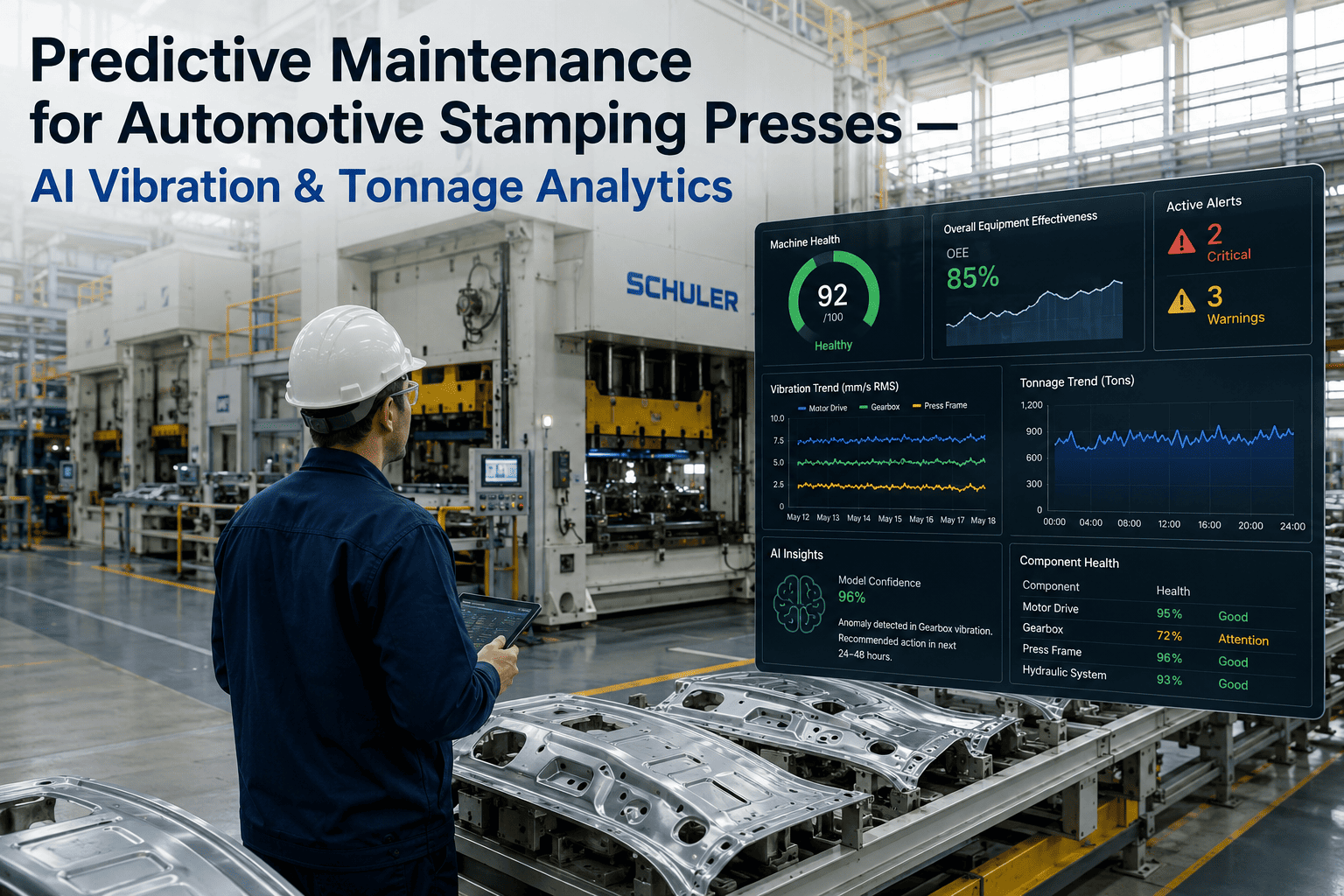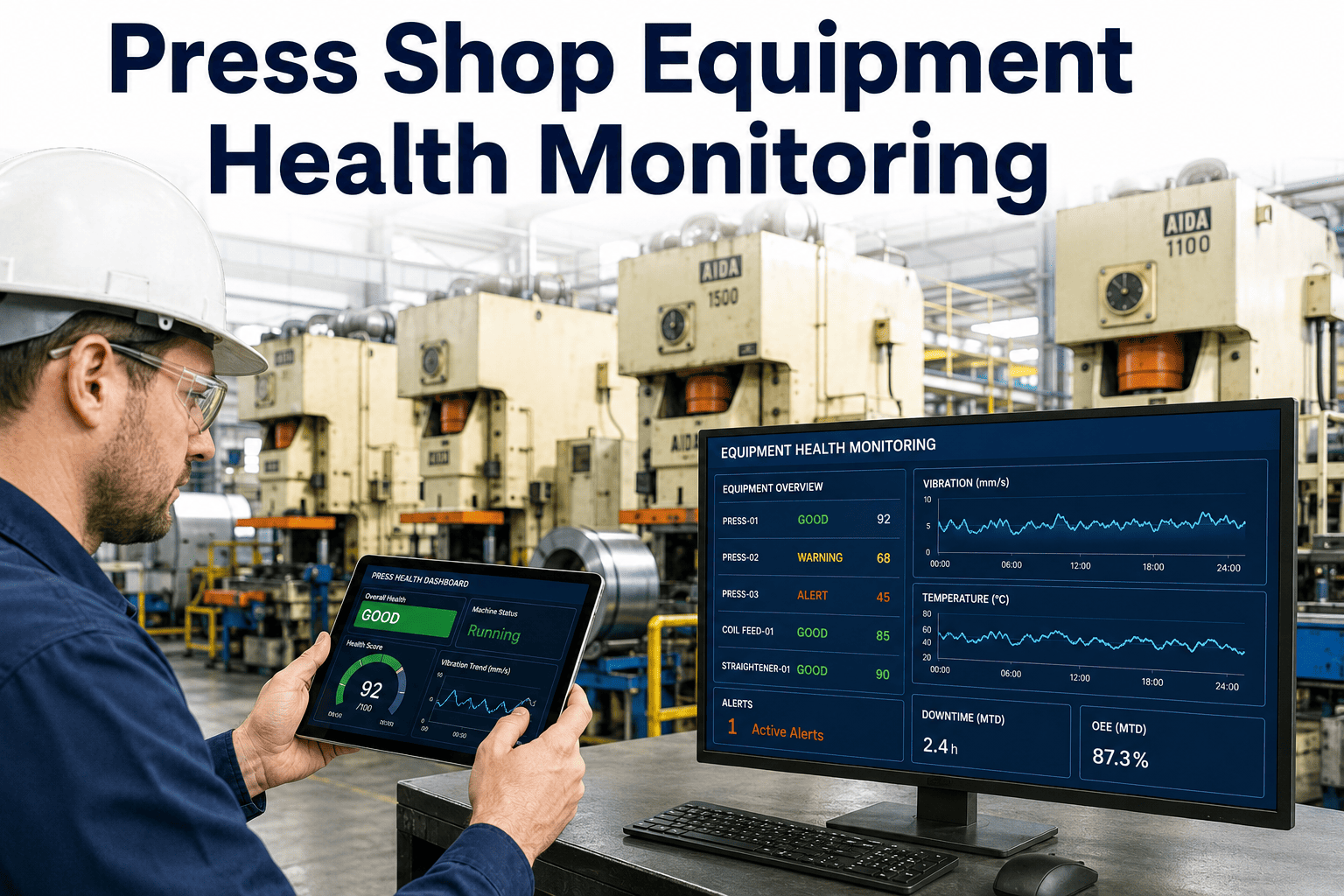
A stamping press does not fail politely. A bearing lets go mid-shift, a die cushion loses pressure for two hundred strokes before scrap becomes visible, or a lubrication line starves a bushing and the die sticks for three hours of recovery — and the entire body shop downstream goes quiet because every panel it needs comes from that one line. Most press maintenance programs still run on fixed intervals: rebuild the clutch every so many cycles, replace bearings every six months, regardless of how the press actually behaves. Real presses don't wear that evenly. AI that reads drive, brake, cushion, and lubrication data continuously catches the drift long before a stroke turns into a stoppage, and iFactory's press shop monitoring platform is built specifically for that signal.
AI Press Shop Equipment Health Monitoring
Why a Press Failure Is Never Just One Machine's Problem
World-class Overall Equipment Effectiveness for automotive stamping sits around 85 percent, yet most press lines run closer to 55 to 70 percent without AI in the loop, which means a meaningful share of available capacity is already being lost to downtime, slow cycles, and scrap before a catastrophic failure ever happens. A single press bearing failure mid-shift, a die cushion that drifts unnoticed for hundreds of strokes, or a lubrication fault that causes a die stick doesn't just stop one machine — it stops every downstream operation that depends on the panels that press produces. Manual checks and fixed-interval maintenance were never built to catch drift that builds gradually between inspection rounds, which is exactly the gap continuous monitoring is designed to close.
Reading the Tonnage Signature
Every stroke of a mechanical or hydraulic press produces a force curve as the ram travels through the cycle — a signature shaped by the drive train, the die, and the material being formed. A healthy press repeats that signature stroke after stroke inside a tight, predictable band. Bearing wear, clutch slip, die wear, and cushion pressure loss all show up first as a small deviation from that band, long before the deviation is large enough to show up as a bad part or an audible knock. Continuous tonnage monitoring compares every single stroke against the learned healthy envelope instead of sampling a handful of strokes per shift.
What's Actually Being Watched, Stroke by Stroke
A press is really five interconnected systems running in sync, and a failure in any one of them can stop the whole line. Fusing signals from all five gives a clearer, faster answer than watching any single system in isolation, because a real fault usually shows up in more than one place at once.
Want to see your own press tonnage signature analyzed for drift? Book a 30-minute walkthrough and bring a shift's worth of stroke data.
How a Fault Actually Unfolds — and When It's Caught
Most press failures follow a recognizable timeline from a small, invisible deviation to a full stoppage, and the whole value of continuous monitoring is compressing the gap between when a fault starts and when someone acts on it. The timeline below shows four of the most common press faults, mapped from the point they actually begin to the point a fixed-interval program would typically catch them, against where AI monitoring catches the same fault instead.
What Each Detection Approach Actually Delivers
The choice isn't really between "maintenance" and "no maintenance" — every press shop maintains its equipment. The real difference is in how early a method catches the fault and how much of the press it actually covers on every single stroke.
| Approach | Coverage | Typical Detection Point | Main Weakness |
|---|---|---|---|
| Fixed-interval rebuilds | Whatever's scheduled that month | Calendar date, not condition | Rebuilds healthy parts early, misses parts that fail sooner |
| Hourly SPC clipboard checks | One tonnage sample per hour | Whatever has already drifted since the last check | Cannot catch drift that builds over a few hundred strokes |
| Vibration-only sensors | Drive train and bearings | Hours to days before failure | Blind to cushion pressure and lubrication faults |
| AI multi-signal monitoring | Drive, brake, cushion, lube, counterbalance | Up to 19 days before failure | Needs a short baseline period per press to tune fully |
The Numbers Press Shops Actually Report
These figures come from press lines running continuous, multi-signal monitoring instead of a fixed rebuild calendar — and they hold up across stamping operations of very different sizes because the underlying failure modes are the same everywhere.
Where This Fits Your Quality System
IATF 16949 requires statistical process control on every critical stamping parameter — tonnage, dimensional measurements, material thickness, and lubrication pressure among them. A paper SPC chart filled in once an hour satisfies the letter of that requirement but not its intent, since drift that builds over three hundred strokes is invisible between hourly checks. Continuous, stroke-by-stroke monitoring turns SPC from a compliance exercise into an actual early-warning system, and because the data is captured automatically it also produces a cleaner audit trail than a clipboard ever could.
Want your SPC and CMMS data flowing automatically instead of from a clipboard? Talk to our reliability engineers about your press line.