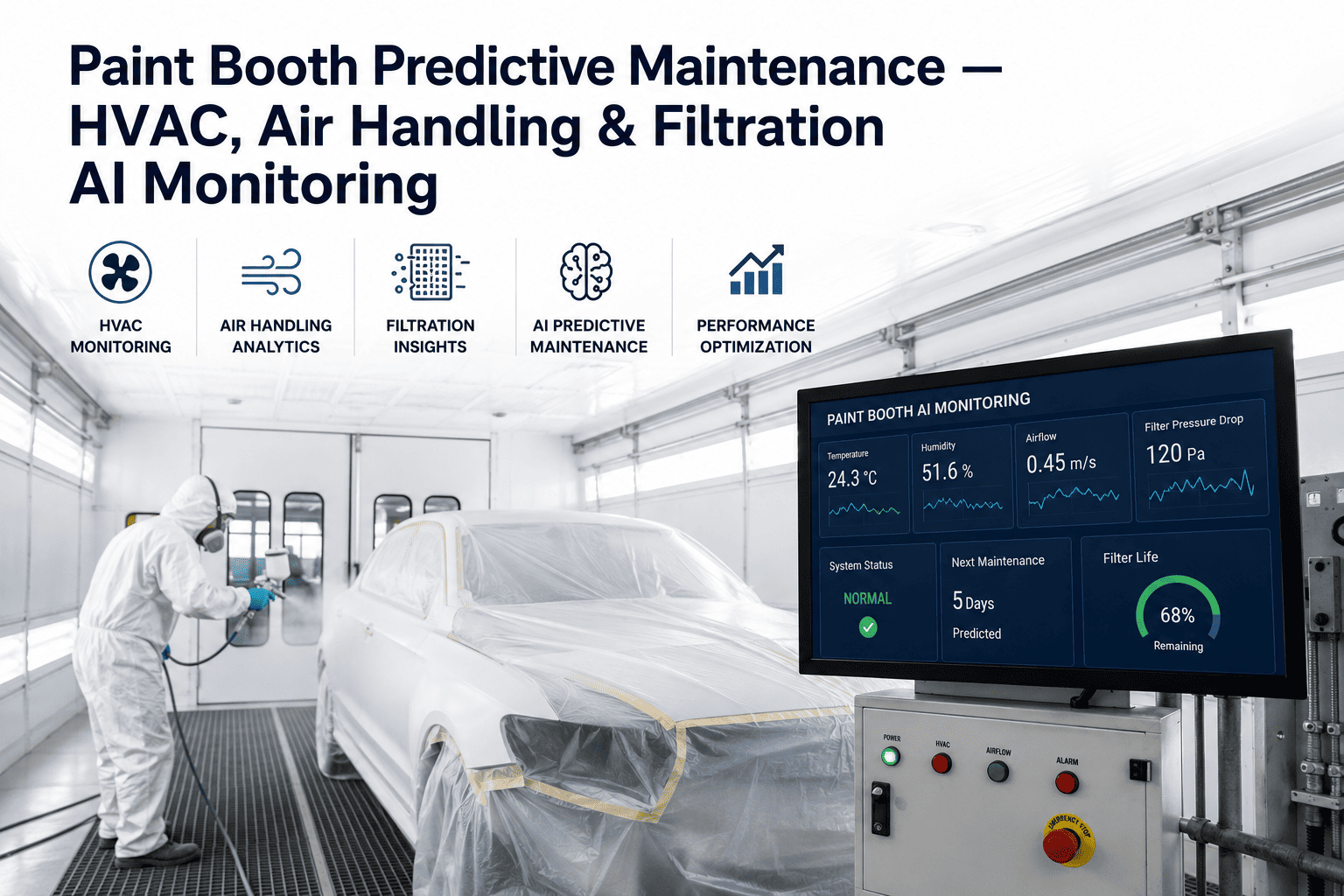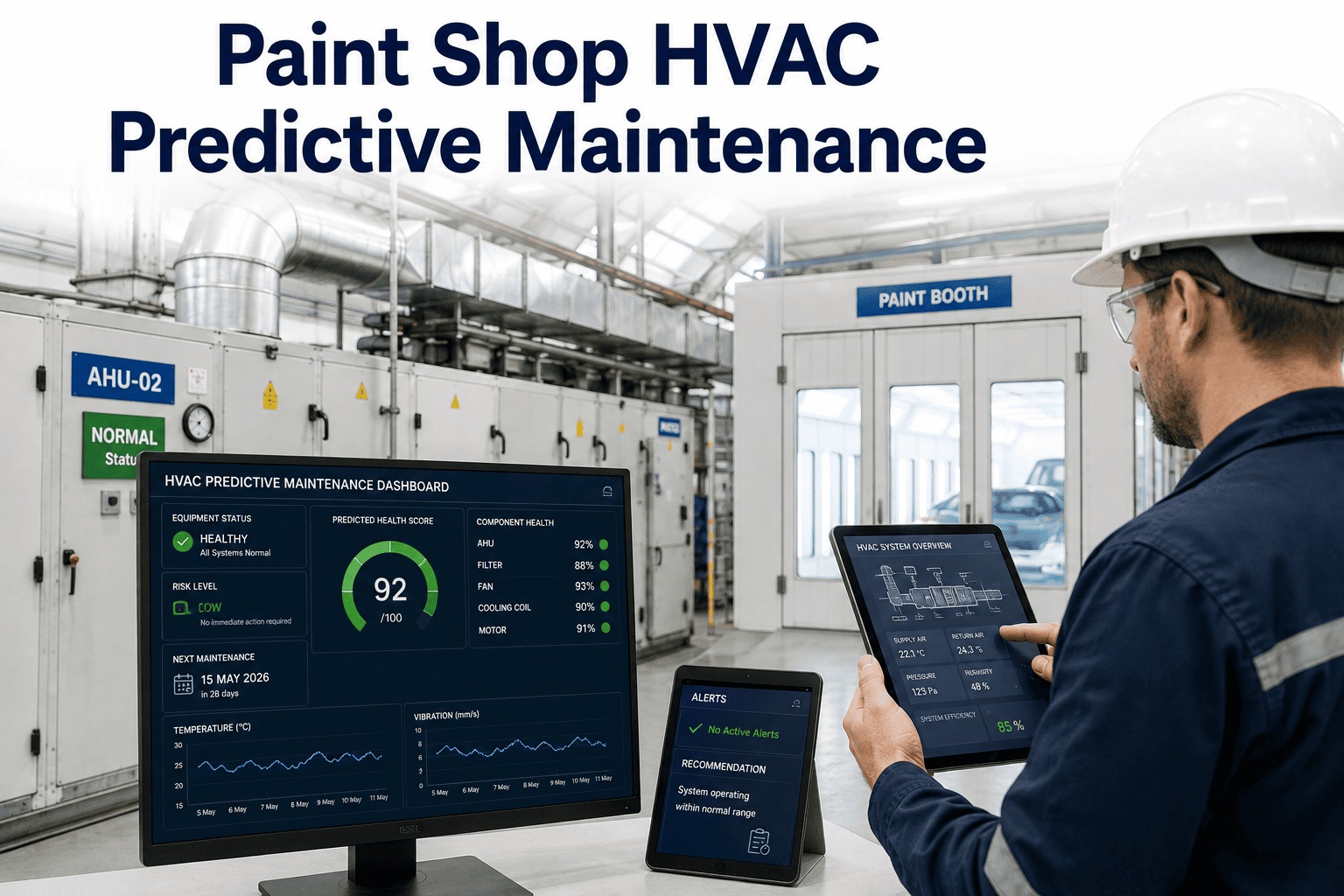
Automotive paint booths run inside an environmental envelope so tight that a two-degree temperature swing or a few points of humidity drift is enough to turn a flawless finish into a rework job. Temperature has to hold between 70 and 80°F, relative humidity between 50 and 70 percent, and booth pressure has to stay positive enough to keep contamination out without so much airflow that overspray ends up back on the part. None of that happens by accident — it depends on heaters, dampers, dehumidifiers, fans, and filters all staying healthy at once, and any one of them drifting quietly is usually invisible until the defects start appearing on finished panels. AI that watches all five continuously catches the drift while it's still a few points off spec, and iFactory's paint shop HVAC monitoring platform is built to hold that envelope automatically.
AI Paint Shop HVAC Predictive Maintenance
Why Paint Booths Have No Margin for Drift
A paint booth's environmental envelope isn't a comfort setting, it's the difference between a finish that meets spec and one that has to be sanded back and resprayed. Temperature affects paint viscosity and cure time, humidity outside the 50 to 70 percent band accelerates solvent evaporation and causes blushing, and booth pressure has to stay positive enough to keep polluted shop air out without pushing so hard that overspray lands back on the wet surface. All three depend on mechanical equipment that degrades slowly and quietly — a dehumidifier valve that starts sticking, a damper that no longer seats fully, a fan straining against a loading filter — and none of that shows up as an alarm until the drift has already crossed the line into visible defects.
A Drift Nobody Would Have Caught Manually
A Tier-1 automotive supplier's dehumidifier valve began sticking, and over the following 48 hours relative humidity crept up by 3 percent — small enough that no operator would have flagged it on a routine walk-through, and slow enough that a scheduled daily check could easily have missed the window entirely. The AI model recognized the upward trend early, well before it crossed the quality threshold, and flagged it for recalibration during a shift change. That single catch avoided an estimated 12 hours of rework, which is the kind of granularity manual checks and time-based schedules simply cannot deliver, since they only ever sample the environment at a handful of fixed moments a day.
Four Systems, Watched Together
No single sensor tells the whole story of a booth's health. Temperature, humidity, airflow, and pressure all interact, which is why the strongest monitoring approach fuses signals from all four systems that hold the envelope together, instead of alarming on any one in isolation.
Want to see your own booth's temperature and humidity trend read for drift? Book a 30-minute walkthrough and bring a week of environmental logs.
Why Filter Loading Quietly Wrecks Airflow
Filters are the single fastest-moving variable in a paint booth's airflow budget, and the two common fan types respond to loading very differently. An axial fan rated for 15,000 CFM can drop to roughly 11,000 CFM once exhaust filters reach half capacity, a loss of about 27 percent that directly compromises vapor control and finish quality. A centrifugal fan rated for 20,000 CFM, by contrast, typically holds above 18,000 CFM even at 80 percent filter loading, which is exactly why centrifugal designs are common on continuous-production body shops. Either way, airflow degrades well before a filter looks visibly clogged, which is why tracking the pressure drop trend matters more than a visual inspection ever could.
Manual Checks vs. Continuous Monitoring
Every paint shop already maintains its HVAC equipment — the real question is how early each approach catches a drift, and how much of the booth's four interacting systems it actually covers between checks.
| Approach | What It Covers | Typical Catch Point | Main Weakness |
|---|---|---|---|
| Daily manual walk-through | Whatever's visibly wrong that day | Once per shift, at best | A 48-hour drift can pass through several checks unnoticed |
| Fixed filter change schedule | Filters only, on a calendar | Independent of actual loading | Changes early or late relative to real pressure drop |
| Threshold alarms | Whatever crosses the hard limit | Only after spec is already violated | No warning before the defect-causing threshold is crossed |
| AI continuous monitoring | Heating, dehumidification, filtration, airflow together | Hours to days before threshold crossing | Needs a short baseline period to learn normal booth behavior |
What Continuous Monitoring Actually Prevents
The value shows up as rework avoided, first-pass yield protected, and equipment that lasts longer because it's never straining against a clogged filter or a stuck valve for weeks at a time.
Want a filter and dehumidifier plan scoped to your own booth's history? Talk to our paint shop engineers.