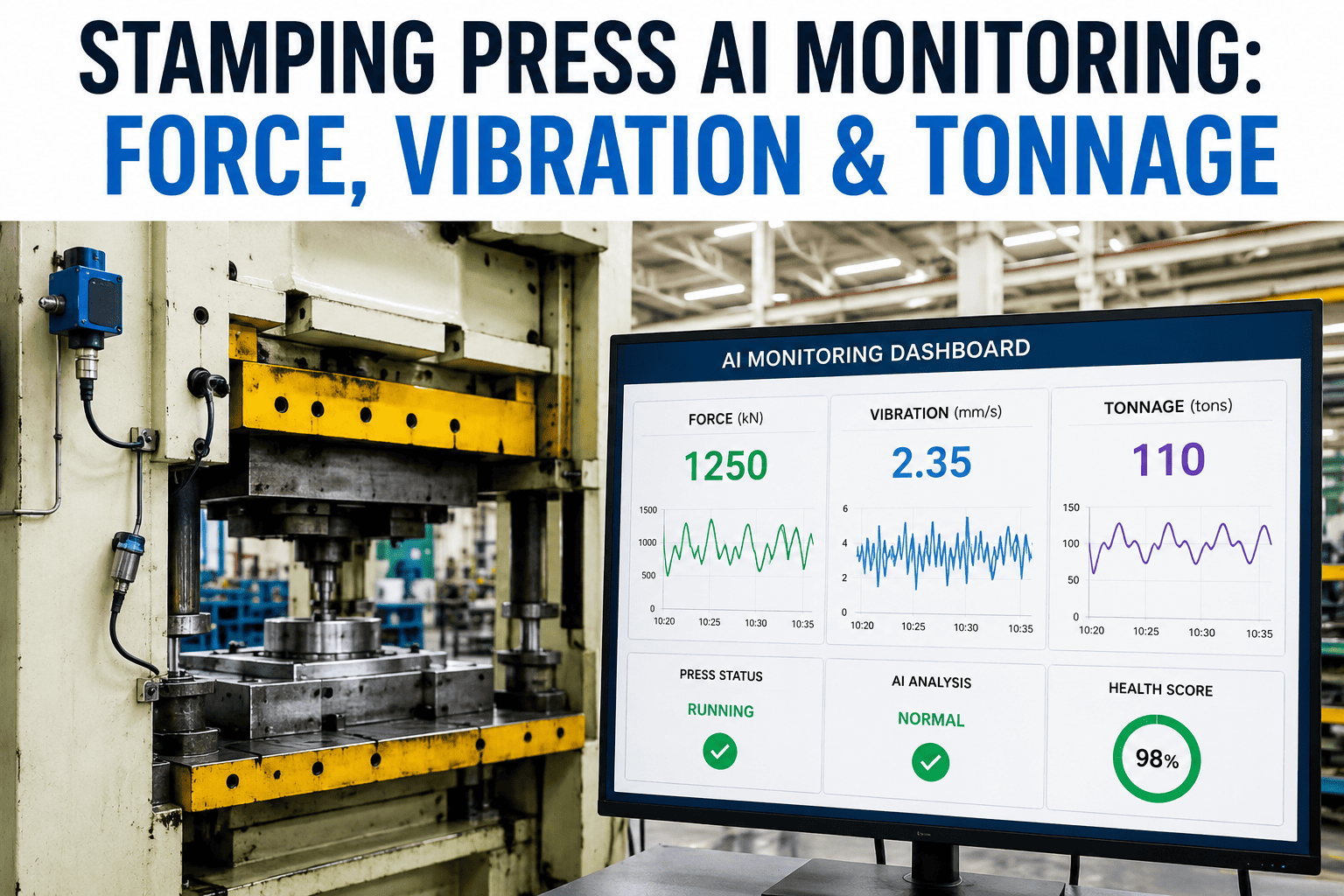
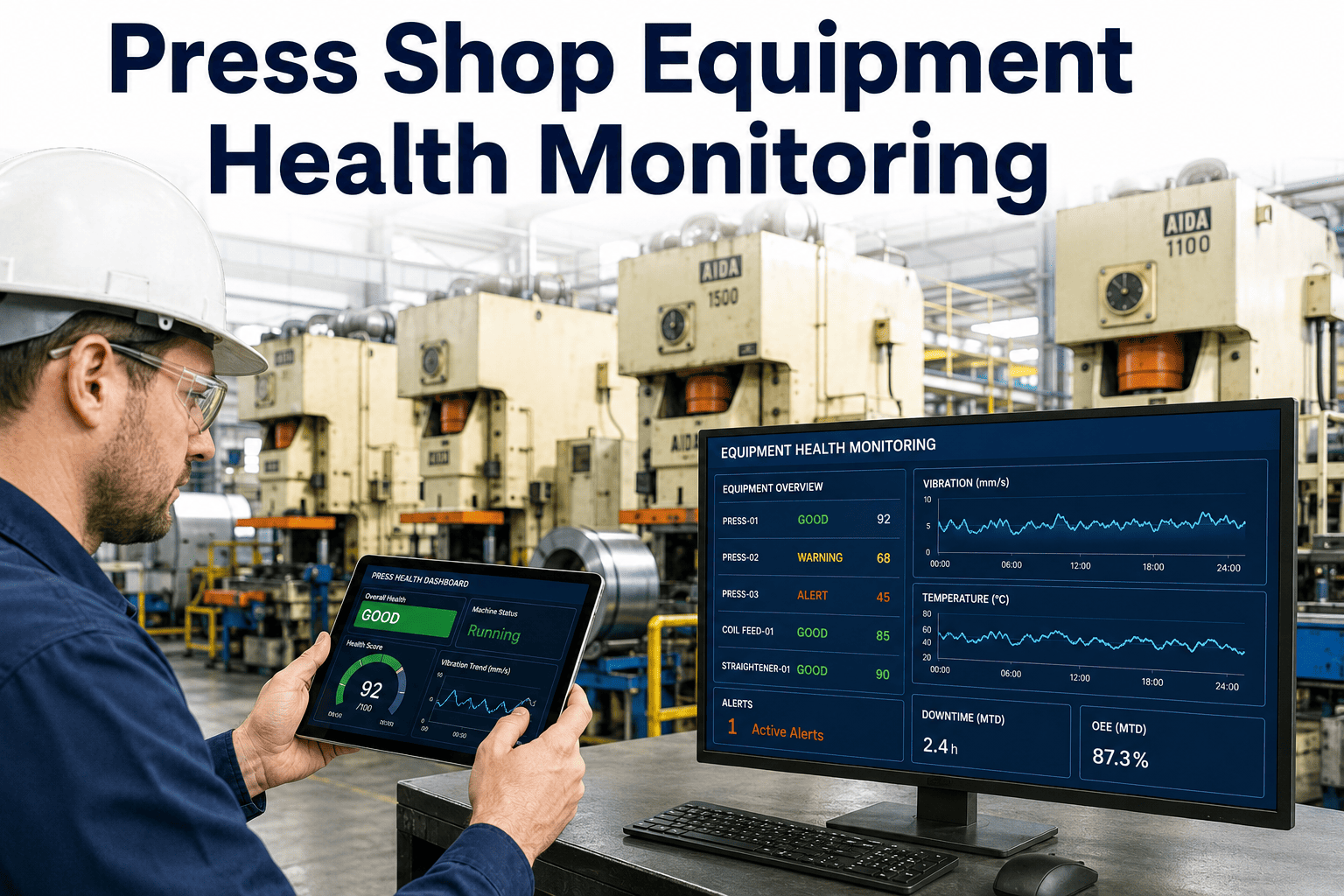
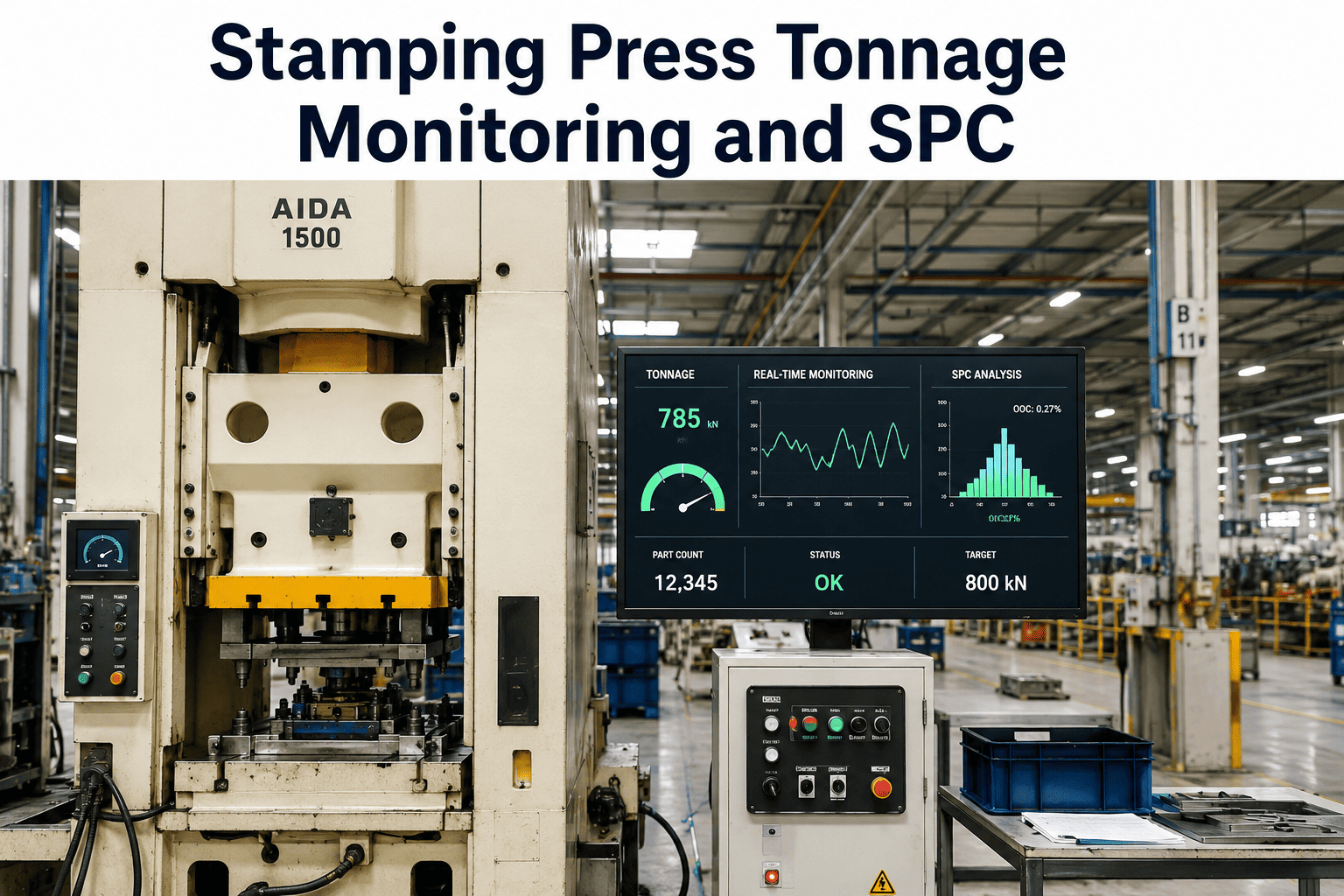
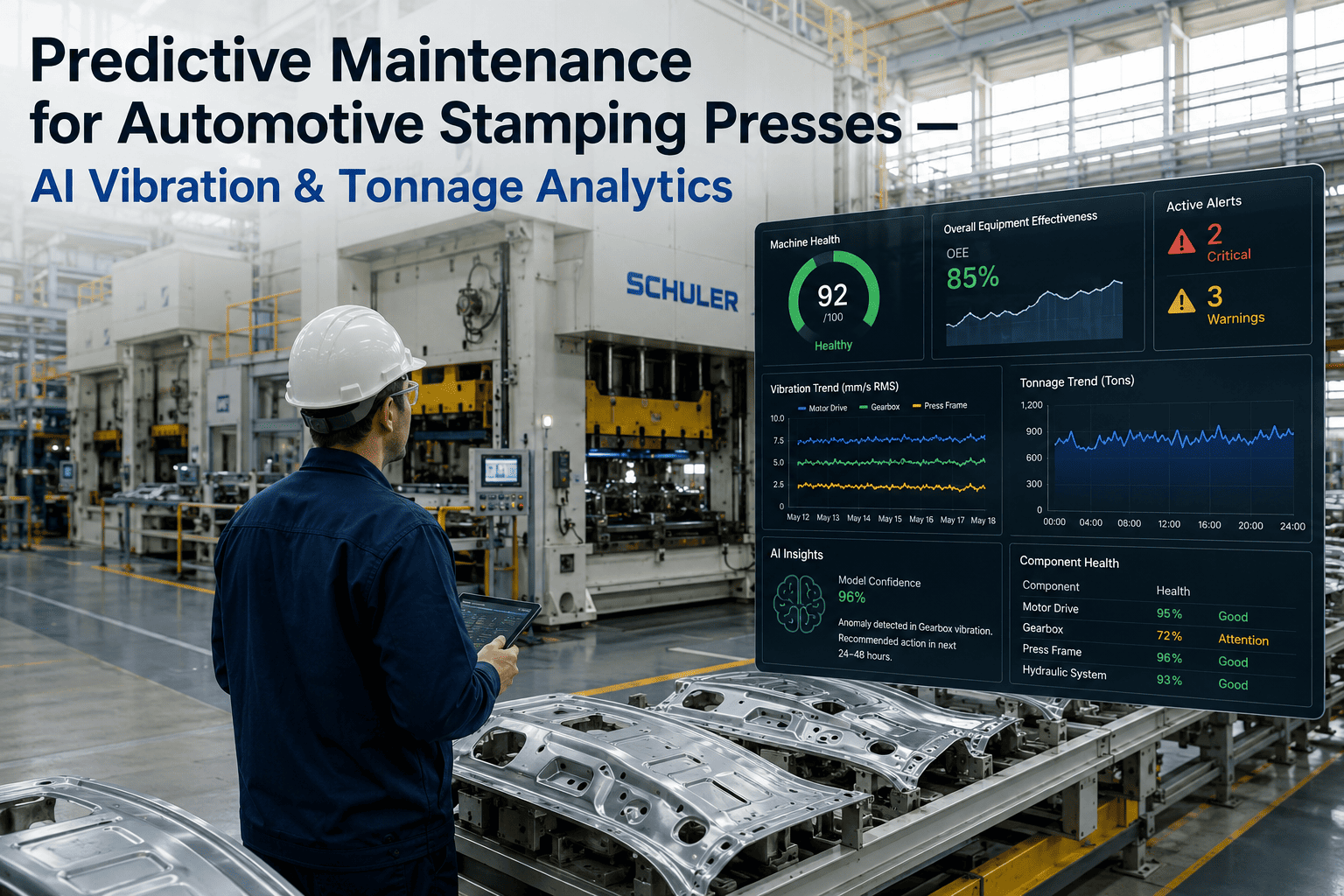
When a stamping press goes down unplanned, it doesn't just stop one machine — it starves every downstream operation in the body shop that depends on the panels that press produces, and a single major press failure can shut down an entire plant's output for a shift or longer. Presses run under enormous cyclical mechanical load on drives, clutches, and bearings that show measurable warning signs of wear well before they actually fail, but most plants still run these components to a fixed calendar-based maintenance schedule rather than reading what the equipment itself is reporting. Our press maintenance specialists can walk through how predictive monitoring turns those warning signs into a scheduled repair instead of an unplanned shutdown.
Stamping & Press Shop
A Press Failure Doesn't Stay Contained to One Machine
Every station downstream of a stamping press depends on the panels it produces, which means an unplanned press failure cascades into a body shop and paint shop with nothing to build, not just a single idle machine.
Component Health Snapshot
Why Calendar-Based Maintenance Misses What Matters
A fixed maintenance calendar assumes every press wears at the same rate regardless of tonnage history, part mix, or die complexity, which is rarely true across a real production schedule where some presses run heavier stampings and higher cycle counts than others. This means calendar-based maintenance is simultaneously over-servicing presses that haven't actually accumulated enough wear to need attention yet, and under-servicing presses running harder duty cycles that are wearing faster than the calendar assumes.
Vibration signatures, bearing temperature trends, clutch engagement timing, and drive motor current draw all carry information about a component's actual condition well before that component fails outright. A bearing beginning to develop a defect produces a distinctive vibration frequency signature days to weeks before the failure that would otherwise show up as an unplanned stoppage, which is exactly the warning window predictive monitoring is built to catch.
Days-Weeks
typical warning window vibration signatures provide before a bearing failure
Scheduled
repair replaces unplanned downtime once a failure trend is confirmed
4
major press subsystems commonly monitored: drive, clutch, bearings, flywheel
Cascading
downstream impact of a single major press failure across the body shop
The Four Subsystems That Drive Most Unplanned Press Downtime
Press downtime doesn't distribute evenly across every possible component — a small number of subsystems account for most unplanned failures, which makes them the natural priority for predictive monitoring investment rather than trying to instrument every part of the press equally from day one.
Main Drive
Motor current draw and torque signature trends flag developing drive train issues before failure.
Clutch & Brake
Engagement timing drift is an early indicator of wear on friction surfaces and pneumatic components.
Main Bearings
Vibration frequency analysis detects developing bearing defects days to weeks ahead of failure.
Flywheel
Balance and vibration trending catches developing imbalance before it stresses connected components.
Want to see which of these four subsystems is closest to a failure trend on your own presses?
Book a walkthrough to review your current condition data.
From Raw Sensor Data to a Scheduled Repair Decision
Predictive monitoring only creates value if the raw sensor trends actually translate into a decision a maintenance planner can act on, which means the model has to do more than just report a number — it has to classify where that number falls on the path from normal operation to a genuine failure risk, and communicate that clearly enough for a planner to schedule a repair during a normal maintenance window rather than reacting to a shutdown.
1
Continuous vibration, temperature, and current draw monitoring per subsystem
2
Model compares live signature against known healthy and failure-trending baselines
3
Condition classified as healthy, watch, or scheduled-repair-needed
4
Maintenance planner schedules repair within the estimated remaining life window
Prioritizing Which Presses Get Instrumented First
A plant with a large fleet of presses rarely needs to instrument every machine simultaneously to see meaningful value, since the presses running the heaviest duty cycles, the highest tonnage stampings, or carrying the most critical single points of failure for the production schedule are the ones where an unplanned failure causes the most damage. Prioritizing predictive monitoring rollout by criticality and duty cycle intensity gets the highest-value coverage in place first, with lower-criticality or lower-utilization presses following in a later phase.
| Press Criticality Factor | Why It Matters | Rollout Priority |
|---|
| No redundant press for the same part | Failure directly stops downstream production with no alternative source | Highest priority |
| Heavy tonnage, high cycle count | Faster wear accumulation increases failure probability sooner | High priority |
| Redundant capacity available | Failure can be absorbed by shifting volume to a backup press | Standard rollout phase |
| Low utilization or seasonal use | Lower cumulative wear reduces near-term failure risk | Later rollout phase |
What Predictive Maintenance Changes About Planning
The practical shift predictive maintenance introduces is moving repair decisions from a fixed calendar to a condition-driven schedule, which requires maintenance planning to become more flexible about when a repair happens but more confident about why it's happening. A repair scheduled because vibration data shows a genuine developing defect is a fundamentally more defensible use of a planned maintenance window than a repair scheduled simply because a certain number of calendar days have passed since the last service.
Fewer
Unplanned Shutdowns
Failures caught in the warning window and scheduled instead of reacted to.
Right-Sized
Maintenance Effort
Service based on actual condition instead of a uniform calendar applied to every press.
Prioritized
By Criticality
Highest-impact presses instrumented first for the fastest return on monitoring investment.
Curious how your current unplanned downtime hours compare to what predictive scheduling would recover?
Talk to our team about reviewing your press downtime history.
Frequently Asked Questions
What sensors are typically needed to start predictive monitoring on an existing press?
A baseline predictive monitoring setup typically uses vibration sensors on the main bearings and drive train, temperature sensors on bearing housings, and current draw monitoring on the main drive motor, all of which can generally be retrofitted onto an existing press without requiring a press replacement or major mechanical modification. Clutch and brake monitoring often uses existing pneumatic or hydraulic pressure signals already present in the press control system, which reduces the amount of new hardware needed for that specific subsystem.
Reach out to our team to review sensor requirements for your specific press models.
How much advance warning does vibration monitoring typically give before a bearing failure?
The warning window varies by bearing size, load, and the specific failure mode developing, but vibration frequency analysis commonly detects a developing bearing defect somewhere in the range of days to several weeks before the failure would otherwise occur without intervention. This window is generally enough time to schedule a repair during a planned maintenance window rather than reacting to an unplanned stoppage, though the exact timeline depends heavily on how quickly a specific defect is progressing once it's first detected.
Book a demo to see how warning windows have played out on comparable press equipment.
Can predictive monitoring reduce our overall maintenance spend, or does it just prevent downtime?
Predictive monitoring typically reduces overall maintenance spend in addition to preventing unplanned downtime, because calendar-based maintenance programs generally over-service some components that haven't actually accumulated enough wear to need attention, replacing parts and performing labor that condition-based monitoring would have shown wasn't necessary yet. The combined effect of avoiding both unnecessary premature maintenance and unplanned failure costs is generally where most of the financial return comes from, rather than downtime avoidance alone.
Talk to our team about estimating this against your current maintenance spend.
How long does it take to build reliable failure baselines for our specific press fleet?
Building baselines for what "healthy" looks like on a specific press typically takes a period of weeks to a few months of continuous monitoring, since the model needs to see the press's normal operating variation across different part numbers, tonnage levels, and shift patterns before it can reliably distinguish a genuine developing fault from normal operational variation. Presses with a documented history of past failures can sometimes accelerate this by using historical sensor data alongside the failure records as additional training examples.
Reach out to discuss what historical data you may already have available.
Does this integrate with our existing CMMS for scheduling the recommended repairs?
Predictive monitoring findings are typically designed to feed into an existing CMMS as a work order recommendation with supporting condition data, rather than operating as a completely separate system maintenance planners have to check independently. This keeps the actual scheduling and work order management inside the system planners already use daily, while the condition monitoring layer supplies the data-backed trigger for when a work order should be generated in the first place.
Book a walkthrough to see this integration against your specific CMMS platform.
Stop Reacting to Press Failures
Read What Your Presses Are Already Telling You
Share your current press downtime history and maintenance schedule. We'll show you what predictive monitoring on your highest-criticality presses would have caught before the next shutdown.
Prioritized
By criticality