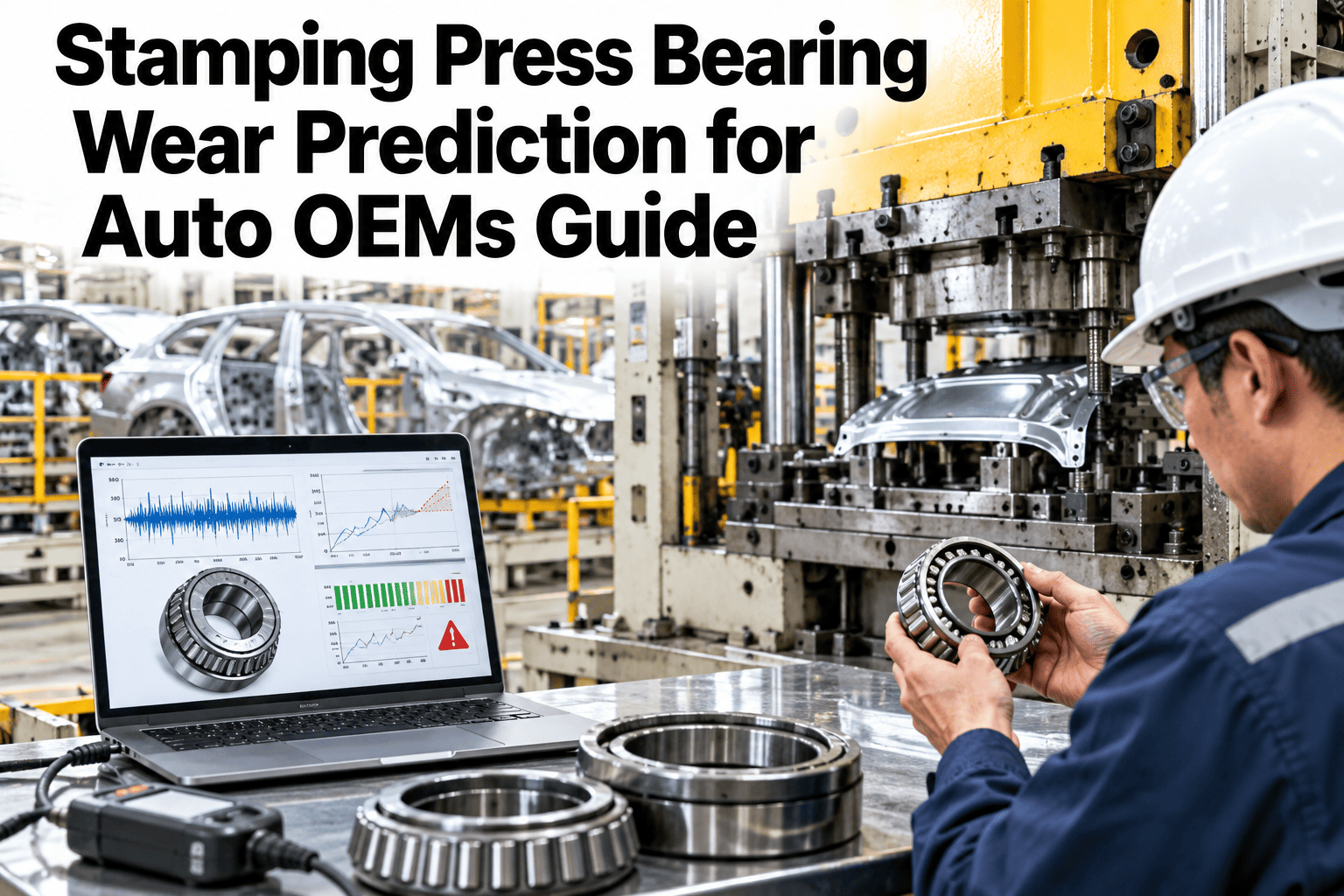
When a bearing in a stamping press fails badly, the damage rarely stays in the bearing. A seized crank or connecting rod can take the press down for weeks, put the die at risk and stall every downstream line that depends on its parts. The warning, however, is usually there for some time, in vibration, temperature, oil condition and subtle changes in the load signature. Bearing wear prediction reads those signs together. Auto plants who want to build that capability can ask iFactory AI how press bearing health is monitored and forecast.
Predict Stamping Press Bearing Wear Before It Becomes a Seized Crank
iFactory AI combines vibration, temperature, lubrication and load signature data to flag bearing degradation on main, connecting rod and crank bearings while a planned repair is still possible.
Why Press Bearings Are Critical
Press bearings carry enormous cyclic loads with little room for error. Four facts explain why they deserve special attention.
Heavy shock loading
Every stroke loads the bearings with high forces in a very short time.
Failure spreads
A failing bearing can damage the crankshaft, connecting rod and housing.
Downtime is long
Bearing and crank repairs on large presses often take days to weeks.
Downstream impact
One press down stops the parts that feed several assembly lines.
Where the Bearings Are and What Wear Looks Like
Different bearings fail in different ways. This table summarises the main groups, and the exact bearing type changes the signs.
| Bearing Group | What It Carries | Typical Wear Sign |
|---|---|---|
| Main bearings | Crankshaft support and the full press load | Rising vibration and temperature, increased clearance |
| Connecting rod bearings | The load between crank and slide | Impact noise, oil contamination, heat |
| Crank or eccentric bearings | Rotation at the crank journal | Clearance growth, load signature changes |
| Clutch, brake and flywheel bearings | Rotation of the drive train | Noise and vibration at specific speeds |
Four Signal Families, Read Together
No single signal predicts a bearing failure. The combination does.
Which Signals Reveal Which Failure Cause
The matrix, shown as an illustration, links failure causes to the signals that usually show them first.
| Failure Cause | Vibration | Temperature | Oil Condition | Load Signature |
|---|---|---|---|---|
| Lubrication starvation | Moderate | High | High | Low |
| Contamination in the oil | Moderate | Moderate | High | Low |
| Overload or off-centre loading | High | Moderate | Low | High |
| Fatigue and surface damage | High | Moderate | High | Moderate |
| Clearance growth from wear | Moderate | Low | Moderate | High |
Find the Press Bearings Most Likely to Fail Next
Book a 30-minute session and iFactory AI will review your press fleet, maintenance history and available signals to show where bearing prediction can help first.
How a Bearing Degrades: The Warning Window
Failures usually follow a path, from first changes to breakdown. The staircase shows an illustrative path, and the time between steps varies widely.
What Gives the Earliest Warning
Not every signal gives early notice. The chart shows an illustrative ranking of how early each tends to show change.
The Prediction Chain From Signals to a Planned Repair
A useful system is a short chain that ends in a maintenance decision.
Scheduled Overhaul or Condition-Based Repair
Fixed overhauls replace bearings that are fine and still miss early failures.
Building a Bearing Program in Five Steps
A first program works best on the largest and most critical presses.
Pick the presses where an unplanned stop hurts most.
Collect vibration, temperature, oil and load data.
Learn each press's normal behaviour over several weeks.
Review presses drifting from normal each week.
Inspect, repair in a planned window and record the findings.
Press Bearing Inspection Checklist
Use this list at every weekly review. Each box should be answerable from data and inspection records.
A Composite Scenario: The Press That Ran Slightly Warmer
This is a composite example, not a named plant. It shows how a trend becomes a planned repair.
Mistakes in Bearing Monitoring
These habits waste the warning.
Relying on one signal
A single signal can mislead in either direction.
Alarms with fixed limits only
Each press has its own normal, so fixed limits miss early drift.
Ignoring oil condition
It is often the earliest sign.
Not recording inspection results
The model cannot learn from what was found.
What iFactory AI Adds to Press Bearing Monitoring
iFactory AI is smart manufacturing and industrial software for automotive stamping plants. Capabilities described here should be confirmed against your specific setup. Explore bearing monitoring in a live product tour on realistic press data.
A 30-Day Plan to Start
A month is enough to baseline a first set of presses.
Review of Stamping Press Bearing Wear Prediction
A practical review of what makes bearing prediction trustworthy on press lines, written as editorial guidance rather than a named expert quote.
Use several signals
Agreement between vibration, oil and load data is far stronger than any single reading.
Baseline each press
Every press has its own normal, so fixed limits alone miss early drift.
Close the loop with inspection
Findings from every inspection sharpen the next forecast.
Frequently Asked Questions
What causes stamping press bearings to fail?
Common causes include lubrication starvation, contamination, overload or off-centre loading, and fatigue. See causes linked to signals in a live demo with realistic data. Wear and clearance growth often follow.
Which signals give the earliest warning?
Oil contamination and particle trends and vibration pattern changes often come first, followed by load signature and temperature trends. Noise is usually late. Reading several together is the most reliable approach.
Can this work on older presses?
Often yes, by adding sensors or using existing controller signals, though older presses may have fewer points. Ask support what older presses can already provide before adding hardware. Start with the most critical presses.
How early can a failure be predicted?
It depends on the failure type. Gradual wear often gives weeks of warning, while sudden damage gives little. A realistic goal is catching the slow ones in time for a planned stop.
How soon can we see results?
Many plants see useful trends within weeks of baselining a first press. Book time to scope a press bearing pilot on your most critical presses. A caught degradation is the clearest proof.
Replace Press Bearings on Your Schedule, Not the Press's
iFactory AI reads vibration, temperature, oil and load data to flag bearing wear while a planned repair is still possible. Book a walkthrough to see it on your own presses.