Musculoskeletal disorders (MSDs) remain the most prevalent and costly occupational health issue in automotive assembly. Every year, thousands of line workers suffer from injuries caused by repetitive motions, awkward postures, and excessive force — leading to lost productivity, high turnover, and millions in workers' compensation. Traditional ergonomic assessments rely on manual observation and subjective checklists, which are time-consuming, inconsistent, and often miss critical risk factors. In the fast-paced environment of automotive manufacturing, where production lines run at high speeds and tasks are highly repetitive, a more precise, data-driven approach is essential. AI-powered motion analysis offers a breakthrough solution, enabling EHS managers to objectively quantify biomechanical stresses, identify high-risk tasks, and design interventions that reduce injury rates. By leveraging computer vision and machine learning, manufacturers can now capture real-time body posture data, calculate risk scores for each joint and movement, and prioritize ergonomic improvements with unprecedented accuracy. This article explores how AI-based ergonomic risk assessment transforms worker safety in automotive assembly, providing a clear roadmap for implementation and measurable outcomes. Book a Demo to see how iFactory can automate your ergonomic evaluations.
AI-Driven Musculoskeletal Risk Assessment for Automotive Assembly
Reduce injury claims and improve worker well-being with objective, real-time motion analysis.
The Traditional Assessment Problem
Manual ergonomic evaluations using tools like REBA, RULA, or NIOSH lifting equation are subjective, slow, and only capture a snapshot. They rely on the observer's expertise, cannot track dynamic movements over time, and often lead to inconsistent results. In a high-volume automotive plant with hundreds of workstations, this approach is unsustainable.
The AI-Powered Solution
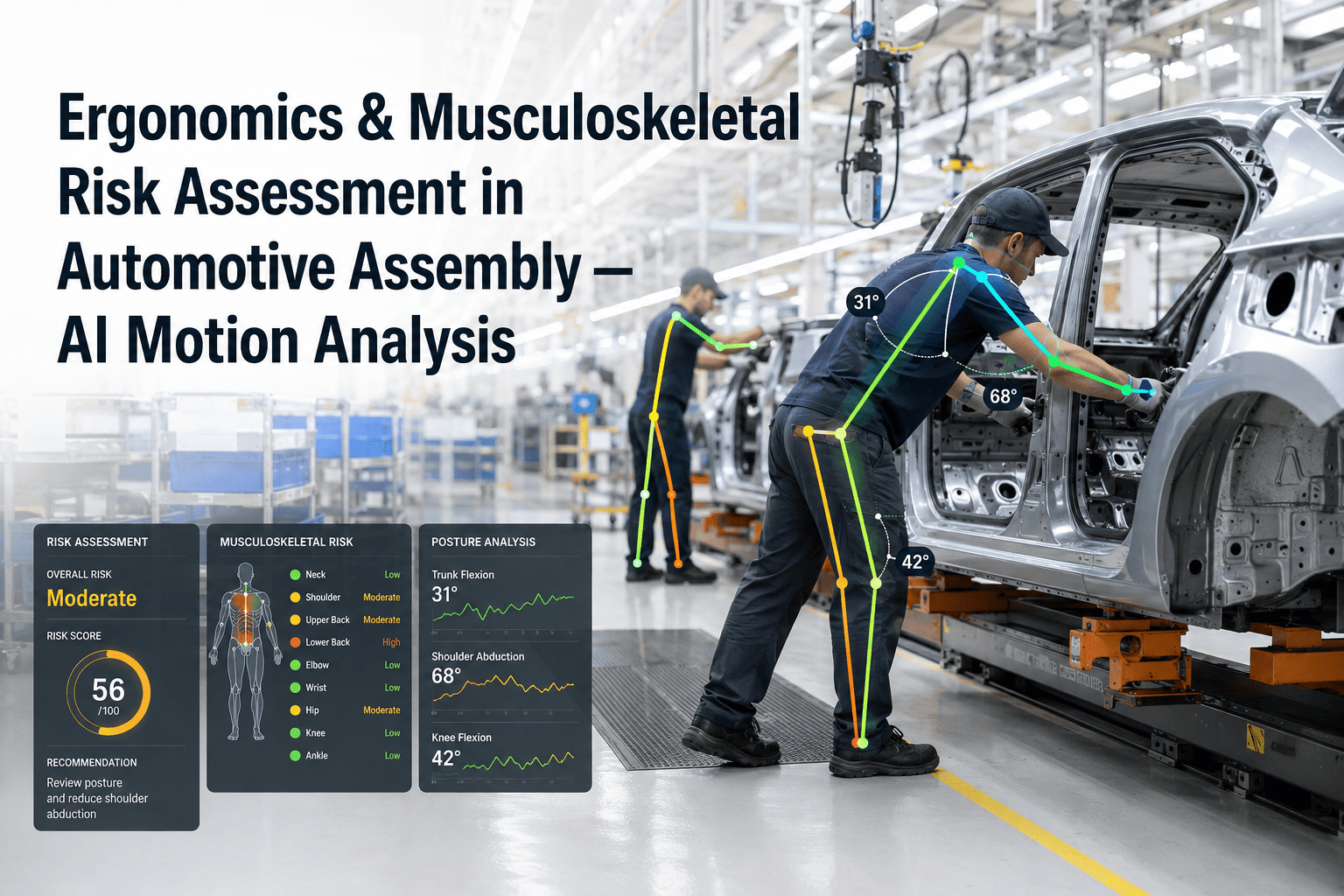
iFactory's AI motion analysis uses standard cameras to capture 3D skeletal tracking in real time. The system automatically calculates joint angles, repetition rates, force estimates, and posture duration for every worker. It generates objective risk scores for each body region (neck, shoulders, back, wrists, knees) and highlights tasks that exceed safe thresholds. This data enables targeted ergonomic redesign and continuous monitoring.
Five Steps to Deploy AI Ergonomic Assessment
Camera Installation
Place standard IP cameras at key workstations covering the full range of worker motion. No sensors or wearables required.
Data Capture & Calibration
The AI system learns the typical movement patterns for each task and calibrates to the specific workstation layout and worker population.
Real-Time Risk Scoring
For each cycle, the system computes risk scores for posture, force, repetition, and duration. Scores are aggregated per workstation and per worker.
Dashboard & Alerts
EHS managers view live dashboards with heatmaps of high-risk tasks. Automated alerts notify when any score exceeds the predefined threshold.
Intervention & Validation
Implement ergonomic changes (e.g., adjustable platforms, tool balancers, rotation schedules) and monitor the impact on risk scores over time.
Transform Your Ergonomics Program
Move from reactive injury management to proactive risk prevention with objective data.
Key Ergonomic Risk Factors Assessed
Awkward Postures
Neck flexion >20°, shoulder abduction >30°, wrist deviation >15° — all automatically detected and scored per second.
Repetitive Motion
Tasks with cycle time <30 seconds and similar motion patterns over 50% of the cycle are flagged as high repetition risk.
Force Exertion
Estimated based on posture, tool weight, and push/pull forces. The system correlates with NIOSH lifting equation parameters.
Static Postures
Holding a fixed position for more than 4 seconds without change increases risk. The system tracks duration of static holds.
Contact Stress
Pressure points from leaning against hard edges or using tools with sharp handles are identified through posture and tool interaction.
Vibration
Use of impact wrenches and other vibrating tools is logged. Cumulative exposure time is tracked per shift.
Risk Score Benchmarks for Automotive Assembly Tasks
| Task Type | Avg Posture Risk | Avg Repetition Risk | Avg Force Risk | Overall MSD Risk |
|---|---|---|---|---|
| Underbody welding | High (7.2) | Medium (5.1) | High (8.0) | High (7.0) |
| Dashboard assembly | Medium (5.8) | High (7.3) | Low (3.2) | Medium (5.6) |
| Seat installation | High (8.1) | Low (2.4) | Medium (5.9) | High (6.8) |
| Engine line testing | Low (3.0) | Low (2.1) | Low (2.8) | Low (2.7) |
| Final trim | Medium (5.5) | High (8.2) | Low (3.5) | Medium (5.9) |
Implementation Progress Tracker
Frequently Asked Questions
How does AI motion analysis compare to traditional ergonomic assessments?
Traditional methods like REBA and RULA rely on manual observation and are subject to observer variability. AI motion analysis provides continuous, objective measurements of every joint angle, repetition, and force estimate. It captures data across multiple cycles and workers, giving a statistically robust risk profile. The AI can detect subtle deviations that humans might miss, such as a 5-degree increase in wrist extension over time. This data-driven approach allows for precise targeting of interventions and validation of their effectiveness. Book a Demo to see the comparison in action.
What kind of cameras and hardware are needed for deployment?
The system works with standard IP cameras already installed in many facilities. No specialized sensors, wearables, or markers are required. The AI processes video feeds in real time using edge computing or cloud-based servers. For optimal accuracy, cameras should be positioned to capture full-body side and front views of the worker. iFactory provides a hardware specification guide and can recommend suitable models if needed. The setup is non-intrusive and does not interfere with production. Support is available for integration planning.
How are worker privacy and data security handled?
iFactory prioritizes privacy and compliance with regulations like GDPR and CCPA. The AI processes video frames to extract skeletal keypoints (joint positions) and does not store raw video footage by default. All data is encrypted in transit and at rest. Workers are not personally identifiable from the skeletal data. Role-based access controls ensure only authorized EHS managers can view aggregated risk scores. Detailed privacy policies and data processing agreements are provided during onboarding. Book a Demo to discuss your specific compliance requirements.
Can the system integrate with existing EHS software and dashboards?
Yes, iFactory offers APIs and data export options (CSV, JSON) to integrate with popular EHS platforms, BI tools (Power BI, Tableau), and custom dashboards. The risk scores can be automatically pushed to your incident management system, enabling correlation between ergonomic risk and actual injury reports. We also support integration with production scheduling systems to correlate risk with shift patterns and overtime. Our technical team provides full support for API integration. Support resources include documentation and sample code.
What is the typical time to see ROI from AI ergonomic assessment?
Most automotive plants see a measurable reduction in MSD incidents within 3 to 6 months of deployment. The ROI comes from fewer injury claims, reduced lost workdays, lower turnover, and improved productivity. For example, a mid-sized assembly plant with 500 workers can save over $1 million annually in direct and indirect injury costs. The system pays for itself within the first year. Additionally, the data supports continuous improvement initiatives and regulatory compliance (e.g., OSHA, ISO 45001). Book a Demo to calculate your potential savings.
Ready to Protect Your Workforce?
Implement AI-driven ergonomic risk assessment and reduce MSDs in your automotive assembly lines.