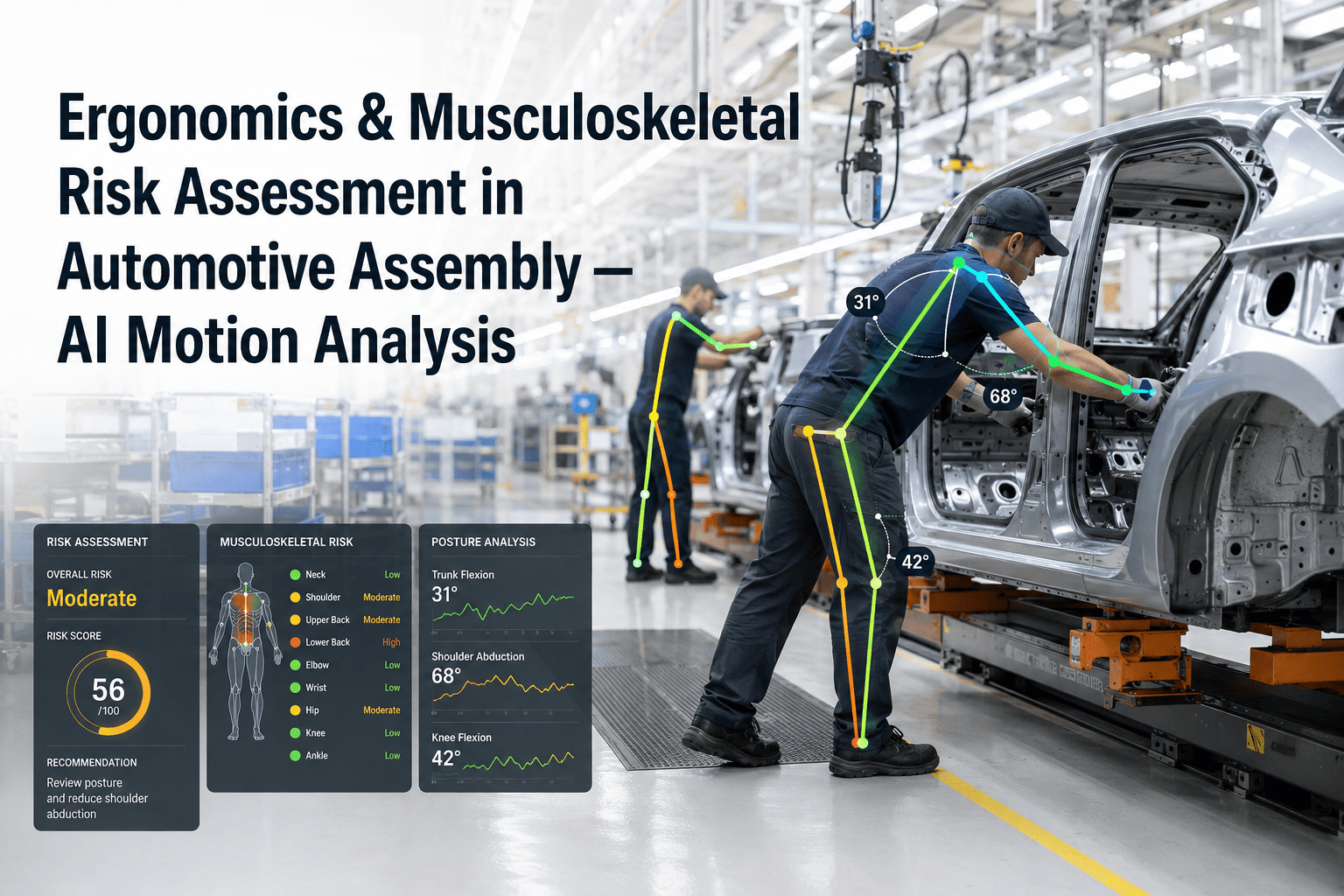
A trim line operator reaching overhead to install a headliner two hundred times a shift will not feel anything wrong for months, and by the time a shoulder injury actually gets reported it has usually been building since long before anyone flagged the task. Paper-based ergonomic audits catch a handful of postures on the day someone happens to be watching, which means most of the actual repetitive strain exposure on a floor goes completely undocumented. Vision-based ergonomic risk scoring changes that by watching every cycle, not just the one someone happened to observe, and you can book a demo to see it scoring tasks on your own line.
ERGONOMIC RISK · VISION AI · REPETITIVE STRAIN · TASK SCORING
Most Ergonomic Injuries Build Quietly for Months Before Anyone Documents the Task
iFactory's vision AI scores posture, reach, and repetition on every cycle at every station, giving safety teams a continuous risk picture instead of a once-a-year paper audit.
Low
Neutral posture, minimal reach, low repetition
Moderate
Some awkward posture or reach, monitored for trend
High
Overhead, twisted, or high-force task flagged for redesign
THE VISIBILITY PROBLEM
A Once-a-Year Audit Cannot See What Happens Two Hundred Times a Shift
Traditional ergonomic assessment relies on a trained observer watching a task for a few cycles and scoring it against a standard checklist such as RULA or REBA. That snapshot is useful, but it captures one moment out of tens of thousands of repetitions a task will actually see over a year, and it misses the gradual changes in pace, fatigue, and technique that build real injury risk over a full shift.
200+
Cycles Per Shift
Typical repetition count for a single manual task on a trim or assembly line in one shift
1 in 1000s
Cycles Actually Observed
Rough share of total repetitions a manual audit actually scores compared to the full shift volume
Months
Before Injury Reported
Typical time a repetitive strain injury develops before it is formally reported to safety staff
MANUAL AUDIT VS CONTINUOUS VISION SCORING
What Changes When Every Cycle Gets Scored, Not Just One
Manual Ergonomic Audit
Scores a handful of observed cycles on a single visit
Depends on the observer's training and judgment
Misses fatigue-driven posture changes late in a shift
Repeated only periodically, often once a year per task
Continuous Vision-Based Scoring
Scores posture, reach, and force indicators on every cycle
Applies a consistent scoring standard across every station
Detects posture drift as fatigue builds across a shift
Runs continuously, updating risk scores in near real time
See Every Cycle on Your Line Scored for Ergonomic Risk
iFactory applies vision-based scoring to every task, every cycle, surfacing the stations that need redesign or cobot support first.
WHAT THE AI SCORES
The Task Elements Vision AI Tracks on Every Cycle
Posture and Joint Angle
Neck, back, shoulder, and wrist angles are tracked continuously against established ergonomic thresholds, flagging awkward postures before they become habitual.
Reach and Overhead Work
Reach distance and overhead duration are measured per cycle, since prolonged overhead work is one of the strongest predictors of shoulder injury on assembly lines.
Repetition Rate
Cycle frequency for each motion type is tracked over the full shift, identifying tasks where repetition alone, even with good posture, still carries meaningful risk.
Fatigue-Linked Drift
Gradual posture and pace changes across a shift are trended, surfacing tasks where fatigue is measurably degrading technique by the final hours.
RISK SCORE BANDS
How Task Scores Translate Into Action for Safety Teams
| Score Band |
What It Means |
Typical Action |
| Green |
Posture and repetition within safe thresholds |
Monitor on the normal review cycle |
| Yellow |
Some elevated exposure, trend worth watching |
Add to next ergonomic review agenda |
| Orange |
Sustained high exposure across multiple shifts |
Prioritize for task redesign or rotation |
| Red |
High-force or extreme-posture task, injury risk elevated |
Escalate for cobot or humanoid support review |
MEASURED RESULTS
Outcomes Reported After Deploying Continuous Ergonomic Scoring
34%
More high-risk tasks identified compared to the prior annual audit cycle
21%
Reduction in reported musculoskeletal complaints after targeted task redesign
6 mo
Average time saved identifying a developing risk compared to waiting for the next scheduled audit
100%
Of monitored cycles scored, compared to a small sampled fraction under manual audit
GETTING STARTED
Rolling Out Vision-Based Ergonomic Scoring Across a Line
Step 1
Install Station Cameras
Cameras are positioned to capture the relevant posture and reach angles for each task without disrupting the existing workstation layout.
Step 2
Calibrate Scoring Model
The model is calibrated against your task standards and established ergonomic frameworks before any scores are used for decision-making.
Step 3
Run Continuous Scoring
Every cycle at every monitored station is scored automatically, building a risk picture across full shifts rather than a single observed moment.
Step 4
Prioritize Redesign
Safety and industrial engineering teams get a ranked list of tasks by risk score, focusing redesign and rotation efforts where they matter most.
FREQUENTLY ASKED QUESTIONS
Questions Safety Teams Ask About Vision-Based Ergonomic Scoring
Does the camera system identify or track individual workers by name?
No, the scoring model is designed to evaluate the task and the motion pattern involved, not to identify or track specific individuals, since the goal is redesigning risky tasks rather than monitoring particular people. Camera feeds are processed for posture and motion analysis and are configured according to your plant's privacy and workforce agreement requirements before any deployment begins.
Book a demo to review the privacy configuration options available.
How accurate is vision-based scoring compared to a trained ergonomic assessor?
The scoring model is calibrated against established frameworks such as RULA and REBA and validated against trained assessor scores during setup, so it is designed to match professional judgment rather than replace it entirely. The real advantage is not replacing the assessor's expertise but multiplying it across every cycle and every station instead of the handful an assessor can physically observe in a visit.
Contact support to review validation results from a comparable deployment.
Can this system account for tasks that vary depending on which vehicle variant is being built?
Yes, the model is trained to recognize the specific task variant in progress and score it against the appropriate baseline, since a headliner install on one trim level can involve meaningfully different reach and posture demands than another. This variant-aware scoring avoids flagging a normal task difference as a false risk signal simply because the vehicle changed.
Book a demo to see variant handling on a mixed-model line.
What happens once a task is flagged as high risk, does the system recommend a fix?
The platform surfaces the specific posture, reach, or repetition pattern driving the score and ranks flagged tasks by severity, giving industrial engineering teams a clear starting point rather than a generic alert. Actual redesign decisions, whether that means a fixture change, task rotation, or cobot support, remain with your engineering team, informed by the detailed scoring data behind each flag.
Contact support to see a sample risk report and redesign workflow.
How long does it take before we see meaningful ergonomic risk data after installation?
Cameras typically begin generating usable posture and repetition data within the first few days, though the model calibration phase against your specific task standards usually takes a few weeks before scores are reliable enough to drive redesign decisions. Most plants see their first ranked risk report within the first month of a station going live.
Book a demo to see a typical rollout timeline for a line your size.
Stop Waiting for an Injury Report to Find the Risky Task
iFactory scores ergonomic risk on every cycle, giving your safety team the continuous visibility a once-a-year audit never could.