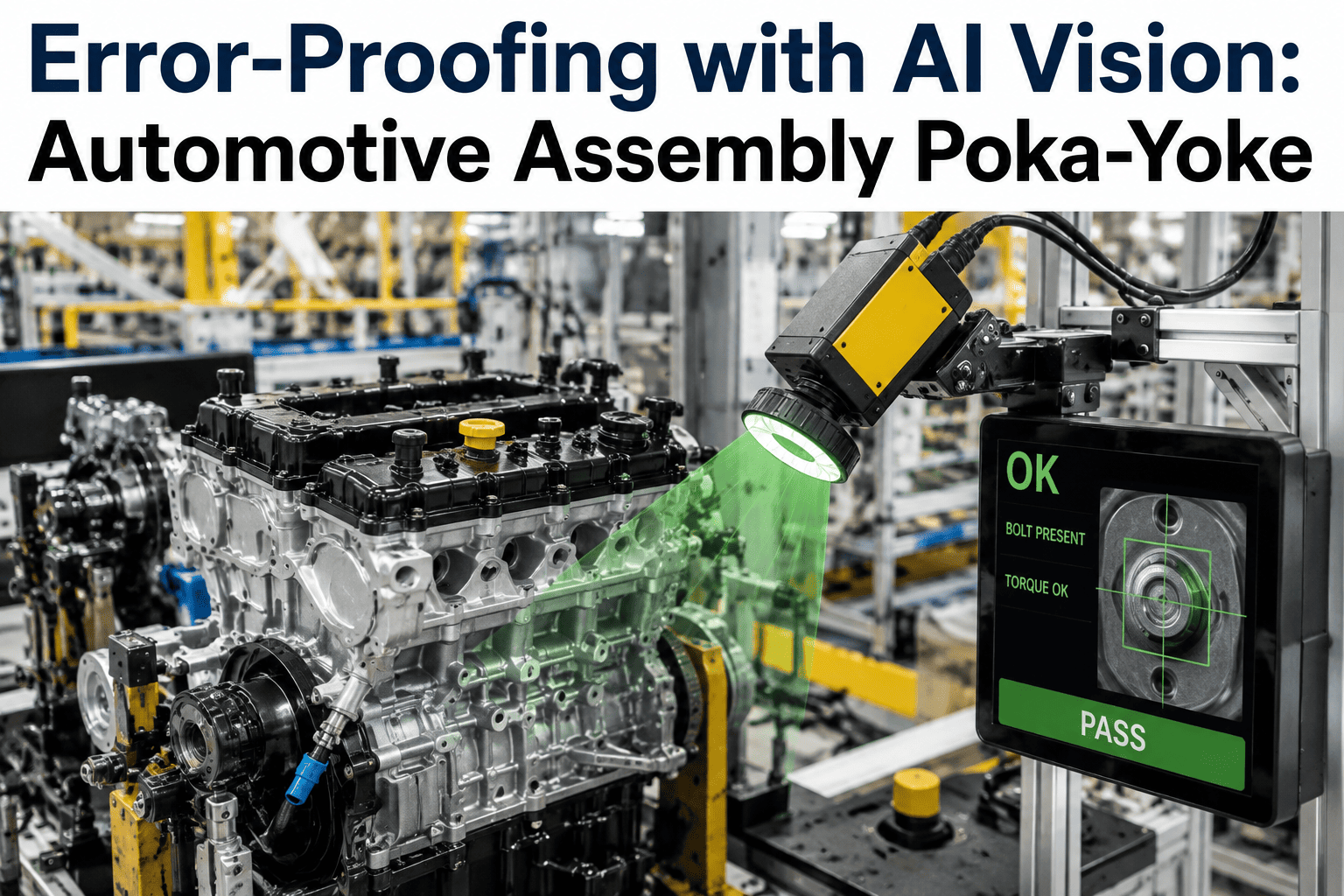
Error-Proofing with AI Vision: Automotive Assembly Poka-Yoke

By James Smith on August 27, 2026

error-proofing-poka-yoke-ai-vision-automotive-assembly

Poka-yoke has always meant designing a station so a mistake is physically impossible, not just discouraged, and for decades that meant asymmetric fixtures, keyed connectors, and switches that would not release the next part until the current one clicked into place. Those mechanical safeguards still work well for what they were built to catch, but a large share of assembly errors today involve a correct part installed the wrong way, a sequence step skipped, or a match between two components that a physical fixture has no way to verify. AI vision extends poka-yoke into that harder territory, and you can book a demo to see where vision-based error-proofing would fit on your own line.

ERROR-PROOFING · AI VISION · POKA-YOKE FOR ASSEMBLY

Mechanical Poka-Yoke Stops at What a Fixture Can Physically Sense

iFactory's AI vision error-proofing extends poka-yoke beyond what limit switches and keyed fixtures can catch, verifying part identity, sequence, and correct matching at stations where a mechanical safeguard alone cannot tell right from wrong.

WHERE MECHANICAL POKA-YOKE STOPS

A Fixture Can Sense Contact, Not Correctness

The strength of a mechanical poka-yoke device is also its limitation, a keyed fixture or a proximity switch responds to physical shape and presence, which means it can confirm a component is in a given location but cannot tell whether that component was the right part number, whether a paired component matches it correctly, or whether a multi-step process was followed in the right sequence. Those failure modes are common wherever visually similar parts, left and right variants, or model-specific components pass through the same station.

1
Mechanical Fixture
Physically blocks assembly if a part does not match the fixture's shape.
2
Proximity and Limit Sensors
Confirm a part is present and a step was physically completed.
3
AI Vision Layer
Confirms part identity, correct variant, matching pair, and sequence order the layers below cannot see.
FAILURE MODES VISION CATCHES

The Errors That Slip Past Physical Fixtures

The specific failure modes AI vision addresses tend to share one trait, they involve a judgment about identity or correctness rather than a purely physical presence or absence that a mechanical switch can register.

Wrong Variant
A visually similar left- or right-hand part installed on the wrong side of the vehicle
Skipped Step
A multi-step sequence where one step is missed but the final fixture still closes
Mismatch
Two components paired incorrectly, such as a color or trim-level mismatch

Identify Your Highest-Value Error-Proofing Station

iFactory can review your current defect data to identify which stations would benefit most from adding a vision-based error-proofing layer. Book a demo to walk through it.

HOW VISION-BASED ERROR-PROOFING WORKS

Verification Happens Before the Station Releases the Part

The core principle of poka-yoke is prevention at the point of assembly, not detection downstream, and vision-based error-proofing preserves that principle by checking the component before the station allows the operator or robot to proceed, rather than flagging a defect after the unit has already moved to the next process.

Identify the Component
The camera confirms the part matches the expected identity for the current build, not just any similar-looking part.
Verify Correct Match
For paired components, confirms the two parts correspond correctly rather than being mismatched.
Confirm Sequence
Where a process has multiple ordered steps, confirms each step occurred before releasing the next.
Hold or Release the Station
The station only proceeds once the vision check passes, keeping prevention at the point of assembly.
MECHANICAL-ONLY VS VISION-EXTENDED ERROR-PROOFING

What a Vision Layer Adds on Top of Existing Fixtures

Vision-based error-proofing is not a replacement for mechanical poka-yoke, it is an added layer that covers the failure modes a physical fixture structurally cannot detect.

Failure Mode Mechanical Fixture Alone With AI Vision Layer
Wrong Variant Installed Not detected if the part physically fits the fixture Detected by confirming part identity against the build spec
Skipped Sequence Step Not detected if the final step still completes normally Detected by verifying each step occurred in order
Mismatched Pair Not detected if both parts fit their respective fixtures Detected by cross-checking the pair against expected correspondence
Correct Presence and Fit Reliably detected, this remains the fixture's strength Confirmed alongside the vision layer for a complete check
WHERE THIS FITS ON THE LINE

Stations With Visually Similar Parts or Multi-Step Sequences

Vision-based error-proofing delivers the most value at stations where parts closely resemble each other or where a process involves several ordered actions that a single mechanical switch cannot fully represent.

Left/Right Part Stations
Prevent mirrored components from being installed on the wrong side of the vehicle.
Trim-Level Variant Lines
Confirm the correct model-specific component is used on mixed-model production lines.
Multi-Step Sub-Assemblies
Verify every step in a sequence occurred before the sub-assembly moves forward.
Paired-Component Stations
Catch a mismatch between two components meant to correspond, such as color or spec pairing.
FREQUENTLY ASKED QUESTIONS

What Process Engineers Ask Before Adding a Vision Layer

Do we need to remove our existing mechanical poka-yoke fixtures to add this?
No, vision-based error-proofing is designed to work alongside existing mechanical fixtures rather than replace them, since the fixtures remain effective at what they already do well, confirming physical presence and fit. The vision layer adds the identity, matching, and sequence checks the fixture cannot perform. Book a demo to see how it would integrate with your current fixtures.
How does the system tell visually similar parts apart reliably?
The model is trained on reference images of each correct part variant, and distinguishing between visually similar parts, such as left and right versions, relies on subtle geometric or marking differences that the model learns to recognize consistently, even when the differences are difficult for an operator to catch quickly under time pressure. Contact our support team to discuss the specific parts you would want distinguished.
Can this stop the line automatically, or does it only alert an operator?
Either configuration is possible depending on the station's existing control integration, a hard stop that prevents the next step until the check passes, or a visual and audible alert that lets the operator correct the issue immediately, consistent with your plant's existing error-proofing policy. Book a demo to review which approach fits your line control setup.
How many reference examples are needed before a new check is reliable?
The number of reference examples needed depends on how much natural variation exists in the correct and incorrect versions of a part, and stations with well-defined, repeatable geometry generally require fewer examples to reach a reliable pass and fail distinction than stations with high part-to-part variation. Contact our support team to get an estimate for your specific parts.
Does adding a vision check slow down the station's cycle time?
Vision checks are designed to run within the existing station cycle time rather than adding a separate inspection step afterward, so the verification happens during the normal process flow instead of extending takt time at the station. Contact our support team to review cycle time implications for your specific station.

Extend Poka-Yoke to What a Fixture Cannot See

iFactory's AI vision layer catches wrong variants, skipped steps, and mismatched pairs before the station releases the part. Book a demo and review your highest-value stations.
Share This Story, Choose Your Platform!