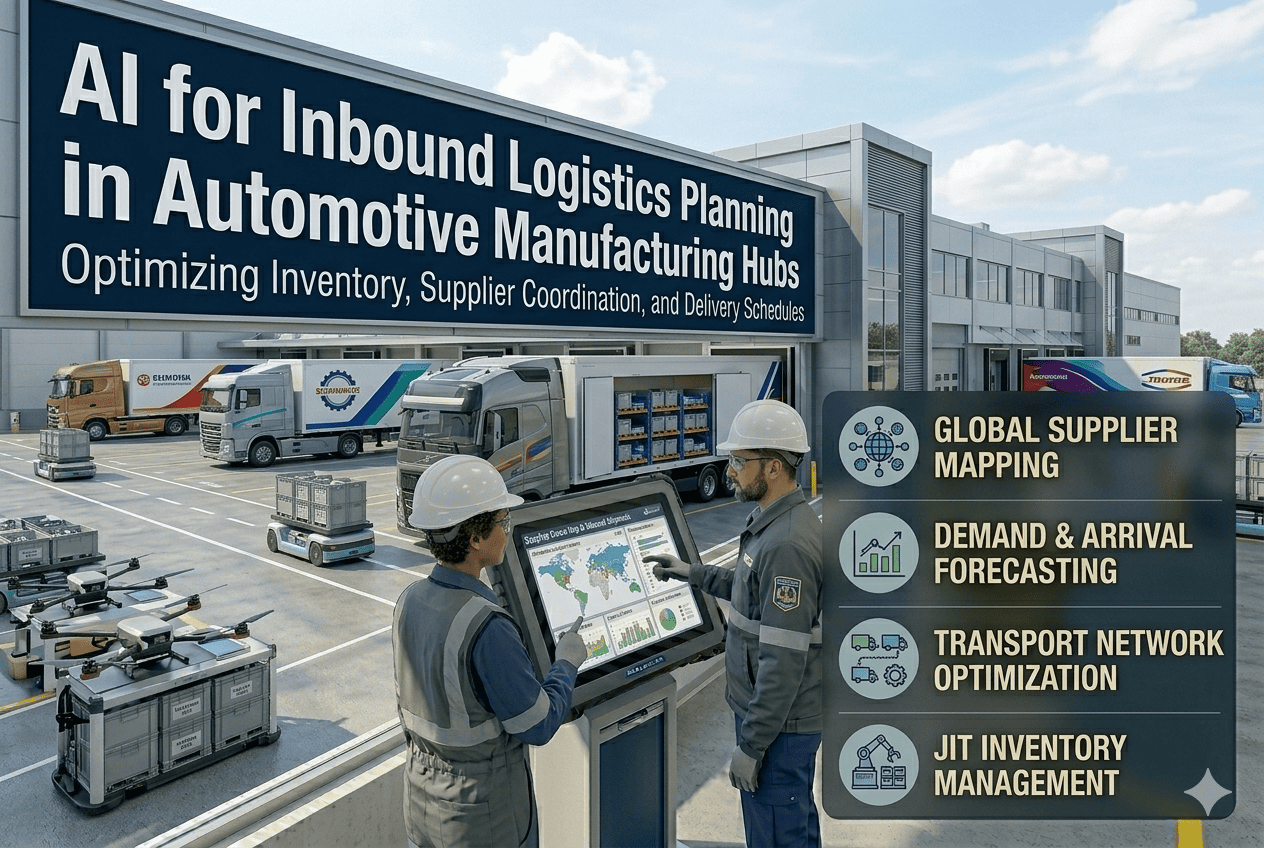
A milk run route built around a fixed departure time and a fixed stop sequence looks efficient on paper until one supplier loads fifteen minutes late, the truck sits in a queue at the second stop, and the whole route arrives at the plant behind the JIT window with a line waiting on parts. Automotive inbound logistics networks depend on milk runs and cross-dock consolidation to keep freight costs down while meeting delivery windows measured in minutes, and a static route plan has no way to absorb the small delays that happen on nearly every run. iFactory rebuilds the route in real time as conditions change, keeps every consolidation center handoff synchronized with the plant's actual need date, and gives logistics teams the visibility to catch a delay before it becomes a missed window — full detail at iFactory support.
AI-Driven Route Optimization · Automotive Inbound Logistics
Milk Run and Cross-Dock Optimization: Keep Every Stop on a JIT Route Synchronized, Even When the First One Runs Late
iFactory continuously re-optimizes milk run routing and cross-dock scheduling against live traffic, dock congestion, and supplier readiness data, so a delay at stop one triggers an automatic adjustment instead of a missed delivery window at the plant.
Cross-Dock
Window Re-Sequenced
Plant Dock
On-Time Arrival Held
Why Static Routes Break
A Fixed Milk Run Schedule Has No Way to Absorb the Delays That Happen Every Day
Route plans built once a quarter assume every stop loads on time, every road is clear, and every cross-dock handoff happens exactly on schedule. In practice, none of those assumptions hold consistently, which is why so many JIT delivery misses trace back to a small delay early in the route.
Supplier Load Variability
A single supplier running behind schedule on dock loading delays every downstream stop on the same route, and a static schedule has no mechanism to compress the remaining legs.
Cross-Dock Congestion
Consolidation centers handling freight from multiple milk runs experience dock congestion that shifts day to day, and a fixed appointment window does not account for which trucks are actually queued.
Traffic and Weather Variance
Route timing built on average transit time ignores the daily variance from traffic incidents and weather, which compounds across a multi-stop route into a much larger delivery window miss.
Volume Fluctuation
Build schedule changes shift the volume each supplier needs to ship on a given day, and a route sized for average volume either runs partially empty or overflows depending on the week.
The Optimization Loop
How iFactory Keeps a Multi-Stop Route Synchronized to the Plant's Actual Need Date
1
Live Route Monitoring
Telematics data from the milk run vehicle, dock scan events at each supplier stop, and real-time traffic feeds are combined into a continuously updated estimated time of arrival for every remaining stop.
2
Deviation Detection
When actual progress falls outside the tolerance needed to hit the plant's JIT window, the system flags the deviation immediately rather than waiting for the driver to report a delay.
3
Dynamic Re-Sequencing
Remaining stops are re-sequenced or cross-dock appointment windows are shifted automatically to recover schedule where possible, prioritizing the parts with the least production buffer remaining.
4
Early Plant Notification
If a delay cannot be recovered within the route, the receiving plant is notified with enough lead time to adjust line sequencing or pull from safety stock rather than discovering the gap at the dock door.
Every Milk Run Route Generates Live Data. Most Logistics Teams Never See It Until the Delivery Is Already Late.
iFactory turns telematics, dock scans, and traffic data into a route plan that adjusts itself throughout the day instead of one built once and left to chance.
Static vs. Dynamic Routing
Inbound Logistics — Fixed Schedules vs. iFactory Continuous Route Optimization
Function
Fixed Milk Run Schedule
iFactory Dynamic Routing
Delay Response
Discovered when the truck fails to hit the next scheduled appointment window
Flagged the moment actual progress deviates from what is needed to hit the plant window
Cross-Dock Appointments
Fixed windows booked in advance regardless of actual dock congestion that day
Adjusted dynamically based on live queue conditions at the consolidation center
Route Sequencing
Same stop order every day regardless of which parts have the least production buffer
Re-sequenced when needed to protect the parts closest to running out on the line
Freight Cost Planning
Fleet sized for peak volume, running underutilized on lower-volume days
Load consolidation adjusted to actual daily volume, reducing underutilized truck capacity
Plant Notification
Plant learns of a delay when the delivery fails to arrive at the dock
Plant receives advance notice with enough lead time to adjust line sequencing
Measured Outcomes
What Logistics Teams Report After Deploying Dynamic Route Optimization
31%
Fewer Missed JIT Delivery Windows
Plants running dynamic re-sequencing on milk run routes report a significant drop in delivery windows missed compared to fixed-schedule routing.
12–18%
Inbound Freight Cost Reduction
Better load consolidation and cross-dock coordination typically deliver freight savings in this range compared to static route planning.
Under 10 min
Deviation Detection Time
The typical time between a route falling behind schedule and the deviation being flagged for action.
40 min+
Average Plant Advance Warning
When a delay cannot be fully recovered within the route, plants typically receive this much advance notice to adjust line sequencing accordingly.
$50K–$500K
Per-Hour Line-Down Cost Exposure
The range plant operators report per hour of production lost to a missed JIT delivery — the exposure dynamic routing is built to reduce.
15%
Improvement in Cross-Dock Throughput
Consolidation centers coordinating appointment windows dynamically report throughput gains from reduced dock queuing and re-work.
Field Case
Recovering a 22-Minute Delay Before It Reached the Plant Dock
A four-stop milk run feeding a body-in-white line lost 22 minutes at its second stop when a supplier's dock was backed up behind an inbound rail delivery. Under the plant's previous fixed-schedule process, that delay would have propagated through the remaining two stops and arrived at the plant roughly 20 minutes behind the JIT window, triggering a line-side buffer draw and a scramble to confirm whether backup stock would cover the gap. With dynamic routing active, the system re-sequenced the final two stops, shortened dwell time at the cross-dock by prioritizing the delayed load, and recovered 18 of the 22 minutes before the truck reached the plant, arriving inside the acceptable delivery window with no line impact.
22 minInitial delay at stop two
18 minRecovered through re-sequencing
0Line-down minutes triggered
Frequently Asked Questions
Milk Run and Cross-Dock Optimization — What Logistics Directors Ask First
What data does iFactory need to optimize our milk run routes?
The core inputs are vehicle telematics or GPS data from the milk run fleet, dock scan or check-in events at each supplier stop and the cross-dock facility, and a live traffic feed for the route corridors involved. Most fleets already generate telematics data through an existing transportation management system or a third-party carrier's tracking platform, and iFactory integrates with that data rather than requiring new hardware in most cases. Where a supplier stop has no digital check-in process today, a simple scan-based check-in can be added with minimal disruption.
Book a Demo to review your current fleet's data readiness.
How does dynamic re-sequencing decide which stop to prioritize when a route falls behind?
Prioritization is based on the production buffer remaining for each part on the route — how many hours of line supply the receiving plant has on hand for that specific part number. A part with a thin buffer is protected first, even if that means accepting a longer delay on a part with several shifts of safety stock still available. This logic is configured per plant and can incorporate additional priority rules, such as a part feeding a bottleneck operation, where any delay carries outsized production risk.
Does this work with third-party logistics providers running our milk runs?
Yes, iFactory is commonly deployed in configurations where a 3PL operates the physical milk run fleet while the plant or a lead logistics provider retains visibility and routing authority. Integration typically connects to the 3PL's existing telematics and transportation management system through standard API access, and re-sequencing recommendations can either be applied automatically or routed to the 3PL's dispatch team for confirmation depending on the operating agreement in place.
Contact support to discuss integration with your current 3PL relationship.
Can this manage cross-dock consolidation centers serving multiple plants at once?
Cross-dock facilities serving multiple plants and multiple milk run routes are one of the primary use cases for this capability, since appointment scheduling conflicts at a shared consolidation center are a common source of downstream delay. The system tracks dock capacity and current queue status across all routes passing through the facility, and appointment windows are adjusted with visibility into how a change on one route affects the others sharing the same dock resources.
How long does implementation take for an existing milk run network?
For a network with telematics and dock-scan data already flowing into a transportation management system, implementation typically takes three to five weeks, covering data integration, route baseline calibration, and a validation period comparing system recommendations against dispatcher judgment before full automation is enabled. Networks with multiple 3PL partners or limited existing digital tracking generally take six to nine weeks.
Book a Demo for a timeline specific to your route network.
A 15-Minute Delay at Stop One Doesn't Have to Become a Line-Down Call at the Plant. Let the Route Adjust Itself.
Continuous milk run and cross-dock optimization built on live telematics, dock scans, and traffic data — live in as little as three weeks.