A short shot, a sink mark, or a warped panel almost never traces back to the mold itself — it traces back to a process parameter that drifted a few degrees or a few bar out of window sometime during the cycle. For a process engineer running injection molding and composite lines side by side, that's the real difference between the two: injection molding problems are usually a melt-temperature or pressure story, while SMC and BMC composite problems are usually a cure-cycle and fiber-distribution story. This piece looks at where automotive plastic and composite quality is actually decided, what the market growth numbers mean for tooling investment, and how AI process monitoring catches parameter drift before it becomes a defective panel. A short walkthrough shows how it applies to your own process parameters.
Automotive Plastics & Composites
Keeping Melt Temperature, Pressure, and Cure Cycles in Window
Interior trim, exterior panels, and structural components each demand different process control. See how AI parameter monitoring closes the gap.
Two Growing Markets, Two Different Process Disciplines
Global injection molding is a $327.5 billion market in 2026, on track to reach $462.5 billion by 2033 at a 5.1% compound annual rate, with expanding EV production cited as a major driver as automakers lean on molded plastic components to cut weight and extend range. Composite molding is growing even faster in percentage terms — the SMC/BMC mould market alone is projected to grow at roughly a 6.9% CAGR through the early 2030s, pushed by the same lightweighting pressure driving injection molding demand, but with a fundamentally different manufacturing discipline behind it. Sheet molding compound favors large structural panels with a smooth surface finish, while bulk molding compound favors smaller, intricate parts like electrical housings and under-hood components where flow characteristics matter more than surface class.
$327.5B
global injection molding market size in 2026
5.1%
injection molding CAGR through 2033
6.9%
SMC/BMC mould market CAGR through the early 2030s
41.2%
share of global injection molding market held by Asia Pacific
Where Injection Molding Quality Actually Breaks Down
Injection molding defects almost always trace back to one of three process variables drifting out of window during the shot: melt temperature, injection pressure, or cooling time. Each produces a distinct, recognizable defect signature, which makes parameter monitoring far more actionable than a generic "quality alert" — an engineer looking at a specific defect type already has a strong hypothesis about which parameter to check first.
1
Melt temperature drift — too low produces short shots and poor surface finish; too high risks material degradation and burn marks.
2
Injection pressure variation — insufficient pressure produces sink marks and voids in thicker sections; excessive pressure produces flash at the parting line.
3
Cooling time inconsistency — insufficient cooling produces warpage as the part is ejected before it's fully stable, a leading cause of dimensional rejects on exterior trim.
Trace Your Defect to Its Parameter
Connect Warpage, Sink Marks, and Flash to Their Root Cause
A demo reviews your shot data to isolate which specific parameter is driving your rejection rate.
SMC and BMC: A Different Set of Failure Modes
Composite molding introduces variables injection molding doesn't have to deal with — fiber orientation, resin flow during compression, and cure kinetics that unfold over the full press cycle rather than a single injection shot. Getting the cure cycle wrong doesn't just risk a cosmetic defect; it directly affects the mechanical strength the composite was specified for in the first place, which matters enormously for structural body panels where SMC's core value proposition is strength-to-weight performance.
| Compound | Typical Application | Primary Process Risk |
|---|
| Sheet Molding Compound (SMC) | Body panels, structural components | Cure cycle timing, fiber distribution during compression |
| Bulk Molding Compound (BMC) | Electrical housings, under-hood parts | Flow consistency into intricate cavity geometry |
| Injection-molded thermoplastics | Interior trim, cosmetic panels | Melt temperature, injection pressure, cooling time |
Matching Process Control to the Part's Job
Not every molded automotive component carries the same consequence if the process drifts. A cosmetic interior trim panel with a minor sink mark is a scrap-cost problem. A structural SMC component with an incomplete cure or misaligned fiber orientation is a mechanical-performance problem that may not surface until the part is under load — which is exactly the kind of defect that's cheapest to catch during the cure cycle itself, not after the part has shipped.
Interior Trim & Cosmetic Parts
Priority: surface finish and dimensional consistency
Key monitoring: melt temperature, cooling time
Failure consequence: scrap cost, cosmetic rejection
Structural & Exterior Panels
Priority: mechanical strength and fiber distribution
Key monitoring: cure cycle, injection/compression pressure
Failure consequence: performance risk, potential field failure
What AI Process Optimization Adds Here
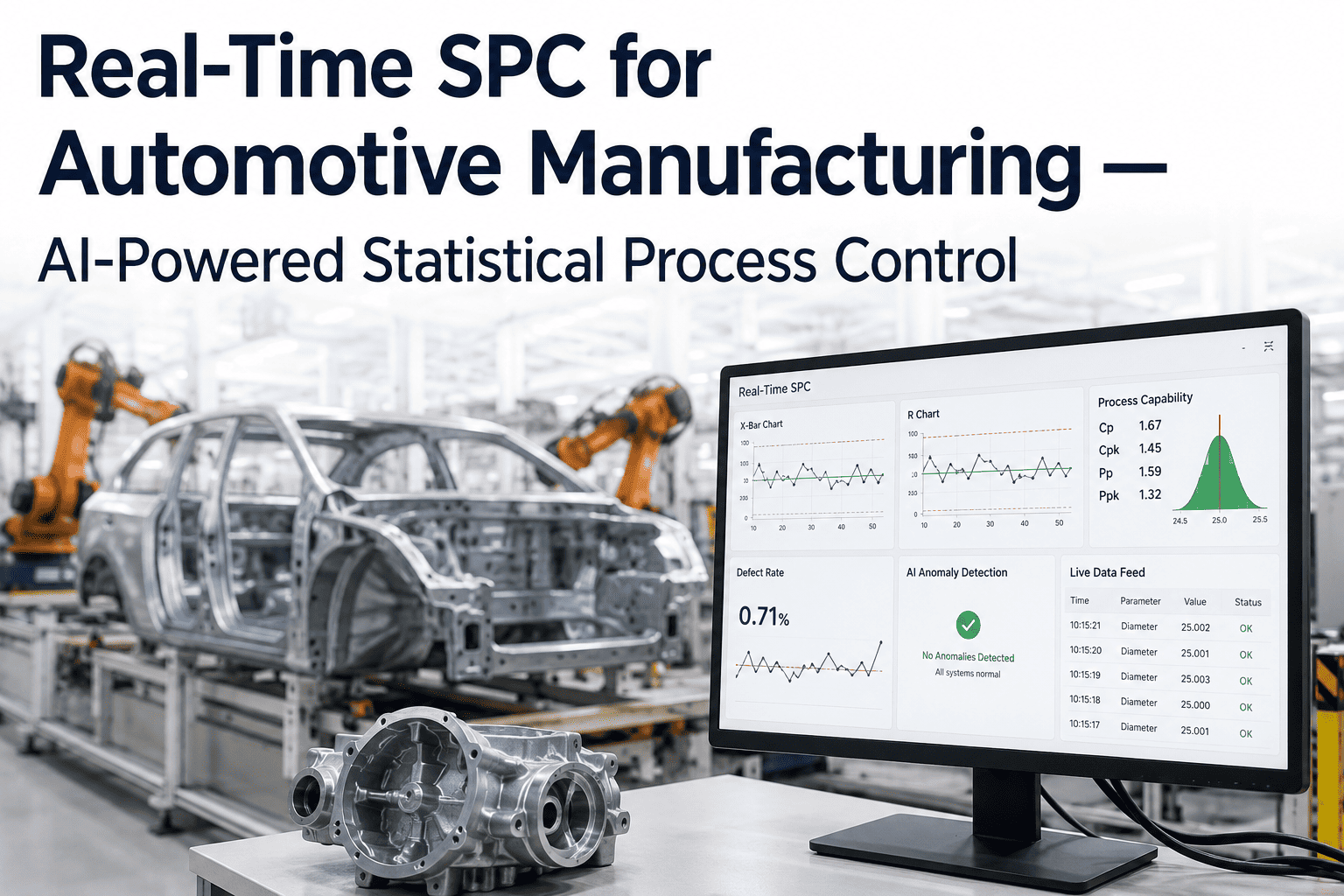
Real-time melt temperature and pressure tracking
Flags parameter drift within the current shot cycle instead of discovering it at post-mold inspection.
Cure cycle monitoring for SMC/BMC presses
Verifies full cure completion before demolding, protecting the mechanical properties the composite was specified for.
Shot-to-shot consistency analysis
Surfaces gradual drift across a production run that a single-shot spot check would never catch.
Defect-to-parameter correlation
Links a specific warpage or sink-mark pattern back to the shot data that produced it, cutting root-cause time significantly.
Common Process Control Gaps
1
Applying injection molding thinking to composite cure cycles. Cure kinetics unfold over the full press cycle, not a single shot, and monitoring built for thermoplastics misses this entirely.
2
Treating minor warpage as purely cosmetic. On structural SMC components, a warpage pattern often signals a cure or fiber-distribution issue that also affects mechanical strength.
3
Sampling shot data instead of tracking every cycle. Gradual parameter drift across a production run is invisible if only occasional shots are reviewed.
4
Using one process control standard across trim and structural parts. A cosmetic trim panel and a structural body panel carry very different failure consequences and need process monitoring calibrated accordingly.
Frequently Asked Questions
How is monitoring composite cure cycles different from monitoring injection molding shots?
Injection molding defects trace back to a single shot event — melt temperature, injection pressure, and cooling time within seconds. Composite cure cycles unfold over a much longer press cycle, often minutes, where the resin needs to reach full cure before demolding without disrupting fiber orientation. Monitoring composite processes means tracking the full cure profile over time rather than a single-point parameter check.
A demo can show how this applies to your specific press cycle.Can this catch defects that don't show up until the part is under load?
Yes, indirectly. While process monitoring doesn't test the finished part under load, it verifies that the cure cycle and fiber distribution stayed within the parameters known to produce the specified mechanical properties, which catches the process conditions that would otherwise produce a part that looks acceptable but underperforms structurally.
Does this work for a plant running both injection molding and SMC/BMC compression presses?
Yes. Because the two processes have different failure modes, the monitoring configuration differs by process type — shot-based parameter tracking for injection molding, full cure-profile tracking for compression molding — but both can run under the same overall production monitoring system.
What's the fastest way to reduce warpage rejects on exterior panels?
Cooling time consistency is the most common root cause of warpage on injection-molded exterior trim, and inconsistent cooling is one of the easiest parameters to monitor continuously since it's directly tied to cycle timing data most modern presses already record. Structural SMC panels more often trace warpage back to cure cycle or fiber distribution instead.
Support can help identify which parameter is most likely driving your specific rejects.How long does a typical rollout take on an existing molding line?
Most plants start with their highest-reject-rate part family, typically live within four to eight weeks depending on existing press instrumentation, and expand to additional presses once the first line demonstrates a measurable reduction in scrap.
Ready When You Are
Keep Every Shot and Cure Cycle Inside Its Window
Book a session and see how AI process optimization handles your specific molding and composite process mix.