A tandem press line only runs as fast as its slowest, least-watched component, and on most lines that component isn't the press itself — it's the destacker, the transfer system, or the die cushion quietly drifting out of tolerance while everyone's attention stays on tonnage and cycle count. Servo transfer failures, destacker double-feeds, and cushion pressure drift rarely announce themselves before they stop the line, and when they do stop it, the resulting downtime cascades across every press downstream in the same tandem sequence. Plants that instrument these supporting systems the same way they instrument the press are catching failures during a scheduled changeover instead of during a production shift. If your maintenance team is still finding out about a failing transfer system when the line actually stops, book a session with an iFactory maintenance engineer to see what changes when it doesn't.
iFactory Stamping Intelligence
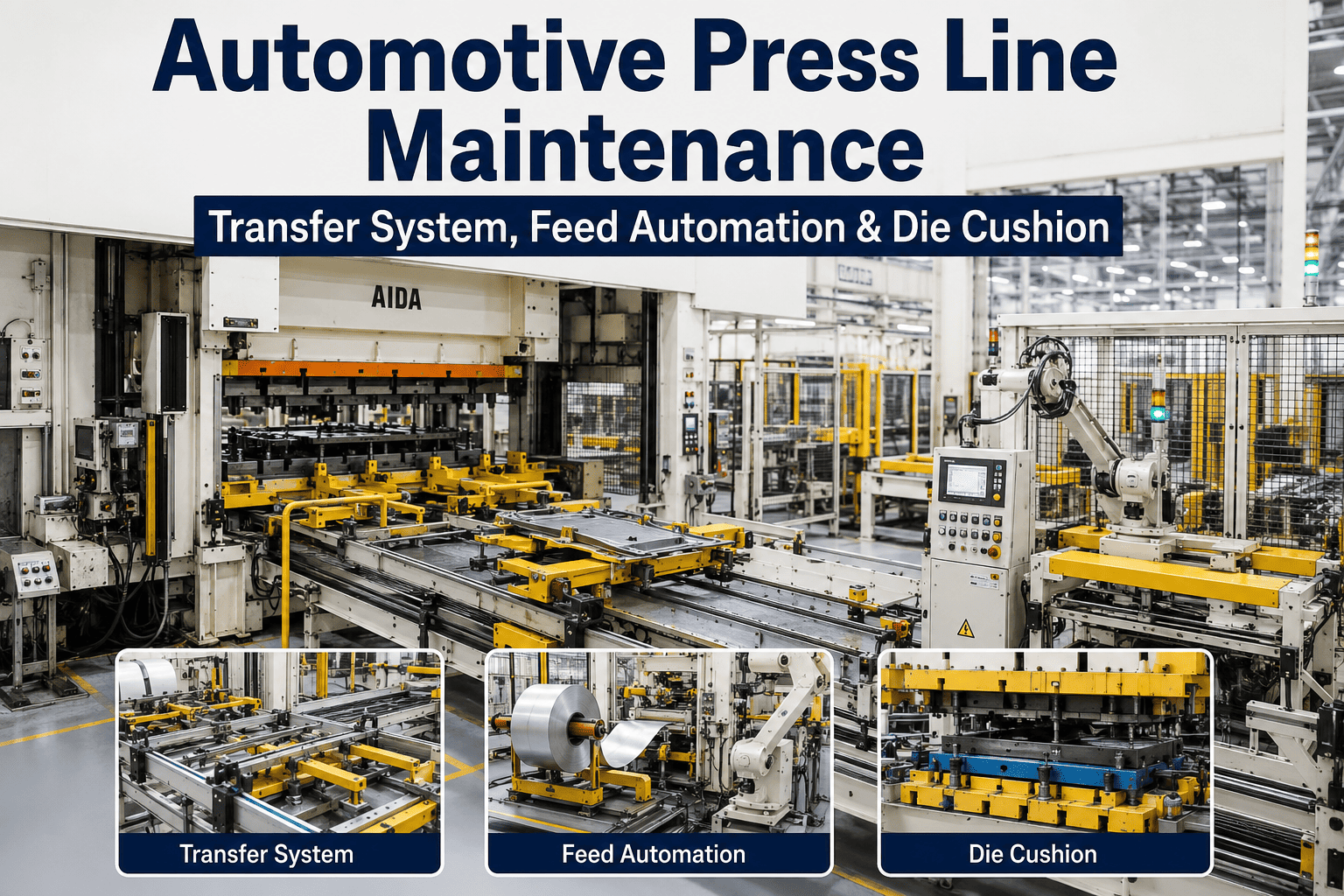
Automotive Press Line Maintenance: Transfer System, Feed Automation & Die Cushion
A press line is only as reliable as its weakest supporting system. This guide covers the transfer mechanisms, feed automation, and die cushions that keep a tandem line running, the failure modes that actually stop production, and how AI-powered monitoring predicts each one before it becomes a line stop.
25-40%
Maintenance spend reduction from condition-based servicing
$260K
Typical hourly cost of an unplanned tandem line stoppage
4-48 hr
Advance warning achievable for progressive component failures
68%
Of stoppages preventable with sufficient lead time
Why Supporting Systems Cause More Downtime Than the Press Itself
Ask most maintenance teams what stops a press line most often, and the honest answer is rarely the press. It's the automation feeding and moving parts between stations — destackers that misfeed, transfer bars that lose timing, die cushions that drift off pressure. These systems run thousands of precise cycles per shift with very little tolerance for wear, and because they operate largely out of sight of the control room, degradation tends to go unnoticed until it produces a hard stop.
On a tandem line, this problem compounds. A transfer failure at station two doesn't just stop station two — it stops every press in the sequence, because parts can no longer move through the line. A single worn component in a feed system can therefore cascade into a multi-press, multi-hour production loss that dwarfs the cost of the part that actually failed.
The Business Case for Monitoring Line Support Systems
- Servo transfer timing and destacker feed consistency tracked continuously catch degradation before a hard stop
- Die cushion pressure monitored in real time prevents the part-quality drift that precedes a full cushion failure
- Cascading tandem-line stoppages are prevented by catching the single component causing them before it fails
Request a Line Reliability Audit →
The Five Modules That Make Up a Tandem Press Line
A modern automotive press line is a sequence of distinct automation modules, each with its own failure signature. Monitoring the line well means watching each module for the specific condition signals that precede its most common failure mode.
01
Destacker
Separates and feeds individual blanks from a stack. Common failure: double-feeds or misfeeds from magnetic separator wear.
02
Feed Line
Positions blanks precisely for the first station. Common failure: positional drift from servo wear affecting first-hit accuracy.
03
Servo Transfer
Moves parts between stations at press speed. Common failure: timing drift causing part-to-die collision or dropped parts.
04
Die Cushion
Controls blank holder force during draw. Common failure: pressure drift causing wrinkling, splitting, or inconsistent draw depth.
05
Blanking & Exit
Separates and conveys finished parts from the line. Common failure: conveyor jams that back up into upstream stations.
Reactive Repair vs. Condition-Based Line Maintenance
| Decision Area |
Reactive Repair |
Condition-Based Maintenance |
| Failure Detection |
Discovered when the line actually stops, mid-shift, with production already lost. |
Detected as a signal trend hours to days before the component actually fails. |
| Servo Transfer Health |
Timing drift invisible until a part collision or dropped part forces a stop. |
Servo timing and positional accuracy tracked continuously against baseline. |
| Die Cushion Pressure |
Checked periodically; drift between checks shows up as inconsistent part quality. |
Pressure monitored continuously and correlated directly with part dimension results. |
| Tandem Line Impact |
A single component failure cascades into a full multi-press stoppage. |
Component-level warning allows the specific failing part to be addressed before cascade. |
| Maintenance Scheduling |
Emergency repairs disrupt planned production and pull technicians off other work. |
Servicing scheduled into planned changeovers based on actual condition data. |
See live health dashboards for every module on your tandem press line
Book a Demo
What Changes When Line Support Systems Are Monitored Continuously
Downtime Prevention
- Servo transfer timing drift flagged before it causes a part collision or dropped part
- Destacker feed consistency tracked to catch double-feed risk before a jam stops the line
- Cascading tandem-line stoppages avoided by isolating the single failing component early
Quality Consistency
- Die cushion pressure held stable, reducing wrinkling and inconsistent draw depth
- Feed positional accuracy maintained, protecting first-hit dimensional consistency
- Part quality drift correlated directly against the specific module causing it
Maintenance Efficiency
- Servicing scheduled against actual component condition rather than a fixed calendar
- Emergency repair frequency drops as failures are caught during planned changeovers
- Technician time redirected from firefighting to planned, condition-driven work
Deployment Timeline: From Sensor Install to Predictive Line Reliability
Week 1-2
Sensors installed across destacker, transfer, and die cushion systems
Vibration, positional, and pressure sensors integrated with existing line controls without disrupting production schedule.
Week 3-4
Live module health dashboards active for maintenance teams
Baseline condition established for each module, with historical trend data building against known service events.
Week 5-8
AI models validated against actual failure and service history
Prediction accuracy confirmed against past failure events before alerts drive scheduling decisions.
Month 3-6
Condition-based scheduling live across the full tandem line
Maintenance planning shifts from calendar to condition, with cascading-failure prevention fully operational.
Frequently Asked Questions
Does this integrate with our existing tandem line PLC and safety systems?
Yes. Monitoring integrates over standard OPC-UA, Ethernet/IP, or direct PLC communication protocols already present on most modern press lines, and it operates alongside existing safety systems without altering their function. Your current line controls and safety interlocks continue to operate exactly as configured, with the monitoring platform adding a real-time analytics layer on top. Specifics for your line configuration are available through
iFactory support.
Which component typically causes the most unplanned downtime on a tandem line?
Servo transfer systems and destackers are consistently the most common sources of unplanned stoppage across tandem lines, since both operate at high cycle counts with tight timing tolerances and comparatively little built-in redundancy. Die cushion pressure drift is a close third, particularly on lines running deep-draw parts where blank holder force consistency is critical to avoiding splits and wrinkles.
How much advance warning can we expect before a component actually fails?
Lead time varies by failure mode, but progressive wear patterns in transfer systems and die cushions typically become visible in sensor trends four to forty-eight hours before an actual failure, while sudden failure modes offer less warning. Historical case data across monitored lines has shown that a majority of stoppages could have been prevented with the advance warning these systems provide.
Can this help us reduce cascading stoppages across a tandem line specifically?
Yes, this is one of the highest-value outcomes of module-level monitoring. Because a single component failure at one station stops every press in a tandem sequence, catching that specific component's degradation before it fails prevents the multi-press cascade entirely, rather than just addressing the failure after the whole line has already stopped.
What is the realistic maintenance cost impact of adopting this approach?
Plants shifting from calendar-based to condition-based maintenance on line support systems commonly see maintenance spend reductions in the range of twenty-five to forty percent, driven by eliminating unnecessary preventive servicing while catching real failures earlier. A cost model specific to your current maintenance programme can be built when you
book a session with our engineering team.
Stop Losing the Whole Line to One Component
Your Transfer System and Die Cushion Are Wearing Right Now. Are You Watching?
iFactory's line reliability platform gives maintenance teams continuous visibility into every module of a tandem press line — catching the single component failure that would otherwise cascade into a full production stop. Sensors live in two weeks. Validated predictions within eight.
25-40%
Maintenance savings
68%
Stoppages preventable