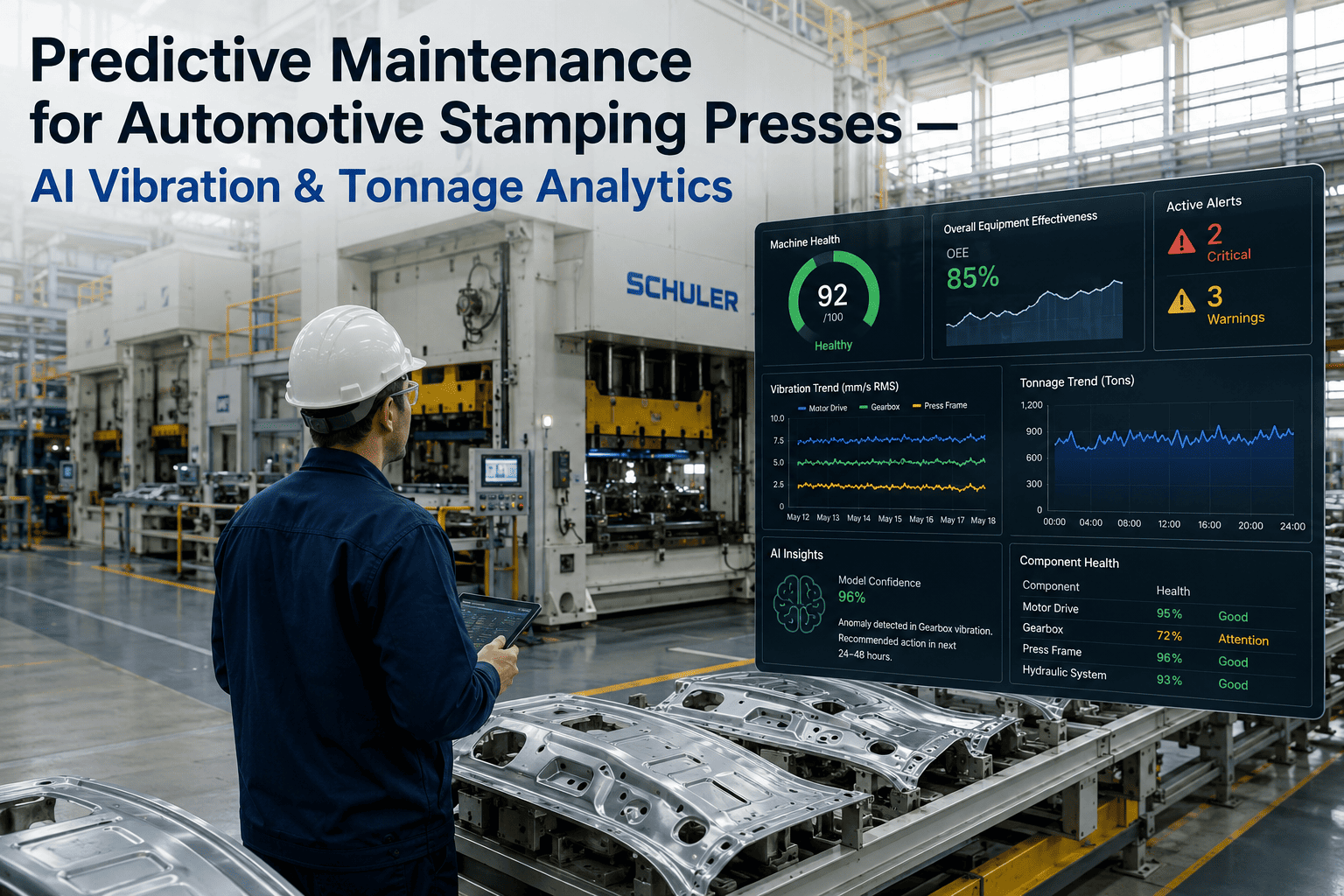
Most stamping plants can tell you their press line's OEE number for last month, and almost none can tell you, without a multi-day manual data pull, exactly which stops last Tuesday afternoon dragged that number down. OEE tracked manually or through end-of-shift paper logs is always retrospective and always incomplete, since stop reasons get logged from memory hours after the fact and short stops under a few minutes often don't get recorded at all. That gap between the real-time reality on the floor and the number in the monthly report is where a huge share of recoverable press line capacity quietly disappears. iFactory's press line OEE platform is built to close that gap automatically.
Press Line OEE Monitoring
Stop Reconstructing OEE From Memory and Paper Logs
Manual OEE tracking misses short stops and relies on end-of-shift memory. See how automated stroke counting and stop-reason capture gives you the real number.
The Three Factors Behind Every OEE Number
OEE breaks down into three multiplied factors, and a press line's real bottleneck is almost always concentrated in one of them far more than the others — but that concentration is invisible without automated, granular tracking underneath the headline percentage.
Availability
Actual run time versus planned production time, driven by stops, changeovers, and die setup
×
Performance
Actual stroke rate versus the press's rated speed, driven by micro-stops and speed reductions
×
Quality
Good parts versus total parts produced, driven by scrap and rework rate
What Manual OEE Tracking Consistently Misses
Short Stops Under-Reported
Stops under a few minutes rarely get logged individually, even though they can add up to a large share of lost time.
Stop Reason Guesswork
Reasons logged hours later from memory are frequently generic or inaccurate compared to what actually happened.
No Real-Time Visibility
Supervisors find out about a bad shift the next morning instead of catching a developing pattern in the moment.
Inconsistent Definitions
Different shifts or lines sometimes apply different rules for what counts as downtime, making comparisons unreliable.
From Stroke Counter to Stop-Reason Analytics
1
Count Automatically
Stroke counts and cycle times captured directly from press controls, no manual tally
2
Detect Every Stop
Short and long stops both captured automatically, including ones too brief to log manually
3
Classify Reasons
AI correlates stop patterns with equipment signals to suggest likely stop reasons in real time
4
Surface the Bottleneck
Dashboard ranks the biggest OEE losses by factor and stop reason, updated continuously
Want to see what automated stop-reason tracking would reveal on your press line? Talk to our team about an OEE assessment.
Manual vs. Automated OEE Tracking
| Aspect | Manual / Paper Log | Automated Monitoring |
|---|
| Short stop capture | Often missed entirely | Every stop captured, no minimum threshold |
| Stop reason accuracy | Relies on memory, hours later | Correlated with real equipment signals |
| Visibility timing | Next-day or weekly reporting | Real time, updated continuously |
| Cross-shift consistency | Varies by who's logging it | Consistent definitions applied automatically |
What Automated OEE Monitoring Delivers
Complete
Capture of every stop, including short ones manual logs miss
Accurate
Stop-reason data tied to actual equipment behavior, not memory
Faster
Response to developing bottlenecks within a shift, not after it ends
Who Uses Press Line OEE Data
01
Line Supervisors
Monitor real-time OEE within a shift to catch developing issues before they affect the whole shift's output.
02
Continuous Improvement Teams
Prioritize kaizen targets using ranked, accurate stop-reason data instead of anecdotal reports.
03
Maintenance
Uses stop pattern data to distinguish equipment-driven downtime from process or material-driven stops.
04
Plant Leadership
Tracks true press line capacity utilization for production planning and capital investment decisions.
Frequently Asked Questions
How much OEE improvement is realistic once tracking becomes automated?
The improvement comes less from the tracking itself and more from what teams do with the newly visible data, so the honest expectation is that automated tracking reveals the real opportunity size first, and the gains follow from acting on what it shows. Plants that previously relied on manual logs often find the real loss picture is larger and differently distributed than their prior reports suggested.
Our team can help benchmark what's typical for your press type.
Does this require new hardware on every press?
Many modern press controls already generate the stroke and stop signal data needed, so integration is often a matter of connecting to existing controls rather than adding entirely new sensors, though older presses may need additional instrumentation depending on their control system.
How does the system determine a stop reason automatically?
AI correlates the timing and signal pattern of a stop against known equipment states — a die change, a material jam, an operator-initiated pause — and suggests the most likely reason, which supervisors can confirm or correct, gradually improving classification accuracy over time.
Can this compare OEE consistently across multiple press lines?
Yes, and this is one of the most valuable applications, since automated tracking applies the same stop and availability definitions consistently across every line, removing the inconsistency that often comes from different shifts or supervisors applying manual logging rules differently.
Where should a plant start with automated OEE monitoring?
Start with the press line where OEE feels lowest but the manual data can't explain why, since that's usually where automated stop-reason tracking reveals the most previously invisible loss.
Book a demo to see how that starting point typically gets identified.
Stop Rebuilding OEE From Memory Every Morning.
Get Automated, Real-Time Press Line OEE Tracking
Bring your current OEE reporting process. We'll show you what automated stroke counting and stop-reason capture would reveal.