A traditional S&OP cycle runs on a fixed monthly cadence, aligning sales forecasts against manufacturing capacity roughly 12 to 18 months out. That cadence was designed for a world where demand and supply conditions shifted gradually enough that a monthly checkpoint was fast enough to catch problems before they became expensive. Automotive supply chains in 2026 don't offer that luxury — a tariff change, a single-source component failure, or a sudden regional demand shift can invalidate an S&OP plan within days of the meeting that approved it, and the next scheduled opportunity to formally revisit the plan is four weeks away. AI doesn't change the S&OP cadence itself so much as it changes what a planner can accomplish inside every stage of that cadence — running the five or ten scenarios there was never time to build manually, and surfacing the exception that would have taken a full planning cycle to notice. The result isn't a faster meeting; it's a meeting where the room actually has options to choose between instead of one plan to defend. See how iFactory compresses the analysis inside every stage of your S&OP cycle so the plan stays current between meetings, not just at them.
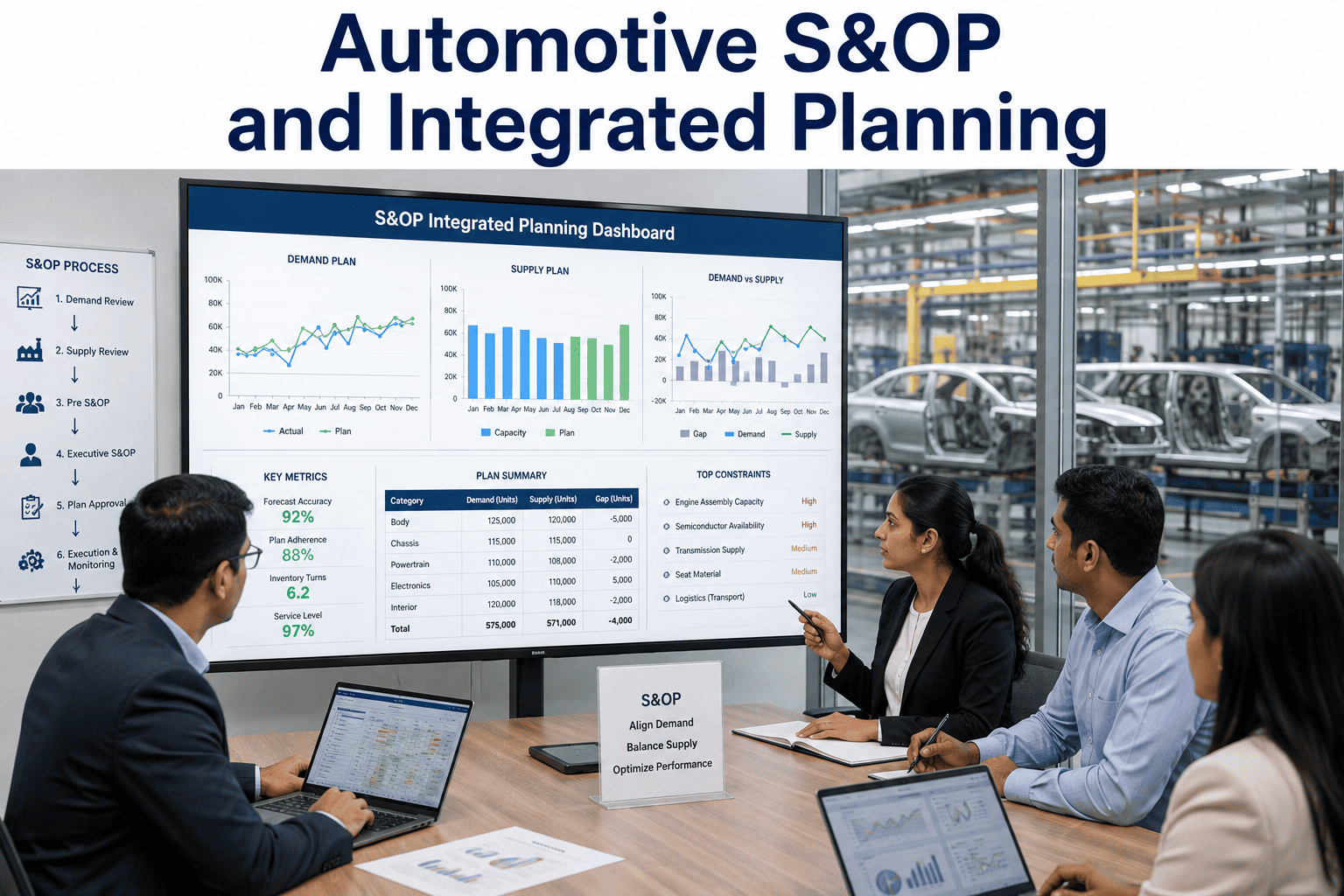
Automotive S&OP and Integrated Planning
The monthly S&OP cadence isn't the bottleneck — the manual analysis inside each stage is. AI compresses scenario building, exception detection, and cross-functional alignment so the cycle keeps pace with a market that changes faster than the calendar it runs on.
It's Not the Calendar. It's What Fits Inside It.
An S&OP Lead doesn't control how often the executive review happens — that cadence is set by the organization, typically monthly, and changing it is a governance decision above the planning function's authority. What an S&OP Lead does control is how much genuine analysis gets done inside each stage before the next deadline arrives, and that's where most planning teams are structurally under-resourced relative to what the market now demands of them.
A planner building scenarios by hand in a spreadsheet can realistically construct and defend two, maybe three, alternative demand-supply scenarios before a pre-S&OP deadline — a base case, an upside, and if there's time, a downside. Modern AI-assisted planning tools let a team compare five to ten scenarios side by side within minutes, each showing projected revenue, margin, capacity utilization, and service-level impact simultaneously. The cadence stays the same. What happens inside it changes completely.
This distinction matters because most conversations about accelerating S&OP focus on the wrong lever. Compressing the cadence itself — moving from monthly to bi-weekly reviews, for instance — adds meeting overhead without necessarily improving decision quality, and it fights against governance structures that exist for legitimate reasons across sales, finance, and operations. Compressing the analysis inside each existing stage delivers the same practical benefit — more current, more thoroughly examined plans — without requiring anyone to renegotiate how often the organization meets.
Stage by Stage, What AI Changes About the Work
Each stage of the standard S&OP cycle has its own manual bottleneck today, and the AI compression applied to each one is specific to that bottleneck rather than a single generic "add AI" intervention layered on top of the existing process.
| Cycle Stage | Manual Process Today | What AI Compresses |
|---|---|---|
| Demand Review | Manual forecast reconciliation across sales, dealer, and market data sources | Automated pattern recognition and demand sensing that flags divergence between forecast and actual sell-through continuously, not just at month-end |
| Supply Review | Manually checking capacity and supplier constraints against the latest demand signal | Real-time capacity and constraint modeling that updates automatically as supplier or plant conditions change mid-cycle |
| Pre-S&OP | Building 2–3 scenarios manually, each requiring hours of spreadsheet work to construct and validate | 5–10 scenarios generated and compared simultaneously, each scored against contribution margin and service-level targets |
| Executive S&OP | Presenting a single recommended plan with limited ability to answer "what if" questions live in the room | Live sensitivity analysis during the meeting itself — testing an executive's what-if question in real time instead of tabling it for next cycle |
The pattern across all four stages is consistent: AI doesn't eliminate the planner's judgment, it removes the mechanical bottleneck that previously prevented that judgment from being applied to more than a couple of options. A planner still decides which scenario recommendation makes sense given context the model doesn't have — a known customer relationship issue, an upcoming labor negotiation, a regulatory change on the horizon — but that judgment is now applied against a richer set of well-scored alternatives rather than the one or two the deadline allowed time to build.
Notice what the recommended scenario in this comparison actually represents — not necessarily the single highest-revenue option, but the one that best balances growth capture against service-level risk given the plant's actual capacity ceiling. This is the kind of trade-off a planning team evaluating only two manually built scenarios rarely gets to see clearly, because building even one additional blended scenario that combines elements of two others is exactly the kind of extra analysis that a tight deadline forces teams to skip. Seeing five or more fully scored options side by side, including a blended option nobody would have had time to construct manually, is where the real decision-quality improvement shows up.
A Plan Built on Two Scenarios Is a Guess With Extra Steps
iFactory generates and compares multiple demand-supply scenarios automatically, ahead of every pre-S&OP cycle, so the room is deciding between real options instead of defending the only plan anyone had time to build.
Four KPIs That Tell an S&OP Lead Whether the Process Is Actually Holding
Completing every scheduled S&OP meeting on time is not the same as running an S&OP process that's actually working — a cycle can hit every deadline on the calendar while quietly drifting out of sync with real demand and supply conditions. These four KPIs, tracked consistently cycle over cycle, are what actually reveals the difference.
Climbing forecast accuracy alongside falling premium freight spend is one of the more reliable combined signals that an S&OP cycle is genuinely holding, rather than just completing its meetings on schedule while quietly losing touch with what's actually happening on the floor and in the supply base.
Compressing Your Cycle Without Changing the Calendar
These four steps focus on expanding what fits inside the existing S&OP cadence rather than proposing a governance change to the cadence itself, which is typically outside the planning function's direct authority to alter.
I've sat through more pre-S&OP meetings than I can count where someone asks "what if demand comes in 15 percent higher in this region" and the honest answer is that nobody built that scenario, because there simply wasn't time before the deadline. That question doesn't go away — it just gets tabled until next cycle, by which point it's often too late to act on the answer even if someone eventually runs the numbers. The value of AI-assisted scenario planning isn't that it makes the meeting faster. It's that the question actually gets answered in the room, the same day it's asked, instead of becoming next month's homework — and by the time next month arrives, the market has usually already moved on to a different question entirely.
Frequently Asked Questions
Answer the What-If Question in the Room, Not Next Cycle
iFactory compresses scenario building, demand sensing, and exception detection inside every stage of your existing S&OP cadence — so the plan stays current between meetings and the executive review can actually explore alternatives instead of defending the only option anyone had time to build.