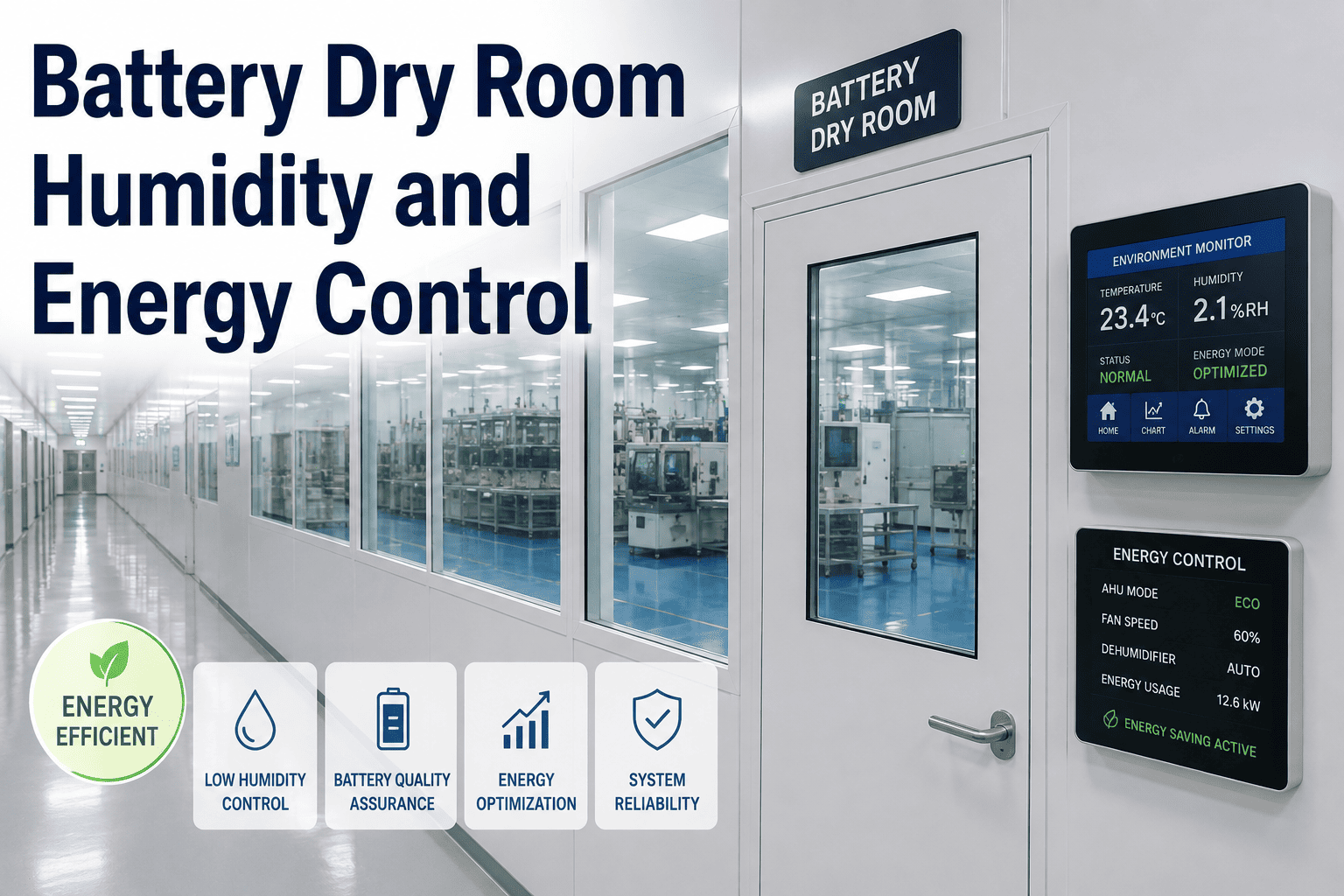
Dry room HVAC and dehumidification alone can consume close to a third to over 40 percent of a gigafactory's total energy bill, and that number climbs fast once a facility pushes dew points below minus 40°C for next-generation cell chemistries. Every additional ten degrees of dryness demands disproportionately more desiccant regeneration energy, which means a dry room that is technically compliant can still be quietly draining the plant's margin. Most facilities design for a single worst-case dew point and run the entire room at that setting around the clock, even when only the electrolyte fill zone actually needs it. The result is a facility that is safe for the battery chemistry but wasteful for the balance sheet, and the two goals do not have to be in conflict. iFactory's dry room intelligence platform is built to hold humidity where cell quality needs it while cutting the energy nobody was watching.
Balancing Ultra-Low Humidity With Energy Reality in the Gigafactory
Dry rooms are the most energy-intensive real estate in a battery plant. See how zone-level AI control holds dew point where it matters and releases energy everywhere else.
Why the Dry Room Became the Energy Problem Nobody Budgeted For
Lithium is aggressively reactive to moisture, so cell assembly, electrode handling, and electrolyte fill all have to happen inside rooms held far below the dew point of any normal industrial space. That requirement was accepted as a fixed cost of battery manufacturing for years, until plant finance teams started asking why one room was quietly consuming more electricity than the rest of the factory combined.
The Dew Point Cost Curve Nobody Sees Until the Utility Bill Arrives
The relationship between dew point and energy is not linear — it is closer to exponential. Pushing a room from minus 40°C to minus 60°C does not cost 50 percent more energy, it can cost several times more, because desiccant regeneration cycles have to run harder and more continuously as the target moisture level approaches zero. Rooms designed around a single blanket setpoint pay this cost everywhere, even in zones like formation or module assembly where the chemistry is already sealed and far less moisture-sensitive.
Relative desiccant regeneration energy demand by target dew point. The gap between minus 45°C and minus 80°C is where most avoidable energy spend hides.
Where Zone-Level Control Changes the Math
A dry room does not need to be one uniform environment. Cell assembly, calendering, and module handling can often tolerate several degrees of dew point headroom compared to electrolyte fill, yet most facilities run every zone at the strictest number in the building out of caution. AI-driven zone control changes that by treating the dry room as a set of independently managed micro-environments instead of one shared setpoint.
Dry Room Requirements by Process Stage
Every process stage carries a different real moisture sensitivity, and the table below reflects the general pattern most gigafactories design around before zone-level optimization narrows it further based on actual production data.
| Process Stage | Typical Dew Point Target | Moisture Sensitivity |
|---|---|---|
| Electrode coating and calendering | -35°C to -40°C | Moderate |
| Cell stacking and winding | -40°C to -50°C | High |
| Electrolyte fill | -60°C to -80°C | Critical |
| Formation and module build | -30°C or ambient controlled | Low to moderate |
Curious what your own dry room's zone-by-zone energy split actually looks like? Talk to our team about a facility energy assessment.
What Changes When Humidity Control Gets Predictive
Reactive humidity control waits for a dew point excursion and then corrects it, which means the dehumidification system is almost always working harder than it needs to. Predictive control instead anticipates moisture load from door openings, personnel movement, material introduction, and outside air conditions before the excursion happens, which keeps the desiccant system running in its efficient operating band rather than constantly overcorrecting.
Who Needs to Sign Off on Dry Room Optimization
Dry room control sits at the intersection of process engineering, facilities, and sustainability reporting, which means a change to how humidity is managed usually needs more than one stakeholder comfortable with the plan before it moves forward.
Mistakes That Undermine a Dry Room Optimization Effort
Most dry room energy projects stall for the same handful of reasons, and almost none of them are technology failures — they are planning and measurement gaps that show up only after the project is already underway.
Frequently Asked Questions
See What Zone-Level Dry Room Control Could Save Your Plant
Bring your current dry room layout and energy bill. We'll show where blanket setpoints are costing you and what a zone-by-zone control model could recover.