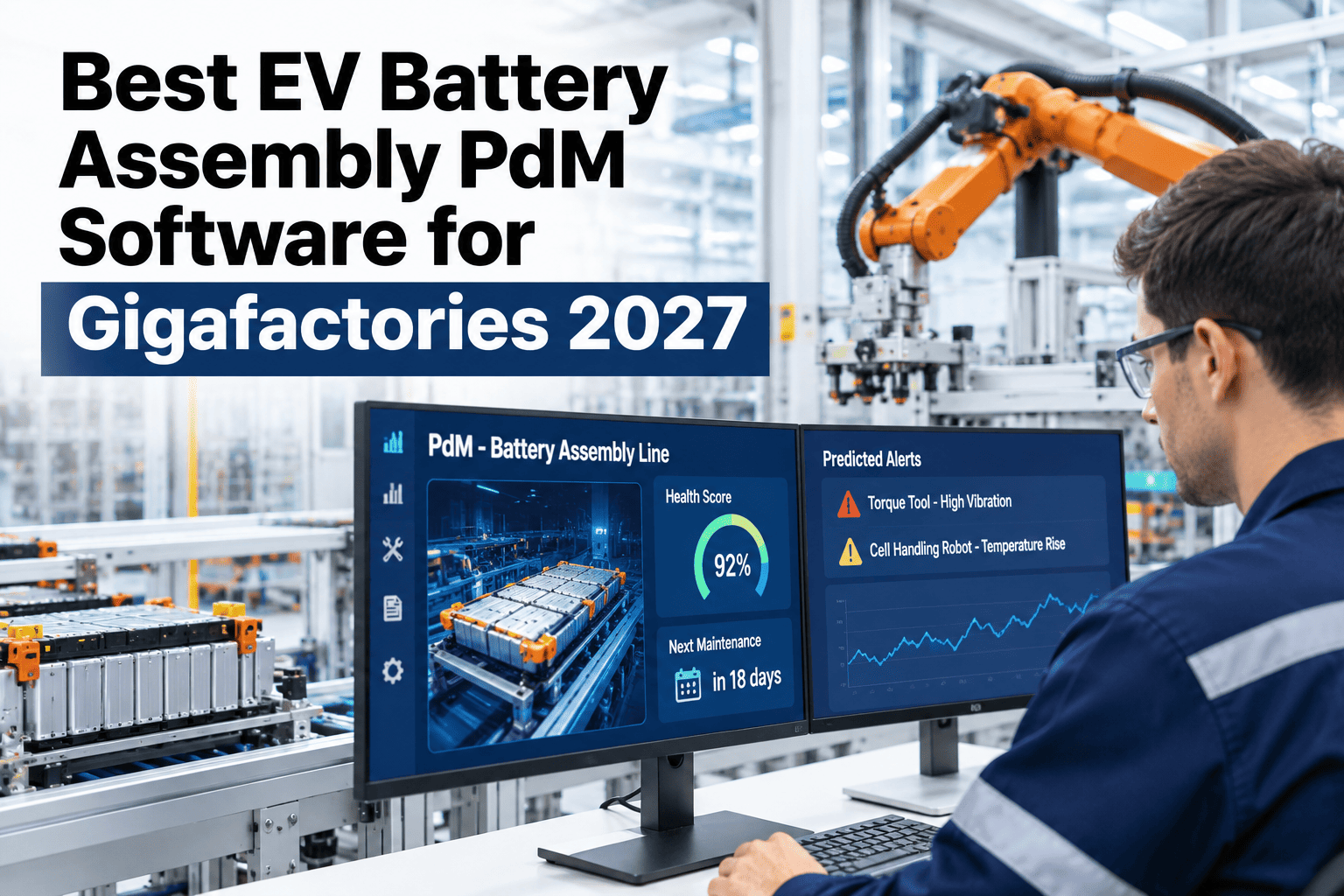
A gigafactory's battery assembly line runs six or more distinct equipment types back to back — welding, cell handling, torque tools, cooling systems, conveyors and testers — and a predictive maintenance program that only covers one or two of them leaves the rest to find out about failures the hard way. Comparing PdM software for 2027 means checking whether a platform actually covers the full equipment mix your line runs, not just the easiest machine to monitor. Gigafactory operations teams can review equipment coverage against their own assembly line with iFactory AI.
Six Equipment Types on One Line — Does Your PdM Platform Cover All of Them?
iFactory AI monitors welding, cell handling, torque tools, cooling, conveyors and testers in one live view, so no equipment type is the blind spot in your reliability program.
Six Equipment Types a Gigafactory Line Actually Runs
Each equipment type fails in its own specific way, with its own leading indicators. A platform built around one failure mode — vibration for rotating equipment, for example — often misses what matters for a completely different equipment type on the same line.
What Full Coverage Actually Looks Like
| Equipment | Partial coverage risk | Full coverage benefit |
|---|---|---|
| Welding | Weld quality drift goes unnoticed until defects appear downstream | Electrode condition tracked before quality is affected |
| Cell handling | Gripper wear risks damaging sensitive cells | Drift caught before a cell is mishandled |
| Cooling | A safety-critical system monitored only reactively | Stability tracked continuously given the safety stakes |
See Which Equipment Types Your Current Setup Actually Covers
Walk through your assembly line's equipment mix against this coverage checklist in a short session.
A Composite Scenario: The Equipment Type Nobody Was Watching
A gigafactory's PdM program had grown organically, starting with conveyor monitoring and later adding torque tool tracking, but cell-handling robots were never brought into the same system since they seemed less failure-prone at first. A gripper wear issue developed gradually on one handling robot and went undetected until it began mishandling cells, a risk the rest of the PdM program had no visibility into because that equipment type had simply never been added. Bringing cell handling into the same unified monitoring as the rest of the line closed that specific blind spot — a gap iFactory AI's team can help check for in your own current coverage.
Why Live Monitoring Matters Especially for Cooling Systems
Battery cooling stability is directly tied to safety, which makes reactive monitoring — checking only after a problem surfaces — a meaningfully higher-risk approach than for less safety-critical equipment. Live, continuous monitoring of flow and temperature stability is what lets a drift be caught and corrected before it becomes a safety concern rather than after.
Frequently Asked Questions
Cover Every Equipment Type on Your Line, Not Just the Easy Ones
iFactory AI monitors welding, cell handling, torque, cooling, conveyors and testers in one unified view. Book a walkthrough with your own line.