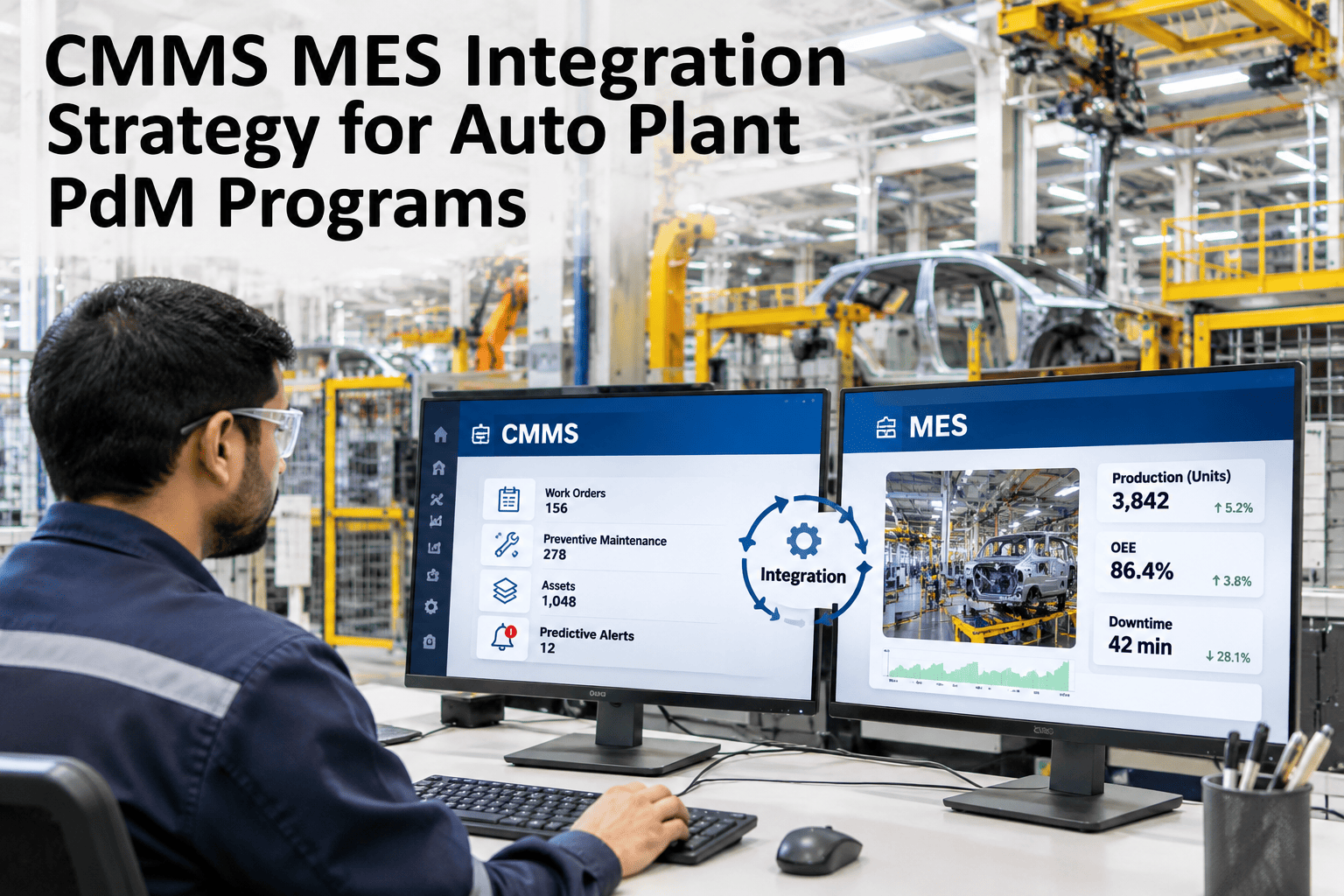
CMMS and MES systems in most automotive plants were bought years apart, from different vendors, by teams with different ideas about what to call the same robot cell. That mismatch is why a predictive maintenance alert can fire correctly and still fail to produce a work order, because the asset ID the PdM model used never matched the one the CMMS expects. iFactory AI, an on-premise AI platform for manufacturing operations, closes that gap through asset ID reconciliation, work-order-to-event linkage and bidirectional sync, and plant IT teams can map their own CMMS-MES handshake with our integration architects before the next PdM rollout.
A PdM Alert That Can't Reach a Work Order Is Just a Notification
iFactory AI reconciles asset identities, links work orders to the events that triggered them, and keeps CMMS and MES status in sync both directions, so a predictive alert becomes a scheduled, parts-staged repair automatically.
Why the Handshake Usually Breaks First
Production rates in MES language speak in cycles, yields and downtime codes. Maintenance in CMMS language speaks in asset classes, PM schedules and spare-part consumption. Both systems may describe the same stamping press, but under different IDs, different naming conventions and different hierarchy levels, so a downtime code fired by MES has nowhere obvious to land in CMMS. A 2026 industry review of automotive MES/MOM deployments found that most plants run the two systems from different vendors with limited native integration, and closing that gap does not require replacing either platform — it requires a unified identity layer between them.
MES groups by line and cell; CMMS groups by equipment class and parent-child hierarchy.
A press called "ST-14" in MES may be "Press 14-B" in CMMS, with nothing linking them.
Many integrations only push MES events to CMMS, never return completion status.
Reports are hand-matched weekly, and the two downtime totals never quite agree.
Three Flows Worth Connecting First
Not every possible data flow between MES and CMMS carries equal value, and automotive plants that start with the highest-ROI connections see results before the project stalls on scope. Our integration team can prioritize these for your specific MES during a scoping call.
An MES downtime code tagged to a reconciled asset ID auto-generates a CMMS work order in seconds, pre-populated with operator notes and shift context.
A closed CMMS work order flips the asset status back to available in MES, releasing blocked production capacity without a manual status update.
Failure codes, repair outcomes and OEE context accumulate against one asset identity instead of two disconnected records.
Integration Patterns Compared
| Pattern | Latency | Setup Effort | Best Fit |
|---|---|---|---|
| Webhook bridge | Near real-time | Low to moderate | Plants with modern MES API access |
| Middleware / integration hub | Real-time | Moderate | Multi-system estates (MES, SCADA, ERP, CMMS) |
| Batch file exchange | Hourly to daily | Low | Legacy MES with no open API |
Get a Quantified Payback Model for Your Plant
Share your asset count and MES platform, and our integration architects will size the downtime-hours-avoided case before you scope the project.
A Five-Phase Rollout That Avoids the Usual Stall
Align MES and CMMS asset trees before any data flow is built.
Agree on a shared taxonomy so a code means the same thing in both systems.
Start with downtime-to-work-order, the flow with the clearest ROI baseline.
Close the loop so work-order completion updates MES asset availability.
Layer in cost reconciliation and condition-based triggers once the core handshake is proven.
Five Common Integration Mistakes
Mismatched asset identity guarantees downstream data quality failures.
Without a return path, MES never learns when an asset is actually repaired.
Asset lists drift apart again within a few years without a maintained owner.
Plant-wide rollout without a proven pilot multiplies small mapping errors.
The Protocol Layer Underneath Every Integration
Asset ID reconciliation gets the attention, but it sits on top of a communication layer that has to move data reliably between systems that were never designed to talk to each other. Most automotive plants already have more of this layer than they realize, built for SCADA and ERP connections, and the integration project's job is to route CMMS and MES traffic through it rather than inventing a new pipe for every connection.
A Realistic Rollout Timeline
Plants that try to connect every system at once tend to stall on the hardest integration first. Sequencing the work by value and difficulty keeps momentum visible to stakeholders who are watching for an early result.
What Changes for the SAP-Anchored Plant
Plants running SAP for maintenance or production face a specific version of this problem, since SAP's own asset identity model may not match either the MES or the shop-floor naming convention in use. The reconciliation step still applies, it just has a third identity system to align, and plants already on SAP Plant Maintenance often find the ERP's asset master is the best anchor to reconcile the other two systems against, rather than building a fourth independent identity layer.
Where iFactory AI Fits
iFactory AI runs the asset ID reconciliation, downtime-code standardization and bidirectional sync on-premise, connecting to MES, SCADA and ERP through standard protocols without custom development for each handshake.
OPC-UA, MQTT and REST connections without replacing existing systems.
A predictive alert, an MES event and a work order all point to the same asset record.
Work-order completion flows back to MES automatically, not just one direction.
Frequently Asked Questions
Almost always because the asset ID the PdM model uses does not match the identity CMMS expects, so the alert has nowhere valid to route. Check your asset ID alignment in a short review.
Downtime-to-work-order carries the clearest ROI baseline for most automotive plants, since it eliminates the manual step that currently costs the most technician time. Ask which flow fits your MES platform first.
No. A unified identity and integration layer connects existing systems without requiring either platform to be replaced, which is the pattern most automotive plants are following in 2026. See how this works with your current stack.
Asset reconciliation and the first high-value flow are usually live within eight to fourteen weeks, depending on how many asset classes need identity cleanup before data can flow reliably. Get a timeline estimate for your plant.
Without a named data owner and a controlled change process, asset lists commonly drift within a few years as equipment is added or replaced, requiring a reconciliation project to repeat. Discuss an ownership model that keeps the identity layer current.
Make a Predictive Alert Become a Scheduled Repair
iFactory AI reconciles asset identities and keeps CMMS and MES in sync both directions, so PdM programs close the loop instead of generating ignored alerts.