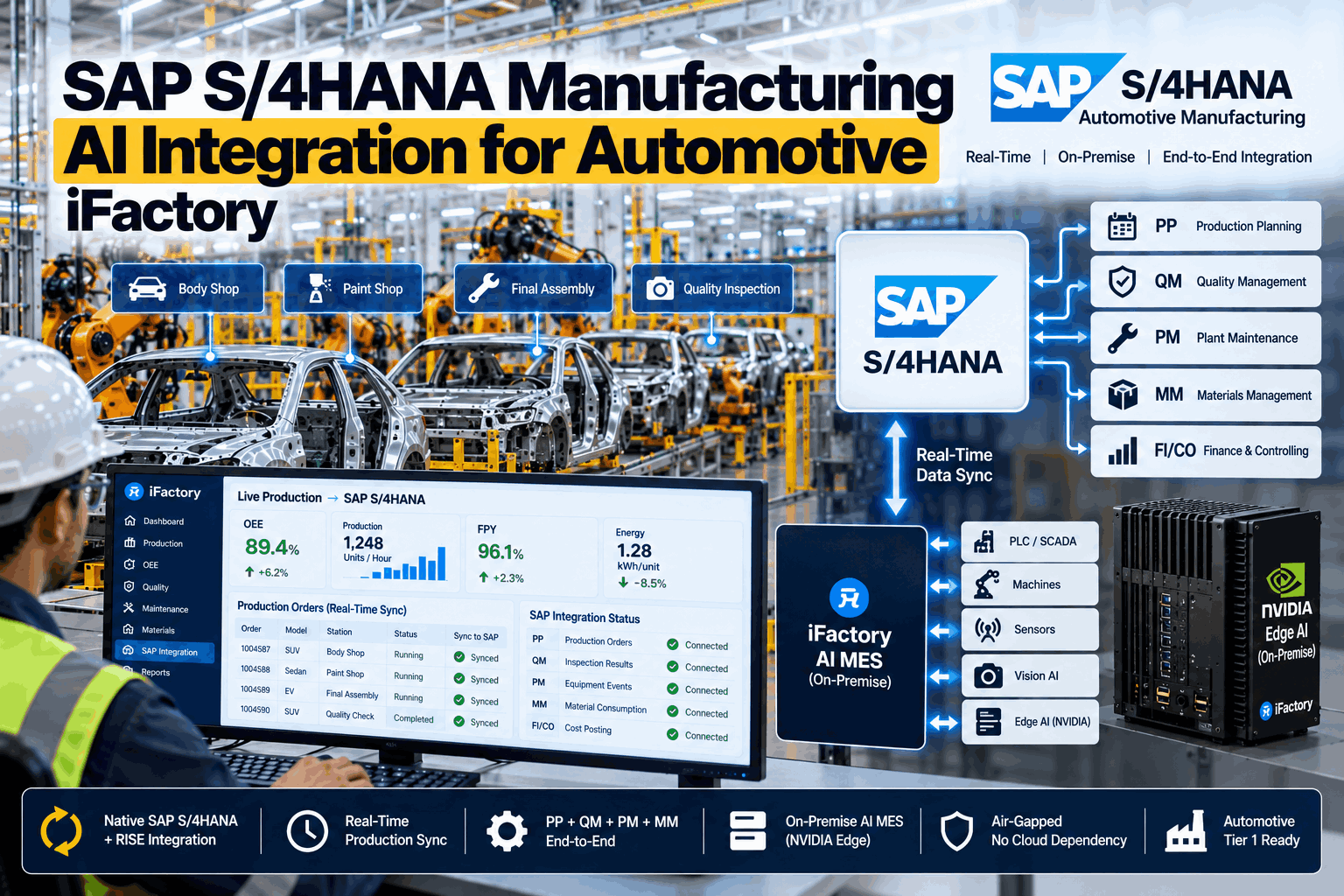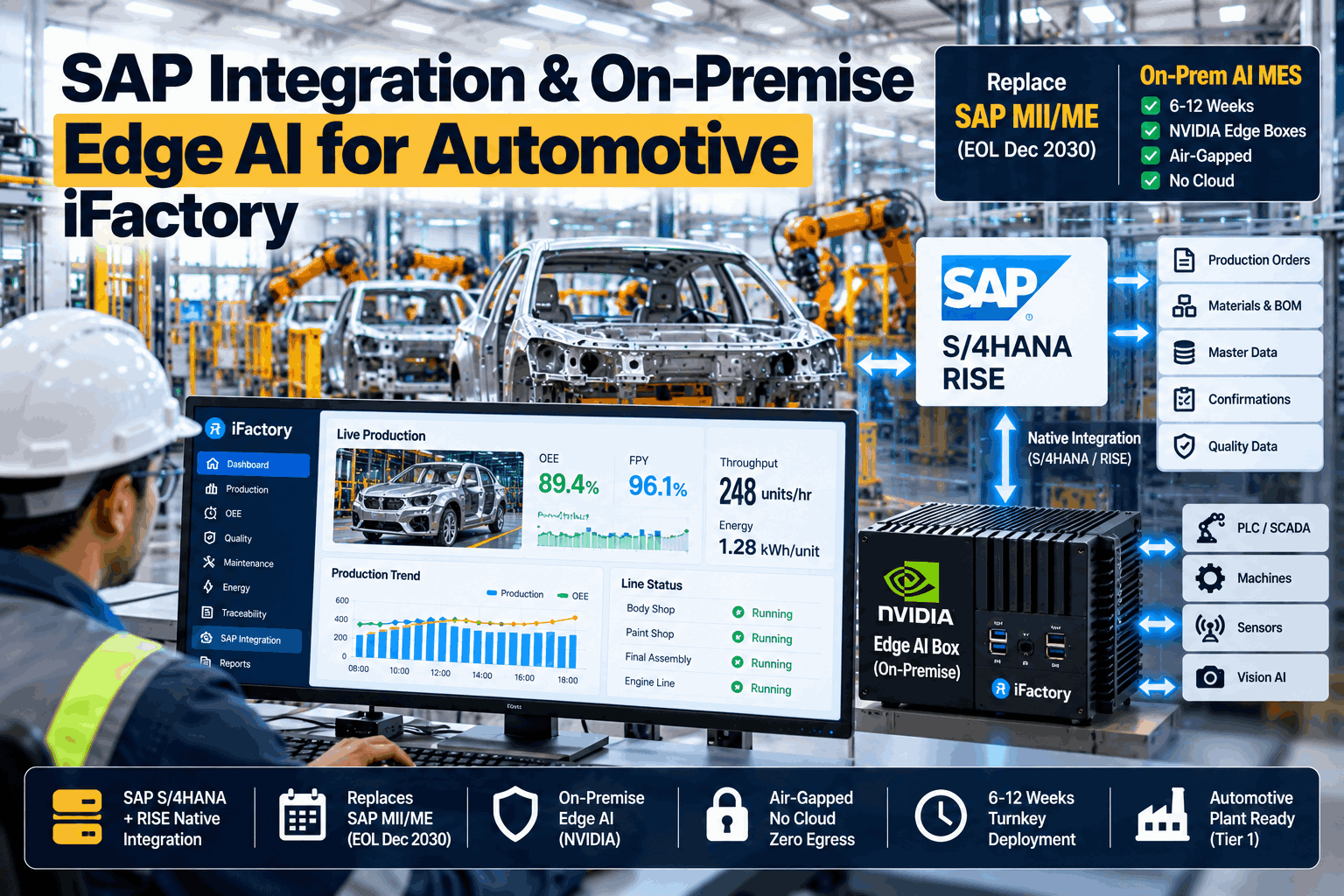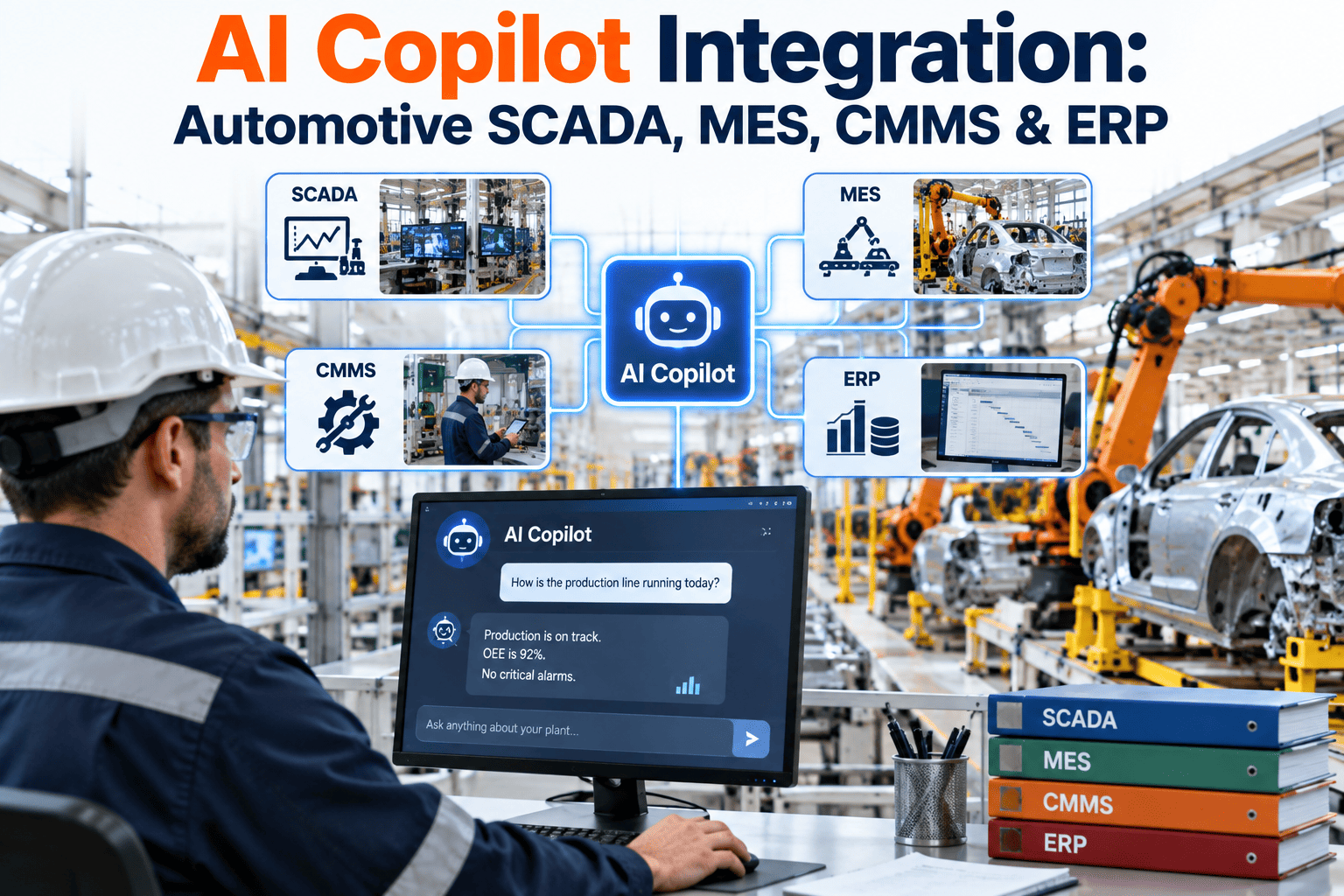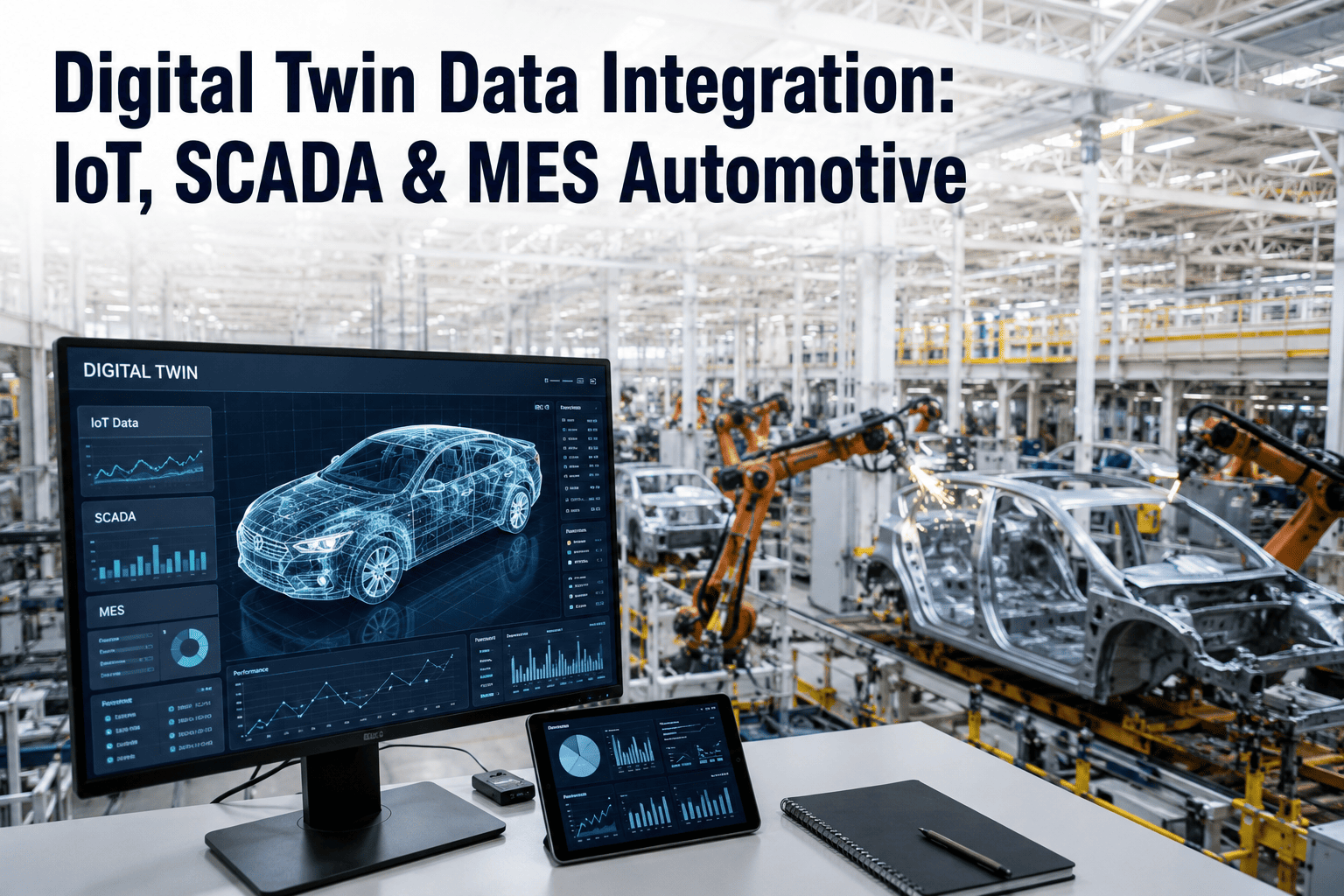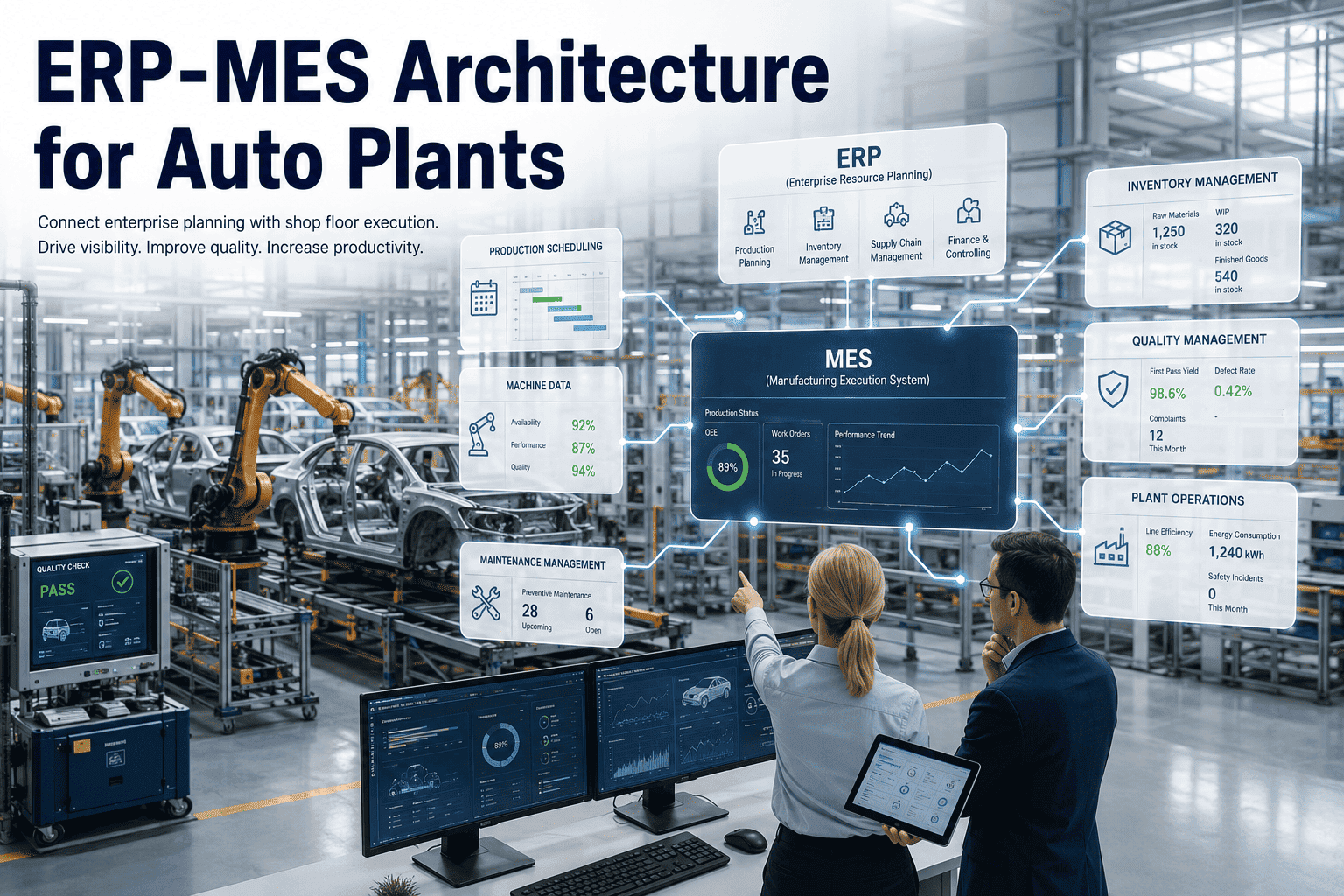
Automotive manufacturing plants operate at the intersection of legacy ERP systems, real-time MES platforms, and rapidly emerging AI workloads. The challenge is no longer about choosing between SAP or MES—it is about architecting a cohesive data fabric that connects SAP S/4HANA, the manufacturing execution system, and predictive AI layers without creating a brittle web of point-to-point integrations. In 2026, leading auto OEMs are abandoning spaghetti architectures in favor of event-driven, API-first meshes that enable real-time visibility from the shop floor to the top floor. This blueprint provides a technically rigorous, vendor-agnostic framework for integration leads and enterprise architects tasked with modernizing automotive IT landscapes. Whether your plant runs SAP ECC, MES from Siemens or Rockwell, or custom AI models, the principles outlined here ensure scalability, low latency, and audit-ready data lineage. Book a Demo to explore how iFactory's integration layer accelerates this transition.
Architect the Unified Plant
Eliminate spaghetti integration. Achieve real-time SAP-MES-AI synchronization with zero data loss. Your blueprint starts here.
The Integration Trilemma: ERP, MES, and AI
Automotive plants operate three distinct systems that must interoperate under stringent quality and cycle-time constraints. SAP S/4HANA manages financials, procurement, and order management. The MES tracks real-time production execution, genealogy, and equipment states. AI layers consume both streams to predict maintenance, optimize scheduling, and detect anomalies. The trilemma emerges because each system has different latency requirements, data models, and ownership domains. Traditional integration approaches—batch file transfers, middleware queues, or direct database links—create tight coupling that breaks when any component upgrades. A modern architecture must decouple these systems while preserving transactional integrity and millisecond-level synchronization for critical events like line stoppages or quality alerts.
The solution lies in an event backbone that publishes standardized production events from MES, which SAP and AI consume independently. SAP subscribes to events for inventory postings, order confirmations, and cost updates. AI models subscribe to the same events for real-time anomaly detection. This pattern eliminates point-to-point interfaces and reduces integration complexity from O(n^2) to O(n). For automotive plants with multiple lines and legacy systems, this event-driven architecture scales horizontally without requiring changes to existing SAP or MES configurations.
SAP S/4HANA Integration Points
- Order-to-production synchronization
- Material consumption and backflushing
- Quality inspection results and certificates
- Time and attendance data for labor costing
- Inventory postings from warehouse systems
MES Integration Capabilities
- Real-time equipment status and OEE data
- Production tracking with serialized genealogy
- Work order execution and operator instructions
- Non-conformance and rework management
- Energy consumption per unit produced
AI Layer Integration Needs
- High-frequency sensor data streams
- Historical maintenance records from SAP PM
- Real-time production events for anomaly detection
- Quality test results for predictive quality models
- Supply chain signals for dynamic scheduling
Step-by-Step Architecture Implementation
Assess Current State & Define Event Taxonomy
Map all existing integrations between SAP, MES, and any AI components. Identify which data flows are real-time critical and which can tolerate batch latency. Define a common event taxonomy aligned with ISA-95 and automotive standards like VDA 5050. Typical events include 'ProductionOrderStarted', 'MaterialConsumed', 'QualityTestCompleted', 'EquipmentFaultDetected'. Each event carries a standardized payload with timestamps, plant identifiers, and trace IDs.
Deploy Event Broker & Establish Governance
Choose a scalable event broker such as Apache Kafka, Confluent, or AWS MSK. Configure topics for each event type with retention policies that support replay for AI training. Define governance rules for schema evolution, access control, and data retention. Automotive plants must comply with ISO 26262 for safety-related events, so partition events by criticality. Establish a registry of event producers and consumers with versioning.
Implement SAP Adapter & MES Connector
For SAP, use the SAP Integration Suite or custom ABAP modules to publish events to the broker. For MES, develop a lightweight connector that reads from MES database triggers or API webhooks. Both adapters must handle exactly-once semantics and provide dead-letter queues for failed events. Automotive plants with legacy MES may require a transformation layer to map proprietary data formats to the common taxonomy.
Integrate AI Model Serving Layer
Deploy AI models as microservices that subscribe to relevant event topics. For example, a predictive maintenance model subscribes to 'EquipmentFaultDetected' and 'SensorReading' topics, then publishes maintenance recommendations back to the broker. Use feature stores to serve historical data for training without impacting operational flows. Ensure model inference latency remains under 100ms for real-time use cases.
Monitor, Test, and Optimize
Implement end-to-end monitoring using distributed tracing (e.g., OpenTelemetry) to track event propagation delays. Set up synthetic tests that simulate production events and measure SAP and AI response times. Optimize topic partitioning and consumer group configurations to handle peak events during model changeovers. Regular chaos engineering exercises ensure the architecture withstands component failures.
Integration Pattern Comparison for Automotive Plants
| Pattern | Latency | Scalability | Complexity | Best For |
|---|---|---|---|---|
| Batch File Transfer | Minutes to hours | Low | Low | Non-critical financial reporting |
| Direct Database Links | Seconds | Medium | Medium | Legacy systems with stable schemas |
| API Gateway | Milliseconds | High | High | Real-time order and quality data |
| Event-Driven (Kafka) | Sub-millisecond | Very High | High | High-frequency production events |
| Hybrid (Event + API) | Milliseconds | Very High | Medium | Mixed workloads with varying criticality |
Ready to Unify Your Plant Data?
Move beyond spaghetti integration. Let iFactory's event-driven architecture connect SAP, MES, and AI in weeks, not years.
Data Governance and Security in Automotive Integration
Automotive plants handle sensitive data including production schedules, quality defects, and proprietary process parameters. Integrating ERP, MES, and AI introduces new attack surfaces and compliance requirements. Every event must carry a digital signature for non-repudiation, and access control lists must restrict which consumers can read specific topics. For example, AI models should not have access to financial data in SAP events unless explicitly authorized. Implement data masking for personally identifiable information in time and attendance events. Regular audits using tools like Apache Ranger ensure compliance with ISO 27001 and TISAX standards. The event broker itself must be deployed in a hardened environment with encryption at rest and in transit.
Beyond security, data lineage becomes critical for traceability. Each production event should include a unique correlation ID that links it back to the originating SAP order and MES work instruction. This enables full traceability from customer order to the specific machine and operator that produced the part. For recall scenarios, the architecture must support replaying events for a specific date range to reconstruct production conditions. Implement a data lake that stores raw events in Parquet format for long-term analytics and AI model retraining, with retention policies aligned to automotive warranty periods.
Common Pitfall #1: Tight Coupling
Direct SAP-to-MES integrations create dependency chains. When SAP upgrades, MES breaks. Event-driven patterns decouple systems, allowing independent upgrades without downtime.
Common Pitfall #2: Data Duplication
Storing the same data in both SAP and MES leads to reconciliation nightmares. Define a single source of truth per data domain and use events to synchronize.
Common Pitfall #3: Ignoring Latency
Batch transfers cause stale data in AI models. Real-time events ensure predictions are based on current machine states, improving accuracy by up to 40%.
Performance Optimization for High-Volume Plants
A typical automotive assembly line produces 60 vehicles per hour, generating thousands of events per minute from robots, conveyors, and quality stations. The event broker must handle peak loads during model changeovers or shift starts, where event volume can spike 10x. Use topic partitioning by production line to parallelize consumption. Each partition maps to a specific line, ensuring that events from the same line are processed in order. Consumer groups for SAP and AI should have independent offset management to avoid backpressure. For AI models that require high-frequency data, consider using a separate, low-latency stream (e.g., Apache Pulsar) for sensor data while routing business events through Kafka. Implement backpressure mechanisms that throttle non-critical events during peak loads to protect SAP from overload.
Monitoring key performance indicators is essential. Track event propagation latency from MES publish to SAP consume, aiming for sub-100ms for critical events. Set up alerting when latency exceeds 500ms, which may indicate network congestion or consumer lag. Use auto-scaling for consumer groups based on lag metrics. For AI inference, pre-warm model containers with the latest feature vectors to reduce cold-start latency. In extreme cases, deploy edge brokers on the plant floor to process events locally before forwarding aggregated data to the central broker, reducing WAN bandwidth and latency.
Frequently Asked Questions
How does event-driven integration handle SAP upgrade cycles?
Event-driven architecture decouples SAP from MES and AI, meaning SAP can be upgraded without impacting downstream systems. The SAP adapter publishes events using a standardized schema that remains stable across SAP versions. During upgrade, the adapter may need minor adjustments, but MES and AI consumers continue operating unchanged. This reduces upgrade risk and allows rolling upgrades without plant downtime. For more details, visit iFactory Support to see how we manage SAP compatibility.
What is the role of ISA-95 in ERP-MES integration for automotive?
ISA-95 provides a standard framework for defining the interface between enterprise systems (Level 4) and manufacturing operations (Level 3). In automotive plants, ISA-95 defines the structure of production orders, material flows, and performance data. By aligning your event taxonomy with ISA-95, you ensure interoperability with any MES or SAP system that follows the standard. This reduces custom mapping effort and future-proofs the architecture. Learn how iFactory implements ISA-95 by booking a demo.
Can legacy MES systems be integrated without replacement?
Yes, legacy MES systems can be integrated using a connector layer that polls the MES database or listens to its proprietary API. The connector transforms legacy data into standardized events and publishes them to the broker. This approach preserves the existing MES investment while enabling modern AI and SAP integration. However, legacy systems may have limited throughput, so consider adding a caching layer to buffer events during peak loads. For a detailed integration guide, contact iFactory Support.
How do you ensure data consistency across SAP, MES, and AI?
Data consistency is achieved through event sourcing and idempotent consumers. Each event carries a unique identifier and timestamp. SAP and AI consumers process events exactly once using idempotency keys. In case of failures, events are replayed from the broker's offset. For critical transactions like order confirmation, implement a two-phase commit pattern using the broker's transactional capabilities. Regular reconciliation jobs compare SAP and MES data and flag discrepancies. iFactory's platform includes built-in consistency checks—book a demo to see them in action.
What are the bandwidth requirements for real-time event streaming in a plant?
Bandwidth requirements depend on event frequency and payload size. A typical automotive plant with 500 machines generating 100 events per minute each, with average payload of 2KB, requires about 10 Mbps for the event stream. This is easily handled by standard plant networks. However, if sensor data is included, bandwidth can increase to 100 Mbps or more. Use data compression and edge aggregation to reduce bandwidth. For plants with limited WAN connectivity, deploy a local broker that syncs with the central broker periodically. For a bandwidth assessment tailored to your plant, contact iFactory Support.
Transform Your Plant Integration Today
Stop fighting point-to-point complexity. Adopt a future-proof event-driven architecture that scales with your production needs.