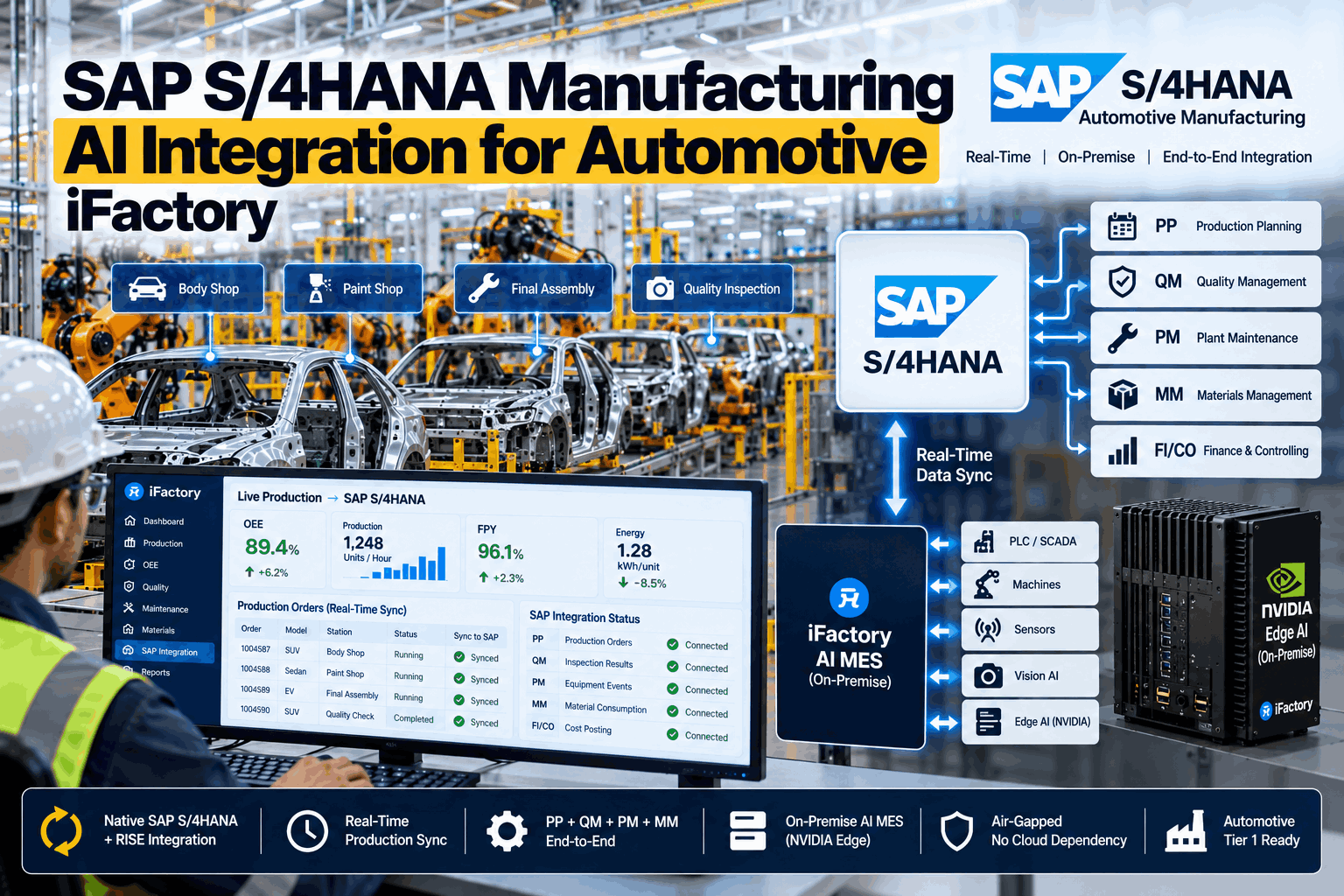
Ask five people at an automotive plant to define the difference between MES and MOM and expect five different answers, and that confusion is not academic since it shapes which system gets budget for the next upgrade. MES tracks work orders and genealogy on the shop floor while MOM sits a layer above, orchestrating scheduling, quality, and maintenance across the wider operation, and most plants end up with both systems half-implemented and poorly connected. AI does not replace either layer, it threads through both, pulling execution data from MES and orchestration context from MOM to make predictions neither system can make alone. You can book a demo to see how iFactory sits across both layers without disrupting either one.
MES/MOM INTELLIGENCE FOR AUTOMOTIVE PLANTS
AI Does Not Replace MES or MOM — It Reads Both and Acts Faster Than Either Can Alone
iFactory integrates with your existing MES and MOM stack, pulling shop-floor execution data and enterprise orchestration context into one predictive layer without requiring a rip-and-replace.
ERP
Orders, planning, finance
MOM
Scheduling, quality, maintenance orchestration
MES
Work orders, genealogy, shop floor execution
SCADA / PLC
Machine and sensor level control
MES VS MOM
Where MES Ends and MOM Begins in an Automotive Plant
The confusion between the two systems is understandable since MOM emerged as a superset concept that absorbed many functions people historically associated with MES. The table below draws the practical line most automotive plants use today.
| Function | MES Scope | MOM Scope |
|---|
| Work Order Execution | Primary owner | Consumes execution status |
| Genealogy and Traceability | Primary owner | Aggregates across lines |
| Production Scheduling | Executes the schedule | Primary owner |
| Quality Management | Captures inspection data | Primary owner |
| Maintenance Orchestration | Logs equipment events | Primary owner |
| Cross-Plant Reporting | Single-line scope | Primary owner |
THE INTEGRATION GAP
Why Most Plants Have Both Systems and Still Cannot Answer Simple Questions Fast
The gap is not that MES or MOM lack data. It is that the two systems were often implemented years apart, by different integrators, with data models that were never designed to talk to each other cleanly.
40%
Of plant engineering time spent reconciling MES and MOM data manually before it can be trusted for a decision
2-3 Days
Typical lag between a shop-floor event and its visibility in enterprise-level MOM reporting
60%
Of automotive plants report MES and MOM systems from different vendors with limited native integration
1
Unified data layer is what closes the gap, without requiring either system to be replaced
Your MES and MOM Both Have the Answer — They Are Just Not Talking to Each Other
iFactory reads execution data from MES and orchestration context from MOM to answer questions neither system can answer alone, without requiring a replacement of either platform. Book a demo to see it connected to your current stack.
WHAT AI ADDS
Five Questions Neither MES Nor MOM Can Answer on Its Own
Each system was built to execute and orchestrate, not to predict. These are the questions plants ask that require reading across both layers simultaneously.
Q
Which work orders are at risk of missing a quality gate before they reach it?
Requires MES execution pace combined with MOM historical quality patterns for that part number and line.
Q
Will a scheduled maintenance window conflict with a critical work order deadline?
Requires MOM maintenance scheduling cross-referenced against live MES work order progress in real time.
Q
Is a genealogy gap on one line likely to repeat on a sister line running the same process?
Requires MES-level traceability data aggregated at the MOM layer across multiple lines and plants.
Q
Which shift-to-shift handovers correlate with the highest downstream defect rates?
Requires MES shift-level execution logs joined with MOM quality outcome data over a rolling window.
Q
Can this week's schedule absorb an unplanned equipment failure without missing ship dates?
Requires live MES throughput data fed into MOM scheduling logic to simulate the impact before committing a decision.
INTEGRATION APPROACH
How iFactory Connects to Existing MES and MOM Without Disruption
Integration happens at the data layer, not the application layer, which is why existing MES and MOM systems keep running exactly as they do today throughout the rollout.
STAGE 1
Read-Only Connection Established
iFactory connects to MES and MOM as a read-only consumer, requiring no changes to either system's configuration or workflows.
STAGE 2
Data Models Reconciled
Part numbers, work order IDs, and line identifiers are mapped across both systems so records reference the same underlying entities.
STAGE 3
Cross-Layer Queries Enabled
Once reconciled, questions that span execution and orchestration data can be answered without manual spreadsheet joins.
STAGE 4
Predictive Models Layered On
With clean cross-layer data flowing, predictive models for quality risk, schedule conflict, and maintenance timing go live incrementally.
READINESS CHECK
MES/MOM Integration Readiness Checklist
Confirm these fundamentals before starting a cross-layer AI integration project.
Current MES and MOM systems and vendors documented, including version numbers
API or database access confirmed available for both systems, even if read-only
Part number and work order ID conventions documented across both platforms
IT and OT teams aligned on data access governance for the integration project
Priority use cases identified, such as quality risk or schedule conflict prediction
Pilot line or product family selected for initial rollout before plant-wide expansion
FREQUENTLY ASKED QUESTIONS
Questions Plant IT and Engineering Teams Ask About MES/MOM Integration
Do we need to upgrade or replace our MES or MOM system before this will work?
In most cases no, since iFactory connects to existing MES and MOM systems as they currently run, regardless of vendor or version, as long as some form of API or database access is available. Very old or heavily customized systems occasionally require additional connector work, but a full replacement is rarely the starting requirement.
Contact support to check compatibility with your specific MES and MOM vendors.
How long does the integration typically take from first connection to a working pilot?
Most plants reach a working pilot on a single line or product family within four to eight weeks, with the majority of that time spent reconciling part number and work order identifiers across the two systems rather than on the technical connection itself. Plant-wide rollout timelines depend heavily on how many lines and product variants need to be mapped.
Book a demo to scope a realistic timeline for your plant.
Does connecting AI to both systems create a new security risk for our OT network?
The integration is designed as a read-only data consumer sitting outside the control path of either MES or MOM, meaning it can read execution and orchestration data without being able to issue commands back into production systems. This keeps the AI layer in an observation role rather than a control role, which is the security posture most OT teams require for any new connected system.
Contact support to review the security architecture with your OT team.
Can we start with just MES data and add MOM integration later?
Yes, many plants start with MES-only integration to establish value on shop-floor predictions like quality risk or throughput forecasting, then add MOM integration once the initial use case proves out. The architecture supports incremental connection rather than requiring both layers to be integrated simultaneously from day one.
Book a demo to discuss a phased integration plan.
What happens to predictions if our MES or MOM system goes down temporarily?
Predictions rely on the most recent data successfully pulled from each system, so a temporary outage means predictions continue running on the last known state until the connection is restored, rather than failing outright. The system flags when underlying data has gone stale so users know to treat predictions with appropriate caution during an outage.
Contact support to review failover behavior for your specific systems.
Stop Reconciling MES and MOM by Hand Every Time a Question Spans Both
iFactory connects to your existing MES and MOM stack to answer cross-layer questions in real time, without replacing either system. Book a demo to see it connected to your current architecture.