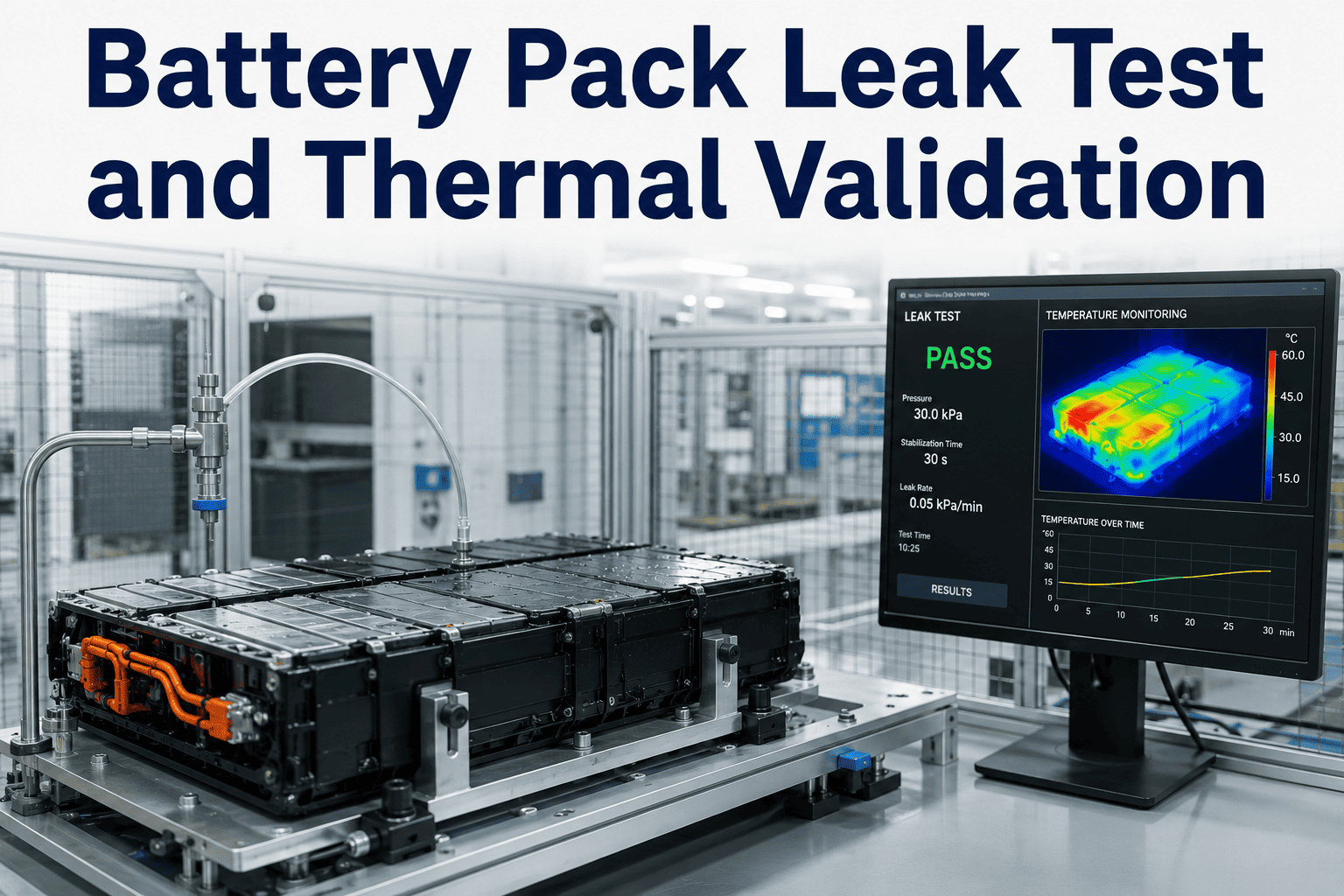
A battery pack that passes leak testing on the line but fails in the field is one of the more expensive quality escapes a gigafactory can have, since the failure mode involves a sealed enclosure that is difficult and costly to inspect again once it leaves the plant. Traditional pressure-decay testing works, but at gigafactory throughput, the threshold between a genuine leak and normal measurement noise gets harder to call correctly, and a test tuned too conservatively throws false alarms that slow the line down for no real quality gain. AI classification trained on helium leak signatures and pressure-decay curves separates a real leak from noise with far more precision than a fixed threshold, cutting false alarms without letting real leaks through. Gigafactory quality teams evaluating this approach can see leak classification running on live pack test data before the next production ramp.
EV Battery Pack Leak Testing AI for Gigafactory Production
Helium leak signature classification, pressure-decay analysis, and false-alarm reduction built for high-throughput lines.
Illustrative pressure-decay curve, classified against the leak threshold in real time
Why Fixed Thresholds Struggle at Throughput
A single fixed threshold rarely fits every pack and every condition, which creates three recurring problems.
A conservative threshold flags normal measurement noise as a leak, slowing the line unnecessarily.
A looser threshold set to reduce false alarms risks letting a genuine small leak through.
Ambient temperature and pack size shift the decay curve, which a fixed threshold cannot adapt to.
Classifying the full decay signature, rather than checking one threshold point, is what lets the system adapt without compromising sensitivity.
Reading a Leak Signature
The shape of the decay curve, not just its final value, is what distinguishes a real leak from noise.
Steady Decline
A consistent, predictable decay pattern typically indicates a genuine, measurable leak path.
Erratic Fluctuation
Noisy, inconsistent readings around a stable baseline usually point to sensor or ambient noise.
Step Change
A sudden shift rather than a gradual decline can indicate a seal defect rather than a slow leak.
Check Your Own False Alarm Rate Against This Model
Book a 30-minute session and bring recent leak test data. iFactory AI will show how many flagged events were likely false alarms.
Fixed Threshold vs Signature Classification
The difference between the two approaches shows up most clearly at gigafactory throughput.
| Factor | Fixed Threshold | Signature Classification |
|---|---|---|
| Decision basis | Single pressure value at test end | Full decay curve shape |
| Noise handling | Flags noise as a potential leak | Distinguishes noise from genuine decay |
| Condition adaptation | Static, does not adjust | Adjusts for ambient and pack variation |
| False alarm rate | Higher at tight thresholds | Lower without losing sensitivity |
What iFactory AI Supports
Leak classification runs on the full test signature, tuned to the specific pack and test rig.
Signature-Based Classification
The full pressure-decay curve is classified, not just a single endpoint value.
False-Alarm Reduction
Noise and genuine leaks are distinguished with far more precision than a fixed threshold.
High-Throughput Ready
Classification runs fast enough to keep pace with gigafactory line speeds.
Pack-Specific Tuning
Classification adapts to pack size and construction rather than one blanket rule.
iFactory AI integrates with existing leak test rigs. Scope covers data integration, classification model training, validation and ongoing monitoring.
Expert Review
The single biggest gain gigafactories see from signature classification is not catching more leaks, it is stopping the line far less often for leaks that were never there. A false alarm at high throughput costs real production time, and that cost compounds across every pack tested in a shift.
Step-change signatures deserve more attention than they typically get. A sudden shift rather than a gradual decline often points to a seal defect that a conventional threshold, tuned for gradual leaks, can miss entirely.
Frequently Asked Questions
Does this require new leak test equipment?
No, the classification model works with data from existing helium or pressure-decay test rigs, reading the output they already produce rather than requiring new hardware. See an integration example with a common rig type in a live session.
How much can false alarms actually be reduced?
The reduction depends on how conservative the current fixed threshold is, but gigafactories moving from a tight threshold to signature classification typically see a substantial drop in false alarms without an increase in missed leaks. Ask support for a false alarm reduction estimate based on your current test data.
Can the model distinguish between different pack sizes on the same line?
Yes, classification is tuned per pack construction and size, since decay signatures differ meaningfully between pack types. A line running multiple pack variants can run separate tuned models for each. Request a multi-pack classification demo.
What happens when the model flags an uncertain case?
A case that falls between a clear pass and a clear leak can be routed to a secondary check or human review rather than forced into a binary decision, which keeps uncertain cases from either slipping through or stopping the line unnecessarily. Contact support to see how uncertain cases are routed.
How long before the model is validated and trusted for production use?
Most deployments run a calibration period comparing model classification against known leak and pass cases before the model runs unsupervised, typically within six to nine weeks depending on how much historical test data is available for training. Book a session to estimate your own validation timeline.
Catch Real Leaks, Stop Chasing False Alarms
iFactory AI classifies the full decay signature, not just one threshold value. Book a walkthrough on your own test data.