A single lithium-ion cell in thermal runaway reaches temperatures above 150°C within minutes. The reaction is self-sustaining — it releases oxygen, ignites gas, and cascades from cell to cell in a chain reaction that conventional suppression systems cannot stop. In EV battery production, this is not a theoretical risk. It is a manufacturing reality that causes facility fires, production shutdowns, and — when defective cells escape to the field — vehicles that combust without warning. AI thermal runaway risk management in EV battery production is now the critical safety and quality layer that separates responsible manufacturers from those still relying on periodic sampling and reactive response. See how iFactory AI detects thermal runaway precursors before they become crises — book a demo.
Before It Starts
What Is Thermal Runaway — and Why Manufacturing Is Ground Zero
Thermal runaway is a cascade failure: heat triggers chemical reactions that generate more heat, which triggers more reactions, in a loop that cannot be broken once started. In lithium-ion batteries, the triggers are three types — mechanical abuse (physical damage during assembly), electrical abuse (overcharge, short circuit), and thermal abuse (excessive heat during formation cycling). All three can originate on the production line.
Where Thermal Runaway Risk Enters the Production Line
The dangerous assumption in battery manufacturing is that thermal runaway is a field problem — something that happens to customers, not on the factory floor. In reality, the seeds of thermal runaway are planted during production. Five manufacturing stages carry the highest risk:
First charge/discharge activates the cell. Voltage anomalies, thermal drift, and impedance spikes during formation are direct precursors to field thermal runaway. Defects invisible to post-formation testing manifest here first.
Metallic particle contamination during electrode coating or calendering creates internal short-circuit paths. A particle 50μm in diameter — invisible to standard inspection — can trigger thermal runaway 18 months after delivery.
Tab welding defects — cold welds, incomplete fusion, spatter — create high-resistance joints that heat under load. Weld quality variation below the threshold of visual inspection is a leading cause of in-field thermal events.
Under- or over-fill causes electrolyte starvation or excess. Both create conditions for lithium plating — metallic lithium deposits that grow into dendrites and pierce separators, causing internal short circuits.
Mechanical stress during module and pack integration can damage cell casings or separator integrity. Cells that appear functional at end-of-line test carry latent damage that accelerates degradation and thermal risk under real-world load.
AI monitors voltage, temperature, current, impedance, gas signatures, and acoustic data simultaneously across all five stages — detecting deviation patterns that precede thermal events by 6–12 hours rather than minutes.
How AI Detects What Humans Miss
The critical gap in traditional battery quality control is time-to-detection. A thermal runaway event in a formation chamber gives operators seconds to respond. A defective cell that escapes inspection gives no warning at all until it fails in a vehicle. AI closes this gap by operating on a fundamentally different timeline.
AI achieves this through multi-signal fusion. No single sensor reliably predicts thermal runaway in isolation — temperature alone lags the event, voltage anomalies can be noise, and gas signals only appear at advanced stages. AI models trained on millions of formation cycles correlate weak signals across voltage, temperature gradient, impedance, current draw, and acoustic data simultaneously, identifying the specific multi-parameter signature that precedes thermal events before any single signal is actionable.
iFactory AI: 4 Layers of Thermal Runaway Protection
AI monitors every cell through every formation cycle in real time. Voltage instability patterns, thermal drift above baseline, and impedance rise anomalies are flagged within 1–2 hours of cycle start — before the cell completes formation. Defective cells are diverted to rework or scrap before entering module assembly.
Before a formation line enters thermal runaway or electrical fault, AI detects precursor signals — rising ambient temperatures, voltage oscillation patterns, or current draw anomalies in the formation equipment itself. Maintenance is alerted 6–12 hours in advance. Downtime drops from 4–6 hours per incident to 15–30 minutes of preventive action.
At end-of-line test, AI analyzes full electrochemical signatures — not just pass/fail thresholds. Cells that pass binary testing but show voltage recovery curve anomalies, temperature stabilization patterns inconsistent with healthy chemistry, or impedance drift outside the statistical model of known-good cells are flagged and removed before pack assembly.
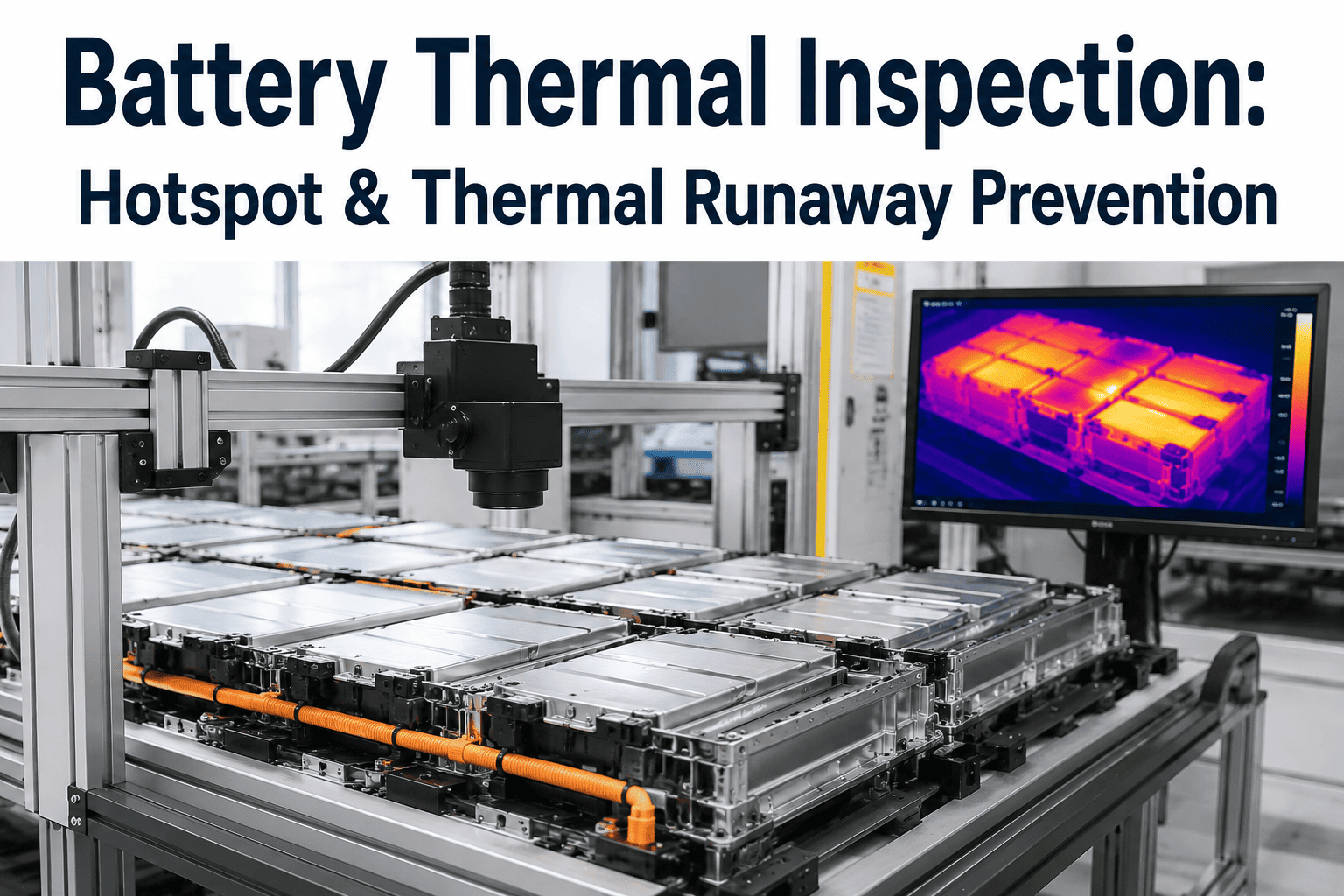
AI-analyzed thermal imaging at pack assembly verifies thermal paste coverage, heat sink contact uniformity, and module temperature distribution under load testing. Hotspots indicating compromised thermal management are detected before the pack is sealed — when they cost minutes to fix, not thousands in field replacement.
The Numbers: AI vs. Traditional Thermal Risk Management
Real-World Impact: Formation Line Thermal Event Prevention
A gigafactory producing 600,000 cells per day experienced recurring formation line shutdowns caused by thermal events in formation chambers. Each incident required 4–6 hours of downtime for cooling, inspection, and restart — costing approximately $1.2M per incident in lost production.
iFactory AI was deployed on the formation line. Within the first week, AI detected sustained temperature drift in early-cycle cells and flagged heat exchanger tubing in one chamber as the root cause. Maintenance intervened within 30 minutes. The thermal event that would have triggered a full shutdown was prevented.
Compliance: AI Supports Evolving Global Safety Standards
Regulators worldwide are tightening thermal runaway requirements. China's GB38031-2025 now mandates "no fire, no explosion" during or after a runaway event. UL9540A:2025 explicitly encourages AI and digital twin approaches. ISO 6469 and UN ECE R100 require documented evidence of thermal management validation. AI provides the continuous monitoring data, anomaly logs, and formation quality records that compliance teams need — automatically, at scale, across every cell produced.
FAQ: AI and Thermal Runaway Risk in EV Battery Production
Can AI actually prevent thermal runaway, or just detect it faster?
What signals does AI monitor to predict thermal runaway?
How far in advance can AI warn of a thermal runaway risk?
Does AI thermal runaway monitoring work for all battery chemistries?
What is the ROI of deploying AI thermal runaway monitoring in a gigafactory?
How long does deployment take and what data is needed?
Detect Thermal Runaway Before It Happens
iFactory AI monitors every formation cycle, flags precursors 6–12 hours in advance, and stops defective cells before they reach battery packs — or customers.