The automotive industry is at a critical inflection point where the convergence of artificial intelligence, autonomous guided vehicles, advanced vision systems, and humanoid robotics demands a fundamentally new approach to plant floor connectivity. Traditional Wi-Fi and wired networks simply cannot deliver the ultra-low latency, massive device density, and deterministic reliability that modern AI-driven manufacturing requires. Private 5G networks, combined with edge computing infrastructure, are emerging as the definitive solution for automotive plants that need to process terabytes of sensor data in real time while maintaining strict security and operational control. This comprehensive guide provides a deep technical analysis of how private 5G and edge networks enable the next generation of smart factory automation, covering architecture, deployment strategies, performance benchmarks, and integration with AI workloads. For plant managers and CTOs seeking to future-proof their operations, exploring these capabilities is essential. Book a Demo to see how iFactory can accelerate your private 5G journey.
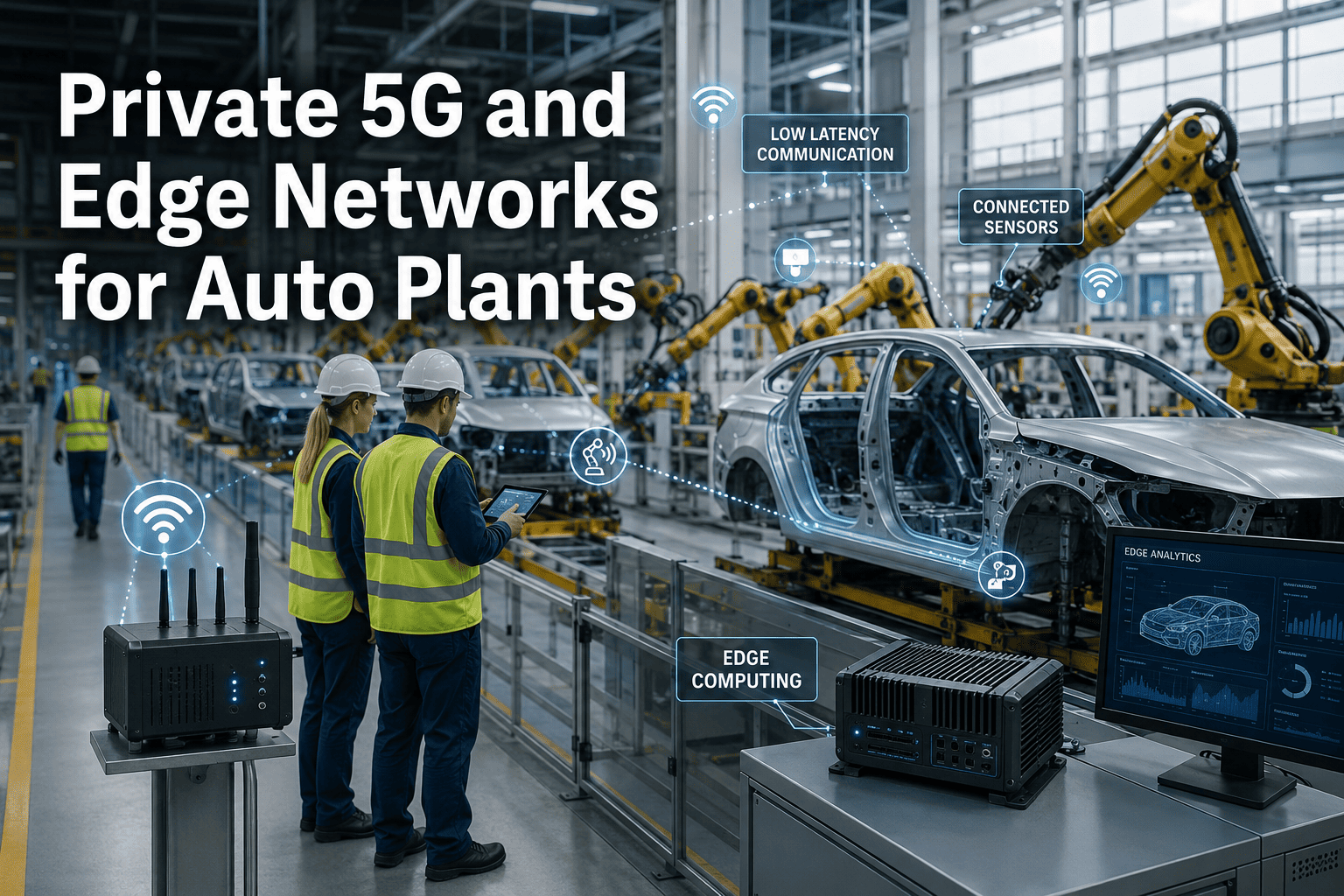
Private 5G and Edge Networks for Automotive AI
Unlock real-time AI at scale with ultra-reliable, low-latency connectivity for AGVs, vision, and humanoids.
The Latency Imperative
Modern automotive AI applications—from real-time defect detection in welding to dynamic path planning for AGVs—require end-to-end latency below 10 milliseconds. Private 5G networks, with their native support for ultra-reliable low-latency communication (URLLC), consistently deliver sub-5ms round-trip times when paired with edge computing nodes located within the plant. This deterministic performance eliminates the jitter and packet loss inherent in Wi-Fi, enabling closed-loop control of robotic systems with zero tolerance for delay. For example, a humanoid robot performing precision assembly must receive sensor feedback and send motor commands within a single control cycle of 1-2 milliseconds. Only a private 5G network with edge processing can guarantee this. Book a Demo to explore latency benchmarks.
Device Density and Scalability
A typical automotive plant floor now hosts thousands of connected devices: sensors, cameras, AGVs, collaborative robots, and wearable terminals. Wi-Fi networks struggle with co-channel interference and limited access point capacity, often failing beyond 200 devices per square meter. Private 5G, operating in licensed or shared spectrum (e.g., CBRS or 3.5 GHz), supports up to 1 million devices per square kilometer with efficient scheduling and orthogonal frequency division multiple access (OFDMA). This scalability ensures that every camera feed, every torque sensor, and every AGV command flows without contention. As plants adopt more AI-driven edge devices, the ability to scale seamlessly becomes a competitive advantage. iFactory’s private 5G solutions are designed to grow with your production needs.
Security and Data Sovereignty
Automotive manufacturers handle sensitive intellectual property—from vehicle designs to proprietary process parameters. Private 5G networks keep all data within the plant perimeter, never traversing public infrastructure. With network slicing, you can isolate critical AI traffic (e.g., vision inference) from less sensitive data (e.g., environmental monitoring). End-to-end encryption, SIM-based authentication, and integration with existing plant security frameworks (e.g., IEC 62443) provide defense-in-depth. Edge computing further enhances security by processing data locally, reducing exposure. For compliance with regional data residency requirements, private 5G offers complete control. Contact support for a security architecture review.
Architecture Deep Dive: Private 5G + Edge
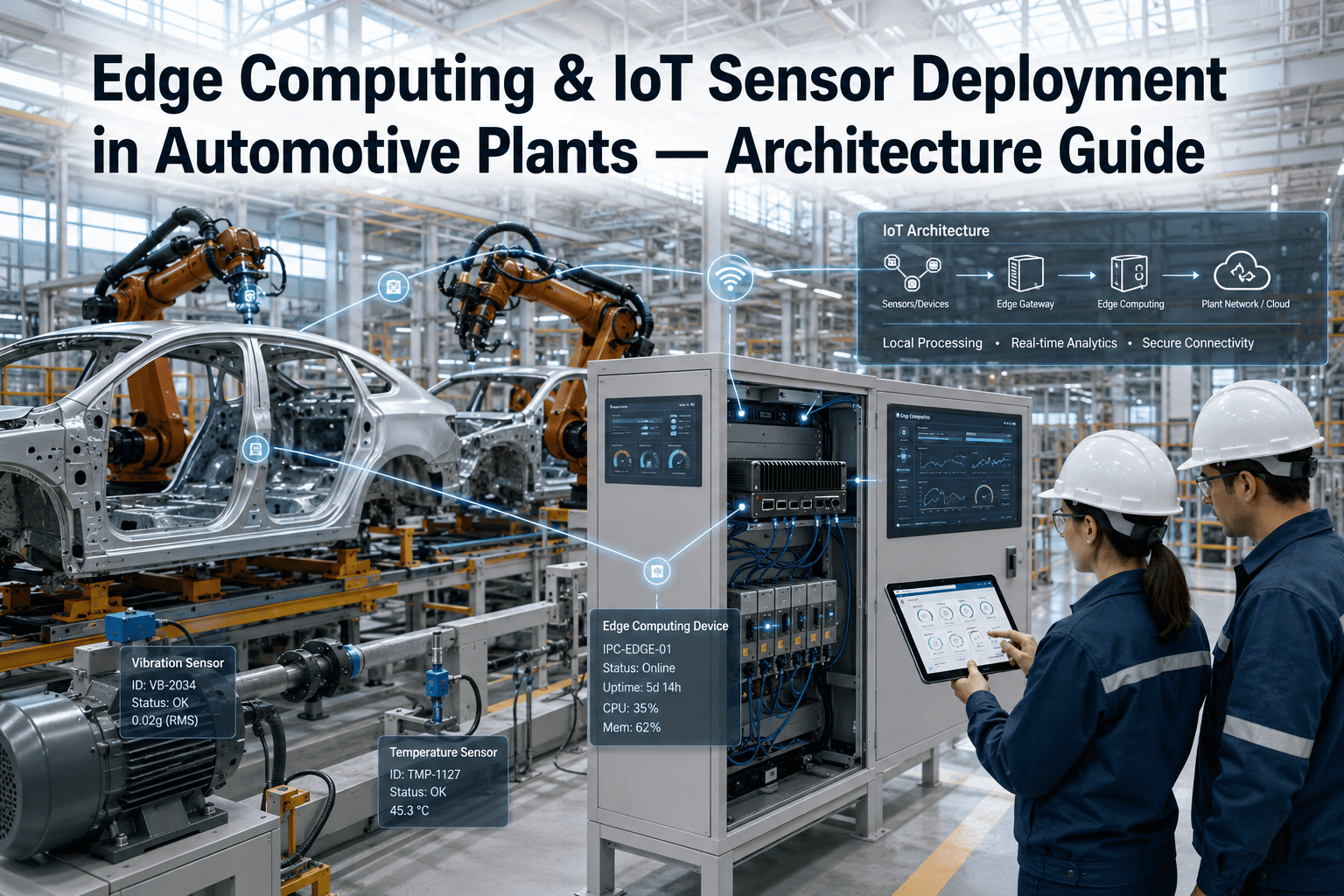
A private 5G network for automotive plants typically comprises a 5G core (5GC) deployed on-premises, a distributed unit (DU) and radio unit (RU) covering the production area, and edge servers co-located with the DU or at a central plant data center. The 5GC handles authentication, mobility, and quality of service (QoS) policies. Edge nodes host AI inference engines, data aggregation services, and real-time analytics. The separation of control and user planes (CUPS) allows user data to bypass the core for ultra-low latency. Network slicing creates virtual networks tailored to specific use cases: one slice for AGV control (ultra-reliable low latency), another for video surveillance (high bandwidth), and a third for IoT sensors (massive machine type communications). This architecture ensures that each application receives the precise performance it requires without interference.
AI Workloads at the Edge
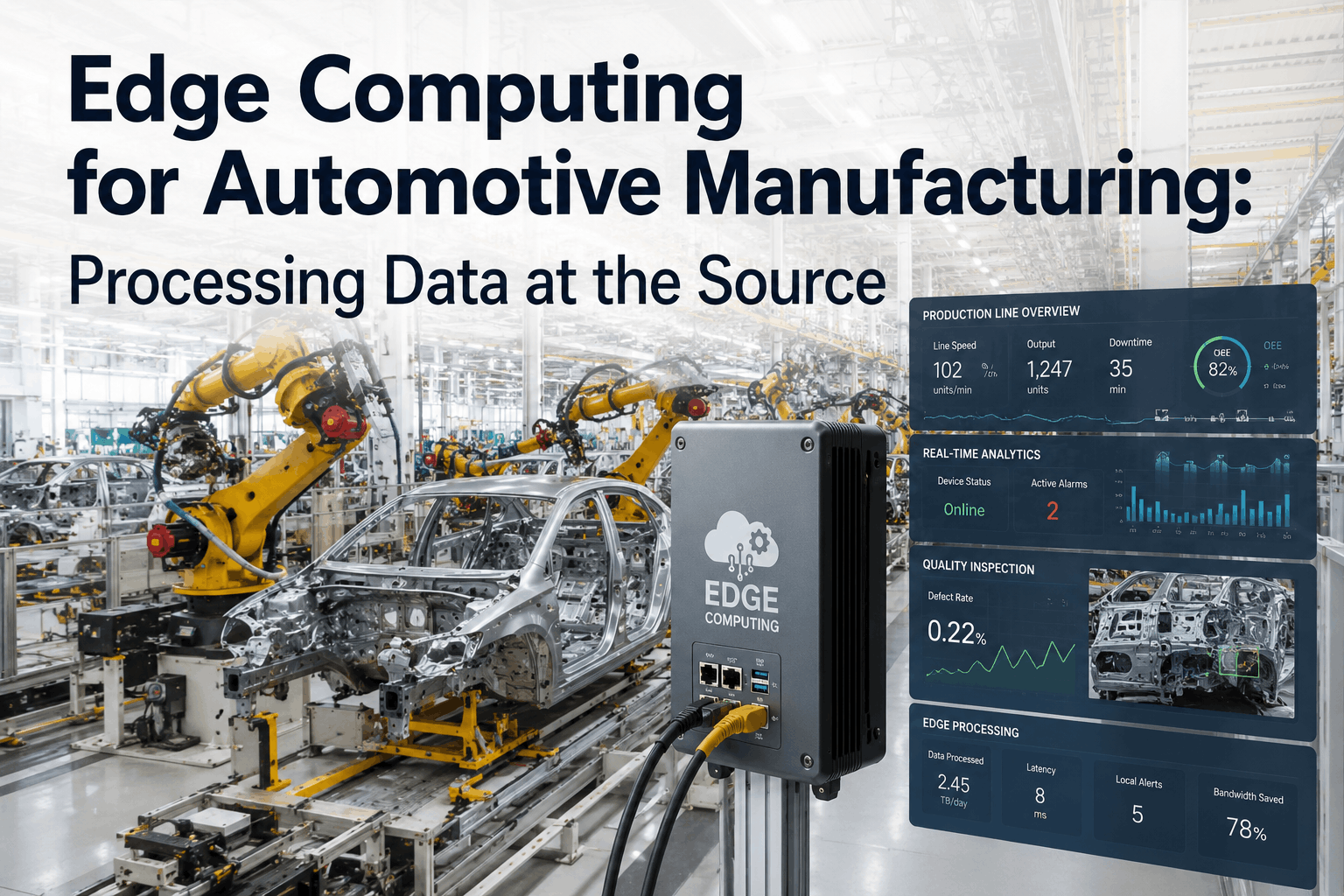
Deploying AI inference at the edge reduces latency and bandwidth consumption dramatically. For example, a vision-based defect detection system on a welding line captures 4K images at 60 fps. Sending all data to a central cloud would saturate a 10 Gbps link and introduce 50ms+ latency. Instead, edge nodes run optimized convolutional neural networks (CNNs) that process frames locally, sending only anomalies to the cloud for retraining. Private 5G’s high uplink capacity (up to 1 Gbps per user) ensures that the raw data can be streamed to the edge without bottlenecks. For AGVs, onboard AI for obstacle avoidance and path planning relies on low-latency sensor fusion from LiDAR and cameras. Edge servers can aggregate data from multiple AGVs and compute global traffic optimization, sending only high-level commands over the 5G link. This architecture reduces onboard compute requirements and extends battery life.
Ready to Transform Your Plant Connectivity?
Deploy private 5G and edge networks that power your AI-driven automation. Get expert guidance from iFactory.
Implementation Roadmap
Site Survey and Spectrum Planning
Conduct RF propagation analysis to determine optimal placement of radio units. Identify spectrum options: CBRS (GAA or PAL), 3.5 GHz, or mmWave. iFactory’s tools automate coverage prediction.
Edge Infrastructure Deployment
Install edge servers with GPU accelerators for AI inference. Configure network slicing and QoS policies. Integrate with existing MES and SCADA systems via APIs.
Device Onboarding and Testing
Register AGVs, cameras, and sensors with SIM-based authentication. Perform end-to-end latency and throughput tests. Validate AI model inference accuracy at the edge.
Continuous Optimization
Monitor network KPIs using AI-driven analytics. Adjust slice parameters for changing traffic patterns. iFactory provides ongoing support and optimization. Contact support for details.
Performance Comparison: Private 5G vs. Wi-Fi 6 vs. Wired
| Metric | Private 5G | Wi-Fi 6 | Wired (Ethernet) |
|---|---|---|---|
| Latency (ms) | 1-5 | 10-30 | 0.1-1 |
| Reliability (%) | 99.999 | 99.9 | 99.999 |
| Mobility | Seamless | Handoff delays | None |
| Device Density | 1M/km² | 2000/AP | Limited by ports |
| Security | End-to-end encryption, SIM-based | WPA3, vulnerable to deauth | Physical only |
| Deployment Cost | Medium-High | Low | High (cabling) |
AGV Fleet Coordination
Private 5G enables centralized traffic management for hundreds of AGVs. Each vehicle streams telemetry and receives collision avoidance commands with sub-10ms latency. Edge servers compute optimal routes in real time, reducing empty travel by 30%.
Vision-Based Quality Inspection
High-resolution cameras on assembly lines send 4K images to edge inference servers. Defects are detected within 5ms, with false positive rates below 0.1%. The system adapts to new models without downtime.
Humanoid Robot Control
Humanoids performing complex tasks require joint-level control loops at 1kHz. Private 5G’s URLLC mode delivers deterministic latency, enabling safe and precise interaction with humans and machinery.
Predictive Maintenance
Vibration and temperature sensors on robotic arms stream data to edge AI models that predict bearing failures 48 hours in advance. Maintenance alerts are sent via the private network, reducing unplanned downtime by 40%.
Frequently Asked Questions
What is the difference between private 5G and public 5G for automotive plants?
Private 5G networks are dedicated to a single enterprise, deployed on-premises with complete control over spectrum, core network, and edge computing. Public 5G networks are shared among many users and managed by a mobile network operator. For automotive plants, private 5G offers deterministic latency, higher security, and guaranteed capacity tailored to industrial AI workloads. Public networks may suffer from congestion and lack of QoS guarantees. iFactory’s private 5G solutions provide the reliability and performance needed for mission-critical automation. Book a Demo to see the difference in action.
How does edge computing integrate with private 5G in a factory setting?
Edge computing nodes are deployed at the network edge, typically co-located with the 5G distributed unit or at a local data center. They host AI inference engines, data processing, and real-time analytics. Private 5G provides the low-latency, high-bandwidth connectivity between devices and edge servers. The integration is seamless: the 5G core routes user-plane traffic directly to the edge via local breakout, bypassing the internet. This architecture enables sub-5ms end-to-end latency for AI applications. iFactory offers pre-integrated edge solutions optimized for common automotive use cases. Contact support for a reference architecture.
What are the key challenges in deploying private 5G for automotive AI?
Key challenges include spectrum acquisition (CBRS or licensed), integration with legacy IT/OT systems, and ensuring interoperability with existing Wi-Fi and wired networks. Additionally, deploying edge infrastructure requires careful planning for power, cooling, and security. Workforce training is essential to manage the new network. iFactory addresses these challenges with end-to-end deployment services, including site surveys, spectrum coordination, and integration with MES/SCADA. Our team provides ongoing support to optimize performance. Book a Demo to discuss your specific environment.
Can private 5G support both real-time control and high-bandwidth video simultaneously?
Yes, through network slicing. Private 5G allows you to create multiple virtual networks on the same physical infrastructure, each with dedicated QoS parameters. A URLLC slice can be configured for real-time AGV control with sub-5ms latency, while an eMBB slice handles high-bandwidth video streams from quality inspection cameras. This separation ensures that control traffic is never impacted by video uploads. iFactory’s network slicing management tools make it easy to define and adjust slices based on production needs. Get support for a detailed slicing blueprint.
What is the ROI timeline for implementing private 5G in an automotive plant?
ROI typically materializes within 12-18 months, driven by reduced downtime, increased throughput, and lower maintenance costs. For example, a plant deploying private 5G for AGV coordination can see a 20% improvement in material handling efficiency. Vision-based quality inspection reduces scrap by 15%. Predictive maintenance cuts unplanned downtime by 40%. Combined, these benefits yield significant annual savings. iFactory provides detailed ROI modeling as part of our engagement. Book a Demo to receive a customized ROI analysis.
Accelerate Your Industry 4.0 Journey
Leverage private 5G and edge networks to unlock the full potential of AI in your automotive plant. Partner with iFactory for expert deployment and support.