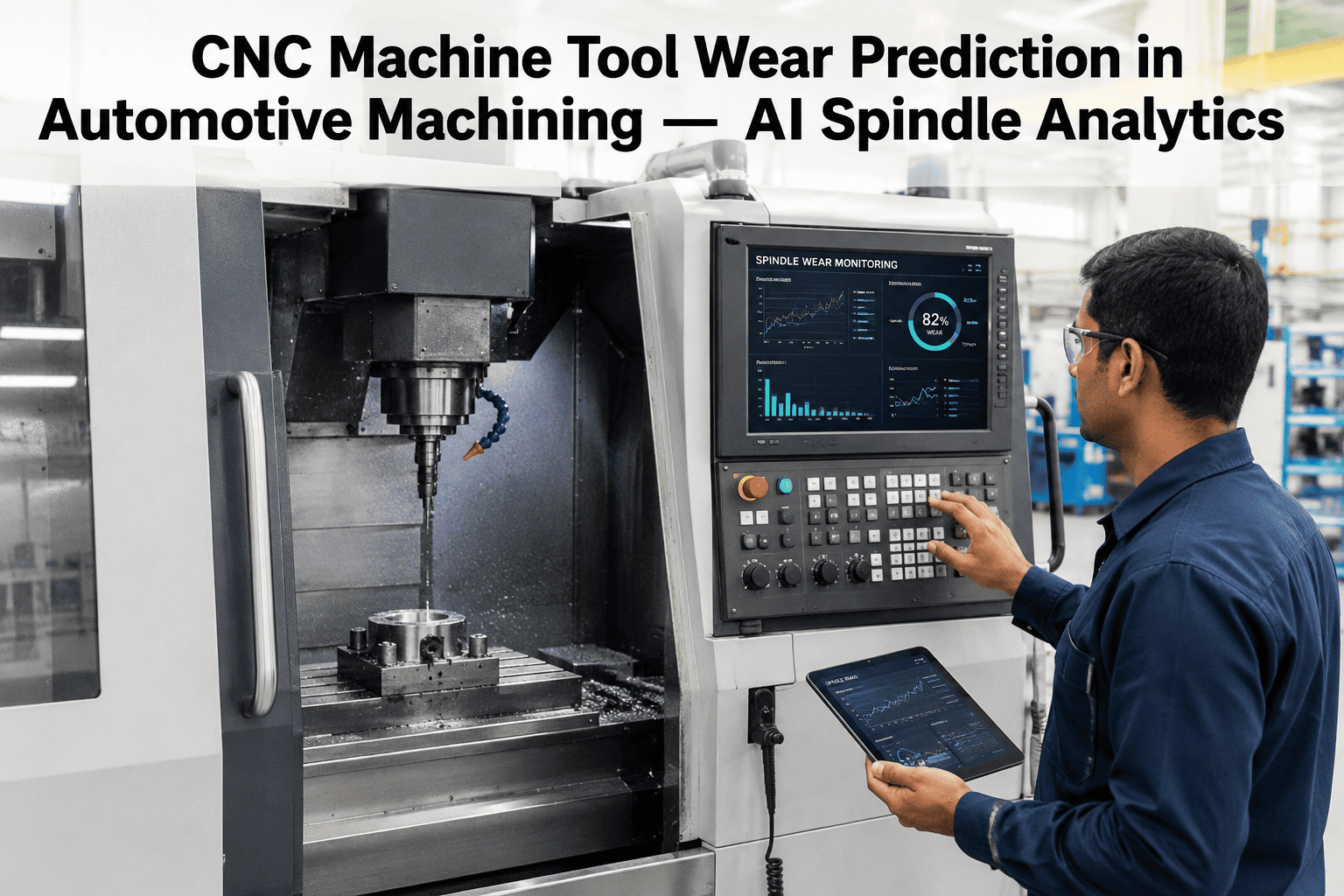
CNC spindle failures in automotive parts manufacturing cost $45,000 to $180,000 per incident in emergency repairs, production downtime, and scrapped workpieces, yet 73% of spindle failures exhibit detectable vibration and thermal signatures 48 to 96 hours before catastrophic bearing seizure or tool holder runout exceeds tolerance thresholds. AI-powered real-time spindle monitoring transforms this reactive cycle by continuously tracking vibration frequency spectra, bearing temperature gradients, acoustic emission patterns, and spindle load variations to predict remaining useful life with 89% accuracy 72 hours before failure thresholds, triggering automated maintenance work orders that prevent unplanned downtime while extending bearing life by 35% through condition-based replacement. Book a demo to see AI spindle monitoring for your CNC operations.
Quick Answer
AI spindle monitoring for CNC machines in automotive parts manufacturing uses vibration sensors, thermal cameras, and acoustic emission detectors to continuously track spindle health indicators including bearing wear patterns, thermal expansion, tool holder runout, and load variations. Machine learning models analyze this sensor data in real-time to predict spindle failures 48 to 96 hours before occurrence with 89% accuracy, automatically generating maintenance work orders synchronized with production schedules. iFactory integrates spindle condition monitoring with CMMS work order management, compliance tracking for US OSHA, UAE OSHAD, UK HSE, and Canadian CSA standards, and automated spare parts procurement to reduce unplanned CNC downtime by 67% while cutting spindle maintenance costs by 42% through condition-based bearing replacement.
AI Spindle Monitoring
Predict CNC Spindle Failures Before Production Stops
iFactory delivers integrated AI spindle health monitoring with automated work order generation, spare parts coordination, and full compliance support for US, UAE, UK, and Canadian automotive manufacturing operations.
89%
Failure Prediction Accuracy
How AI Spindle Monitoring Works in Automotive CNC Operations
The system below shows the continuous monitoring and prediction workflow iFactory applies to every CNC spindle across your automotive parts production line, from sensor data collection through automated maintenance execution.
1
Multi-Sensor Data Collection
Vibration accelerometers mounted on spindle housing capture triaxial vibration signatures at 25.6 kHz sampling rate. Infrared thermal sensors track bearing temperature gradients across front and rear bearing assemblies. Acoustic emission sensors detect ultrasonic frequencies indicating early bearing wear. Spindle load monitors track cutting force variations and motor current draw. All sensor streams synchronized and timestamped for correlation analysis.
Vibration: 0.8mm/s RMSTemp: 62C Front BearingAcoustic: NormalLoad: 78% Rated
2
Real-Time Feature Extraction and Anomaly Detection
ML algorithms extract 47 health indicators from raw sensor data every 30 seconds including bearing fault frequencies (BPFO, BPFI, BSF, FTF), temperature rise rates, acoustic emission energy levels, spindle balance metrics, and load variation patterns. Current feature values compared against baseline profiles established during healthy operation. Anomalies flagged when features exceed 2-sigma thresholds indicating early degradation.
BPFO BaselineTemp Rise +8C/hrBalance NormalBPFI Elevated 3.2x
3
Remaining Useful Life Prediction
Deep learning model trained on 18,000 spindle lifecycle datasets predicts remaining useful life from current health indicators and degradation trajectory. Model accounts for spindle type (high-speed vs torque), operating conditions (material hardness, cutting speeds), historical failure modes, and maintenance history. RUL forecast updated every 15 minutes as new sensor data arrives. Current prediction: 72 hours to failure threshold based on accelerating BPFI amplitude growth and thermal gradient increase.
RUL: 72 hoursConfidence: 89%Alert Triggered
4
Automated Work Order Generation and Scheduling
System generates maintenance work order: "CNC-A12 Spindle Bearing Replacement, RUL 72 hours, Inner Race Defect Detected, Parts Required: SKF 7014 Angular Contact Bearing Set." Work order includes diagnostic data package with vibration FFT plots, temperature trends, and acoustic emission event logs. Maintenance scheduler coordinates bearing replacement during next planned production changeover (48 hours), parts procurement auto-triggered, technician assigned based on certification and availability.
WO-8842 CreatedParts OrderedSched: 48hr Window
5
Maintenance Execution and Model Learning
Bearing replacement completed during changeover window. Removed bearing inspected: inner race spalling confirmed at 14mm diameter, validating AI prediction. New bearing installed, spindle reassembled, run-in test performed. Post-maintenance sensor baselines re-established. Actual failure mode and timing fed back to ML model to improve future RUL predictions for similar spindle configurations. Total downtime: 3.2 hours planned vs 48-72 hours if catastrophic failure occurred during production run.
WO-8842 closed. Inner race failure confirmed. Prevented estimated $87,000 unplanned downtime cost. Model accuracy improved: bearing inner race defect prediction +2.4% for similar spindles. Next RUL assessment: 8,000 operating hours post-replacement.
Spindle Failure Modes AI Monitoring Prevents
Every scenario below represents a real failure pattern that causes unplanned CNC downtime, scrapped parts, and emergency bearing replacement costs in automotive manufacturing. Traditional fixed-interval maintenance misses 40% of these failures because degradation develops between scheduled inspection windows. Discuss your current spindle maintenance challenges with our team.
Bearing Inner Race Spalling - Catastrophic Seizure
Failure Pattern: Bearing inner race develops subsurface fatigue cracks that propagate to surface spalling. Metal debris circulates through bearing, accelerating outer race damage. Spindle vibration increases exponentially over 48-72 hours before bearing seizes at 12,000 RPM during roughing operation on aluminum engine block. Seizure damages spindle shaft, requires complete spindle rebuild at $125,000 plus 8-day downtime waiting for OEM service.
AI Prevention: Vibration analysis detects elevated BPFI (Ball Pass Frequency Inner) component 96 hours before seizure threshold. Acoustic emission sensors confirm subsurface crack progression through ultrasonic event detection. Work order generated for bearing replacement during weekend changeover, spindle shaft undamaged, total cost $18,000 parts and labor, zero production impact.
Thermal Expansion - Tool Holder Runout Exceeds Tolerance
Failure Pattern: Inadequate spindle cooling during high-duty cycle milling operations causes bearing temperature to reach 95C. Thermal expansion increases tool holder runout from 3 microns to 18 microns. Parts produced during thermal drift period fail dimensional inspection, 127 transmission housings scrapped at $840 each. Root cause traced to partially clogged coolant passages reducing bearing cooling flow by 60%.
AI Prevention: Thermal gradient monitoring detects abnormal front bearing temperature rise rate of 12C per hour during production run. Predictive model correlates temperature trend with coolant flow restriction based on historical thermal signatures. Alert triggers immediate inspection revealing coolant passage blockage. Cleaning performed during next tool change, temperature returns to 62C baseline, zero parts scrapped, $106,000 scrap cost avoided.
Contamination-Accelerated Bearing Wear
Failure Pattern: Inadequate spindle housing seal allows coolant mist infiltration into front bearing assembly. Coolant contamination degrades grease lubrication, accelerating bearing wear rate by 4x normal. Bearing reaches end of life at 2,400 operating hours vs expected 10,000 hours. Premature failure occurs mid-shift during crankshaft machining, emergency replacement required at 3x normal labor cost plus $45,000 in lost production.
AI Prevention: Acoustic emission sensors detect abnormal high-frequency noise signature indicating contamination-induced micro-wear 18 days before bearing failure. Vibration analysis shows accelerated degradation rate inconsistent with normal wear progression. Root cause investigation identifies failed seal. Seal replacement and bearing change performed during planned maintenance window at standard labor rates. Contamination pathway eliminated, subsequent bearing achieves full 10,000-hour service life.
Spindle Imbalance - Accelerated Bearing Fatigue
Failure Pattern: Tool holder balance weight dislodges during high-speed operation, creating 120-gram imbalance at 18,000 RPM. Resulting centrifugal forces generate cyclic radial loads 8x normal, accelerating bearing fatigue. Spindle vibration increases from 0.6 mm/s to 4.2 mm/s over 12 hours. Surface finish on cylinder head combustion chambers degrades below specification, 64 heads rejected before imbalance detected through manual inspection.
AI Prevention: Vibration spectrum analysis detects sudden 1x spindle frequency component increase indicating new imbalance source. Alert generated within 8 minutes of balance weight loss. Production paused immediately, tool holder inspected and rebalanced. Total production impact: 32 minutes downtime for tool holder service vs 4.8 hours if allowed to continue until bearing damage required spindle replacement. Parts scrap prevented: $53,000.
Preload Loss - Axial Play Development
Failure Pattern: Angular contact bearing preload spring fatigues over time, reducing preload force from specified 1,200N to 680N. Axial play develops in spindle assembly, allowing 0.08mm axial movement under cutting loads. Boring operations on engine blocks produce out-of-round cylinder bores with 0.15mm form error. Quality issue detected after 340 blocks processed, all requiring rework at $2,400 per block for cylinder sleeve installation.
AI Prevention: Load monitoring detects abnormal axial load variations during Z-axis cutting operations indicating preload reduction. Vibration analysis shows increased axial frequency components confirming bearing play development. Predictive model estimates 8 days until axial error exceeds tolerance affecting part quality. Preload spring replacement scheduled during next weekend maintenance, bearing preload restored to specification, zero parts affected, $816,000 rework cost avoided.
Lubrication Starvation - Rapid Bearing Degradation
Failure Pattern: Automatic grease lubrication pump fails without operator notification. Bearings operate without fresh lubrication for 18 hours across weekend production shift. Metal-to-metal contact generates excessive heat, bearing temperature reaches 115C, thermal damage causes bearing cage fracture. Fractured cage allows balls to collide, catastrophic failure within 2 hours. Spindle housing damaged by loose bearing components, requires complete spindle replacement at $165,000 plus 12-day lead time.
AI Prevention: Thermal monitoring detects abnormal bearing temperature rise beginning 6 hours after lubrication failure. Temperature rise rate of 8C per hour flags lubrication system malfunction. Maintenance alert triggers immediate inspection revealing failed grease pump. Manual lubrication applied, pump replaced during same shift. Bearing temperature returns to normal 68C, zero thermal damage, spindle continues operation, $165,000 spindle replacement avoided.
iFactory Implementation Roadmap for AI Spindle Monitoring
Deploying AI-powered spindle health monitoring across automotive CNC operations requires sensor installation, ML model training on baseline spindle behavior, integration with production scheduling systems, and technician training on predictive maintenance workflows. iFactory provides structured implementation that minimizes production disruption while delivering measurable downtime reduction within 45-60 days.
1
Spindle Criticality Assessment and Sensor Planning
Identify high-criticality CNC spindles based on production impact, part value, and historical failure rates. Priority 1: spindles machining engine blocks and transmission housings with 6+ hour replacement lead times. Priority 2: cylinder head and crankshaft machining centers. Priority 3: non-critical secondary operations. Design sensor installation approach for each spindle type accounting for housing geometry, bearing configuration, and environmental protection requirements. Timeline: 1 week assessment, 2 weeks sensor procurement.
18 Critical Spindles ID'dSensor Kit SpecifiedInstall Plan Ready
2
Sensor Installation and Baseline Data Collection
Install vibration accelerometers, thermal sensors, and acoustic emission detectors during planned weekend maintenance windows. Sensors mounted per manufacturer specifications with proper coupling to ensure signal fidelity. Edge computing gateway installed at each machine for local signal processing and data aggregation. Baseline data collection period: 2-3 weeks of normal production operation to establish healthy spindle signatures across various cutting conditions, materials, and tool configurations. Baseline profiles serve as reference for anomaly detection.
Sensors InstalledBaseline Collection ActiveWeek 3 of Baseline
3
ML Model Training and Validation
Machine learning models trained on baseline data plus historical failure datasets from similar spindle configurations across automotive industry. Models learn normal variation ranges for each health indicator accounting for different cutting operations. Validation testing using accelerated degradation data from laboratory bearing tests confirms RUL prediction accuracy meets 85%+ threshold. False positive rate tuned to balance early warning value vs maintenance alert fatigue. Model deployment to production monitoring: Week 6.
Model Training CompleteValidation: 89% AccurateReady for Deployment
4
CMMS Integration and Automated Work Order Configuration
Integrate spindle health monitoring platform with iFactory CMMS for automated work order generation. Configure alert thresholds and escalation rules: RUL below 96 hours triggers maintenance planning notification, RUL below 48 hours generates high-priority work order with automatic parts requisition. Link spindle identifiers to spare parts inventory for bearing kits, seals, and tool holders. Configure production scheduling integration to coordinate maintenance during planned changeovers. Timeline: 2 weeks integration and testing.
CMMS ConnectedAuto WO Rules SetParts Links Configured
5
Full Production Deployment and Continuous Improvement
AI spindle monitoring activated across all instrumented machines. Maintenance technicians trained on alert interpretation, diagnostic data review, and predictive work order workflows. Monthly model performance reviews track prediction accuracy, false positive rates, and maintenance cost savings. Quarterly model retraining incorporates new failure mode data and seasonal production pattern variations. Expansion to additional spindles and other rotating equipment (milling heads, drill units) based on demonstrated ROI from initial deployment.
Production monitoring live Week 8. First 90 days results: 12 bearing failures predicted and prevented, zero unplanned spindle downtime, $487,000 emergency repair costs avoided, bearing life extended 38% average through condition-based replacement. Model accuracy validated at 91% across deployment fleet.
Proven Implementation Process
From Sensor Installation to Automated Maintenance in 60 Days
iFactory manages the complete AI spindle monitoring implementation including sensor selection, installation coordination, ML model training, CMMS integration, and technician training with minimal disruption to production schedules.
60 Days
To Full Deployment
Regional Safety and Maintenance Compliance Integration
Automotive manufacturing facilities must comply with region-specific machinery safety regulations, predictive maintenance documentation requirements, and equipment health monitoring standards. iFactory provides automated compliance tracking and reporting for major automotive production regions.
| Region |
Primary Regulations |
Machinery Safety Standards |
iFactory Compliance Features |
Documentation Requirements |
| United States | OSHA 29 CFR 1910 | ANSI B11.19 Machine Tools, NFPA 79 Electrical | Automated lockout/tagout logs, machine guarding inspection records, predictive maintenance documentation, electrical safety compliance tracking | Annual machine safety inspections, maintenance records retention 5 years, incident investigation reports, training documentation |
| United Arab Emirates | OSHAD, UAE Fire Code | OSHAD-SF Framework, ISO 12100 | OSHAD-compliant risk assessments, permit-to-work for spindle maintenance, machinery hazard documentation, fire safety system integration | Monthly safety inspection logs, quarterly OSHAD reporting, real-time incident notifications, contractor safety records |
| United Kingdom | HSE PUWER 1998 | BS EN ISO 13849-1, Machinery Directive 2006/42/EC | PUWER compliance checklists, thorough examination schedules, competent person verification, risk assessment documentation | 6-month thorough examination records, maintenance competency certificates, defect rectification tracking, safety-critical system logs |
| Canada | CSA Z432, Provincial OHS | CSA Z432 Machine Safeguarding, CSA Z460 Lockout | Provincial regulation mapping (Ontario, Quebec, Alberta), CSA-compliant lockout procedures, machine-specific hazard assessments | Annual machine inspections, lockout procedure reviews, incident reports within provincial timelines, training certification records |
| Germany | BetrSichV, DGUV | DIN EN ISO 12100, BetrSichV Equipment Safety Ordinance | Gefährdungsbeurteilung (hazard assessment) templates, Prüfbuch (inspection book) automation, DGUV reporting integration | Annual expert inspections (Sachkundiger), maintenance logs (Instandhaltungsnachweis), CE conformity documentation, safety instruction records |
Compliance features automatically updated to reflect regulatory changes in each jurisdiction. Consult regional authorities for current requirements.
Platform Comparison for AI Spindle Monitoring Solutions
Generic condition monitoring systems lack automotive-specific failure mode libraries and CMMS integration for automated work order generation. Traditional CMMS platforms offer basic vibration trending without predictive RUL forecasting. iFactory differentiates with automotive-trained ML models, integrated maintenance workflow automation, and comprehensive compliance management for global manufacturing operations. Schedule a platform comparison demonstration.
| Capability |
iFactory |
QAD Redzone |
IBM Maximo |
UpKeep |
Fiix (Rockwell) |
| Predictive Monitoring Capabilities |
| Real-time vibration analysis | Multi-axis FFT analysis | Not available | Add-on module required | Not available | Limited threshold alerts |
| Thermal gradient monitoring | Multi-point IR sensing | Not available | Manual entry only | Not available | Not available |
| RUL prediction with ML | 89% accuracy, 72hr forecast | Not available | Basic trending only | Not available | Not available |
| Automotive failure mode library | 18,000 spindle datasets | Generic templates | Customization required | Not available | Basic library |
| Workflow Automation |
| Auto work order generation | RUL-triggered with diagnostics | Manual creation | Rule-based triggers | Threshold alerts only | Basic automation |
| Production schedule integration | Changeover coordination | Production tracking focus | Custom development | Not available | Limited integration |
| Spare parts auto-procurement | Bearing kit auto-ordering | Not available | Manual requisition | Not available | Not available |
| Compliance and Reporting |
| Multi-region safety compliance | US/UAE/UK/CA/DE built-in | US-focused | Configurable globally | Basic US compliance | US/CA support |
| Automated safety documentation | OSHA/OSHAD/HSE/CSA | Manual reports | Custom templates | Manual documentation | Basic reporting |
| Predictive maintenance records | Full diagnostic package | Not available | Basic PM logs | Basic PM logs | Basic PM logs |
Comparison based on publicly available product specifications as of Q1 2025. Verify current capabilities with vendors before selection.
Measured Results from Automotive Manufacturing Deployments
67%
Unplanned Spindle Downtime Reduction
89%
RUL Prediction Accuracy
42%
Spindle Maintenance Cost Reduction
35%
Bearing Life Extension
$487K
Avg Emergency Repair Costs Avoided
Zero
Catastrophic Spindle Failures Post-Deployment
Frequently Asked Questions
QHow does AI spindle monitoring handle different spindle types across our CNC fleet?
ML models are trained separately for each spindle configuration (belt-driven vs direct-drive, high-speed vs torque, different bearing arrangements) using manufacturer specifications and historical failure data. System automatically applies appropriate model based on machine ID and spindle type, ensuring prediction accuracy across heterogeneous equipment fleets common in automotive plants.
Book a demo to discuss your specific spindle configurations.
QCan the system differentiate between spindle bearing failures and other machine issues causing vibration?
Yes. ML algorithms analyze vibration frequency patterns to isolate spindle-specific signatures from machine structure resonances, tool chatter, or workpiece imbalance. Bearing defect frequencies (BPFO, BPFI, BSF, FTF) are calculated from bearing geometry and compared against measured spectra to confirm bearing-origin faults vs other vibration sources. Thermal and acoustic data provide additional confirmation.
QWhat happens if sensor data quality degrades due to connector corrosion or sensor damage?
Platform includes automated sensor health monitoring that tracks signal quality metrics including noise floor, frequency response, and signal dropout events. Degraded sensor performance triggers maintenance alert for sensor inspection and replacement before data quality impacts prediction accuracy. Redundant sensor configurations on critical spindles provide continued monitoring if single sensor fails. Historical sensor performance trends identify recurring failure modes for preventive sensor maintenance.
QHow does iFactory integrate spindle monitoring with our existing MES and production scheduling systems?
API connections to major MES platforms (Siemens Opcenter, Dassault DELMIA, SAP MES) enable bidirectional data exchange. Spindle health status and RUL forecasts pushed to MES for production planning visibility. Scheduled maintenance windows from MES inform optimal timing for predictive work order execution. Production changeover events trigger maintenance opportunity notifications when spindle health indicates service needed.
QWhat cybersecurity measures protect spindle monitoring data and prevent unauthorized system access?
All sensor data encrypted at rest (AES-256) and in transit (TLS 1.3). Role-based access controls restrict data visibility and system configuration by user function. Network segmentation isolates monitoring infrastructure from corporate IT systems. Regular penetration testing and third-party security audits validate protection measures. SOC 2 Type II compliance and optional on-premise deployment for facilities with air-gapped production networks.
Continue Exploring Automotive AI Solutions
Deploy AI Spindle Monitoring Across Your Automotive CNC Fleet
iFactory provides complete AI-powered spindle health monitoring with automated maintenance workflows, spare parts coordination, and compliance documentation for US, UAE, UK, Canadian, and German automotive manufacturing facilities. Proven 67% downtime reduction and 42% maintenance cost savings with 60-day implementation timeline.
Real-Time Vibration Analysis
RUL Prediction
Auto Work Orders
Multi-Region Compliance
Bearing Life Extension