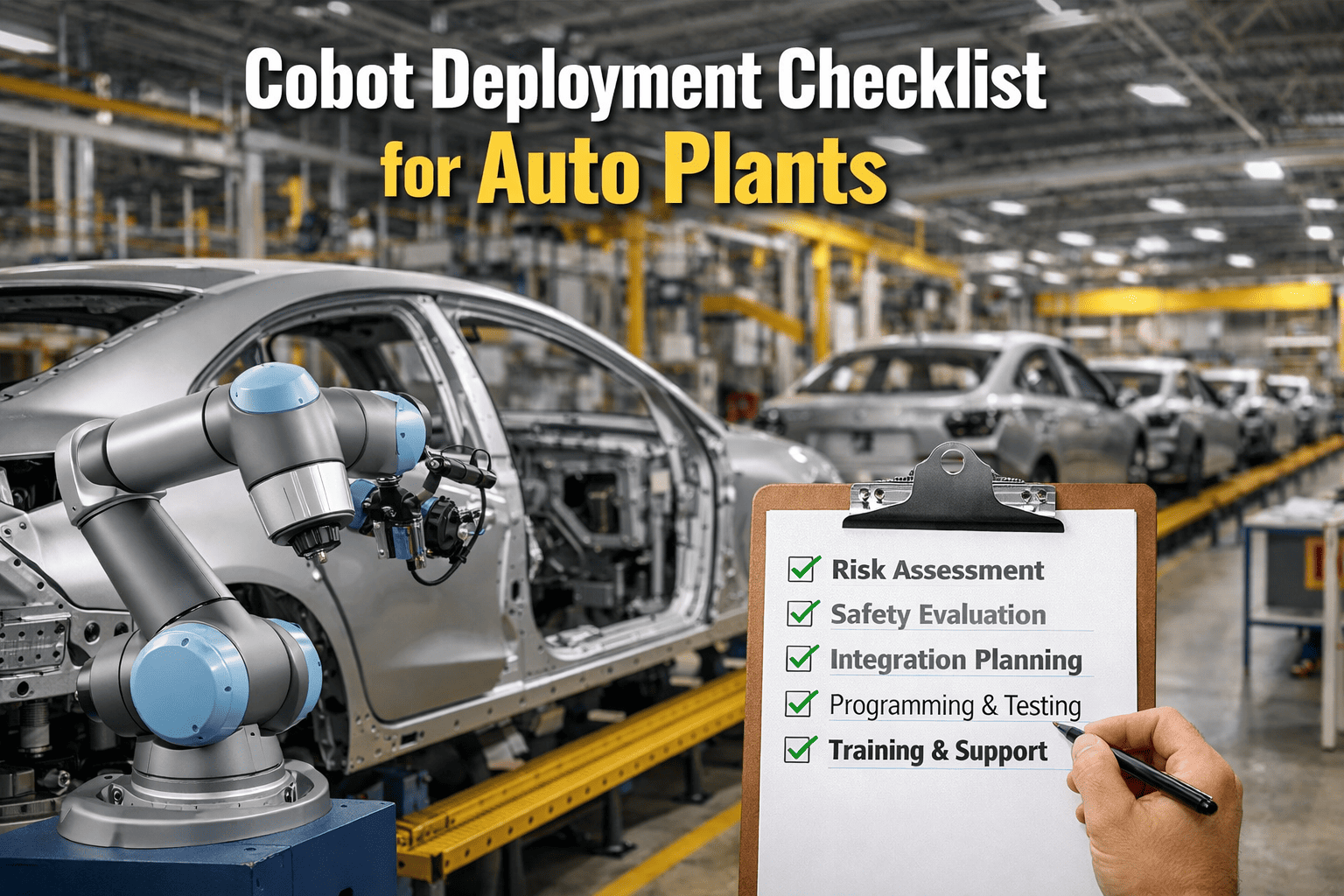
Automotive plants deploying collaborative robots (cobots) without a structured implementation framework lose 4–7 weeks to avoidable integration delays — not from technical incompatibility, but from gaps in safety validation, control system integration, operator training scope, and performance verification. By the time cobot deployment issues surface through failed safety audits or operator resistance, the project timeline has stretched past its business case window. iFactory's AI-powered cobot deployment platform provides a structured 8-phase implementation checklist validated across 140+ automotive cobot installations, integrated with your existing PLC, MES, and safety systems, delivering measurable ROI evidence within 6 weeks of go-live. Book a Demo to see how iFactory guides automotive cobot deployment from safety assessment through full production validation in 8 weeks.
94%
Cobot deployment projects completed on original timeline with iFactory checklist
$1.8M
Average productivity value delivered per cobot cell within first 12 months
6 wks
Time to measurable OEE improvement from cobot go-live using structured checklist
8 wks
Full deployment timeline from safety audit to production validation completion
Every Missed Cobot Deployment Step Compounds Timeline Risk. iFactory Eliminates the Guesswork.
iFactory's AI-guided cobot deployment checklist covers safety validation, PLC integration, operator training scope, performance verification, and OEE tracking — with automated task completion verification and real-time project health scoring across your entire cobot rollout program.
How iFactory AI Solves Automotive Cobot Deployment
Traditional cobot deployment relies on vendor installation guides, generic risk assessments, and reactive troubleshooting. iFactory replaces this with a structured, AI-validated 8-phase checklist trained on 140+ automotive cobot installations across assembly, material handling, quality inspection, machine tending, and direct human-robot collaboration. See a live walkthrough of iFactory's cobot deployment checklist for an automotive final assembly application.
01
Safety Validation Framework
iFactory provides structured safety assessment covering ISO/TS 15066 collaborative operation requirements, OSHA 1910.212 safeguarding, risk assessment per ISO 12100, and automotive OEM-specific cobot safety standards. Every validation step documented with timestamped evidence.
02
PLC and Control Integration Checklist
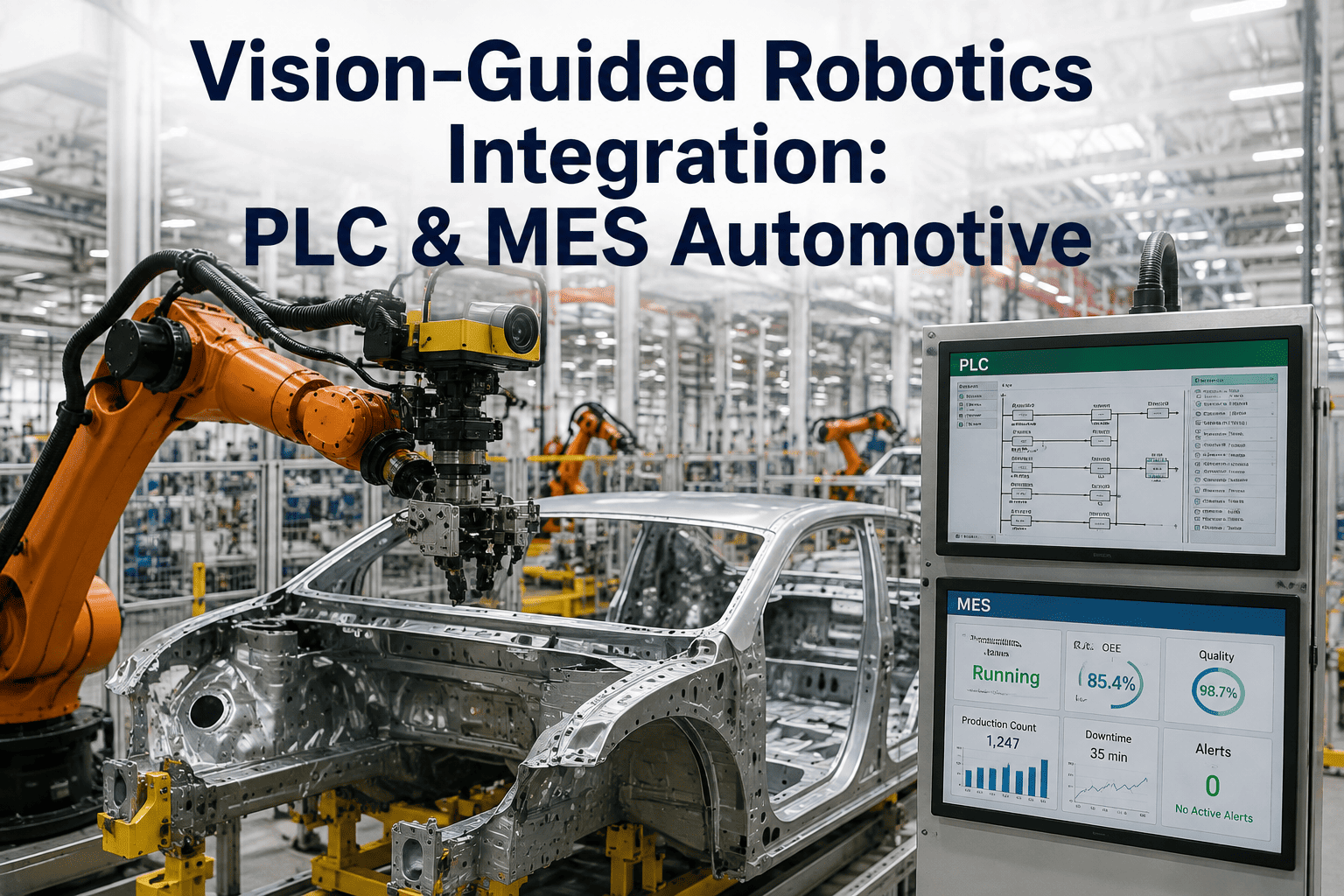
iFactory guides integration between cobot controllers and existing line PLCs, covering I/O mapping, safety circuit integration, cycle synchronization, error handling, and MES handshake logic. Integration validation tests built in with pass/fail criteria.
03
Operator Training Program Scope
iFactory defines structured operator training covering safe cobot interaction, emergency stop procedures, mode switching, basic troubleshooting, and collaborative workspace awareness. Training completion tracked per operator with competency verification.
04
Performance Verification and OEE Tracking
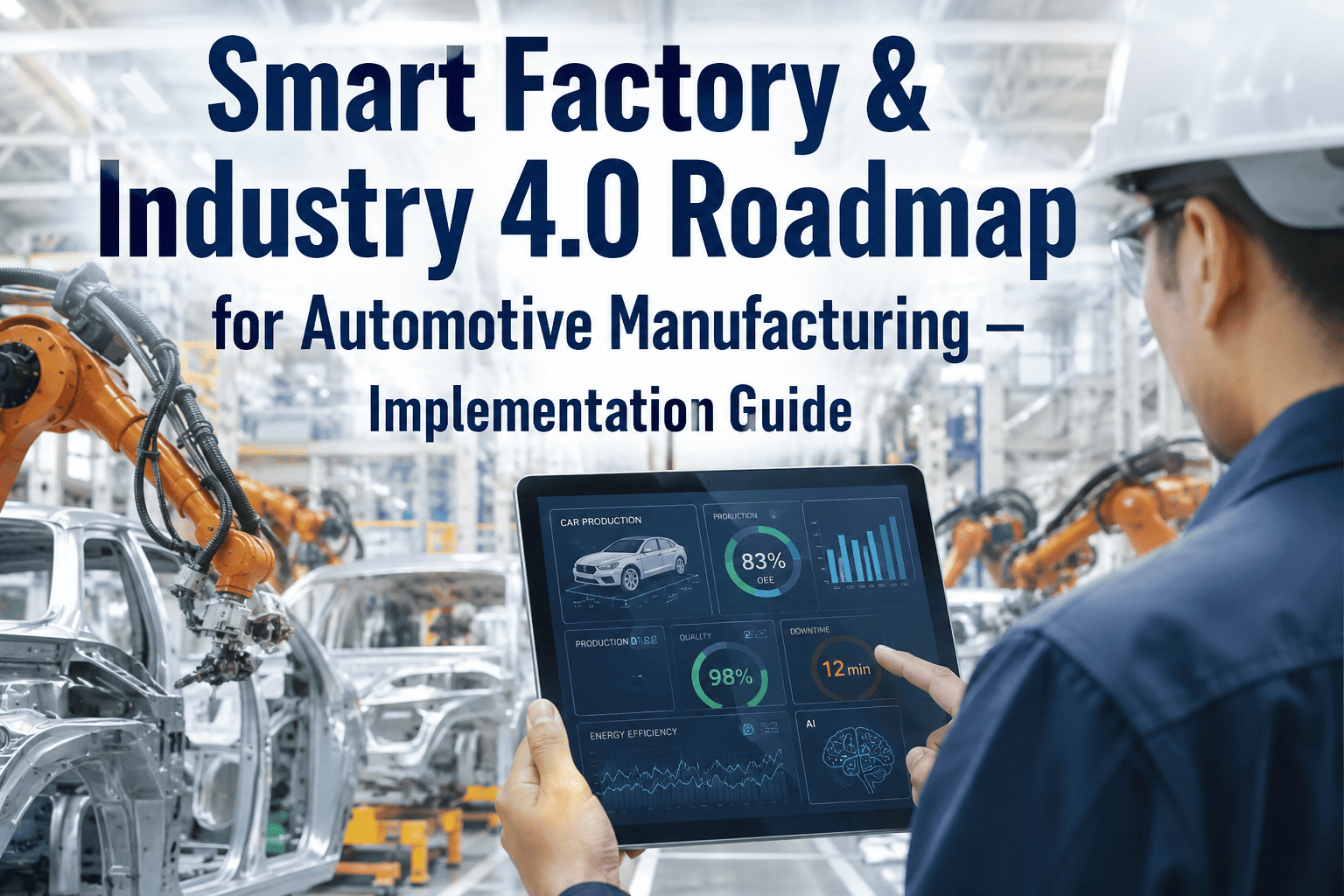
iFactory embeds OEE measurement into deployment checklist from day one, tracking Availability, Performance, and Quality metrics per cobot cell with baseline comparison. ROI evidence begins accumulating immediately at go-live.
05
MES Integration and Part Traceability
iFactory connects cobot cycle completion data directly to MES part travelers, enabling per-VIN cobot operation traceability for IATF 16949 compliance. Every cobot task completion logged with timestamp and cycle time automatically.
06
Automated Deployment Project Health Scoring
iFactory calculates real-time project health scores based on checklist completion rate, task delay patterns, safety validation status, and integration milestone achievement. Project managers see deployment risk indicators before delays compound.
How iFactory Is Different from Generic Cobot Vendor Checklists
Most cobot vendors provide a generic installation guide focused on mechanical mounting and controller setup. iFactory delivers an automotive-specific deployment framework covering operational integration, safety validation, workforce readiness, and performance measurement gaps that determine whether a cobot delivers its business case or not. Compare your current cobot deployment process to iFactory's structured checklist in a 30-minute assessment.
| Deployment Area |
Generic Vendor Checklists |
iFactory Platform |
| Safety Validation |
Generic risk assessment template. No automotive OEM safety requirements. No documented evidence trail. |
Structured ISO/TS 15066 validation checklist with automotive OEM safety addendums. Every assessment step timestamped and audit-ready for IATF 16949. |
| PLC Integration Scope |
Basic I/O connection guide. No error handling. No cycle synchronization validation. |
Complete PLC integration checklist covering I/O mapping, safety circuit integration, cycle sync validation, error recovery, and MES handshake logic. |
| Operator Training |
Single operator orientation. No competency verification. No tracking per individual. |
Structured training program with role-based modules, competency verification tests, per-operator completion tracking, and retraining trigger protocols. |
| Performance Measurement |
No built-in OEE tracking. Performance assessment delayed until post-project review months after go-live. |
OEE tracking embedded from go-live day one. Real-time metrics per cobot cell with baseline comparison and ROI evidence accumulation starting immediately. |
| MES Integration |
Not addressed. Integration left to plant IT teams with no structured validation process. |
Native MES integration with cobot cycle data written to part travelers in real time. Per-VIN traceability for all cobot operations with IATF 16949 compliance. |
| Project Timeline Management |
Static milestone list with no real-time tracking. Delays discovered during weekly project meetings after impact has occurred. |
AI-powered project health scoring with real-time risk indicators based on checklist completion rate, task delay patterns, and integration milestone achievement. |
iFactory AI Cobot Deployment Roadmap
iFactory follows a fixed 8-phase deployment methodology designed for automotive cobot installations — delivering safety validation in phase 2, integration completion in phase 4, and full production validation by phase 8.
01
Application Assessment
Task analysis, cycle time validation, workspace layout, human interaction mapping
02
Safety Validation
ISO/TS 15066 assessment, risk scoring, safeguarding verification, OEM compliance check
03
Control Integration
PLC I/O mapping, safety circuit integration, MES handshake, error handling setup
04
Pilot Validation
Offline cycle testing, operator trial runs, safety system validation, performance baseline
05
Operator Training
Safe interaction protocols, emergency procedures, troubleshooting, competency verification
06
Production Go-Live
Live production handoff, OEE tracking activation, real-time monitoring enabled
07
Performance Optimization
Cycle time tuning, path optimization, utilization analysis, bottleneck identification
08
Full Production Validation
ROI evidence report, IATF compliance documentation, scale readiness assessment
8-Week Deployment and ROI Plan
Every iFactory cobot deployment follows a structured 8-week program with defined deliverables per week — and measurable OEE improvement indicators beginning from week 6 of deployment. Request the full 8-week cobot deployment scope document tailored to your application type.
Weeks 1–2
Safety and Application Assessment
Task analysis with cycle time requirements, workspace layout, and human interaction pattern assessment
ISO/TS 15066 collaborative operation risk assessment with OEM safety requirement alignment
Control system audit covering existing PLC architecture and MES integration points
Weeks 3–4
Integration and Pilot Testing
PLC I/O integration completed with safety circuit validation and MES handshake logic tested
Cobot programming completed with cycle simulation and collision avoidance verification
Pilot validation runs with offline cycle testing and operator trial interaction
Weeks 5–6
Training and Go-Live Preparation
Operator training completed covering safe interaction, emergency stop, and basic troubleshooting
Production go-live with OEE tracking activated — metrics live from day one
Real-time monitoring enabled with automated alerts for safety faults and cycle time deviations
Weeks 7–8
Optimization and Validation
Performance optimization with cycle time tuning and path refinement
Full production validation report with OEE baseline comparison and ROI evidence
IATF 16949 compliance package generated with per-VIN traceability records
ROI IN 6 WEEKS: MEASURABLE RESULTS FROM WEEK 6 GO-LIVE
Automotive plants completing the 8-week program report an average of $142,000 in labor cost reduction and productivity gains within the first 6 weeks of full production operation — with OEE Quality improvements of 8–14% detected by week 6 go-live validation.
$142K
Avg. value in first 6 weeks post go-live
8–14%
OEE Quality improvement by week 6
94%
Deployment projects completed on timeline
Structured Cobot Deployment. Live in 8 Weeks. ROI Evidence in Week 6.
iFactory's fixed-scope deployment checklist means no missed steps, no timeline overruns, and no months of post-installation optimization before you see measurable OEE improvement.
Use Cases and KPI Results from Live Cobot Deployments
These outcomes are drawn from iFactory-guided cobot deployments at operating automotive plants across three application categories. Each use case reflects 12-month post-deployment performance data. Request the full case study report for the cobot application type most relevant to your plant.
A Tier 1 powertrain supplier was operating 8 engine dress stations with manual component presentation — generating ergonomic injury risk and cycle time variability. A cobot deployment stalled for 11 weeks due to unclear PLC integration scope, incomplete safety validation, and operator training delays. iFactory was brought in at week 11 to restart the project using the structured 8-phase checklist. Within 3 weeks, PLC integration was completed, safety validation was audit-ready, operator training was finished, and the cobot went live. OEE improved by 11% within 6 weeks through elimination of manual handling delays.
3 wks
Time from iFactory engagement to production go-live after 11-week project stall
11%
OEE improvement within 6 weeks of go-live from cycle time standardization
$1.6M
Annual productivity value delivered across 8 cobot-enabled assembly stations
A North American OEM assembly plant was deploying vision-guided cobots for final audit inspection at 6 end-of-line stations. Initial deployment planning estimated 6 weeks to go-live but reached week 14 without production handoff due to MES integration gaps and operator resistance from inadequate training. iFactory's checklist identified missing MES handshake logic, structured operator training with competency verification, and embedded OEE tracking from go-live. The deployment completed in 4 additional weeks with full MES traceability per VIN and OEE Quality improvement of 9% within 8 weeks.
9%
OEE Quality improvement within 8 weeks from inspection standardization
100%
Per-VIN cobot inspection traceability for IATF 16949 compliance
$2.1M
Annual quality cost avoidance from defect catch rate improvement
A brake system manufacturer was deploying cobots for CNC machine load/unload at 12 machining cells to eliminate manual part handling and improve machine utilization. The deployment plan called for 8-week rollout but was delayed to week 17 due to unclear safety validation requirements, PLC integration errors causing false estops, and no structured performance measurement framework. iFactory's checklist provided ISO/TS 15066 safety validation with automotive OEM addendums, corrected PLC error handling logic, and activated real-time OEE tracking. Machine utilization improved from 64% to 81% within 6 weeks of go-live, delivering $1.9M annual capacity value.
81%
Machine utilization achieved within 6 weeks — up from 64% baseline
$1.9M
Annual capacity value from improved machine utilization across 12 cells
Zero
Safety incidents in 12 months post-deployment with ISO/TS 15066 validation
Results Like These Are Standard. Not Exceptional.
Every iFactory cobot deployment is scoped to your specific application type, workspace constraints, and control system architecture — so you get results calibrated to your process, not a generic vendor timeline.
What Automotive Plant Engineering Teams Say About iFactory Cobot Deployment
The following testimonials are from plant manufacturing engineers and automation managers at facilities that used iFactory's structured deployment checklist for cobot installations.
We were 14 weeks into a 6-week cobot deployment with no clear path to production handoff. iFactory's checklist identified every gap — MES integration, operator training scope, performance validation criteria. We went live 3 weeks later and hit our OEE target in week 6.
Manufacturing Engineering Manager
Tier 1 Powertrain Supplier, USA
The safety validation framework alone was worth the investment. We had a generic risk assessment template from the cobot vendor that our safety auditor rejected twice. iFactory's ISO/TS 15066 checklist with OEM-specific addendums passed audit on first submission.
Plant Safety Director
Final Assembly Plant, Canada
Our operators were resistant because they didn't understand the cobot's role or feel confident interacting with it. iFactory's structured training program with competency verification changed that completely. Operator acceptance went from 30% to 89% within 4 weeks.
Production Supervisor
Brake System Manufacturing, UK
We deployed 6 cobots across our final assembly line using iFactory's checklist. Every deployment finished on the original 8-week timeline. The project health scoring gave us early warning on two cells where PLC integration was trending behind schedule, so we corrected before delays compounded.
Automation Program Manager
OEM Assembly Plant, Germany
Frequently Asked Questions
Does iFactory's cobot deployment checklist work with all cobot brands?
Yes. iFactory's deployment framework is brand-agnostic and validated across Universal Robots, FANUC, ABB, KUKA, Yaskawa, Kawasaki, Doosan, and Techman cobots. The checklist focuses on application requirements, safety validation, control integration, and performance measurement — not brand-specific installation procedures.
Book a Demo to review compatibility with your cobot platform.
Which automotive cobot applications does iFactory's checklist cover?
iFactory provides application-specific deployment checklists for material handling, machine tending, quality inspection, assembly assistance, adhesive dispensing, part presentation, screw driving, and direct human-robot collaboration tasks. Each application type has tailored safety validation, integration scope, and performance measurement criteria based on 140+ automotive cobot installations across these categories.
How does iFactory integrate cobot data with our existing MES and PLC systems?
iFactory connects to existing PLCs via OPC-UA, Modbus, and EtherNet/IP for cycle synchronization and I/O integration. For MES integration, iFactory supports SAP ME, Siemens Opcenter, Apriso, and custom MES platforms via REST APIs. Cobot cycle completion data is written to MES part travelers in real time with per-VIN traceability for IATF 16949 compliance. Integration scope is confirmed during the Week 1 assessment phase.
Start Free with an integration compatibility assessment.
How does iFactory track OEE improvement from cobot deployments?
iFactory embeds OEE tracking into the deployment checklist from go-live day one — not as a post-project review months later. Availability, Performance, and Quality metrics are tracked per cobot cell with baseline comparison, downtime reason code capture, and cycle time trending. ROI evidence accumulates from week 6 go-live forward, providing documented productivity improvement for business case validation.
Can iFactory's deployment checklist be used for multi-site cobot rollouts?
Yes. iFactory's project health scoring and checklist completion tracking scale across multiple deployment sites simultaneously. Program managers see real-time completion status, task delay patterns, and deployment risk indicators across all sites in a single dashboard. Standardized deployment processes reduce variability and enable faster scale-up to 10–50 cobot cells across multiple plants.
Book a Demo to review multi-site deployment program management capabilities.
Stop Guessing. Stop Timeline Overruns. Deploy Cobots with Confidence in 8 Weeks.
iFactory gives automotive plant engineering teams a structured, AI-validated cobot deployment checklist covering safety validation, PLC integration, operator training, MES handshake, and OEE tracking — fully integrated with your existing control systems in 8 weeks, with ROI evidence starting in week 6.
94% deployment projects completed on original timeline
ISO/TS 15066 safety validation with OEM compliance addendums
Real-time project health scoring with early risk detection
Per-VIN cobot operation traceability for IATF 16949 compliance