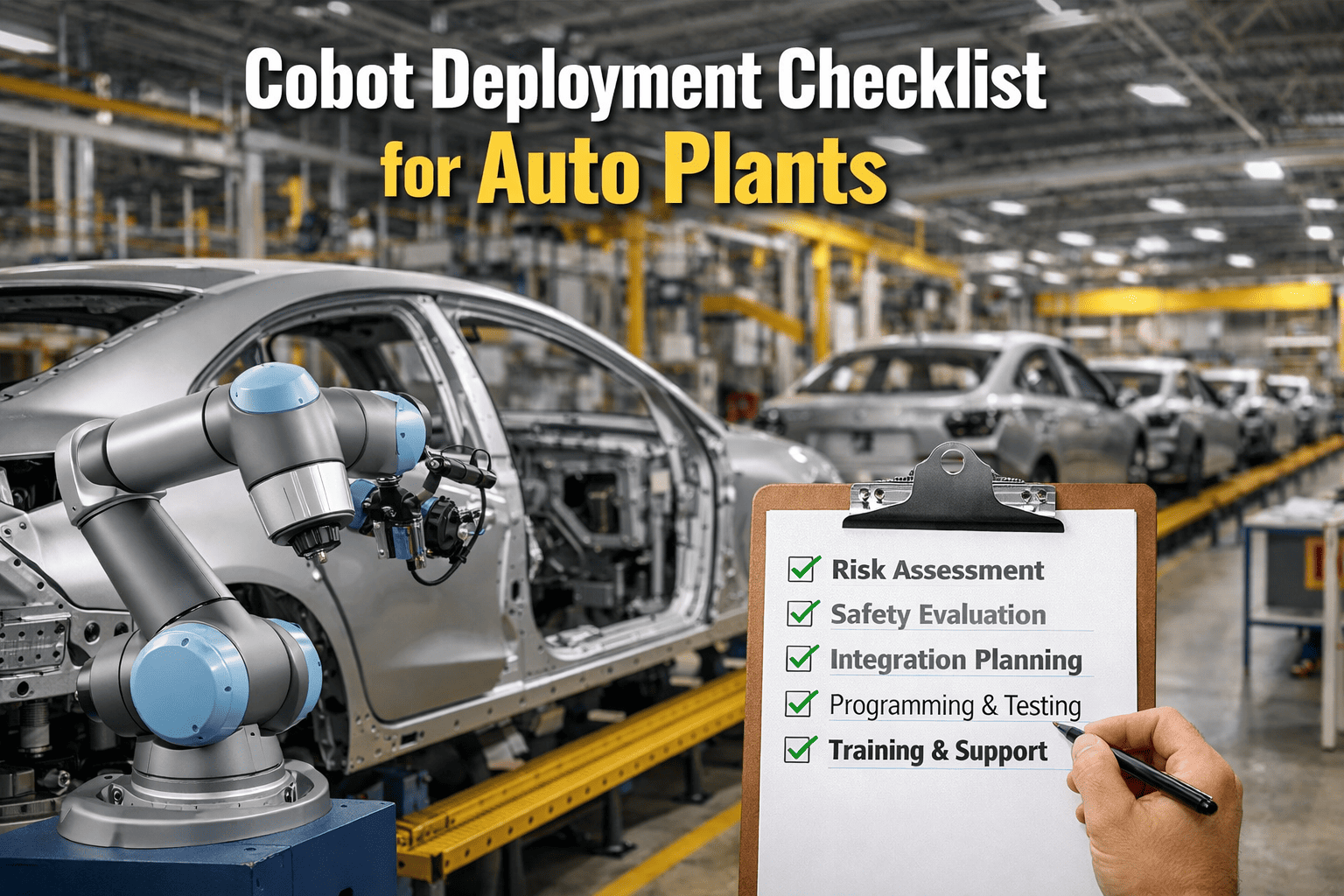
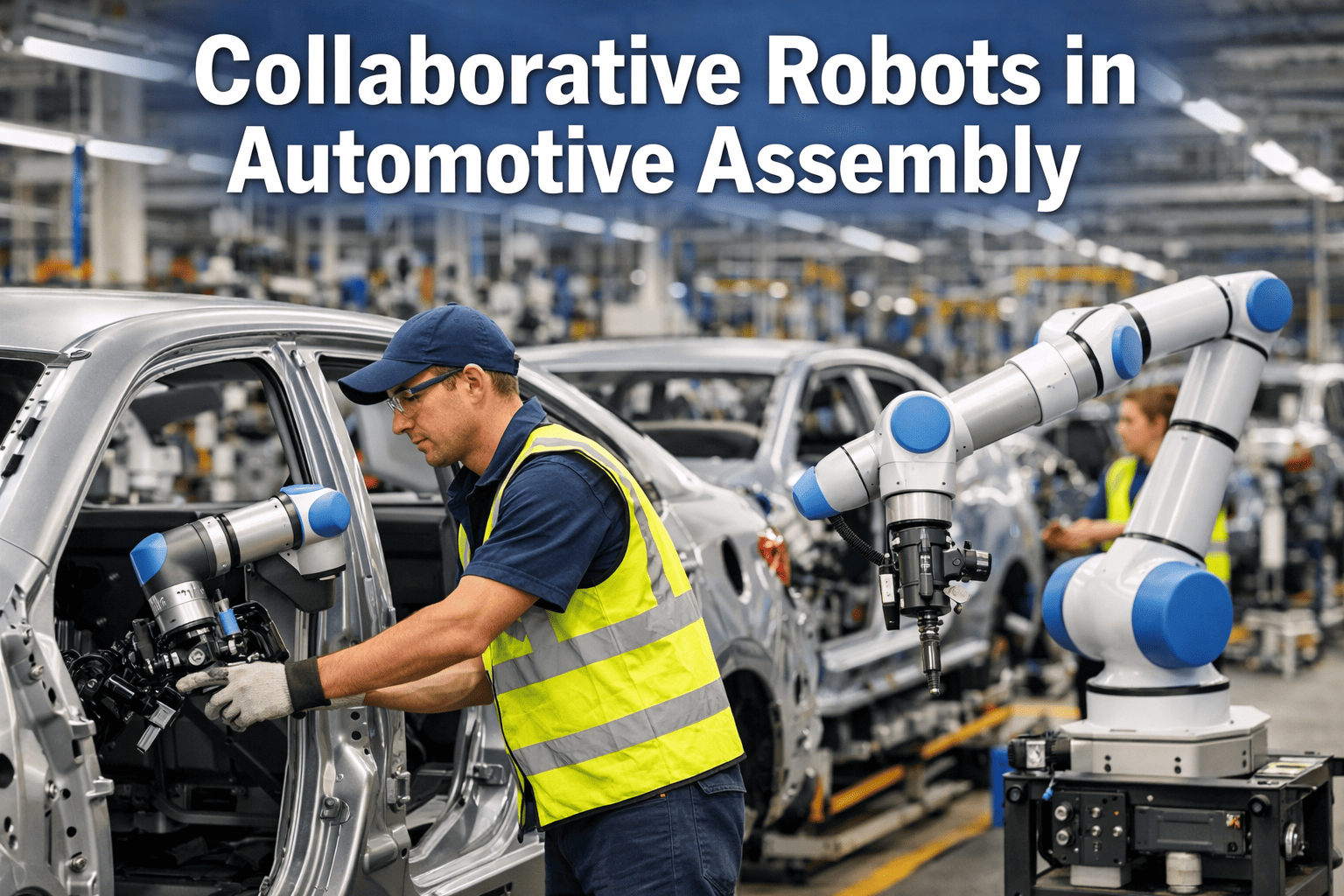
Walk a modern trim and final assembly line and you'll increasingly see a robot arm working elbow to elbow with a person, no fence between them, no safety cage separating the two. That's the defining shift cobots brought to automotive assembly: industrial robots historically needed isolation because their force and speed made proximity to a human dangerous, while cobots are engineered with force limits and fault detection that let them share a workspace directly. That changes what's worth automating. Tasks that were too variable, too dexterous, or too low-volume to justify a fenced industrial robot cell — torque fastening on a mixed-model line, adhesive application that still benefits from a person's judgment on placement, component loading into tight assemblies — are now candidates for a cobot working alongside the person already doing that job, not replacing them outright. Explore which of your assembly stations fit that profile with a Book a Demo.
Not Every Automation Decision Requires a Fence Around It
AI-guided cobots handle torque fastening, adhesive application, component loading, and quality inspection directly alongside operators — deployed with the same rigor as any process change, without a full-scale industrial robot cell.
Where Cobots Are Actually Earning Their Place on the Line
Automotive assembly generated the earliest and still the largest share of cobot deployments in manufacturing, and the applications that stuck are the ones where consistency and repeatability matter more than raw speed — exactly the profile of tasks that were previously done by hand with variable outcomes.
Torque Fastening
Force-torque sensing applies exact fastener preload within tight tolerance, preventing both overtightening damage and undertightening connection failures on repetitive fastening operations.
Adhesive & Sealant Application
Consistent pressure and bead placement on door panel insulation, sealing applications, and trim adhesion — work that benefits from robotic consistency but still often runs alongside a human operator.
Component Loading
Adaptive grippers handle varied part geometries in steering column, airbag connector, and electronic control assembly without damaging sensitive components or connectors.
Vision-Guided Inspection
Cameras and sensors mounted on or alongside cobots check dimensional accuracy, verify component placement, and flag surface defects at the station where the part is being handled.
Map Your Line for Cobot-Ready Stations
iFactory helps process engineers identify which stations benefit from cobot deployment and tracks torque, cycle time, and quality data once they're live.
Fenceless Doesn't Mean Unassessed
The absence of a physical safety cage is the result of a formal risk assessment, not a shortcut around one. Every collaborative application still requires evaluation against ISO/TS 15066 biomechanical limits, which define force and pressure thresholds that vary by body region — what's acceptable for contact with a forearm can be dangerous for a head or neck, and the risk assessment has to account for that difference station by station.
Task and workspace analysis identifies where operator and cobot paths actually intersect during the cycle.
Biomechanical risk assessment evaluates force and pressure limits against ISO/TS 15066 for each contact scenario.
Speed, force, and torque limits are configured per application, not applied as a single blanket setting.
Ongoing monitoring confirms the cobot continues operating within its assessed and validated safety envelope.
What Separates a Successful Cobot Rollout From a Stalled One
Cobot adoption isn't a plug-and-play decision, even though the hardware itself deploys faster than a traditional industrial robot cell. Success depends less on the robot's capability and more on how carefully the task was selected and how the surrounding process was adapted around it.
| Factor | Good Cobot Candidate | Poor Cobot Candidate |
|---|---|---|
| Task variability | Consistent motion, varied part orientation | Fully unpredictable, no defined cycle |
| Payload and torque | Within collaborative robot limits | Requires industrial-grade force levels |
| Ergonomic profile | Repetitive, fatiguing for operators | Already low physical demand |
| Volume and mix | High-mix, low-to-medium volume | Ultra-high volume, single part number |
We picked our first cobot application badly — a task that looked repetitive on paper but had more part-to-part variation than we'd accounted for, and it stalled for months. The second deployment, adhesive application on door insulation, worked because we actually walked the process with the operator first instead of assuming the job description told us everything. That one paid back in under a year.
Frequently Asked Questions
Q: Can a single cobot handle multiple different applications across a shift?
Yes — separate AI sub-models trained per application category, such as material handling, fastening, component installation, and adhesive dispensing, account for the different mechanical loading, cycle time patterns, and failure modes each task involves, so a multi-application cobot fleet is fully supported within a single deployment. Application-specific detection parameters are typically configured during a model training phase using historical performance data from each workstation type.
Q: What quality documentation does cobot deployment support for automotive customers?
Structured quality records auto-generate in formats aligned to IATF 16949 automotive quality management, AIAG PPAP documentation packages, VDA automotive standards, and customer-specific requirements including Ford Q1, GM BIQS, and FCA TQM. This matters particularly for torque fastening and adhesive applications where preload and coverage traceability are frequently required as part of a supplier's quality submission package.
Q: How do we know if a task's payload is within collaborative robot force limits?
Collaborative robots are mechanically designed with joint torque limits — often in the range of a few dozen newton-meters — that trigger a fault or shutdown if resistance exceeds a safe threshold, which is fundamentally different from industrial robots rated for hundreds of newton-meters. High-torque tightening applications that exceed a cobot's rated capacity typically still require either an industrial robot in a fenced cell or a human operator using an ergonomic support arm. Talk through your specific torque specifications with Support before selecting hardware.
Q: What's a realistic payback period for a well-chosen cobot application?
Payback periods under 12 months are typical for well-chosen applications, driven by a combination of direct labor augmentation, reduced ergonomic injury and workers' compensation exposure, and quality improvement from consistent torque, placement, and inspection that reduces rework and warranty costs. Poorly chosen applications — tasks with too much unaccounted variability — extend or eliminate that payback, which is why task selection matters more than the hardware decision itself.
Q: Does deploying cobots reduce headcount on the line?
Most successful automotive cobot deployments position the robot as an augmentation to the operator already at that station rather than a replacement for them — handling the repetitive, fatiguing, or precision-critical portion of the task while the operator continues to apply judgment the robot can't. The reported benefits across deployed programs lean toward higher throughput and lower injury rates from the same workforce rather than reduced headcount. Schedule a Book a Demo to walk through deployment models that fit your workforce plan.
Find the Stations Where a Cobot Actually Pays Back
Get a task-by-task assessment of where collaborative robots fit your line — and where they don't.