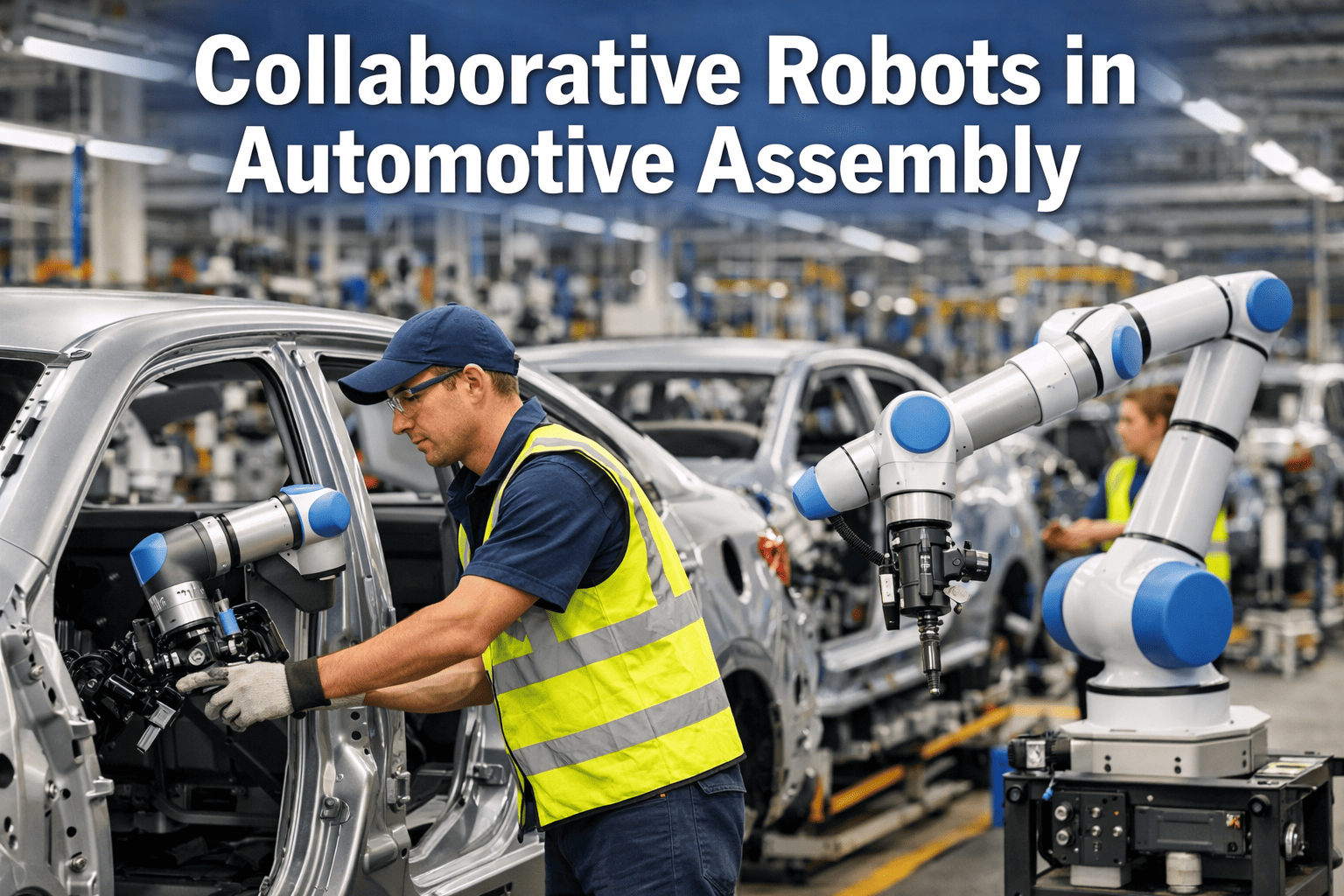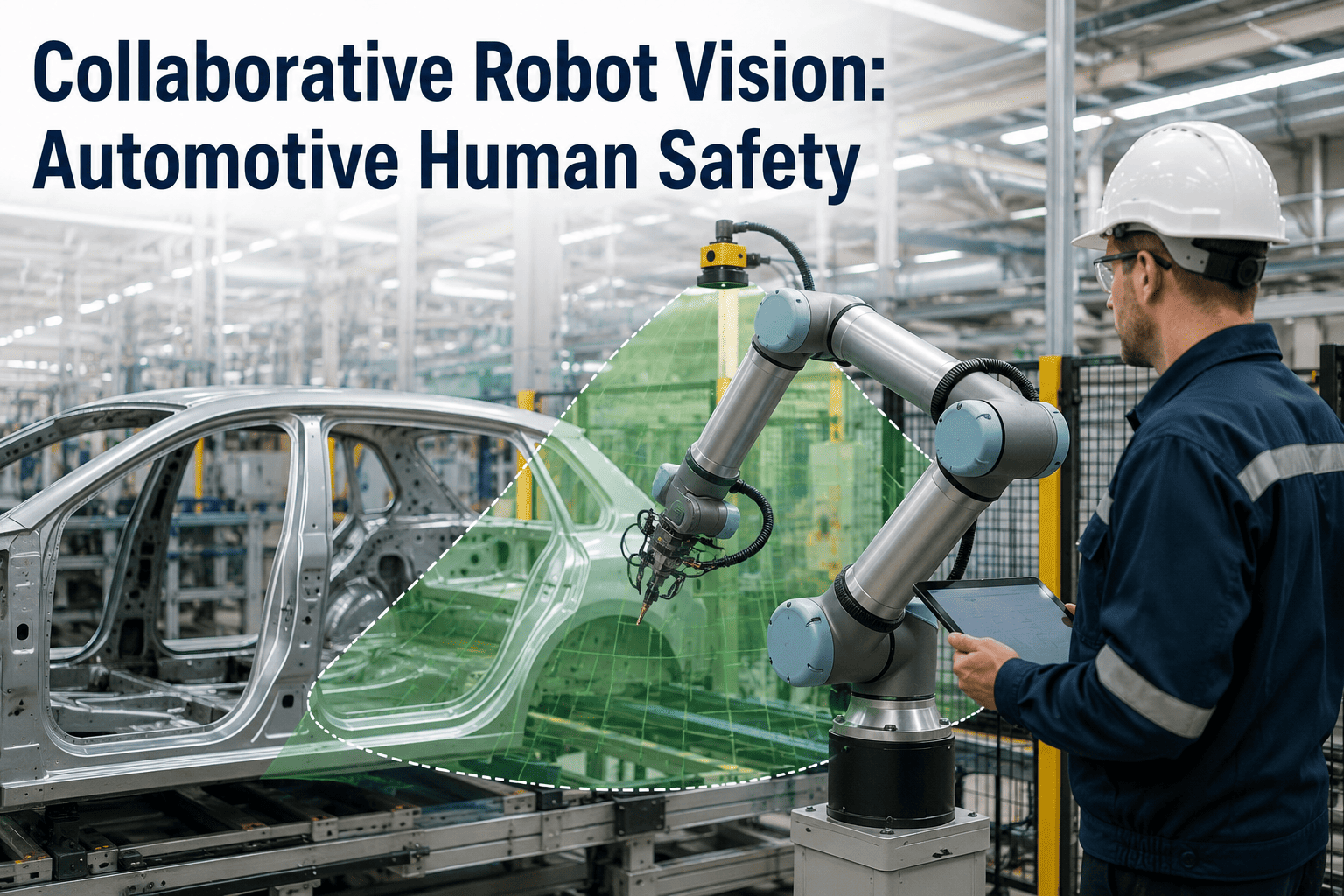
A collaborative robot working next to a person on an automotive line has to answer one question continuously, dozens of times a second: is a human close enough right now that the robot needs to slow down, or stop entirely? Fixed safety mats and light curtains answer that question with a hard boundary line. Vision-based safety systems answer it with something closer to spatial awareness, tracking where a person actually is and adjusting robot behavior accordingly — which is the difference iFactory's cobot vision integration is built around for automotive assembly lines.
Not Every Safety Zone Should Trigger the Same Robot Response
Vision-enabled cobots don't just detect a person's presence — they track position continuously and scale robot speed across graduated zones, instead of forcing a single all-or-nothing stop boundary.
Why a Single Stop Boundary Isn't Actually the Safest Option
A fixed light curtain or safety mat has one job: detect a breach and stop the robot. That's reliably safe, but it's also blunt — it can't distinguish between a person walking past at a distance and a person reaching directly into the robot's working envelope, so it treats both the same way. Graduated vision-based zones respond proportionally instead, which keeps the robot productive during low-risk proximity while still stopping completely when a person actually enters the danger zone.
Monitor Zone
The outermost tracked area, where a person's presence is logged and the system stays alert but the robot continues normal operation at full speed.
Slow Zone
A closer tracked area where robot speed is automatically reduced in proportion to how close the person is, giving both the robot and the person time to react before any contact risk develops.
Stop Zone
The innermost boundary immediately around the robot's working envelope, where any human presence triggers an immediate, full stop regardless of what task the robot was performing.
Adaptive Speed Control
The continuous adjustment of robot velocity as tracked distance changes, rather than a binary full-speed-or-stopped behavior — this is what keeps the robot productive most of the time.
Fixed Safety Devices vs. Vision-Based Zone Tracking
Both approaches are built to prevent the same outcome, but they differ significantly in how much productivity they preserve while doing it. A fixed device treats every breach identically; a vision system treats a breach differently depending on where and how close it actually is.
| Safety Approach | Fixed Mats / Light Curtains | Vision-Based Zone Tracking |
|---|---|---|
| Detection Type | Binary breach detection at a fixed boundary | Continuous position tracking across zones |
| Robot Response | Full stop on any breach | Graduated slowdown, full stop only in innermost zone |
| Productivity Impact | Frequent full stops for low-risk proximity | Continued operation during low-risk proximity |
| Layout Flexibility | Boundary fixed by physical device placement | Zones can be reconfigured without moving hardware |
Layout flexibility deserves particular attention for automotive lines, where cell layouts change more often than the underlying safety infrastructure typically wants to. A fixed light curtain repositioned to match a new cell layout usually means new hardware installation and requalification. A vision system's zones can often be reconfigured through software, which shortens the changeover process considerably when a line is rebalanced or a new task is added to a collaborative cell.
Keep Your Cobots Running Without Compromising on Safety
iFactory's vision-based safety zones let automotive cells stay productive during low-risk proximity while still stopping instantly when it matters.
Deploying Vision-Based Cobot Safety: The Process
Map the cell's actual working envelope
Document the robot's full range of motion and the tasks performed in the cell before defining zone boundaries, so zones reflect real risk rather than a generic template.
Define graduated zones and speed response curves
Set monitor, slow, and stop zone boundaries along with how quickly robot speed should scale down as a person moves through the slow zone.
Validate detection under real operating conditions
Test detection reliability under the cell's actual lighting, occlusion patterns, and typical operator movement before relying on it in production.
Integrate with robot controller response
Connect zone tracking output directly to the robot's speed and stop controls, confirming response time meets the required safety standard for the application.
Monitor and refine after go-live
Review actual zone trigger frequency after deployment to identify whether boundaries are too conservative or too tight relative to real operator movement patterns.
A Composite Scenario: The Cell That Was Stopping More Than It Was Working
An automotive final assembly line installed a collaborative robot for a fastening task, protected by a fixed light curtain sized to the cell's original layout. Operators working an adjacent station frequently passed within the curtain's boundary while performing unrelated tasks that never actually brought them near the robot's working envelope, triggering full stops dozens of times per shift purely from incidental proximity rather than genuine risk.
The frequent stops were costing measurable cycle time, but the team's first instinct — disabling or repositioning the curtain — would have compromised the actual safety intent. Replacing the fixed curtain with a vision-based system that tracked continuous position instead of a single boundary let the team define a wider monitor zone where incidental passing traffic didn't affect the robot at all, a slow zone that only activated when someone approached with clear intent toward the robot's actual working area, and a tight stop zone immediately around the fastening tool itself. Full stops dropped to only the situations that actually warranted them, and the cell's effective uptime improved without loosening the underlying safety standard the original curtain had been sized to meet.
Stop Losing Cycle Time to a Safety System That Can't Tell the Difference
iFactory's graduated safety zones respond to real proximity risk instead of triggering a full stop on every incidental pass near the cell.
Frequently Asked Questions
How is vision-based cobot safety different from a standard light curtain?
A light curtain detects a breach at one fixed boundary and stops the robot entirely, while a vision-based system tracks a person's actual position continuously across graduated zones, allowing the robot to slow down proportionally rather than stopping for every incidental proximity event. Visit support to see how zone tracking is configured for a specific cell layout.
Does a vision-based safety system meet the same safety standards as fixed devices?
Vision-based safety systems are designed and validated against the same collaborative robot safety requirements that govern fixed devices, with the graduated response built on top of that underlying safety foundation rather than replacing it — the goal is preserving the safety standard while reducing unnecessary full stops.
Can zone boundaries be changed after installation without new hardware?
In most vision-based deployments, zone boundaries are configured in software rather than fixed by physical device placement, which makes reconfiguring a cell for a layout change considerably faster than relocating and requalifying a physical light curtain or safety mat. Book a demo to see how zone reconfiguration works in practice.
How much productivity improvement is realistic from switching to graduated zones?
It depends heavily on how much incidental, low-risk traffic was triggering full stops under the previous fixed-boundary system — cells with significant adjacent foot traffic tend to see the largest reduction in unnecessary stops once graduated zones replace a single stop boundary.
What happens if the vision system loses track of a person mid-cycle?
A properly configured system defaults to the most conservative response, typically a full stop, whenever tracking confidence drops below a reliable threshold — the system is built to fail toward caution rather than assume a person has left the monitored area. Contact support for details on how tracking confidence and fallback behavior are configured.