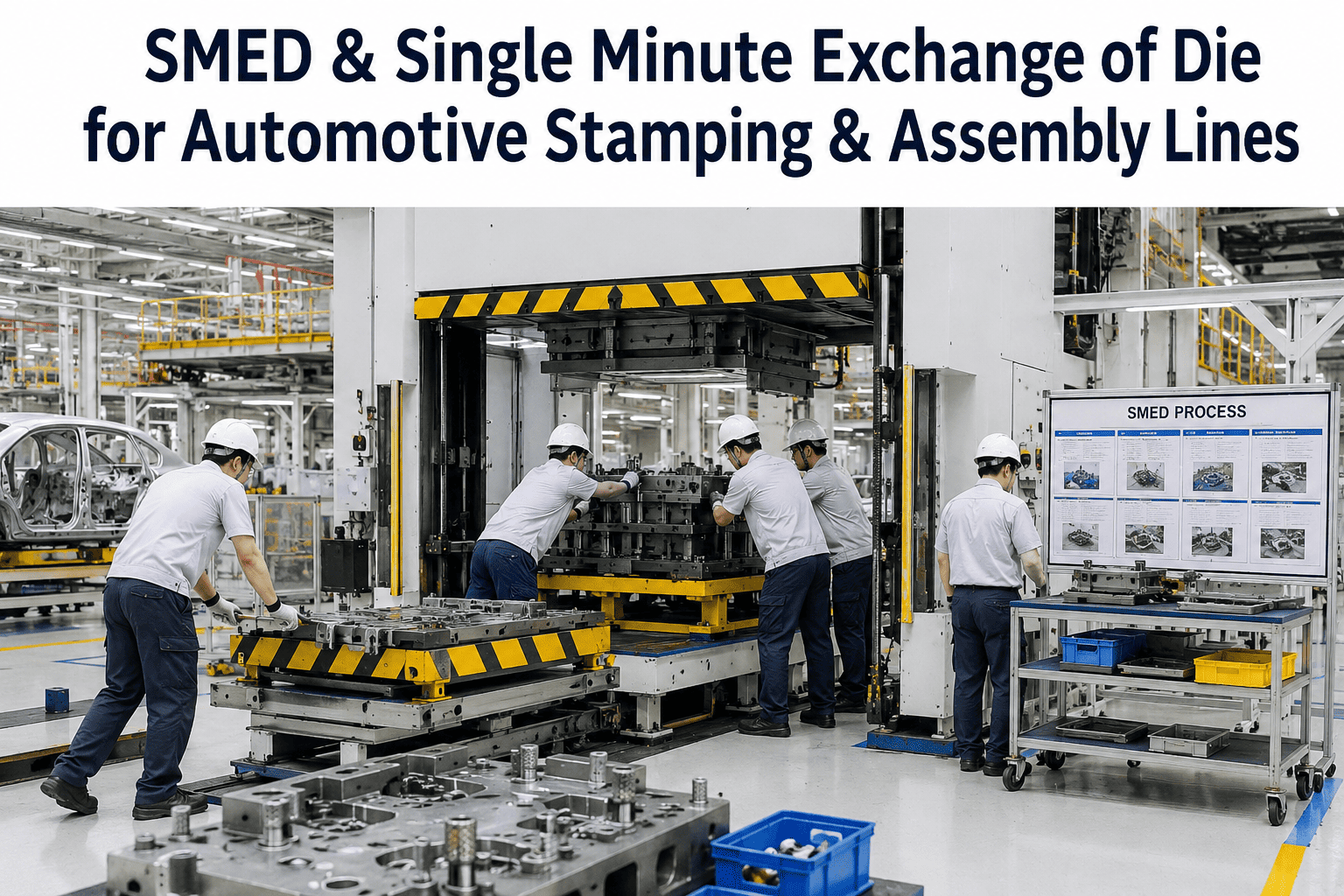
A stamping press earning $400 an hour in production value sits idle for two to four hours during a typical manual die change — searching for the right shims, hand-tightening a dozen clamps, and eyeballing alignment before the first hit. SMED, or Single-Minute Exchange of Die, is the discipline of converting as much of that work as possible into steps done before the press stops, and automating the rest so what remains takes minutes instead of hours. This page breaks down the SMED framework as applied to modern stamping operations, and you can map it against your own press changeover routine with our team.
Cut die changeover time from hours to minutes with AI-assisted SMED
iFactory AI applies pre-staging automation, quick-clamp verification, and computer-vision alignment checks to compress stamping die changeovers without adding risk to press operators.
Internal versus external activity — the core of every changeover reduction
SMED's foundational insight is that every changeover task falls into one of two categories, and most plants have never deliberately separated them. Internal activities can only happen while the press is stopped. External activities can happen while the press is still running the previous job.
- Removing the outgoing die from the bolster
- Setting and clamping the incoming die
- Final alignment and shut height adjustment
- First-hit verification and part inspection
- Staging the incoming die and tooling at the press
- Pre-heating or pre-checking clamps and sensors
- Gathering shims, gauges, and changeover documentation
- Pre-loading the new die's process parameters in the controller
Most manual changeovers treat both categories as internal by default, because nobody staged the external work in advance. Converting even half of a changeover's tasks from internal to external is typically the single largest time reduction available before any new hardware is installed.
Where a typical changeover's two hours actually go
The bar below shows a representative breakdown of a manual stamping die changeover against the same changeover after SMED conversion and AI-assisted verification.
Want this breakdown run against your own press?
Time-study one changeover with our team and we'll show exactly which segments of your process are internal, external, and eliminable.
What actually compresses internal time once external tasks are staged
Separating internal from external work removes waiting time, but the internal work itself still needs to get physically faster. Four technology categories do most of that compression in modern stamping operations.
Automated pre-staging
The incoming die, shims, and tooling are queued at the press bay before the current job even finishes, driven by a schedule that iFactory AI generates from the upcoming production plan rather than a paper changeover board.
Quick-clamp systems
Hydraulic or pneumatic clamps replace multi-bolt manual fastening, cutting die-set time from tens of minutes to under two. Sensor feedback confirms clamp pressure is within specification before the press is allowed to cycle.
Automated alignment verification
Computer-vision cameras check die registration and shut height against the stored specification for that die number, replacing manual gauge checks and catching misalignment before the first production hit rather than after a scrapped part.
Parameter auto-recall
Press tonnage, stroke length, and feed settings for the incoming die are pulled automatically from a stored recipe tied to the die ID, eliminating manual re-entry errors that are a common cause of scrapped first-off parts.
An eight-step path from manual changeover to SMED-compliant
SMED conversion is a structured process, not a single equipment purchase. These are the steps iFactory AI's stamping team walks through with a press line during a changeover reduction program.
Video time-study the current changeover
Record a full changeover start to finish to establish an accurate baseline, since verbal estimates from the floor are consistently lower than the measured reality.
Classify every task as internal or external
Walk through the recorded footage task by task, tagging each one against whether it truly requires the press to be stopped.
Convert internal tasks to external where possible
Redesign the sequence so staging, gathering, and pre-checking happen before the press stops, using the production schedule to trigger staging automatically.
Streamline remaining internal tasks
Apply quick-clamp hardware and standardized shim sets to reduce the physical time required for the internal tasks that cannot be eliminated.
Add automated verification
Deploy vision-based alignment checks and clamp-pressure sensors so the press can be cleared to cycle without a manual gauge check on every changeover.
Standardize the new sequence
Document the converted process as the new standard work, including exactly which tasks happen externally and when they should start relative to the current job's completion.
Train and pilot on one press
Run the new sequence on a single press for several changeovers, measuring actual time against the target before rolling the standard out further.
Scale and continuously refine
Extend the converted process to remaining presses, feeding actual changeover data back into the pre-staging schedule to keep improving timing accuracy.
What changes at each stage of the changeover
The comparison below lines up a manual changeover against an AI-assisted one at each stage of the process, showing where the time and risk actually come out.
| Stage | Manual changeover | AI-assisted changeover |
|---|---|---|
| Tool and shim gathering | Operator searches storage during press downtime | Pre-staged at the press before the outgoing job finishes |
| Die clamping | Multi-bolt manual tightening, uneven torque risk | Quick-clamp actuation with sensor-verified pressure |
| Alignment check | Manual gauge measurement, operator judgment | Computer-vision registration check against stored spec |
| Parameter entry | Manual re-entry from a paper travel card | Auto-recall from a stored recipe tied to die ID |
| First-hit verification | Visual inspection of first few parts | Automated dimensional check flags deviation immediately |
Typical outcomes from SMED and AI-assisted changeover programs
Results vary by die complexity and starting baseline, but these ranges reflect what stamping operations commonly see after a structured SMED conversion.
FAQ: SMED and AI-assisted die changeover in stamping
See where your press changeover time is actually going
We'll walk through a video time study of one changeover, classify every task as internal or external, and show what a converted SMED process would look like on your line.


.png)