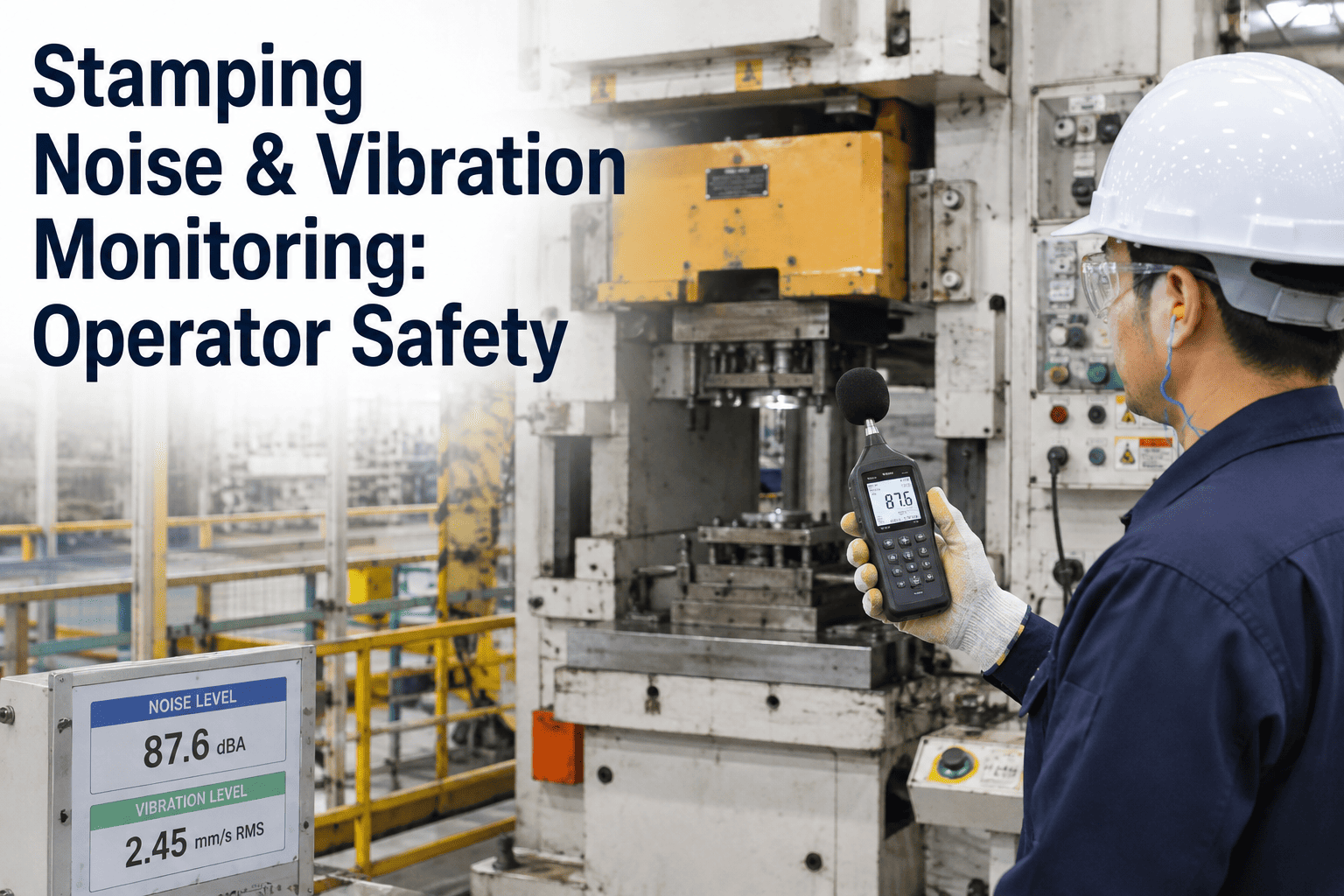
Press shops are loud in a way that most other areas of an automotive plant simply aren't. A single blanking press can produce impact peaks well above 100 dB(A), and when six or eight presses are running on the same floor, the noise doesn't just add up politely — it compounds into a working environment where operators wear hearing protection every shift and still leave with ringing ears. Vibration is the quieter cousin of the same problem: press frames, dies, and feed systems transmit mechanical shock through the floor, through handles, and through whatever an operator happens to be standing near. Most plants know these hazards exist. Far fewer have continuous, quantified data on how bad they actually are at any given press, at any given hour, which makes it nearly impossible to prove a control is working until someone reports pain. A continuously monitored noise and vibration program changes that from a compliance guess into a data-backed safety practice.
Operator Safety · Stamping Operations
Noise and Vibration Monitoring in the Stamping Shop: Turning a Known Hazard Into Measured Risk
Press impacts, die changes, and feed systems generate noise and vibration exposure that's easy to acknowledge and hard to actually track shift over shift. iFactory continuously measures both at the press level, flags exposure trends before they become injury reports, and gives safety teams a defensible, timestamped record instead of a periodic spot-check that only captures a single day out of the year.
Continuous
Noise dosimetry, not annual spot checks
Per-Press
Vibration data tied to specific equipment
Trend-Based
Alerts before exposure limits are exceeded
Why This Gets Missed
The Gap Between Knowing Noise Is a Problem and Actually Measuring It
Annual Surveys Miss the Real Pattern
A once-a-year industrial hygiene survey captures a single snapshot on a single day, while actual exposure varies press to press, shift to shift, and job to job depending on what's being run. A press that runs a quiet job the week of the survey and a loud one every other week of the year looks compliant on paper while operators experience something quite different day to day.
Hearing Protection Isn't a Complete Answer
PPE reduces exposure but doesn't eliminate it, and without ongoing measurement there's no way to confirm that protection is actually keeping cumulative dose within a safe range over a full shift. Fit, wear time, and consistent use all affect real-world attenuation, and none of those factors show up in a paper compliance checklist alone.
Vibration Is Harder to Notice Than Noise
Operators adapt to vibration exposure the way they adapt to background noise, which means hand-arm vibration syndrome risk can build for months before anyone reports discomfort. By the time tingling or numbness gets reported, the underlying exposure pattern has often been present for far longer than anyone realized.
Engineering Controls Get Installed and Forgotten
A damping mount or an acoustic enclosure gets installed once and assumed to keep working indefinitely, when in reality wear and misalignment can quietly erode its effectiveness. Without a way to re-measure performance, a control that has degraded by half still looks like a completed action item on a safety audit checklist.
What Gets Measured
Building a Continuous Picture of Noise and Vibration Exposure
Noise
Sound Level Dosimetry at the Press
Sensors positioned at operator stations track A-weighted sound pressure levels continuously, building an actual time-weighted average exposure profile instead of relying on a single measurement taken during a quiet moment of a shift. The result is a running record that reflects what an operator actually experiences across an entire shift, not a five-minute reading.
Vibration
Hand-Arm and Whole-Body Vibration Tracking
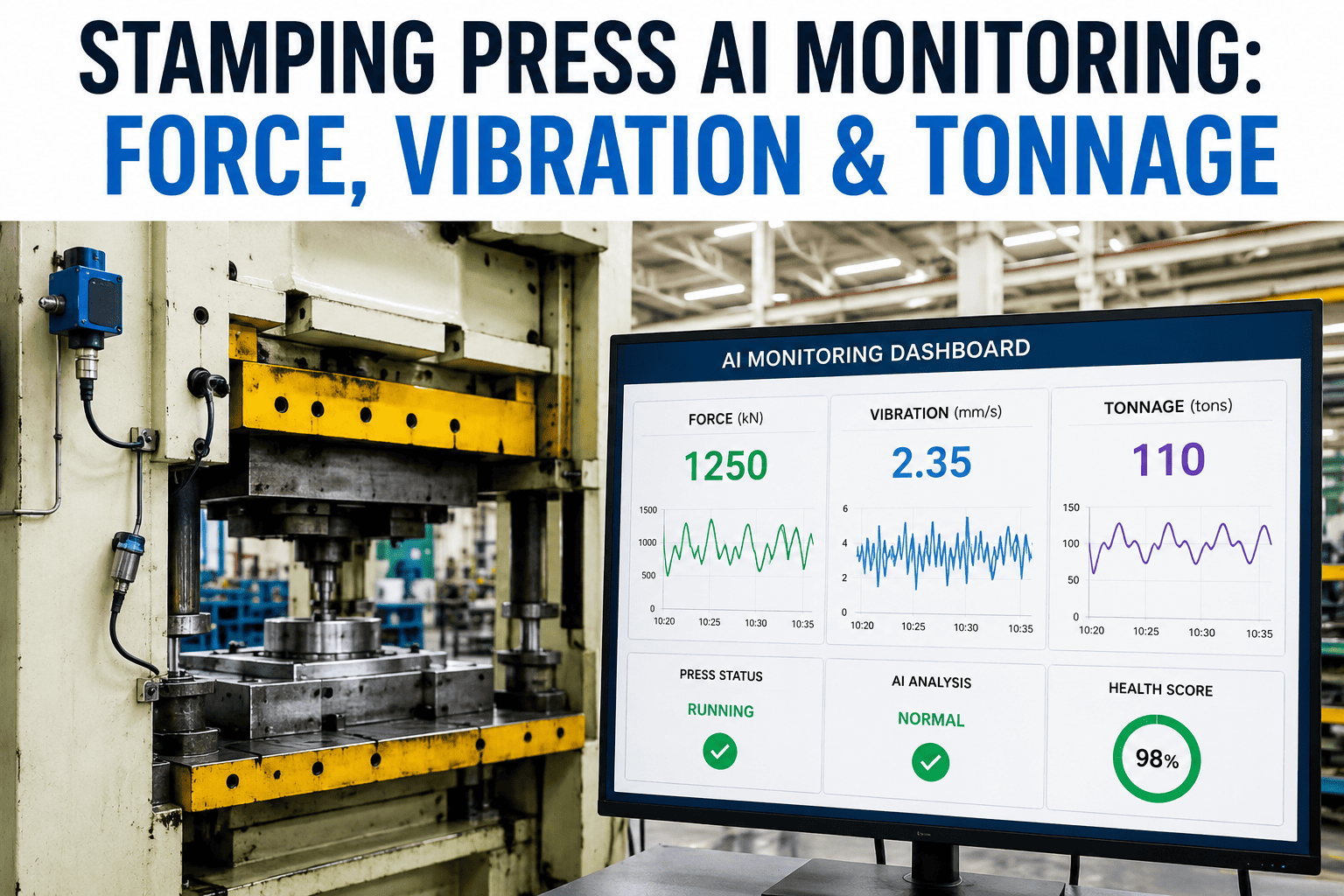
Accelerometers on feed controls, die handling points, and press platforms quantify vibration magnitude and frequency, the two factors that determine actual injury risk under most occupational exposure standards. Frequency weighting in particular is easy to get wrong with manual spot checks, since it requires consistent instrument calibration and placement every single time.
Trend
Shift, Job, and Press Comparisons
The same data gets rolled up across shifts and job types, surfacing which specific presses, dies, or operations are consistently the loudest or roughest, rather than treating the whole shop as one undifferentiated risk. That ranking is what turns a general safety concern into a prioritized, budgetable action list.
Control
Engineering Control Effectiveness Over Time
Before-and-after data around a damping mount, enclosure, or maintenance action shows whether the fix actually held, instead of assuming a control installed six months ago is still performing the same way. It also gives the maintenance team a concrete signal for when a control needs re-servicing rather than waiting for a complaint.
See Your Own Press Floor's Exposure Pattern
Most Shops Are Surprised by Which Press Is Actually the Worst
Bring your current noise survey results and we'll walk through what continuous monitoring typically reveals that a once-a-year spot check doesn't catch.
Two Approaches Compared
Periodic Surveys vs. Continuous Monitoring
| Factor | Periodic Survey | Continuous Monitoring |
|---|
| Frequency | Typically annual or after a complaint | Every shift, every press, ongoing |
| Captures job variation | Only the job running that day | All jobs, all presses, over time |
| Detects control decay | Rarely, unless surveyed again | Yes, through trend comparison |
| Supports early intervention | Limited, data is already old | Yes, alerts on rising exposure trends |
| Documentation for audits | A single dated report | A continuous, timestamped record |
Regulatory Context
Where Continuous Data Fits Into an Existing Compliance Program
Time-Weighted Averages Are the Standard Unit
Most occupational noise exposure limits are expressed as an eight-hour time-weighted average, which means the number that actually matters isn't the loudest single moment on the floor but the cumulative dose an operator carries across a full shift. A press that produces a brief, sharp impact every few seconds can build a higher time-weighted average than a machine that runs steadily louder but less frequently, which is exactly the kind of pattern a single spot measurement is likely to miss entirely.
Hearing Conservation Programs Need Ongoing Records
A formal hearing conservation program typically requires documented exposure monitoring, audiometric testing schedules, and evidence that engineering and administrative controls are actually functioning, not just installed. Continuous exposure data gives the program a timestamped, ongoing record to draw from, rather than forcing the safety team to reconstruct exposure history after the fact when an audiometric test flags a threshold shift.
Vibration Standards Separate Hand-Arm and Whole-Body Exposure
Hand-arm vibration exposure, relevant to feed controls and manual die handling, is evaluated differently from whole-body vibration transmitted through a press platform or operator stand, and each has its own frequency-weighted exposure calculation. Tracking both separately, rather than treating vibration as a single undifferentiated hazard, is what lets a safety team target the right control for the right exposure pathway.
Documentation Quality Matters During an Audit
When a regulator or an internal audit asks how a specific press's noise level was determined to be within limits, a continuous, timestamped monitoring record answers that question far more convincingly than a single survey report from a year ago, especially if production conditions, tooling, or maintenance status have changed since that survey was conducted. It also removes the guesswork of trying to reconstruct what a press sounded like on a specific day months after the fact.
How a Rollout Proceeds
From First Sensor to a Shop-Wide Exposure Baseline
1
Install noise and vibration sensors at two or three representative presses
2
Collect a baseline across a full week of normal production, all shifts
3
Identify which jobs or presses exceed comfortable or regulated thresholds
4
Expand sensor coverage to remaining presses in priority order
5
Set exposure trend alerts and review them in regular safety meetings
A Composite Scenario
A Press Line Where the Loudest Machine Wasn't the One Anyone Suspected
Before
The safety team assumed the largest blanking press was the primary noise concern, based on its size and the general impression operators gave during walkarounds. Hearing protection compliance was tracked, but actual dose data existed only from an annual third-party survey conducted on one arbitrary production day, and vibration was not measured at all beyond an informal note that a few operators mentioned hand fatigue on certain shifts.
After
Continuous dosimetry showed a smaller progressive die press, running a job with a fast feed cycle, actually produced the highest cumulative daily exposure because of how frequently it cycled rather than how loud any single impact was. The team retargeted a damping retrofit to that press instead of the one everyone had assumed was worst, and vibration data confirmed the same press also had the highest hand-arm exposure among all lines monitored, which made the case for that investment straightforward to justify to plant leadership.
Before You Start
Getting Ready for a Noise and Vibration Monitoring Program
Pull your most recent noise survey and note which presses and jobs it actually covered, and which ones it did not
List any engineering controls already installed, when they were last verified as functioning, and who owns re-checking them
Identify two or three presses to start with — highest suspected exposure or highest operator time
Confirm who on the safety team will own reviewing exposure trend alerts once monitoring begins
Common Questions
Noise and Vibration Monitoring — FAQ
Does continuous monitoring replace our required regulatory noise surveys?
It complements them rather than replacing the formal requirement in most jurisdictions, but it gives you far more data to act on between surveys. Continuous exposure trends also make the periodic survey results easier to interpret, since you already know whether the day it was conducted on was typical or unusually quiet, and whether it happened to land during a lighter production week.
Our team can walk through how this fits alongside your existing compliance calendar and documentation practices.
How many sensors does a typical press line need?
Most shops start with sensors at two or three presses that seem highest-risk based on size, job mix, or operator feedback, then expand once the baseline data confirms where the priorities actually are. A full press shop rollout usually follows a phased sequence rather than instrumenting every machine on day one, and the initial baseline period is often what determines the actual order of that expansion.
Can this data help us decide where to invest in engineering controls?
Yes, and that's often the most valuable part. Comparing exposure data across presses shows exactly which machines would benefit most from a damping mount, an enclosure, or a maintenance intervention, instead of spreading a limited budget evenly across the floor based on assumption. That prioritization also makes it easier to justify a capital request, since the case is built on measured exposure rather than a general sense that the floor is loud.
What happens when an exposure trend alert fires?
The alert flags that a specific press or job is trending toward or past a defined exposure threshold, giving the safety team time to investigate before it becomes an incident report. That might mean checking whether a control has degraded, whether hearing protection compliance has slipped, whether a new job or tooling change altered the noise profile, or whether maintenance is overdue on a specific component.
Book a demo to see how alert thresholds are configured for your operation.
Does this require operators to wear additional equipment?
No, sensors are mounted at the press and workstation level rather than worn by operators, so there's no additional burden on the person doing the job. The measurement happens in the environment itself, which also means it keeps working consistently regardless of who's operating the press that shift, and it removes the compliance question of whether a personal dosimeter was actually worn correctly for the full shift.
Stop Guessing at Exposure Between Annual Surveys
Get a Continuous, Defensible Record of Noise and Vibration on Your Press Floor
iFactory tracks noise and vibration exposure at the press level continuously, so your safety team can act on real trends instead of a single yearly snapshot.