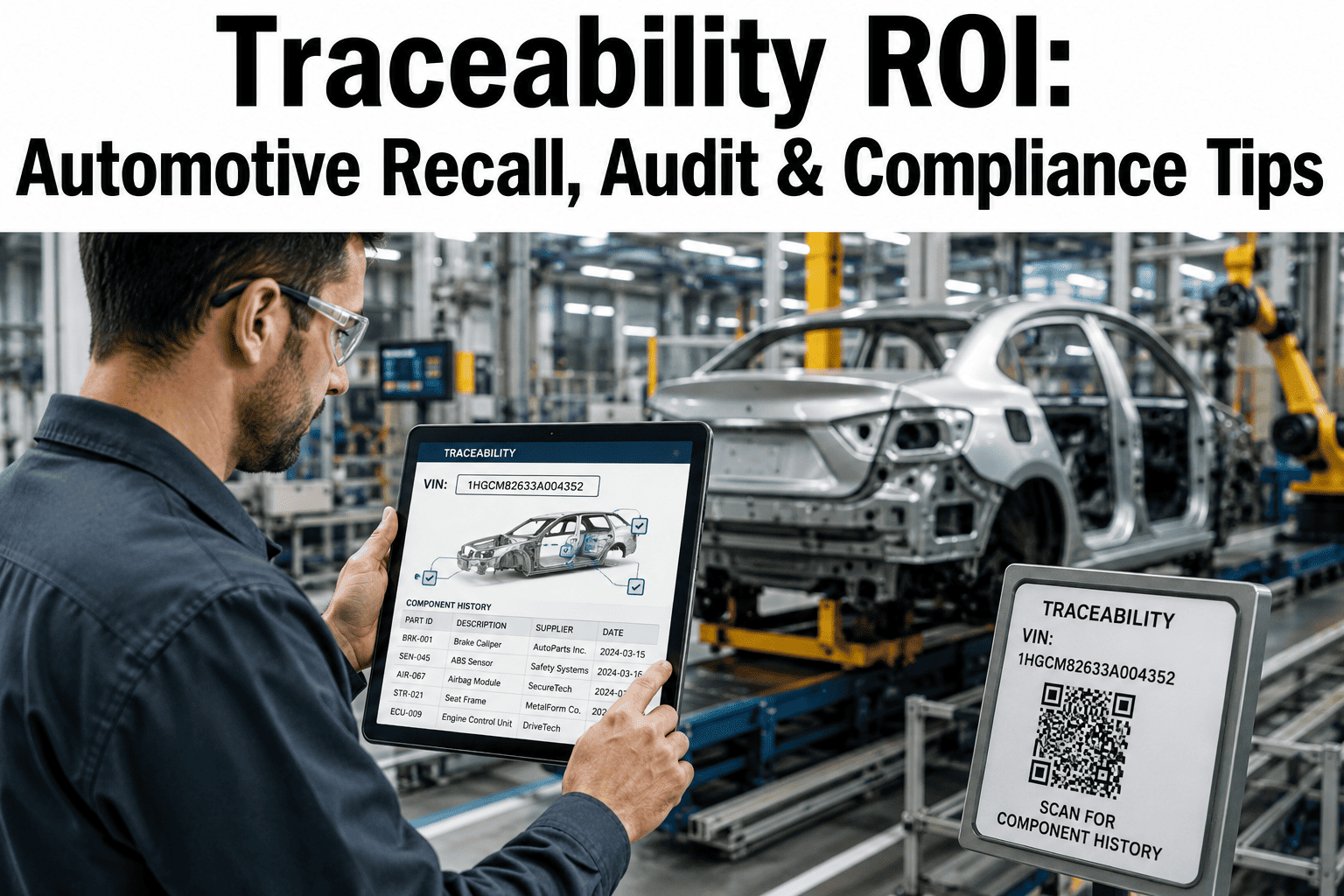
A single vehicle leaving final assembly carries more than three dozen labels, plates, and barcodes — VIN plates, tire pressure placards, emissions certification labels, airbag warnings, paint code stickers, and traceability barcodes tied to every major component. Manual audits sample a fraction of these, checking legibility and placement on maybe one body in twenty during a shift. The ones that slip through — a transposed digit on a VIN plate, a barcode that scans clean but decodes against the wrong build record — don't surface until a recall investigation, a customs hold, or a regulatory audit years later, when the cost of the miss has multiplied far past what it would have taken to catch it on the line. If your final inspection stations are still relying on spot checks for something this consequential, it's worth seeing how AI-based label and barcode verification actually performs against your own label library — book a demo.
Every Vehicle Carries Dozens of Labels. One Wrong Character Fails the Audit.
AI-based label and VIN barcode verification checks presence, placement, print quality, and content accuracy on every unit — not a sampled percentage — before it ever leaves the plant.
The Compliance Blind Spot Nobody Budgets For
Label verification sits in an odd spot on most quality checklists. It is treated as a formality — a visual glance to confirm something is stuck to the door jamb — rather than as a regulatory control point with its own failure modes and its own downstream consequences when it goes wrong.
Part of the reason is that label defects rarely cause an immediate, visible problem. A car with a wrong tire placard still drives fine off the line. A barcode that decodes to the wrong lot number still scans as a successful read. The gap between "looks fine today" and "creates a real problem" can be months or years, which is exactly the kind of delayed feedback that manual sampling is worst at catching.
A missed or wrong label on any one of these does not stop the vehicle from driving. It stops the vehicle from clearing a customs inspection, passing a state registration check, or surviving the documentation review that follows a warranty claim — which is exactly why it tends to get discovered at the worst possible time.
None of this is a staffing problem. Even a diligent inspector checking labels visually is reading small print under booth lighting, on a moving line, for the same repetitive task hundreds of times a shift — the conditions under which attention naturally narrows to the labels that look obviously wrong rather than the ones that are subtly incorrect.
How AI Actually Reads a Label
The task looks simple from the outside — point a camera at a sticker and read it. In practice it is a five-stage pipeline, because a label has to be found, read correctly under real plant lighting, decoded if it carries a barcode, and then checked against data that lives in a completely different system.
Each stage has its own failure conditions the model has to be trained against — a plate mounted at a slight angle, a barcode partially obscured by a wiring harness clip, print that looks legible to a person but sits right at the edge of an OCR confidence threshold. Getting all five stages to run inside the takt time of the station is what separates a working deployment from a lab demo.
Regulatory Requirements Mapped to What Gets Checked
Label rules differ by region and by label type, and the penalty for getting them wrong ranges from a rework loop to a stalled export shipment. Every plant that ships to more than one market ends up maintaining several overlapping rule sets at once, which is exactly where manual review starts to break down.
The table below is a simplified view of what a verification system is typically configured to check against each category, drawn from the standards most automotive plants are already auditing against today.
| Label Category | Common Standard | Required Content | What AI Verification Confirms |
|---|---|---|---|
| VIN Plate & Sticker | ISO 3779 / regional motor vehicle codes | 17-character VIN, consistent across all locations | Character-level match across plate, door jamb, and barcode |
| Emissions Certification | EPA / CARB / regional equivalents | Mandated wording, engine family, model year | Text presence, wording accuracy, correct engine family code |
| Safety Certification | FMVSS or regional safety standard | Manufacture date, GVWR, tire and rim data | Numeric field accuracy against the vehicle's actual build spec |
| Component Traceability | IATF 16949 traceability requirements | Supplier lot code, part number, serial data | Barcode decode matched to expected supplier and lot record |
| Export & Market Labels | Destination-market regulations | Correct language, units, and market-specific wording | Variant detection and label-to-destination matching |
None of these checks require a person to know the underlying regulation by heart. The rules are encoded once per label type and market, and the verification step becomes a repeatable, auditable pass or fail rather than a judgment call made under time pressure at the end of a shift.
When a regulation changes — a wording update, a new engine family code, a revised market label requirement — the rule set is updated once centrally rather than retrained into every inspector's memory across three shifts, which is usually where compliance drift actually starts.
Failure Modes This Catches That Humans Routinely Miss
Most label defects are not dramatic. They are small, plausible-looking errors that pass a quick glance and only surface when someone actually needs the data months or years later — during a recall, a customs hold, or a dealer warranty claim.
Where It Sits Across the Line
Verification does not need to happen at a single station. Most plants layer checks at the points where labels are applied or where their accuracy matters most for the next process step.
Integrating With Systems You Already Run
Label verification is only useful if it can talk to the systems that already know what a vehicle is supposed to look like. That means the deployment question is rarely about the cameras — it is about the data connections around them.
The build sheet and BOM data typically live in the plant's MES or MOM layer, and that connection is what turns a label read into a verified match rather than just a confirmed presence. Supplier lot data for traceability barcodes usually sits in a quality or ERP system one layer further out, and pulling that in is what makes a recall traceback possible in minutes instead of days.
Most plants already run machine vision cameras at label-critical stations from earlier quality initiatives. Existing camera infrastructure can usually be reused for this layer as long as resolution and frame rate clear the minimum threshold for OCR accuracy, with new cameras added only at genuine coverage gaps rather than across the entire line.
The practical starting point is almost always an inventory exercise — walking the line station by station, listing every label and barcode applied, and mapping each one to the system that already holds its expected value. That inventory alone often surfaces gaps most quality teams did not know they had, well before any camera gets installed.
A Rollout That Doesn't Ask You to Trust It Blind
Quality teams are understandably cautious about handing any automated system authority over a compliance-relevant decision. A sensible rollout earns that authority in stages instead of asking for it upfront.
What Changes When Verification Is Continuous
The shift from sampled manual checks to continuous automated verification changes more than the pass rate. It changes what the quality team can actually answer when a customer, a regulator, or an auditor asks a specific question about a specific vehicle.
These are directional figures drawn from how plants typically report the shift, not a guarantee — the real numbers depend on your current label mix, your line speed, and how much of this data already lives in a connected system versus a spreadsheet.
The more durable change is qualitative: a quality team that used to answer "was this vehicle's label correct" with a shrug and a shift log now answers it with a timestamped image and a matched build record, for any VIN, on demand.
Every Plant's Label Set Is Different. Let's Map Yours First.
Before recommending a station layout or camera count, the fastest path is a short conversation about your VIN placement, your barcode formats, and your current manual process.
Vehicle Label & VIN Barcode Verification — Questions Quality Teams Ask
Stop Sampling Compliance. Verify Every Vehicle.
iFactory reads, decodes, and cross-checks every label and barcode against your build data as each vehicle passes — turning label verification from a spot check into a permanent, VIN-linked record.