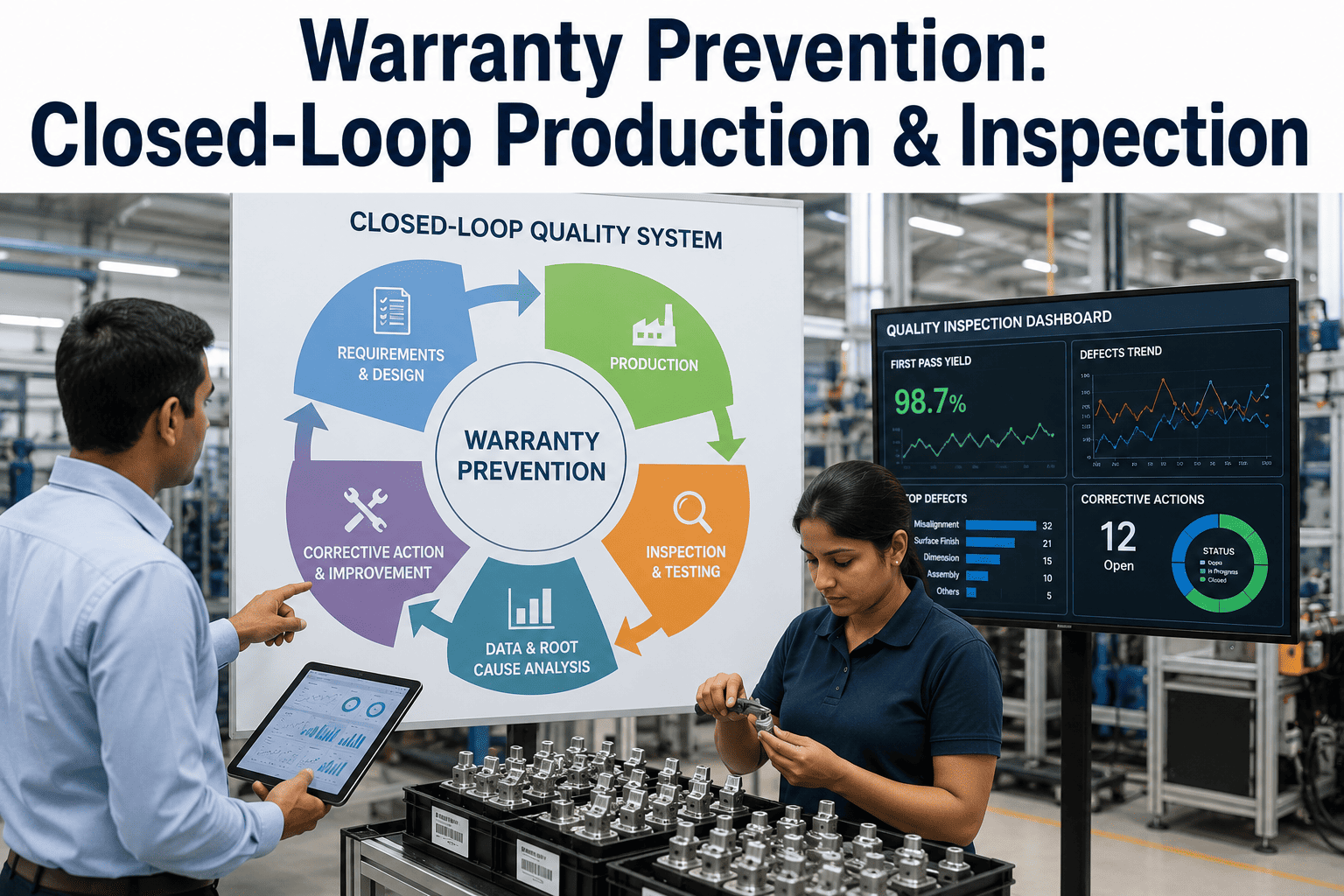
Most warranty programs are built to process claims efficiently after a defect has already reached a customer, but very few are built to feed what's learned from those claims back into the production line that's still building the same vehicle. A weld inspection station, a torque verification step, or an incoming component check can all be tuned to catch a specific failure mode, but only if someone connects the warranty claim pattern to the exact inspection gate that should have caught it in the first place. Closing that loop, from claim signal back to production and inspection parameters, is what separates a warranty program that just tracks cost from one that actually prevents the next thousand claims. This page covers what a closed-loop prevention system looks like in practice, how to identify which claims are worth feeding back into production, and what tends to break down when plants try to build this connection. You can talk to support about connecting your current warranty and quality inspection systems.
Turn Warranty Signals Into Production Line Changes Before the Next Thousand Units Ship
iFactory routes warranty and complaint patterns back to the specific inspection gate or process parameter that should catch them, closing the loop between what customers experience and what the line checks for.
Defect pattern identified in field data
Linked back to a specific process step or component
Existing check tightened or new check added
Confirms the change actually reduced the defect
Warranty, Quality, and Production Usually Work From Different Data
The reason this feedback loop so often stays open isn't a lack of data, it's that warranty claims, quality inspection results, and production line parameters typically live in three different systems owned by three different teams, none of which was built with the others in mind. Warranty administration is optimized for processing and reimbursing claims accurately, quality inspection systems are optimized for pass/fail decisions at a station, and production systems are optimized for throughput and process control. None of them is designed to ask the question that actually prevents future claims: does this defect pattern point back to something our inspection process should already be catching, and isn't?
Warranty administration is focused on claims processing speed and accuracy, not on identifying which claims trace back to a preventable production gap.
A warranty claim code and an inspection station defect code are often defined independently, making it hard to map one directly to the other without manual translation.
Months or years can pass between when a vehicle is built and when a related defect surfaces as a claim, by which point the production context has faded from memory.
Even when a connection is found, there's often no clearly assigned role responsible for translating that insight into an actual inspection or process change.
Not Every Warranty Claim Points to a Fixable Production Gap
Some warranty claims genuinely reflect random component failure, wear-and-tear outside any reasonable inspection window, or misuse that no production or inspection change could have prevented. Trying to trace every single claim back to a production root cause wastes effort on cases where there simply isn't one. The claims worth prioritizing for closed-loop analysis are the ones showing a pattern, not an isolated incident.
| Signal | Worth Feeding Back? | Why |
|---|---|---|
| Isolated single claim, no repeat pattern | Usually not | Likely random variation rather than a systemic production issue |
| Cluster tied to a specific plant or shift | Yes, high priority | Strongly suggests a localized process or training issue worth investigating |
| Cluster tied to a specific supplier lot | Yes, high priority | Points directly to an incoming inspection gap worth tightening |
| Rising trend across an entire model year | Yes, high priority | Indicates a design or standard process issue, not a localized anomaly |
| Claim tied to documented customer misuse | No | Not preventable through inspection or production changes |
What Actually Changes on the Line Once a Pattern Is Confirmed
Once a claim cluster is confirmed to trace back to a specific production step, the actual intervention usually falls into one of a few categories. Understanding these categories helps quality and production engineering teams move faster from "we found a pattern" to "we changed something and it worked," rather than getting stuck debating options in the abstract.
The check already exists but its pass/fail threshold is too loose to catch the specific variation that's leading to field failures.
No station currently checks for the failure mode at all, requiring a new inspection point to be added at an appropriate stage of production.
The defect traces back to a process setting, such as torque, temperature, or cure time, that needs adjustment rather than a purely inspection-based fix.
The root cause sits with a supplied component, requiring the fix to happen at incoming inspection or with the supplier directly rather than on the assembly line itself.
A Fix Isn't Confirmed Until Claim Rates Actually Drop
It's common for a production or inspection change to get implemented with confidence that it addresses the root cause, only for no one to go back and confirm that warranty claim rates for that defect actually declined afterward. Without that verification step, the loop isn't really closed, it's just assumed to be closed, and there's no way to know whether the fix worked or whether claims are still coming in from a cause that wasn't fully addressed.
Tracking claim rate for the specific defect category before and after the change, segmented by build date so vehicles produced before and after the fix can be compared cleanly, is the most direct way to confirm effectiveness. This comparison also needs enough time to pass for claims to actually surface, since warranty claims often lag the build date by weeks or months depending on when a defect becomes noticeable enough for a customer to bring the vehicle in.
Connecting a Claim to a Specific Build Record
None of this closed-loop analysis is possible without solid traceability linking a warranty claim back to the exact vehicle, and ideally the exact build shift, line, and supplier lot, that produced it. VIN is the natural anchor for this, but VIN alone only gets you to "this vehicle," not to "this vehicle built on this line, during this shift, using components from this supplier lot." That deeper level of traceability is what actually makes it possible to distinguish a random isolated failure from a pattern worth investigating.
Many plants already capture much of this data for other reasons, torque values for compliance, supplier lot numbers for recall readiness, shift and line assignment for production tracking, but it often lives in separate systems that were never designed to be queried together against a warranty claim. Building the connective layer that lets a quality analyst pull up a claim and immediately see the build context behind it is usually the single highest-leverage investment in making closed-loop prevention practical rather than a manual, ad hoc exercise every time a pattern needs investigating.
Links a claim to the specific line, shift, and date the vehicle was assembled, the starting point for any pattern investigation.
Connects a specific part installed on the vehicle back to the supplier batch it came from, critical for tracing supplier-driven defects.
Captures torque, temperature, cure time, and other in-process values at the moment of assembly for later correlation against claims.
Records what each in-line inspection station actually measured or flagged for the vehicle, not just a final pass or fail status.
Getting Production Teams to Trust Warranty-Driven Change Requests
Even with solid traceability and a confirmed pattern, production teams don't always welcome a change request that originated from warranty data, especially if it arrives without clear evidence or feels like it's coming from a team that doesn't understand the realities of the line. Building credibility for this kind of feedback loop usually requires bringing production engineering into the investigation early, rather than handing them a conclusion after the fact and asking them to implement a fix they weren't part of diagnosing.
Framing the request around the specific data pattern, rather than a general sense that "warranty claims are up," also matters enormously. A production team asked to investigate a vague cost trend has little to act on, while a team shown a specific claim cluster tied to a specific shift, line, or supplier lot, with the underlying build data attached, has something concrete to validate and respond to. This specificity is usually the difference between a change request that gets implemented quickly and one that sits in a backlog because no one is confident it's pointing at the real cause.
Over time, as production teams see closed-loop requests consistently backed by solid data and confirmed by post-fix claim rate improvements, trust in the process tends to build on its own, making each subsequent request easier to act on than the last. Programs that skip the early credibility-building work and expect production teams to simply comply with warranty-driven requests from day one tend to see much slower adoption and more pushback along the way.
This Reduces Claims, It Doesn't Eliminate Them
It's worth being clear-eyed about what closed-loop prevention can and can't achieve. Even a well-built feedback loop won't catch every defect before it reaches a customer, since some failure modes only manifest under real-world conditions that no in-plant inspection could reasonably replicate, and some component wear genuinely falls within normal expected variation. The goal isn't zero warranty claims, it's steadily reducing the share of claims that trace back to a preventable, catchable production gap, while accepting that a baseline of claims tied to normal wear, edge-case usage, and genuinely random component variation will always exist.
Measuring progress against this realistic goal, tracking the trend in preventable-versus-total claim rate over time rather than chasing an unrealistic target of eliminating warranty claims entirely, keeps the program focused on what it can actually influence and avoids the frustration that comes from measuring against a standard that was never achievable in the first place.
Tracing a Recurring Fastener Claim Back to a Torque Setting
A recurring warranty claim category for a loose interior trim fastener had persisted for several months, coded generically as a trim quality issue with no clear pattern investigation, since claims trickled in slowly enough to avoid triggering a formal escalation.
Once claims were cross-referenced against build data, the pattern concentrated heavily on one assembly line during a specific shift window. Investigation traced it to a torque tool calibration drift that wasn't being caught by the existing spot-check inspection frequency. Increasing check frequency at that station and recalibrating the tool brought the claim rate down to baseline within two build months, confirmed by comparing claim rates on vehicles built before and after the change.
A Practical Starting Point for Building the Loop
Choose a warranty claim category with a clear repeat pattern rather than trying to build loop coverage across every defect type at once.
Confirm you can reliably connect that claim category back to line, shift, and supplier lot data for the affected vehicles.
Involve production and quality engineering early, sharing the specific pattern rather than a general cost trend, to build shared ownership of the fix.
Once a change is implemented, compare claim rates by build date on either side of the change to confirm it actually worked before moving to the next category.