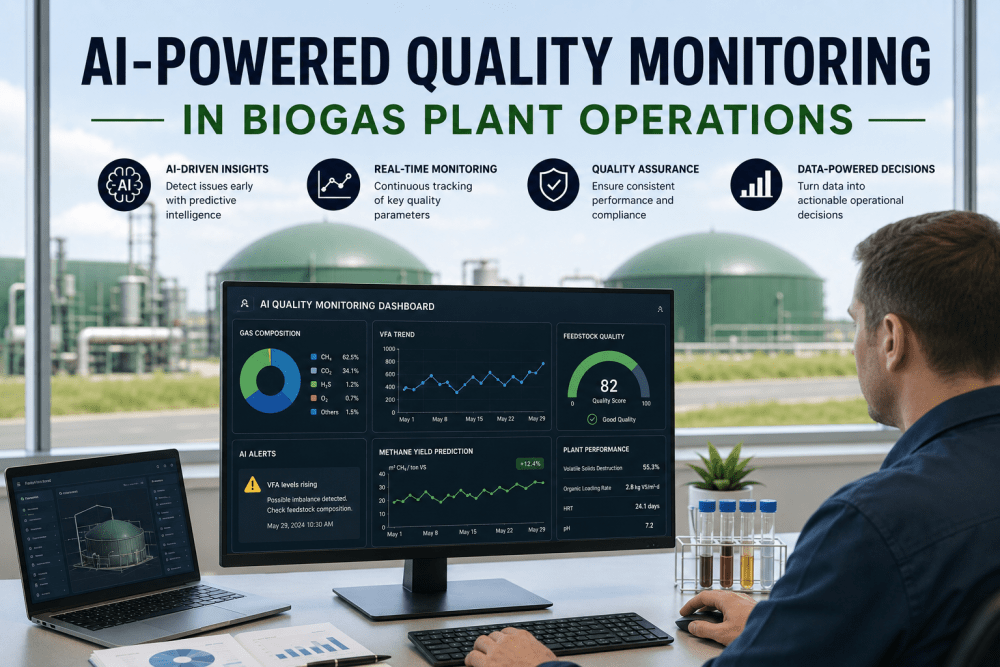
Every biogas plant operates with the same fundamental challenge: the gap between when process conditions drift and when the lab confirms that drift is the window where methane yield is lost, digestor stability is compromised, and feedstock value is wasted. AI-powered quality monitoring closes that gap by transforming continuous sensor streams — gas composition analyzers, in-line VFA probes, and feedstock characterization data — into early-warning signals that reach operators hours or weeks before conventional lab tests would catch the same trend. Book a Demo to see how iFactory AI's quality monitoring platform connects your biogas plant's sensor network to real-time process intelligence.
Is Your Biogas Plant Still Waiting for Lab Results to Tell You What AI Could Have Predicted Days Ago?
iFactory AI's quality monitoring platform ingests gas composition, VFA trends, feedstock data, and process parameters into AI models that detect process drift before yield is lost — delivering real-time alerts, predictive insights, and compliance-ready quality records in a single system built for AD operations.
Why Conventional Quality Monitoring Falls Short in Biogas Operations
Anaerobic digestion is a biologically mediated process where quality — methane yield, digestor stability, feedstock conversion efficiency — is a function of continuous variables that interact non-linearly: feedstock composition, organic loading rate, temperature, pH, VFA concentration, alkalinity, trace element availability, and microbial population dynamics. Conventional quality monitoring relies on periodic grab samples analyzed in the lab for VFA, alkalinity, NH4-N, and biogas composition — typically sampled once per shift or once per day at most plants.
AI quality monitoring changes this by ingesting continuous sensor data streams — in-line gas composition analyzers, pH and VFA probes, temperature sensors, flow meters, and feedstock characterization data — into machine learning models trained on each digestor's unique operating history. The models learn the correlation patterns between normal process variation and eventual process upset, enabling them to detect the early signatures of VFA accumulation, ammonia inhibition, or trace element depletion days or weeks before those conditions manifest as measurable yield loss or process instability. Book a Demo to explore iFactory AI's biogas quality monitoring framework.
Biogas Composition Analytics
Continuous CH4, CO2, H2S, O2, and H2 monitoring from in-line gas analyzers feeding AI models that detect composition shifts indicating feed stock changes, digestor overload, or trace element depletion before yield is affected. H2S spike prediction enables proactive media change scheduling and reduces iron chloride dosing cost.
VFA and Process Chemistry Trend AI
Continuous VFA, alkalinity, and NH4-N data from in-line or near-line sensors analyzed by AI models trained on each digestor's unique operating history. The models detect the early signature of VFA accumulation — typically a shift in the VFA-to-alkalinity ratio — 48–72 hours before conventional lab thresholds are breached.
Feedstock Quality and Methane Potential
Near-infrared and dielectric spectroscopy sensors on feedstock reception lines characterize TS, VS, COD, and methane potential of every incoming load. AI models correlate feedstock quality data with digestor performance and methane output, enabling real-time feedstock blend decisions that maximize yield from available substrate inventory.
How AI Transforms Biogas Quality Monitoring — Five Core Application Areas
AI applied to biogas quality monitoring is not a single technology deployment — it is a portfolio of analytical capabilities that address distinct monitoring challenges across the AD process chain. The five application areas below represent where AI delivers the most measurable impact in biogas quality operations, ranked by implementation maturity and documented return on investment from operational AD deployments.
AI-Powered Biogas Composition Monitoring and Anomaly Detection
Continuous gas composition analyzers generate a data stream of CH4, CO2, H2S, O2, and H2 concentrations that contains early indicators of every significant process event — feedstock change impacts, organic overloading, micronutrient depletion, and microbial population shifts. AI models trained on each AD facility's gas composition history detect the subtle pattern changes that precede measurable yield loss, enabling operators to intervene before the CH4 fraction drops below target.
- CH4 fraction trend deviation detection; model distinguishes diurnal process variation from genuine instability signals
- H2S concentration prediction from feedstock composition and process parameters; proactive media change scheduling
- H2 concentration monitoring as early indicator of organic overloading; hydrogen appears before VFA accumulation is measurable
- AI model retrained automatically as new gas composition data accumulates; facility-specific drift patterns learned continuously
VFA Trend AI for Early Digestor Upset Detection
Volatile fatty acid concentration is the single most informative parameter for digestor health assessment — but its value depends entirely on trend detection, not absolute measurement. AI models trained on VFA, alkalinity, and NH4-N time-series data learn each digestor's normal operating band and detect the early signature of VFA accumulation — typically a shift in the VFA-to-alkalinity ratio trajectory — that precedes process failure by days. Operators receive early-warning alerts with recommended corrective actions before the condition reaches critical threshold.
- VFA-to-alkalinity ratio trajectory monitoring; normal drift vs. instability signature distinguished by AI pattern recognition
- Early VFA accumulation alerts generated 48–72 hours before conventional lab test thresholds would detect the trend
- Causal analysis models correlate VFA shifts with specific feedstock changes, loading rate adjustments, or temperature excursions
- Recommended corrective actions — feed rate reduction, micronutrient dosing, or alkalinity supplementation — included in alert
AI-Driven Feedstock Quality Characterization and Blend Optimization
Feedstock variability is the primary source of process instability and yield loss in biogas plants. AI quality monitoring addresses this by correlating real-time feedstock characterization data — TS, VS, COD, methane potential — from near-infrared or dielectric spectroscopy sensors with digestor performance outcomes. The machine learning model learns how each feedstock type and blend affects VFA profile, gas composition, and methane yield, enabling operators to adjust blend ratios proactively based on predicted digestor response rather than reacting to instability after it appears.
- In-line feedstock characterization sensors classify every incoming load by TS, VS, COD, and predicted methane potential
- AI correlation model links feedstock blend composition to downstream VFA profile, gas composition, and methane yield
- Real-time blend recommendation engine suggests feedstock adjustments to maximize yield from available substrate mix
- Gate fee optimization data generated from feedstock quality-to-yield correlation; high-yield feeds priced accordingly
Methane Yield Prediction from Process Parameter Integration
Methane yield is the ultimate metric of biogas plant quality performance — but it is a lagging indicator that reflects conditions that existed hours or days earlier. AI yield prediction models integrate real-time gas composition, VFA trend, feedstock characterization, temperature, loading rate, and hydraulic retention time data to generate a continuously updated methane yield forecast for the next 6 to 24 hours. Operators use this forecast to make proactive adjustments to feedstock blend, loading rate, and process conditions that keep yield within target range.
- Multi-variable yield prediction model ingests gas composition, VFA data, feedstock quality, and process parameters
- 6-hour and 24-hour methane yield forecasts generated continuously; deviation from target triggers recommendation action
- Model identifies which process variable has the strongest influence on current yield deviation; targeted corrective actions recommended
- Yield forecast accuracy tracked against actual production; model retrained on new data to improve prediction precision over time
AI-Enhanced Digestate Quality Monitoring and Compliance
Digestate quality certification — trace element content, pathogen indicators, nutrient composition — is a regulatory obligation for biogas plants that sell or distribute digestate as fertilizer or soil amendment. AI quality monitoring supports compliance by predicting digestate quality outcomes from process parameters and feedstock data, enabling operators to adjust process conditions to meet target digestate specifications before the material is removed from the digestor. Post-process quality data is automatically compiled into compliance-ready certification reports.
- Digestate quality prediction models estimate NPK content, trace element composition, and pathogen indicators from process data
- Process adjustments recommended when predicted digestate quality deviates from certification specification targets
- Compliance-ready digestate certification reports auto-generated from quality monitoring data and lab verification records
- Historical digestate quality database supports continuous improvement in fertilizer product consistency and market positioning
iFactory AI Platform Architecture for Biogas Quality Monitoring — From Sensor to Decision
Deploying AI quality monitoring in a biogas plant requires an architecture that bridges the process instrumentation layer — gas analyzers, pH and VFA probes, temperature sensors, flow meters, feedstock characterization sensors — and the analytics layer where AI models, alert logic, and compliance documentation run. iFactory AI is designed for this OT-IT integration, with native connectivity to common AD plant PLC platforms, sensor communication protocols, and edge computing environments.
Sensor Data Ingestion Layer
Gas composition analyzers (CH4, CO2, H2S, O2, H2), in-line pH and VFA probes, temperature sensors, flow meters, feedstock characterization sensors, and digestor level sensors aggregated into iFactory's unified data ingestion layer. Native Modbus, OPC-UA, 4-20mA, and SDI-12 protocol support eliminates custom integration development. Edge processing nodes handle facilities with limited network connectivity.
AI Analytics and Model Training Engine
Machine learning models trained on each digestor's unique operating history generate gas composition anomaly detection, VFA trend early warnings, feedstock quality correlations, methane yield predictions, and digestate quality forecasts. Models retrain automatically as new process data accumulates; prediction accuracy metrics tracked and reported to operations team monthly.
Alert and Recommendation Layer
AI-generated alerts surface in iFactory's operations dashboard with severity classification, predicted time-to-impact, and recommended corrective actions. Operators receive early-warning notifications for VFA accumulation, gas composition drift, and yield forecast deviations — with enough lead time to adjust feedstock blend, loading rate, or micronutrient dosing before the condition affects production.
Compliance and Reporting Layer
Digestate quality certifications, feedstock acceptance records, gas composition reports, and environmental monitoring documentation auto-generated from verified quality monitoring data. All quality records maintained in iFactory's audit-ready format with timestamps, sensor IDs, and data integrity validation — ready for regulatory inspection or customer audit at any time.
- Gas composition checked via daily or weekly lab GC; CH4 drift detected retrospectively after yield impact
- VFA and alkalinity measured from grab samples; digestor condition unknown between sampling events
- Feedstock quality assessed visually or with delayed lab tests; blend decisions based on experience, not data
- Methane yield calculated at end of day or week; no ability to predict future yield from current conditions
- Digestate quality confirmed after material removal; non-compliant batches require costly reprocessing or disposal
- Compliance reports compiled manually from multiple data sources; audit preparation consumes days per event
- Continuous CH4, CO2, H2S monitoring; AI detects composition shifts within hours of upstream process change
- VFA-to-alkalinity ratio tracked continuously; AI generates early-warning alerts 48–72 hours before upset threshold
- In-line feedstock characterization with AI yield correlation; blend recommendations optimized for methane output
- AI methane yield forecast updated every 6 hours; proactive adjustments keep yield within target range
- Digestate quality predicted from process data; process adjustments made before material removal
- Digestate, feedstock, and emissions reports auto-generated from iFactory quality monitoring records
Measurable Outcomes from AI Quality Monitoring in Biogas Plants — A Benchmark Framework
Measuring the business impact of AI quality monitoring in biogas operations requires KPIs spanning process stability, yield performance, feedstock utilization, and compliance efficiency. The benchmark table below provides the performance metrics iFactory tracks for each application area, with representative before-and-after ranges from AD plant deployments. Individual facility results depend on baseline monitoring maturity, digestor configuration, feedstock type, and the completeness of sensor integration at deployment. Book a Demo to benchmark your biogas plant's quality monitoring maturity against iFactory's capability model.
| Quality Monitoring Area | KPI Tracked | Baseline (Conventional) | With iFactory AI | Primary Value Driver |
|---|---|---|---|---|
| Gas Composition | CH4 fraction deviation detection time | 12–24 hours (next lab cycle) | 1–3 hours | Yield preserved by early composition shift response |
| VFA Monitoring | Digestor instability warning lead time | 0 hours (detected after upset) | 48–72 hours | Preventive intervention before yield loss |
| Feedstock Quality | Feedstock characterization frequency | Visual + periodic lab testing | Every load, real-time | Blend optimization for maximum methane yield |
| Methane Yield | Yield prediction accuracy (24-hour) | No predictive capability | ±4–7% forecast accuracy | Proactive yield management instead of retrospective analysis |
| Digestate Quality | Non-compliance batch detection | After removal and lab testing | Predicted before removal | Reprocessing cost eliminated for predicted non-compliant batches |
| Compliance Reporting | Report preparation time per cycle | 40–60 hours manual | 4–8 hours automated | Quality compliance documentation auto-generated |
What Biogas Quality Leaders Say About AI Monitoring Implementation
The plant managers and process engineers who have moved from periodic lab-based quality monitoring to AI-augmented, continuous process surveillance share a consistent experience: the most significant value comes not from the yield improvement alone
We operate a 5 MW electric AD plant processing a blend of source-separated organics, industrial food waste, and agricultural residues. Before deploying iFactory's AI quality monitoring platform, our quality management relied on daily lab VFA and alkalinity tests, weekly gas chromatography for biogas composition, and operator judgment for feedstock blend adjustments. The problem was not that our lab was slow — it was that the digestor did not wait for lab results. Feedstock composition would shift with every new delivery, and by the time we confirmed a VFA accumulation trend on Thursday from Wednesday's samples, the digestor had already been accumulating acid stress for 24 to 36 hours.
The AI deployment connected our existing in-line pH and temperature sensors, added continuous gas composition monitoring, and integrated feedstock characterization data from a near-infrared spectrometer installed on our reception line. Within the first eight weeks, the system detected a developing VFA accumulation event on a Saturday afternoon — a period when our lab is not staffed and samples would normally sit in the refrigerator until Monday morning. The AI alerted the on-call operator at 2:30 PM that the VFA-to-alkalinity ratio trajectory was deviating from the normal operating band.
Deploy AI-Powered Quality Monitoring Across Your Biogas Plant Operations
From gas composition analytics to VFA early warning and methane yield prediction — iFactory AI delivers the full quality monitoring intelligence stack for AD plants in one platform built for biogas operations.
AI Quality Monitoring in Biogas Plants Is a Present Operational Advantage
The case for AI-powered quality monitoring in biogas operations is built on a foundation that every AD plant manager already understands: the digestor does not wait for lab results. Between the moment a grab sample is collected and the moment the lab result reaches the operator, biological processes continue shifting in response to feedstock variability, loading changes, and environmental conditions — and every hour of undetected drift is an hour of methane yield that cannot be recovered.
The technology is not speculative. The sensor infrastructure exists in most AD plants today, deployed but underutilized for quality monitoring because the analytical layer that connects raw sensor data to process decisions has been missing. iFactory AI provides that analytical layer, turning existing instrumentation into an early-warning system for process instability, a continuous quality documentation engine, and a yield optimization platform that compounds value with every operating day. Book a Demo with iFactory's biogas team to build a site-specific AI quality monitoring assessment for your AD facility.
Deploy AI Quality Monitoring for Your Biogas Plant with iFactory
iFactory registers every quality sensor, monitors gas composition and VFA trends in real time, predicts methane yield from process data, and generates audit-ready compliance documentation — in one platform built for anaerobic digestion operations.
AI-Powered Quality Monitoring in Biogas Plants — Frequently Asked Questions
How does AI detect VFA accumulation in anaerobic digestors before conventional lab sampling?
AI models trained on each digestor's VFA-to-alkalinity ratio history learn the normal operating band and detect the subtle trajectory shifts that precede a measurable VFA increase. Rather than waiting for a discrete VFA measurement to exceed a threshold — which means the accumulation has already occurred — the AI detects the rate of change in the VFA-to-alkalinity ratio, the compounding pattern across consecutive readings, and correlations with feedstock changes, loading rate adjustments, or temperature excursions. This pattern-based detection typically generates alerts 48–72 hours before conventional grab-sample thresholds are breached, giving operators time to implement corrective actions — feed rate reduction, buffer addition, or micronutrient dosing — that prevent the accumulation from reaching yield-impacting levels.
What sensors are required to deploy AI quality monitoring in an existing biogas plant?
The minimum viable sensor set for AI quality monitoring includes continuous biogas composition monitoring (CH4, CO2, H2S), in-line or near-line pH and temperature, and digestor feed rate and loading data — most of which is already installed in modern AD plants. The highest incremental value sensors to add are in-line VFA probes (or frequent near-line FOS/TAC analyzers) and feedstock characterization sensors such as near-infrared spectrometers for real-time TS, VS, and methane potential assessment. iFactory's AI platform is designed to work with whatever sensor infrastructure exists at each facility, with model accuracy improving as additional sensor data streams are integrated over time.
How does AI quality monitoring integrate with existing biogas plant PLC and SCADA systems?
iFactory AI is designed for OT-IT integration in biogas environments where PLCs, SCADA systems, and sensor networks are the primary operational data sources. The platform includes native connectivity for Modbus RTU and TCP, OPC-UA, and 4-20mA analog signal protocols common in AD plant instrumentation. For facilities with existing data historians or SCADA platforms, iFactory connects via standard database connectors to pull historical and real-time data without requiring changes to the control system architecture. Edge processing nodes handle facilities with intermittent connectivity, ensuring continuous AI monitoring regardless of network reliability.
What is the typical ROI timeline for AI quality monitoring in a biogas plant?
Biogas plant operators deploying AI quality monitoring typically recover platform investment within 9–15 months through a combination of methane yield improvement (12–18% typical range), avoided digestor upset events (each prevented upset avoids $30,000–$60,000 in lost production and potential digestate disposal costs), feedstock optimization value (5–8% yield improvement from AI-optimized blending), and compliance reporting labor reduction (80–90% reduction in manual report compilation hours). The yield improvement alone — a 15% increase on a 500 Nm3/hr CH4 production facility at current gas prices — can generate $80,000–$120,000 in additional annual revenue that directly offsets platform cost.
Can AI quality monitoring predict specific digestor failure modes beyond VFA accumulation?
Yes. AI models trained on comprehensive process data can detect early signatures of multiple digestor failure modes including ammonia inhibition (detected through NH4-N trend analysis combined with gas composition shift and VFA profile changes), trace element depletion (detected through gradual methane yield decline and H2S concentration changes), temperature zone separation loss in multi-stage digestors (detected through temperature sensor cross-correlation changes), foaming events (detected through pressure and level sensor pattern changes combined with gas composition variability increase), and hydraulic short-circuiting (detected through tracer response pattern changes and gas composition instability). Each failure mode has a distinct multi-variable signature that AI pattern recognition can learn from historical operating data and detect before the condition becomes critical.