A permit renewal officer at a European cement plant pulls together the energy section of the compliance dossier and realizes the plant's specific heat consumption figures from the last three years are scattered across kiln logs, spreadsheet exports, and a consultant's report from two audits ago, none of them mapped clearly back to the BAT conclusions the competent authority will actually be checking against. The plant almost certainly is applying most of the relevant Best Available Techniques already, it just has no clean way to prove it on paper. That gap between doing the right thing operationally and being able to demonstrate it during a permit review is where most BREF energy sections run into trouble, and closing it starts with continuous monitoring you can actually hand over, which our team can walk through if you book a demo.
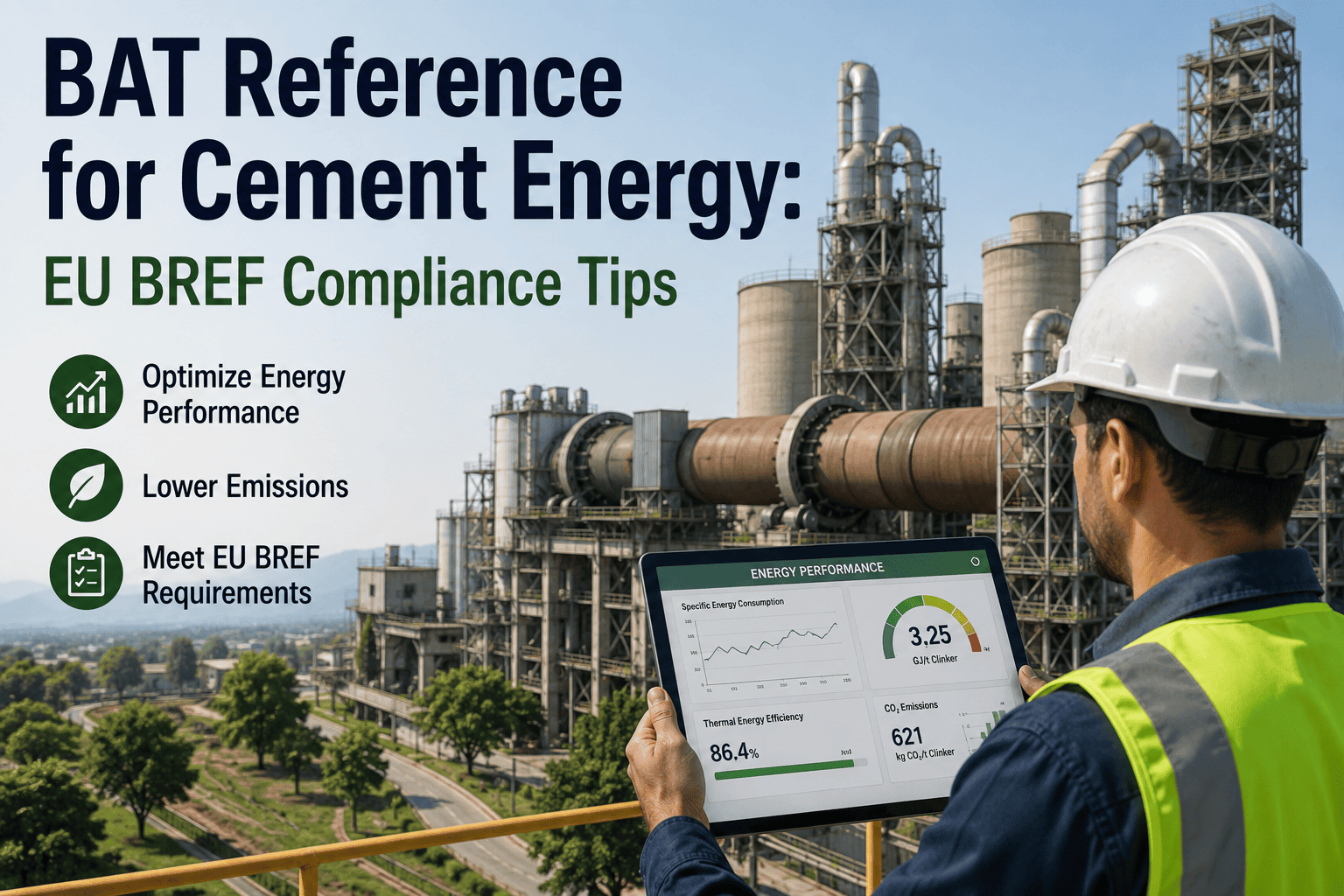
Best Available Techniques Reference for Cement Energy: EU BREF Compliance Tips
Every EU cement plant operating under an Industrial Emissions Directive permit is expected to apply the Best Available Techniques set out in the Cement, Lime and Magnesium Oxide BREF, and to be able to show a competent authority exactly how each technique maps to the plant's actual energy performance. The techniques themselves are well documented. What trips plants up during a permit review is rarely the engineering, it's the evidence.
The BREF Isn't Guidance, It's the Legal Basis for Your Permit Conditions
The Best Available Techniques Reference Document, or BREF, for the production of cement, lime, and magnesium oxide is produced through what's known as the Sevilla process, a structured exchange of information between Member State experts, industry representatives, environmental groups, and the European Commission's Joint Research Centre. The output of that process, the BAT conclusions, is adopted as a formal Commission Implementing Decision, and under the Industrial Emissions Directive, permit conditions issued by national authorities have to be based on those conclusions, not simply informed by them.
That distinction matters more than most plants treat it. A BREF isn't a best-practices whitepaper a plant can reference selectively, it's the document a permitting authority will hold a plant's actual performance against during every renewal cycle, and the Industrial Emissions Directive framework it sits under now covers tens of thousands of industrial installations across the EU, cement plants prominent among them given their energy intensity and emissions profile.
For the energy chapter specifically, the BREF sets out both the techniques a plant is expected to apply and, where data supports it, the associated energy consumption levels that represent what a well-run installation using those techniques should be able to achieve. A modern preheater-precalciner kiln operating well against BAT reference performance sits meaningfully below the EU-wide historical average, and that gap between the reference level and where a given plant actually sits is exactly what a permit review is designed to surface.
Six Techniques That Show Up Repeatedly Across a BAT Energy Compliance File
The BREF describes a broad set of techniques across raw material handling, kiln operation, grinding, and heat recovery, but a handful come up in almost every plant's compliance documentation because they carry the largest measurable effect on specific energy consumption. Mapping your plant's actual operational history against these six is usually the fastest way to see where the evidence gap actually sits, and it's also the fastest way to spot which techniques were applied years ago but have since drifted out of the operating condition that originally earned them a place in the file.
A BAT-AEL Is a Reference Range, Not Automatically a Hard Limit
One of the most common misunderstandings plants run into is treating every BAT-associated level as a fixed emission limit value the way they might treat a national air quality standard. In practice, a BAT-AEL is the range of performance the reference document associates with correctly applying the technique, and permitting authorities have some flexibility in how strictly that range is translated into binding permit conditions, particularly where site-specific factors genuinely limit what's achievable.
This nuance matters most in exactly the moment a plant is least prepared for it, mid-review, when an inspector or permitting officer flags a figure that sits outside the expected band and asks for an explanation. Plants that can point to a documented, technically reasoned derogation, tied to their specific raw material burnability, kiln age, or fuel mix, tend to move through that conversation quickly. Plants that can only offer an informal explanation on the spot often find the finding gets escalated into a formal condition or a follow-up audit, simply because there was nothing on file to close the question the first time it was raised.
| Concept | What It Means | Why It Matters for Your Plant |
|---|---|---|
| BAT-AEL (Associated Emission Level) | The performance range achievable when the relevant technique is correctly applied under normal operating conditions | Sets the expected band your monitoring data should sit within once the technique is in place |
| Site-Specific Derogation | A documented case where local factors, such as raw material burnability or existing kiln design, justify a level outside the standard range | Requires its own evidence trail, since an undocumented deviation reads as non-compliance, not as a justified exception |
| BAT-Associated Energy Consumption Level | The energy-specific reference figure tied to a given technique combination, used to benchmark thermal and electrical performance | The figure your energy audit and monitoring data get compared against at permit renewal |
See How Continuous Monitoring Maps to Your BAT Compliance File
iFactory tracks specific heat and electrical consumption trends against your plant's operating history, so the evidence for a permit renewal is already assembled instead of reconstructed under deadline.
Five Steps From Operational Practice to a Defensible Compliance Dossier
Plants that walk into a permit review confident rather than scrambling almost always followed some version of the same sequence, treating the compliance file as something built continuously across the permit cycle rather than assembled in the final weeks before submission.
The Difference Between Assembling Evidence and Already Having It
Two plants can apply exactly the same techniques and end up in very different positions at permit renewal, purely based on whether their energy performance data was tracked continuously or has to be reconstructed from scattered sources under time pressure.
| Approach | What Happens at Renewal | Typical Result |
|---|---|---|
| Manual, Spreadsheet-Based Records | Kiln logs, lab results, and utility bills get pulled together from multiple systems and reconciled by hand | Gaps and inconsistencies surface late, often during the authority's own review rather than before submission |
| Annual Snapshot Reporting | Performance is summarized once a year without a clear trend line showing how consistently it held within range | A single bad month can look like a persistent problem, or a real drift can hide inside an annual average |
| Continuous Monitoring Platform | Specific heat and electrical consumption are tracked automatically against BAT-AEL reference bands as operating conditions change | Deviations get flagged and investigated in near real time, and the trend evidence is already formatted for a compliance dossier |
iFactory's platform tracks specific energy consumption trends against kiln and mill operating conditions automatically, which is part of why plants using it going into a permit renewal typically spend the review period confirming data rather than chasing it down. Our support team can walk through how that monitoring maps to your BREF chapter before you book a demo.
A Permit Review That Turns Up a Gap the Plant Didn't Know It Had
A cement plant preparing for a routine permit renewal pulled three years of specific heat consumption data and found that, while the annual averages looked broadly consistent with the BAT-associated range, one quarter each year showed a clear spike coinciding with a scheduled refractory maintenance window, when the kiln ran at reduced efficiency for several weeks during ramp-up. The plant had never flagged this pattern internally because the annual average absorbed it.
Rather than let the competent authority discover the pattern first, the plant's energy team used the continuous trend data to document the cause, quantify the effect, and describe the ramp-up procedure changes already being tested to shorten the recovery window. What could have looked like an unexplained deviation in a spot-check review instead became evidence of a plant that understood its own performance in detail and was actively managing it, which materially changed the tone of the renewal conversation.
The Measurable Difference Between Reactive and Continuous BAT Compliance
These are the outcomes plants consistently report once BAT technique mapping and continuous energy monitoring replace a once-a-cycle scramble to assemble the compliance file.
Questions Cement Plants Ask About BAT Energy Compliance
Walk Into Your Next Permit Renewal With the Evidence Already Built
iFactory helps cement plants track specific heat and electrical energy consumption continuously against BAT-AEL reference ranges, so the compliance dossier is a export, not a scramble.