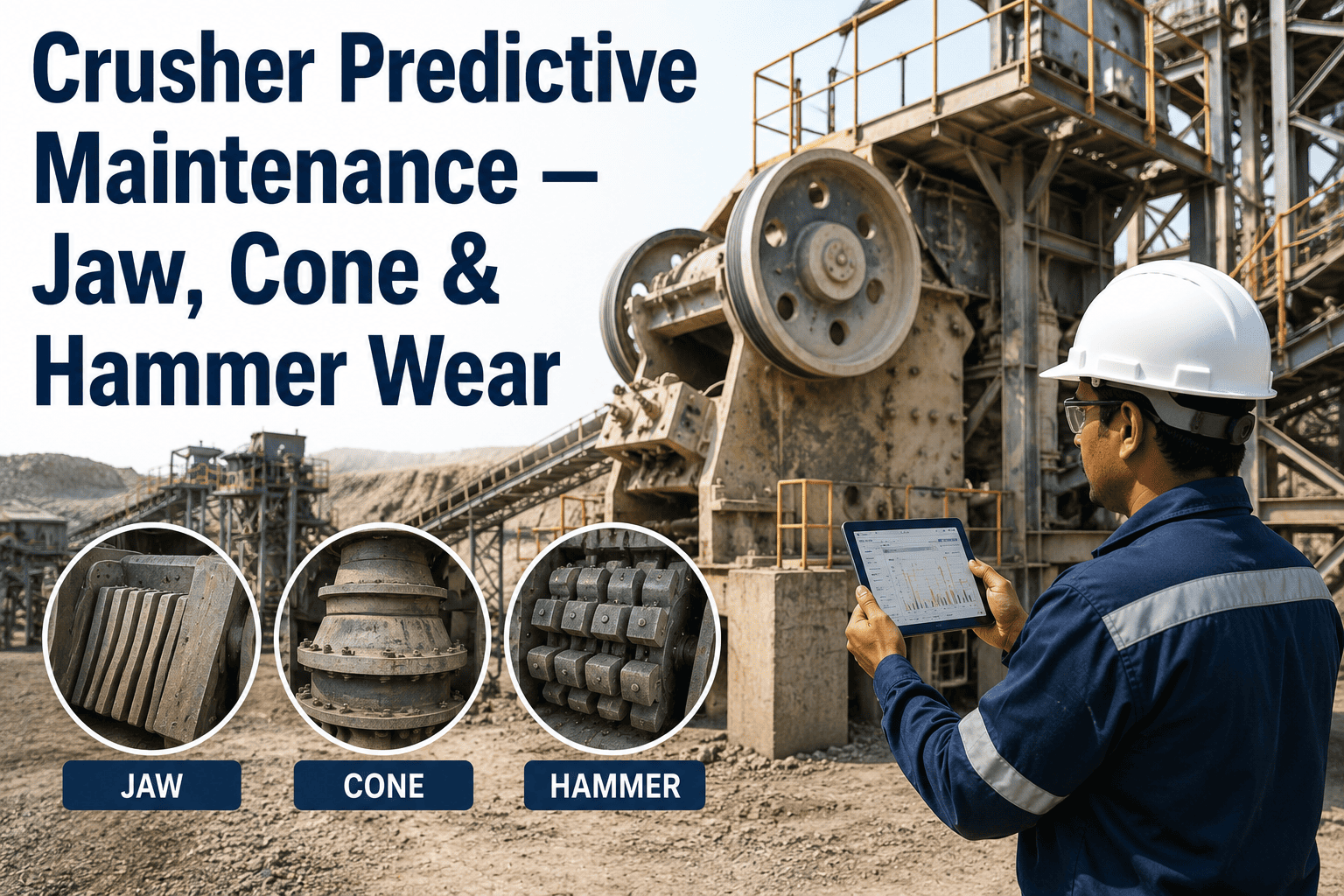
A primary crusher sitting at the head of a cement plant's crushing circuit can stop the entire raw material flow within minutes of a bearing seizure, and by the time that seizure happens the warning signs have usually been present for weeks. Bearing vibration climbs gradually before it spikes, lubrication oil accumulates wear metal before a seal fails outright, and closed-side setting drifts before a liner finally breaches. Up to 70 percent of crusher failures in cement plants trace back to bearing or wear conditions that develop a detectable signature well before the machine actually stops. This page covers how vibration monitoring and oil analysis work together with AI pattern recognition to turn those early signatures into scheduled maintenance instead of emergency shutdowns, and how booking a short walkthrough can show what that looks like for a specific crusher fleet.
CEMENT PLANT · CRUSHER RELIABILITY · PREDICTIVE MAINTENANCE
Bearing Seizures and Liner Breaches Rarely Happen Without Warning
iFactory fuses vibration trending, oil analysis, and AI pattern recognition into a single early-warning system for jaw, cone, impact, and hammer crushers, catching degradation weeks before it reaches the crushing chamber.
FAILURE SIGNATURES
What Each Crusher Type Tells You Before It Fails
Jaw, cone, impact, and hammer crushers each degrade differently because their mechanical loading is different, and a predictive maintenance program has to track the specific signals that matter for each type rather than applying one generic threshold across the whole fleet. Jaw crushers reveal wear through toggle plate deflection and jaw gap drift. Cone crushers reveal it through mantle wear tracked as closed-side setting drift. Impact and hammer crushers reveal it fastest through rotor imbalance following blow bar or hammer wear, since imbalance accelerates bearing wear disproportionately once it develops.
Jaw Crushers
Fixed and swing jaw plate wear tracked by profile gauge, toggle plate deflection checked semi-monthly, eccentric shaft bearing vibration and temperature trended continuously, jaw gap setting compared against product size specification.
Cone Crushers
Mantle and bowl liner wear measured by closed-side setting drift, eccentric assembly inspected at each major liner replacement, main shaft bearing oil temperature and pressure monitored continuously for early lubrication failure signs.
Impact Crushers
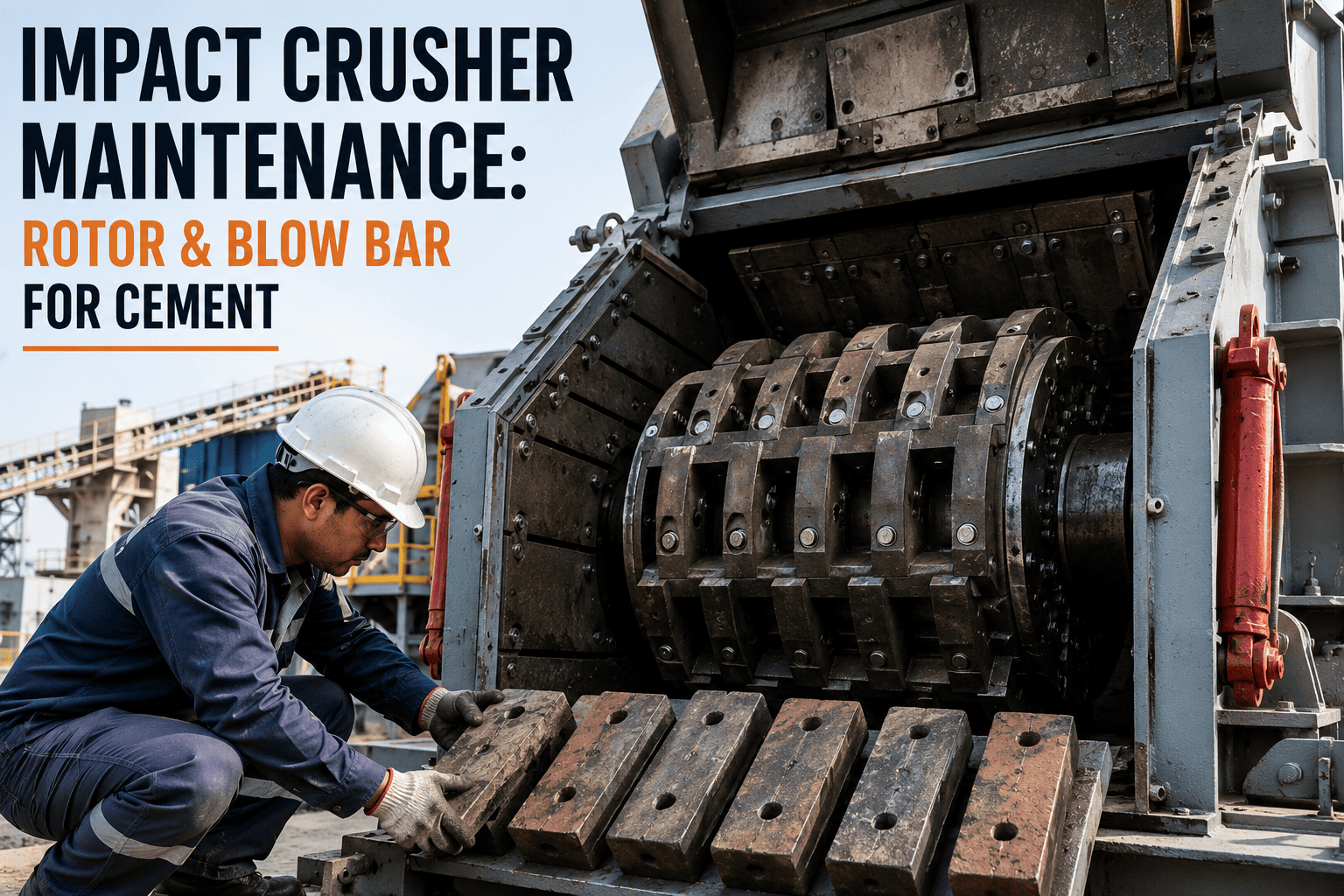
Blow bar wear measured by template gauge at each planned access, rotor balance checked after every replacement set since imbalance above roughly 50 gram-metres triggers immediate balancing before restart, rotor bearing vibration trended against ISO 10816 thresholds.
Hammer Crushers
Individual hammer weight tracked per position since a differential above roughly 50 grams triggers full hammer set replacement to prevent rotor imbalance, liner plate thickness measured quarterly, disc and pin wear inspected at each access.
VIBRATION SIGNATURES
Reading the Frequency Band Before the Failure Arrives
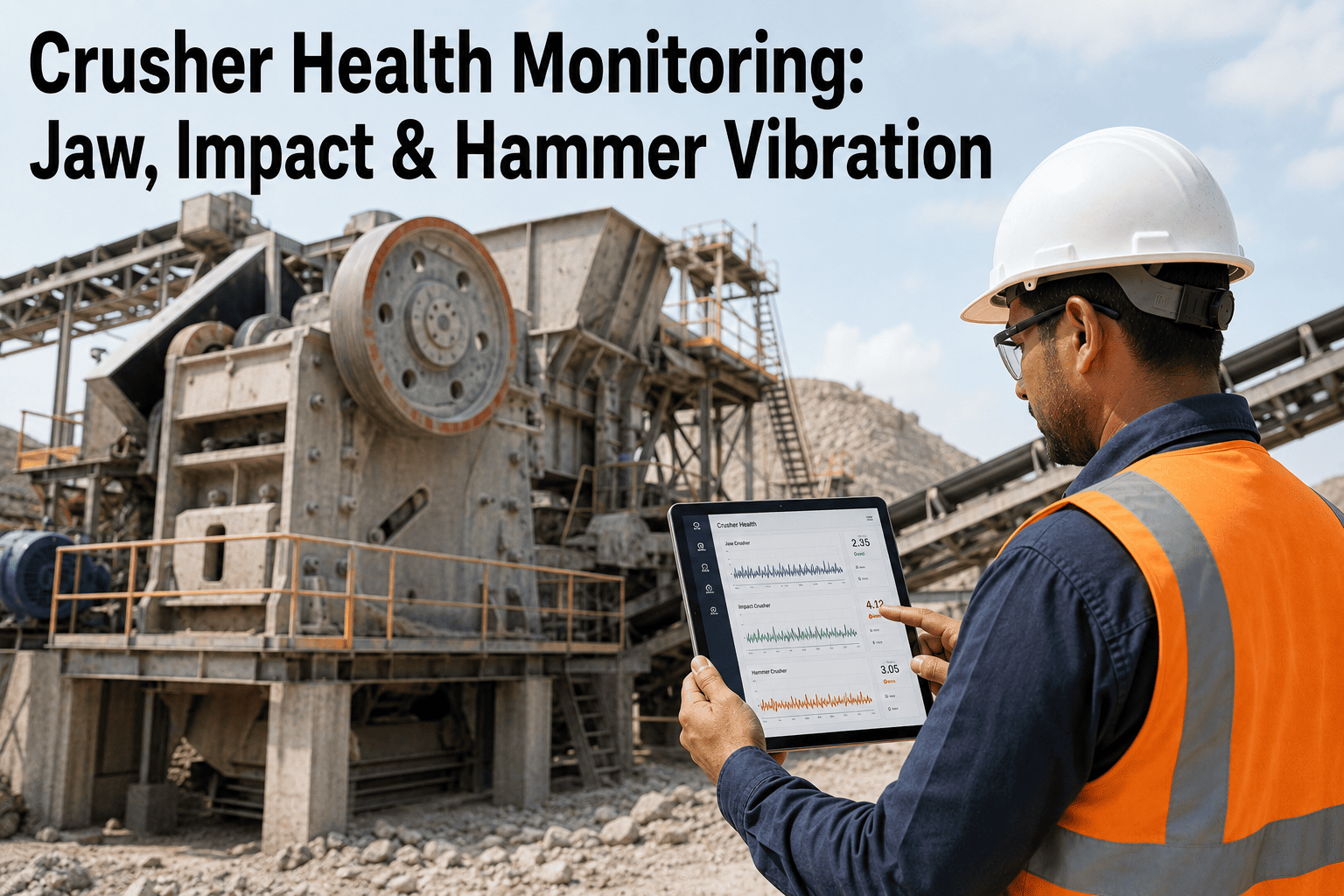
Vibration analysis works because different mechanical failure modes generate energy at predictable frequency bands relative to shaft rotational speed, and tracking the trend in each band over time gives a lead time measured in weeks rather than days. Bearing RMS vibration on both drive and non-drive ends typically gives 3 to 6 weeks of warning before main shaft or eccentric bearing deterioration becomes critical. Motor current draw trending catches feed overload, liner wear, or tramp metal impact 2 to 4 weeks out. Bearing temperature trending reveals lubrication failure, overload, or seal degradation with 1 to 3 weeks of lead time, while oil pressure and temperature on the lubrication system can shrink that window to just days once a lube pump or filter issue is underway.
| Signal | What It Indicates | Typical Lead Time |
|---|
| Bearing RMS vibration (drive and non-drive end) | Main shaft and eccentric bearing deterioration | 3–6 weeks |
| Motor current draw trend | Feed overload, liner wear, tramp metal impact | 2–4 weeks |
| Bearing temperature (main, eccentric, countershaft) | Lubrication failure, overload, seal degradation | 1–3 weeks |
| Closed-side setting drift | Liner wear, eccentric wear, setting mechanism wear | 4–8 weeks |
| Oil pressure and temperature | Lube pump failure, filter blockage, oil degradation | Days to weeks |
Stop Losing Crusher Availability to Reactive Bearing Replacements
iFactory trends vibration, motor current, bearing temperature, and closed-side setting against each crusher's own operating baseline, learned over 2 to 4 weeks of normal operation, so early warnings reflect your specific machine and feed material rather than generic industry averages.
OIL ANALYSIS
What Lubrication Oil Is Telling You That Vibration Cannot
Vibration analysis is strongest at catching mechanical wear that produces a physical signature, but oil analysis catches contamination and lubrication chemistry issues that vibration alone will miss until they have already caused mechanical damage. Wear metal analysis identifies which specific component is shedding material into the oil, distinguishing between normal running-in wear and abnormal wear from a developing bearing or gear problem. Water contamination and particle counting catch seal degradation and filtration breakdown before they accelerate wear rates across the whole lubrication circuit. Combined with vibration trending, oil analysis closes the gap between "something is wearing" and "this specific component is wearing abnormally fast," which materially changes how a maintenance team prioritizes the resulting work order.
01
Wear Metal Analysis
Spectrometric analysis identifies iron, copper, chromium, and other wear metals in the oil sample, and the specific metal signature points to which component, bearing, gear, or shaft, is generating the wear.
02
Particle Count and Contamination
Particle counting against ISO cleanliness codes flags filtration breakdown or seal failure introducing abrasive contaminants that accelerate wear across every lubricated surface in the circuit.
03
Viscosity and Additive Depletion
Viscosity drift and additive package depletion indicate the oil has reached the end of its useful protective life, independent of any contamination, and signal a change interval rather than a mechanical fault.
04
Correlation With Vibration Trend
When an oil finding and a vibration trend point at the same component simultaneously, confidence in the diagnosis rises sharply, and that combined signal is what should trigger an emergency versus routine work order.
FROM SIGNAL TO WORK ORDER
How AI Pattern Recognition Turns Sensor Trends Into Action
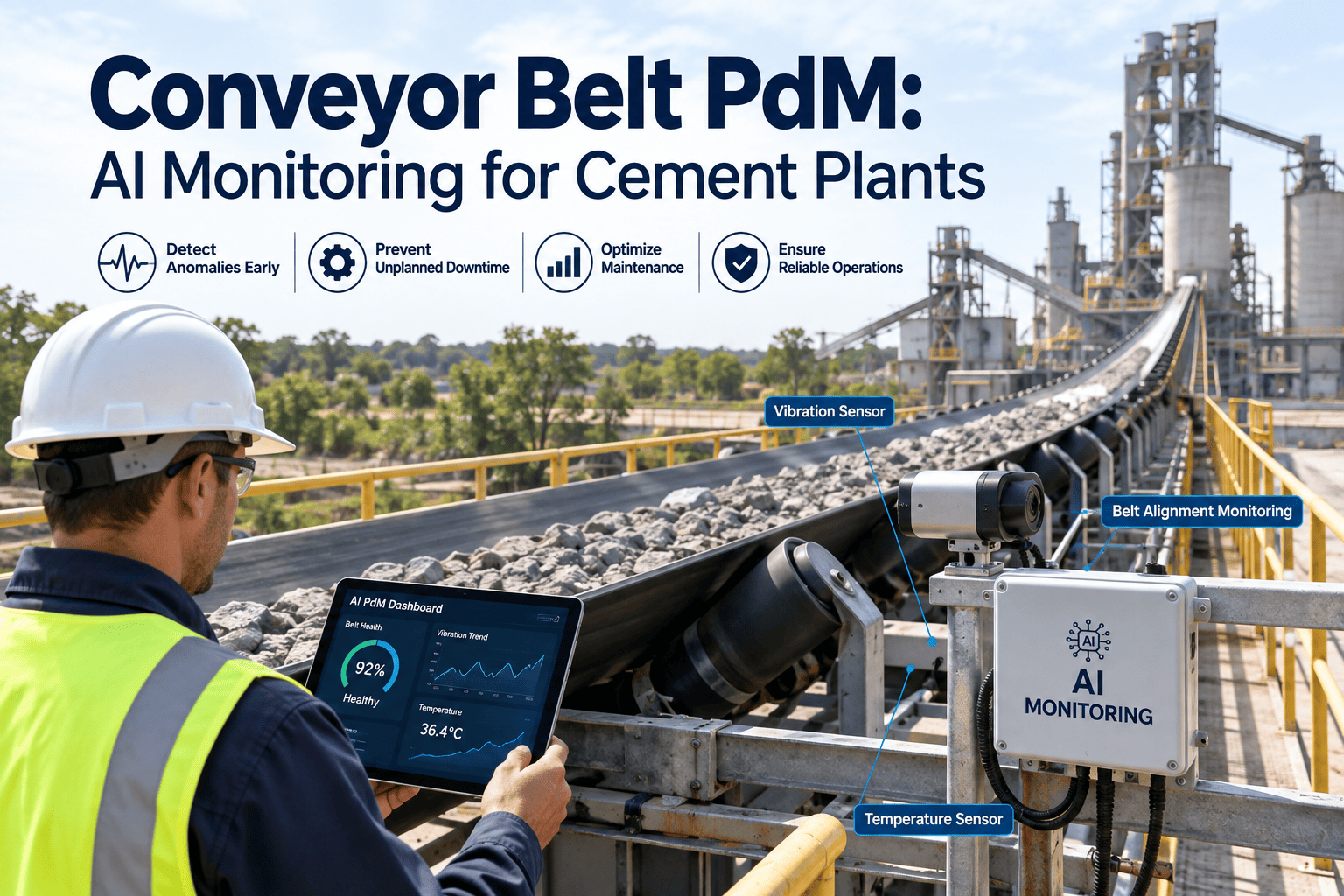
Raw vibration and oil data is only useful if it reaches a technician's work queue before the failure does, and that requires more than threshold alarms. AI pattern recognition learns each crusher's individual normal operating signature over roughly two to four weeks, covering how vibration and temperature behave differently under varying feed rates and across shifts, so it can flag a genuine deviation rather than a normal operating swing. When a bearing RMS trend and a 5 to 6 degree bearing temperature drift both develop over 72 hours, that combination is a high-confidence bearing-failure precursor that should generate an emergency work order automatically rather than waiting for a human to notice two separate charts moving in the same direction.
1
Baseline learning. The AI model observes 2 to 4 weeks of normal operation across varying feed rates and shifts to establish what "normal" looks like for that specific machine.
2
Continuous deviation scoring. Every new vibration, temperature, current, and oil reading is scored against the learned baseline rather than a fixed generic threshold.
3
Multi-signal correlation. The system checks whether multiple independent signals, vibration, temperature, oil chemistry, are moving together toward the same failure mode before escalating severity.
4
Automatic work order generation. A confirmed high-confidence anomaly generates a work order with the affected component, severity, and recommended action attached, and routes it to the technician on shift.
ROOT CAUSE CATEGORIES
What Actually Drives Crusher Bearing and Wear Failures
Reducing crusher breakdown frequency requires understanding not just which signal moved, but why it moved in the first place, since the same vibration or temperature symptom can trace back to several very different root causes. Lubrication-related causes are the single largest category, but feed material variability, tramp metal events, and installation or alignment issues each contribute a meaningful share of unplanned crusher downtime across a typical cement plant crushing circuit.
Lubrication Failure
Contaminated, degraded, or insufficient lubrication is the single largest driver of premature bearing failure, and it is also the most preventable when oil analysis and lubrication scheduling are tracked consistently.
Tramp Metal Impact
Uncrushable metal entering the feed stream generates sudden shock loading on bearings, eccentric assemblies, and rotor components, often producing a step-change in vibration rather than a gradual trend.
Feed Material Variability
Changes in limestone hardness, moisture content, or particle size distribution shift the load pattern on crushing surfaces, accelerating wear rates beyond what a fixed tonnage-based interval assumes.
Alignment and Installation Issues
Misalignment introduced during a bearing or liner replacement can shorten the expected service life of an otherwise healthy component dramatically, which is why post-repair vibration verification matters as much as pre-repair diagnosis.
GETTING STARTED
How a Crusher PdM Rollout Typically Progresses
Moving a crusher fleet from reactive to predictive maintenance does not happen in a single step, and most successful rollouts follow a similar sequence that lets the AI model build confidence on real operating data before it starts driving maintenance decisions.
1
Instrument the highest-consequence crushers first. Primary crushers whose failure would halt the raw mill are typically prioritized over secondary or tertiary units for initial sensor deployment.
2
Establish the baseline. Two to four weeks of continuous monitoring across normal feed and shift variation gives the AI model enough data to distinguish real deviation from routine operating swings.
3
Calibrate alert thresholds against real events. Early alerts are reviewed manually to confirm accuracy before thresholds are tightened and work order automation is switched on.
4
Expand to the full crushing circuit. Once the initial deployment demonstrates reliable early warning, coverage extends to secondary and tertiary crushers using the same baseline methodology.
70%
Of Cement Crusher Failures Are Bearing or Wear-Related With a Detectable Signature
3–8
Weeks of Typical Advance Warning From Combined Vibration and Oil Trending
56%
Of Premature Bearing Failures Are Lubrication-Related and Preventable
$120K–$350K
Per Day of Lost Production Risk When a Primary Crusher Fails Without Warning
FREQUENTLY ASKED QUESTIONS
Common Questions on Crusher Vibration and Oil Analysis
What is a minimum viable sensor setup to start predictive maintenance on an existing crusher fleet?
A minimum viable configuration includes vibration accelerometers on the main bearings, motor current monitoring pulled from the motor control center, and bearing temperature sensors at each critical bearing position. Oil analysis can begin with periodic laboratory sampling before moving to inline sensors if budget requires a phased rollout. Most existing condition monitoring hardware already installed on a crusher can be accepted directly rather than requiring a full sensor replacement, which keeps the initial deployment cost manageable. You can review what your current instrumentation already supports through
the support team.
How does liner wear get predicted without a direct wear sensor on the liner itself?
Liner wear is tracked indirectly through motor current draw trends and closed-side setting drift rather than a physical wear sensor, since increasing current draw at a constant feed rate correlates with liner surface loss changing crushing geometry. Combined with throughput history, these indirect signals produce a reliable wear curve accurate enough for replacement planning without requiring the crusher to be opened for inspection between scheduled outages.
Why does rotor imbalance matter so much more on impact and hammer crushers than on jaw or cone crushers?
Impact and hammer crushers run at far higher rotational speeds than jaw or cone crushers, in some cases exceeding 50,000 RPM at the rotor tip, which means even a small mass imbalance from uneven blow bar or hammer wear generates disproportionately large centrifugal forces on the bearings. That is why balancing after every blow bar or hammer set replacement is treated as a mandatory step rather than an optional check, since skipping it accelerates bearing wear far faster than the wear rate the crusher would otherwise experience.
Does predictive maintenance replace tonnage-based preventive maintenance triggers entirely?
No, tonnage-based triggers remain useful for wear components with a fairly predictable, linear wear curve like jaw plates or blow bars, since they set a reliable outer boundary for replacement planning. Predictive maintenance layers on top of those triggers to catch abnormal wear rates driven by feed material changes, tramp metal events, or lubrication problems that a fixed tonnage interval alone would miss, and it can also extend replacement intervals when actual wear is running slower than the tonnage-based assumption predicts.
How long does it take an AI model to reach reliable prediction accuracy on a newly monitored crusher?
Most crusher-specific AI models reach reliable baseline accuracy within 2 to 4 weeks of continuous monitoring across normal operating variation, and prediction confidence continues improving as the Shift Logbook and sensor history accumulate additional confirmed failure and near-miss events. Early weeks of deployment typically involve slightly wider alert thresholds while the model learns machine-specific normal ranges, narrowing to tighter, more precise alerting once the baseline stabilizes. Book a walkthrough at
this link to see baseline learning timelines for a specific crusher configuration.
Move From Reactive Crusher Firefighting to Scheduled Reliability
iFactory consolidates vibration, oil analysis, motor current, and inspection findings into one crusher asset record, learns your specific machine baselines, and auto-generates prioritized work orders the moment a high-confidence failure signature emerges.