Impact Crusher Maintenance: Rotor & Blow Bar for Cement
By Johnson on August 19, 2026
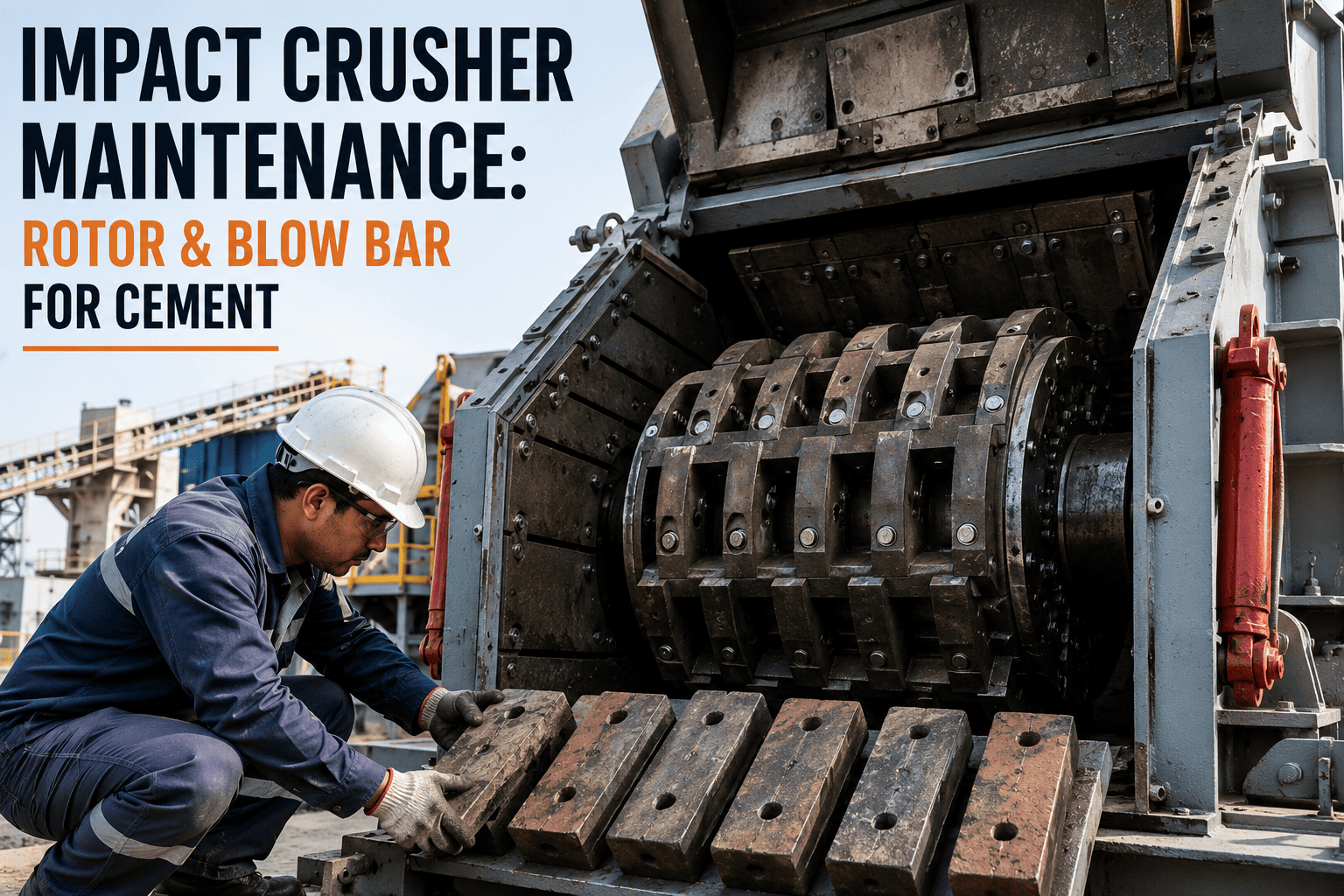
An impact crusher that was hammering through limestone at full tonnage two weeks ago and is now vibrating, surging, and choking mid-shift did not fail overnight. Blow bar wear, rotor imbalance, and curtain misalignment all build gradually, and by the time an operator notices the change in sound or throughput, the crusher has usually been running degraded for days. Cement plants that catch this drift early avoid the unplanned changeout that stops the whole crushing circuit; the ones that do not end up pulling a rotor on an emergency basis with a queue of trucks backed up behind it. This guide covers what actually wears on an impact crusher, how to read the warning signs before failure, and where predictive monitoring changes the maintenance conversation — you can also book a demo to see how it applies to your crushing circuit.
CEMENT OPERATIONS · CRUSHER BREAKDOWNS · ROTOR & BLOW BAR
Stop Losing Crushing Circuit Uptime to Blow Bar and Rotor Failures
Blow bar wear and rotor imbalance are the two most common reasons an impact crusher goes down unplanned. Both leave a trail of warning signs weeks before failure — if the plant is watching for them.
Of impact crusher downtime traced to blow bar or rotor issues
4-8 hrs
Typical downtime for a reactive blow bar changeout
2-3 wks
Warning window most crushers give before a wear-driven failure
Why Impact Crushers Fail Differently Than Jaw or Cone Crushers
A jaw crusher wears at a compression surface and a cone crusher wears at a fixed gap — both degrade in a fairly linear, predictable way. An impact crusher is a different animal. The rotor spins at high speed, and the blow bars mounted to it strike the feed material directly, which means wear is driven as much by impact energy and material hardness as by tonnage processed. That makes blow bar wear far less predictable on a fixed calendar schedule, because a batch of harder-than-usual limestone or a spike in feed size can accelerate wear dramatically in a single shift. Add rotor imbalance from uneven wear across the bar set, and the failure mode compounds: an out-of-balance rotor vibrates, stresses its bearings, and can ultimately damage the rotor disc itself if it runs long enough in that condition.
This is why impact crusher maintenance programs built purely on inspection intervals tend to either over-replace bars that still have useful life, or miss a rapid wear event between scheduled checks. Continuous condition monitoring closes that gap by tracking the signals that change before a bar set needs attention, rather than waiting for the next calendar-driven walkdown.
Blow Bar Tip Wear
The leading edge takes the direct impact load and wears fastest, gradually shortening the bar and changing the strike angle against the feed material.
Blow Bar Body Erosion
Abrasive fines erode the bar body between impacts, thinning the cross-section and increasing the risk of a fatigue crack under repeated impact stress.
Rotor Disc and Hub Wear
Material buildup and wear plate erosion around the rotor disc change the rotor's effective balance over time, even when the bars themselves look serviceable.
Curtain and Apron Liner Wear
Impact aprons and curtain liners wear unevenly depending on feed distribution, which shifts the crushing gap and changes product size distribution before anyone adjusts for it.
Side Liner and Breaker Plate Wear
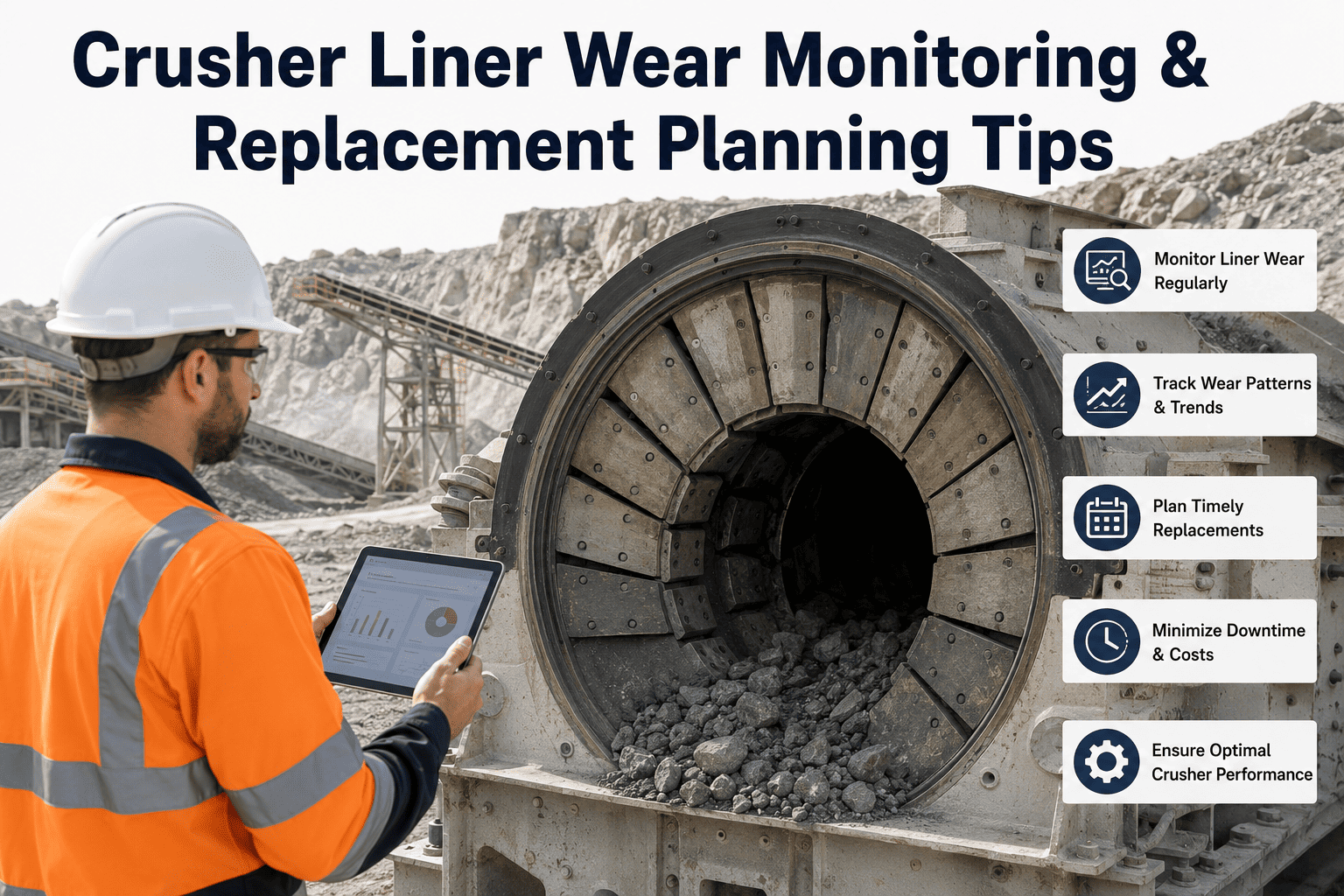
Side liners protect the housing but wear fastest at the feed entry point, and a worn breaker plate lets material bypass the intended crushing zone.
Bearing and Housing Vibration
Rotor imbalance from uneven bar wear transmits directly into the bearing housings, and left unaddressed it shortens bearing life independently of the wear parts themselves.
Blow Bar Material Options and What They Trade Off
Material selection is one of the biggest levers a plant has over changeout frequency, but the harder materials are not automatically the right choice for every application — the trade-off is wear life against impact toughness.
Blow Bar Material
Best Suited For
Relative Wear Life
Impact Toughness
High-Manganese Steel
High-impact, variable feed size
Moderate
High — work-hardens under impact
High-Chrome White Iron
Abrasive, lower-impact material
High
Lower — more prone to cracking on shock loads
Chrome-Moly Alloy Steel
Mixed abrasion and impact conditions
Moderate to High
Moderate
Bi-Metal Composite Bars
High-throughput circuits seeking longer intervals
High
Moderate — wear face backed by tougher core
Reading the Wear Curve Before It Becomes a Failure
Blow bar wear does not progress at a constant rate, and the stage a bar set is in changes what action actually makes sense — rotating bars, adjusting the curtain, or scheduling a full changeout.
Stage 1
Break-In Wear
New bars wear fastest in the first days of service as the striking edge conforms to the material stream. Throughput and product size are typically stable through this stage.
Stage 2
Steady-State Wear
The longest stage — wear proceeds at a predictable, near-linear rate. This is the window where bars can often be rotated to even out remaining wear life across the set.
Stage 3
Accelerated Wear
As the bar shortens, strike geometry changes and wear rate increases. Product size distribution starts drifting coarser and vibration signatures begin to shift.
Stage 4
Critical Wear
Vibration rises sharply, throughput drops, and the risk of a bar failure or rotor imbalance event increases quickly. Waiting past this stage risks unplanned downtime rather than a scheduled changeout.
See Your Crusher's Wear Curve Before It Reaches Stage Four
iFactory tracks vibration, throughput, and product size trends against your crusher's own baseline, flagging accelerated wear early enough to plan the changeout instead of reacting to it.
Curtain Adjustment: The Setting Most Plants Get Wrong
Curtain gap controls product size, and as blow bars wear shorter, the effective gap opens even if the curtain position never moves — which is why product size can drift coarser over weeks without anyone touching the adjustment. Getting this right is a repeatable process rather than a judgment call.
1
Measure Current Bar Length
Check remaining blow bar length against the original dimension to establish how much the effective strike radius has shrunk since installation.
2
Compare Against Target Product Size
Pull recent product size distribution data and compare it against the specification the downstream mill or kiln feed system expects.
3
Adjust Curtain Gap Incrementally
Move the curtain in small, documented increments rather than a single large correction, and verify the effect on product size before making a further change.
4
Log the Adjustment Against Bar Wear
Recording each curtain adjustment against the bar wear level it was made to correct builds the data trail that predicts when the next adjustment will be needed.
5
Reassess at the Next Changeout
Use the accumulated adjustment history to refine how early the next bar set's curtain schedule should start, rather than restarting the process from scratch.
Reactive vs. Predictive Rotor and Blow Bar Maintenance
Reactive Approach
Predictive Approach
Bars replaced on a fixed calendar interval regardless of actual wear
Bars replaced based on measured wear trend and vibration signature
Rotor imbalance discovered when vibration alarms trip
Imbalance trend flagged weeks before it reaches an alarm threshold
Curtain adjusted only when product size complaints arrive
Curtain schedule driven by tracked bar wear and size-distribution data
Changeout scheduled as an emergency, often mid-shift
Changeout planned during a scheduled maintenance window
Bar sets frequently over-replaced to avoid surprise failures
Bar life extended safely using real wear data instead of guesswork
Rotor Balance: The Signal Most Plants Check Too Late
Rotor balance rarely gets attention until vibration is already high enough to trigger an alarm, but by that point the imbalance has often been building for weeks. Uneven blow bar wear shifts the rotor's center of mass gradually, and each small shift adds vibration load onto the bearings before it ever shows up as an audible or visible problem on the floor. Tracking vibration continuously, rather than at scheduled inspection intervals, is what turns rotor balance from a reactive alarm into an early planning signal.
Uneven Bar Wear Across the Set
If bars are not rotated on a consistent schedule, the ones in the primary strike zone wear faster than the rest, shifting rotor mass distribution over time.
Material Buildup on the Disc
Sticky or fine material can accumulate unevenly on the rotor disc and hub, adding localized mass that throws off balance independent of bar condition.
Bearing Wear from Sustained Imbalance
Once imbalance sets in, bearing wear accelerates in a feedback loop — the more worn the bearing, the more vibration the same imbalance produces.
Building an Inspection Routine That Actually Catches Wear Early
Most plants already have a blow bar inspection routine in some form — the gap is usually in what gets recorded and compared over time, not in whether the inspection happens at all. A walkdown that notes "bars look fine" without a measurement leaves nothing to trend against next time, which means the crusher is effectively back to a fixed-interval replacement schedule even if the inspection itself was more frequent.
1
Measure, Do Not Just Observe
Record actual bar length and thickness at each inspection rather than a subjective "good, fair, replace soon" note, so the data can be trended against previous readings.
2
Pair Physical Checks with Vibration Data
A walkdown measurement combined with continuous vibration trending gives a far more complete picture than either signal alone, since vibration can flag imbalance between physical inspections.
3
Track Product Size as a Third Signal
Product size distribution drifting coarser over time, even without a curtain change, is often the earliest visible sign that blow bar wear has reached the accelerated stage.
4
Feed the Data Back Into Planning
Wear trend data is only useful if it reaches the people scheduling changeouts and ordering parts — closing that loop is what turns inspection data into avoided downtime.
What Early Detection Looks Like in Practice
Before
A Reactive Changeout Mid-Shift
A cement plant's primary impact crusher was on a fixed six-week blow bar changeout interval. A harder-than-usual limestone batch accelerated wear well ahead of schedule, and the crusher began vibrating heavily during a night shift. The rotor was pulled on an emergency basis, and the crushing circuit was down for most of a shift while a replacement bar set and crew were mobilized.
After
A Planned Window Instead of a Shutdown
With continuous vibration and throughput monitoring in place, the same wear acceleration was flagged as an early trend within days, before vibration reached alarm level. Maintenance scheduled the changeout for an upcoming planned window, ordered the bar set in advance, and the crusher never lost a shift to an unplanned stop.
Getting Started: A Practical Checklist
Establish a Wear Baseline
Record current blow bar dimensions, rotor vibration levels, and product size distribution as the starting reference point for trend comparison.
Track Vibration Continuously
Move from periodic vibration checks to continuous monitoring so a wear-driven imbalance shows up as a trend rather than a surprise alarm.
Log Every Curtain Adjustment
Build a record connecting each curtain adjustment to the bar wear level that prompted it, so future changeouts can be anticipated rather than reacted to.
Pre-Stage Replacement Bar Sets
Use the wear trend to order the next bar set with enough lead time to avoid a rushed, premium-priced emergency order.
Frequently Asked Questions
How often should impact crusher blow bars be replaced?
There is no single correct interval — actual service life depends on feed hardness, throughput, and blow bar material, and can vary significantly even between two crushers running the same limestone source. A fixed calendar interval tends to either waste remaining bar life or miss a rapid wear event, which is why tracking wear against a measured baseline gives a far more reliable changeout signal than a generic schedule.
What causes rotor imbalance on an impact crusher?
Rotor imbalance most often develops from uneven wear across the blow bar set — if one or two bars wear faster than the others, the rotor's mass distribution shifts and vibration increases. Material buildup on the rotor disc and hub can produce the same effect even when the bars themselves are within tolerance, which is why vibration monitoring catches imbalance issues that a visual bar inspection alone can miss.
How do I know if my curtain adjustment is still correct?
Compare current product size distribution against the target specification for the downstream mill or kiln feed. If the product is trending coarser without any change in feed material, worn blow bars have effectively opened the crushing gap even though the curtain position has not moved, and an adjustment is likely overdue. Reach out through support if you want help setting up that comparison against your own historical data.
Can predictive monitoring extend blow bar life, not just predict failure?
Yes — one of the most common outcomes plants see is safely extending bar life beyond what a conservative fixed schedule would allow, because the wear trend shows exactly how much service life remains rather than forcing an early precautionary replacement. Over a year, that reduction in premature changeouts adds up to real savings in both parts spend and planned downtime.
What is the fastest way to see this working on our own crusher data?
The quickest path is connecting existing vibration and throughput data to a monitoring model built around your crusher's own operating baseline rather than a generic benchmark. Most plants can see a first wear-trend view within the initial working session — you can book a demo to walk through what that looks like against your equipment.
Turn Blow Bar Wear Into a Planned Event, Not an Emergency
iFactory monitors rotor vibration, throughput, and product size trends continuously, so wear-driven failures show up as an early signal instead of a mid-shift shutdown.