Cement plants run some of the heaviest rotating equipment in industry, and mills, fans, and crushers absorb constant shock loading and abrasive dust that wear bearings, gears, and rotor components long before a failure ever shows up on a control room screen. Most plants still rely on a technician walking the floor with a handheld vibration meter once a week or once a month, which means a bearing that starts degrading on a Tuesday might not get checked again until the following week, by which point the damage has often progressed past the point of a simple repair. Continuous vibration monitoring closes that gap by tracking every critical asset around the clock instead of in periodic snapshots. See how iFactory turns raw vibration data from mills, fans, and crushers into early fault alerts with a Book a Demo.
Catch The Bearing Fault Before It Becomes A Mill Stoppage
Ball mills, vertical mills, ID fans, and crushers each fail in different ways and at different frequencies. iFactory continuously monitors vibration on every one of them, flags the earliest signs of bearing wear, gear damage, and imbalance, and routes the alert to your maintenance team before it turns into unplanned downtime.
Cement Equipment Fails In Ways Manual Checks Miss
A ball mill trunnion bearing, a vertical mill roller bearing, an ID fan shaft, and a crusher rotor all generate distinct vibration signatures long before they generate an audible or visible symptom. A monthly handheld reading might catch a fault once it is already advanced, but it almost never catches the early stage where the fix is a scheduled bearing swap instead of an emergency mill stop. The four issues below are the ones that show up most often across cement plants that still rely on periodic manual checks.
Weekly Snapshots Miss Fast-Developing Faults
A bearing spall or a cracked gear tooth can progress from a barely detectable signal to a functional failure within days under the constant load of a running mill, well inside the gap between two scheduled manual readings.
Dust And Access Limit Manual Route Reliability
Crusher housings and preheater-area fans are often coated in fine dust and sit in awkward access points, which means manual readings get skipped or shortened more often than the route sheet suggests.
Different Assets Need Different Fault Signatures
A single generic alarm threshold applied across a ball mill trunnion bearing and an ID fan shaft bearing produces both missed faults and false alarms, because the two assets run at different speeds and load patterns.
Trend Context Gets Lost Between Readings
Without a continuous trend line, a technician comparing this month's reading to last month's has no way to tell whether a fault is developing gradually or accelerating, which is the detail that actually determines urgency.
What Each Critical Asset Actually Tells You Through Vibration
Ball mills, vertical mills, fans, and crushers do not fail the same way, so the vibration signature worth watching is different for each one. Understanding what each asset's vibration pattern typically reveals is the starting point for setting up monitoring that actually catches the right faults early.
Ball Mill — Trunnion And Girth Gear Faults
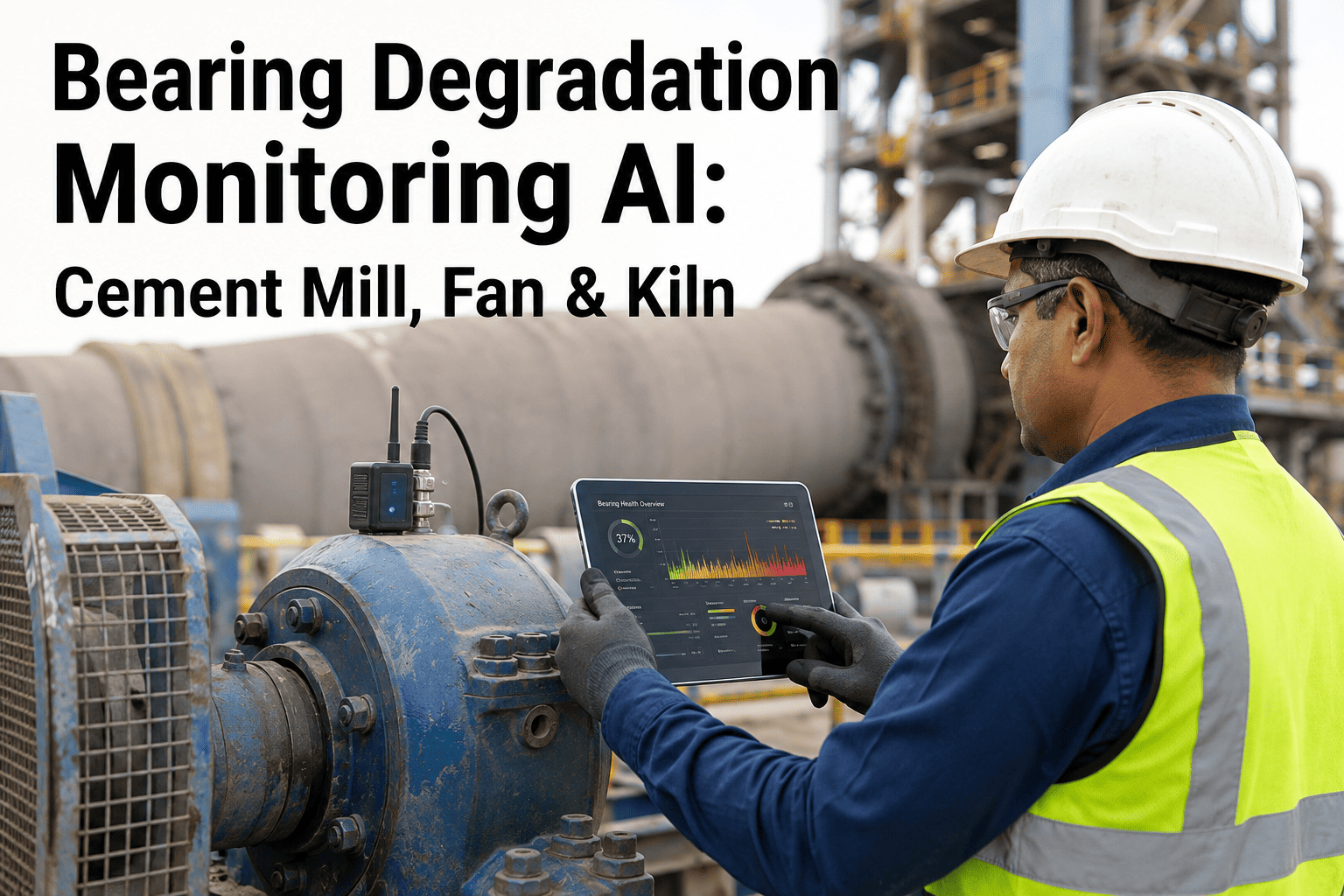
Ball mill trunnion bearings show early wear as a rise in high-frequency envelope energy long before overall vibration amplitude moves, while girth gear mesh faults appear as sidebands around the gear mesh frequency tied to pinion rotational speed.
Vertical Mill — Roller And Table Bearing Wear
Vertical roller mills develop distinctive impact vibration as roller bearings wear against the grinding table, and because the rollers rotate at low speed, this fault type needs low-frequency envelope analysis rather than standard overall vibration alone.
ID Fan — Imbalance And Blade Erosion
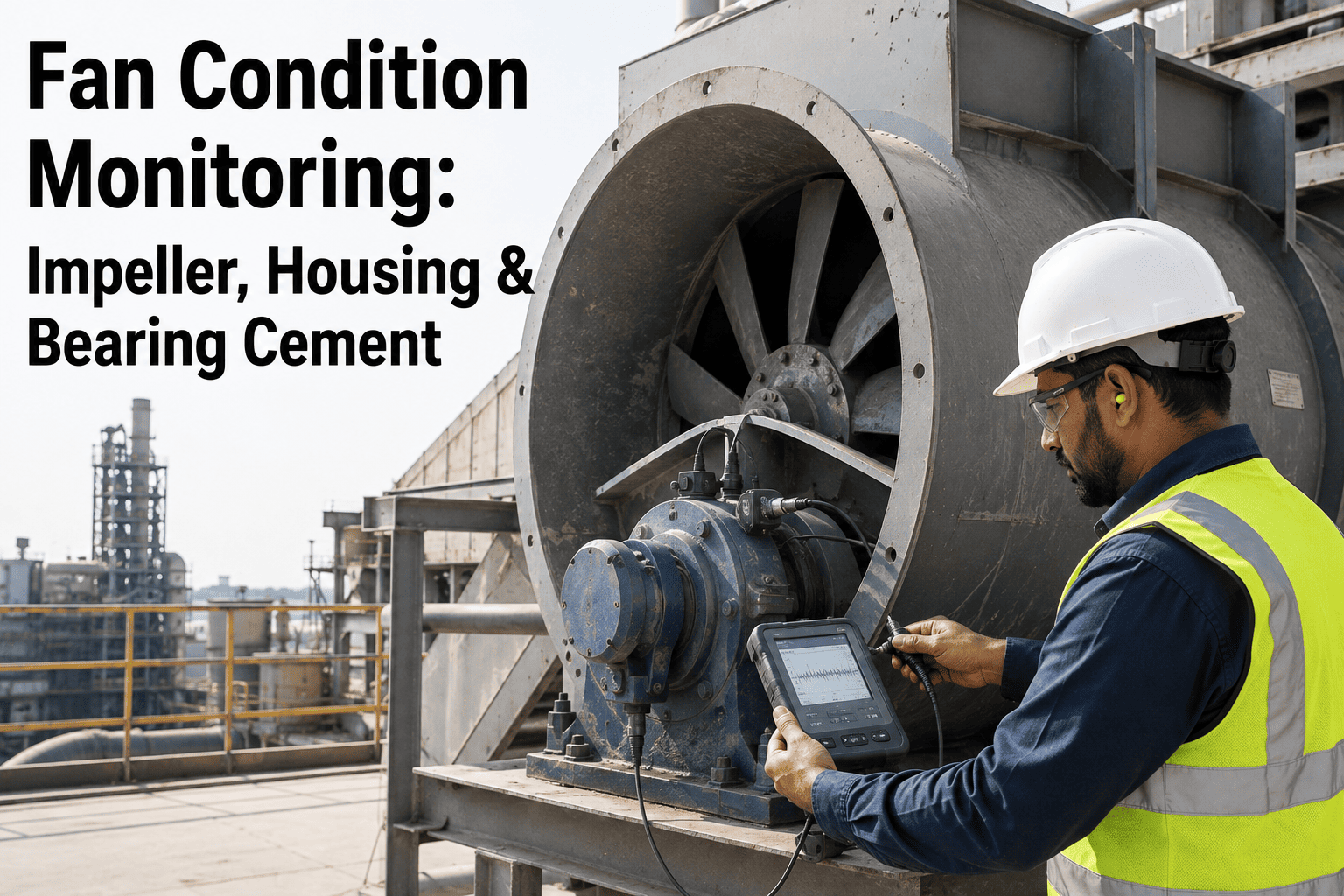
ID fans handling hot, dust-laden gas accumulate material unevenly on the blades over time, which shows up as a rising 1x running speed peak, while blade erosion or cracking produces higher-order harmonics that a route-based check often misses.
Crusher — Shaft Misalignment And Bushing Wear
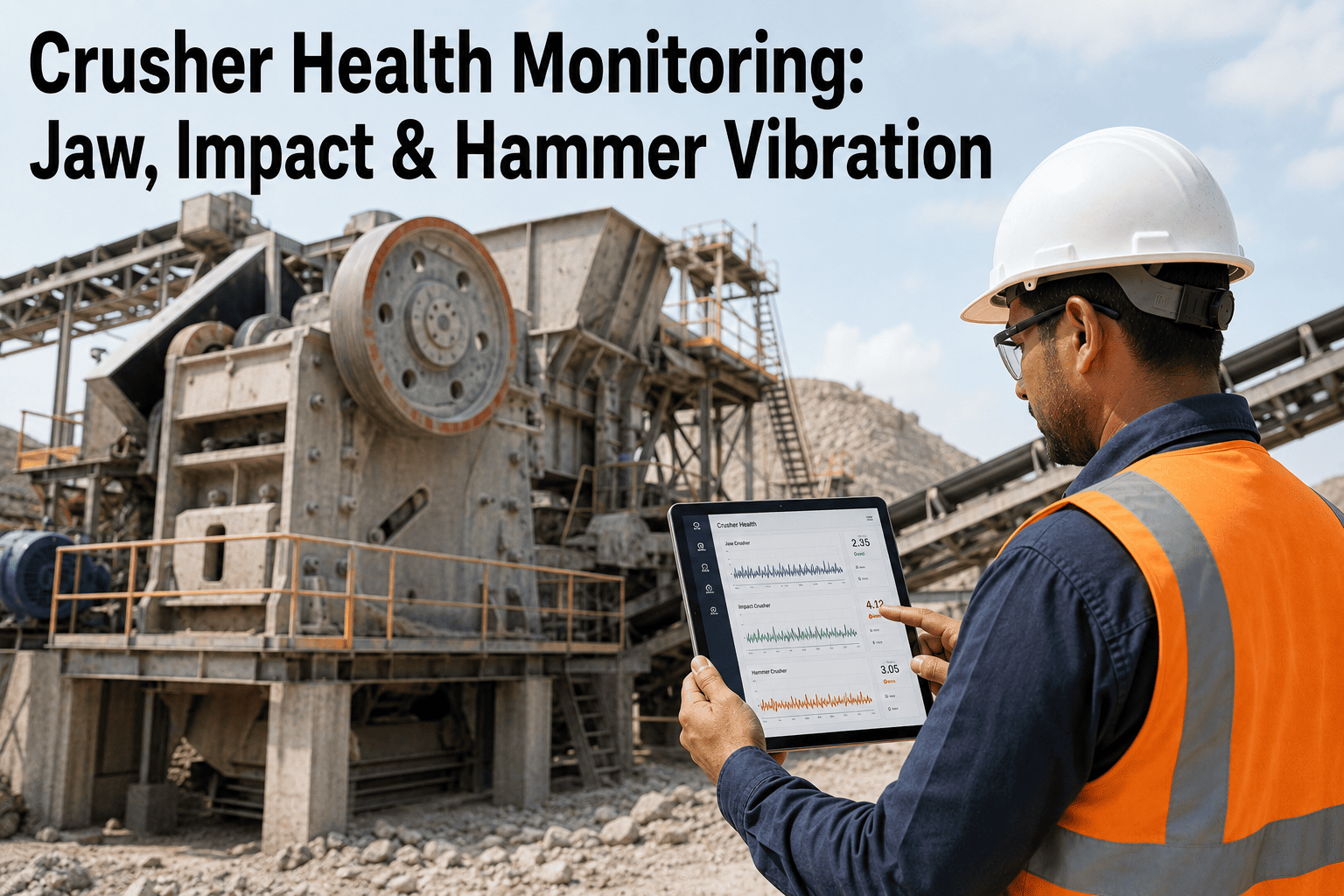
Jaw and cone crushers under variable impact loading tend to show misalignment as elevated 2x running speed vibration and bushing wear as a broadband noise floor increase that gradually swallows the discrete fault peaks underneath it.
Where To Mount Sensors And What Fault Each One Is Watching For
Sensor placement determines whether a fault gets caught early or missed entirely. The table below outlines typical mounting points and the dominant fault type each location is meant to catch across the four equipment types covered here.
| Equipment | Sensor Location | Primary Fault Watched | Typical Alert Trigger |
|---|---|---|---|
| Ball Mill | Trunnion bearing housing, both ends | Bearing spall, lubrication starvation | Rising high-frequency envelope energy |
| Vertical Mill | Roller bearing housing, table bearing | Roller bearing wear, table bearing looseness | Low-frequency envelope impact pattern |
| ID Fan | Drive-end and non-drive-end bearing housings | Imbalance, blade erosion, misalignment | 1x and 2x running speed amplitude rise |
| Crusher | Main shaft bearing housing, motor bearing | Bushing wear, shaft misalignment | Broadband noise floor and 2x speed rise |
Alert thresholds should be tuned per asset rather than applied as a single plant-wide value, since a threshold calibrated for a slow-turning vertical mill roller will either miss faults or trigger constant false alarms if applied unchanged to a faster-turning ID fan shaft.
How A Rising Vibration Trend Turns Into A Scheduled Repair
The value of continuous monitoring is not just catching a fault, it is catching it early enough that the response is a planned repair instead of an emergency shutdown. Here is what that path typically looks like once monitoring is in place.
Without continuous monitoring, this same sequence usually starts with an unusual noise or a temperature alarm noticed by an operator on shift, at which point the bearing has often already progressed well past the early-warning stage and the repair window has narrowed from a planned outage to an unplanned stop.
One Dashboard For Every Mill, Fan, And Crusher On The Plant
Instead of chasing four different fault signatures across four different route sheets, iFactory tracks every asset continuously against thresholds built for its specific failure modes.
Where Cement Plants Run Into Trouble Setting This Up
Vibration monitoring programs that fail to deliver value usually run into one of the same handful of problems, most of which show up months after go-live rather than immediately.
Copying Thresholds Across Dissimilar Assets
Using the same alarm limit on a fast-turning fan shaft and a slow-turning mill roller produces either missed early faults on the slow asset or a flood of false alarms on the fast one, and both outcomes erode trust in the system over time.
Sensor Placement Chosen For Convenience, Not Fault Coverage
Mounting a sensor wherever is easiest to reach instead of on the actual bearing housing closest to the fault source significantly reduces the chance of catching a developing problem early enough to matter.
No Baseline Captured After Repairs
If the vibration baseline is not recaptured after a bearing replacement or rebuild, the next trend comparison is measured against outdated data, which can hide a genuine new fault or generate an alert against a signature that is now normal.
Treating Alerts As Standalone Instead Of Linked To Work Orders
A vibration alert that does not automatically generate or attach to a work order tends to sit in an inbox until someone manually follows up, which reintroduces the same delay continuous monitoring was meant to eliminate.
We used to find out about a trunnion bearing problem when the mill started making a noise the operator couldn't ignore, and by then we were looking at an unplanned stop instead of a scheduled swap. Since putting continuous vibration monitoring on our mills, fans, and crushers, we catch bearing wear weeks earlier and schedule the repair into a planned window almost every time. It has changed how our reliability team spends its week.
What Plants Typically See After Deploying Continuous Vibration Monitoring
Results vary with equipment condition and how well thresholds are tuned per asset, but the ranges below reflect what cement plants commonly report after moving from periodic manual checks to continuous monitoring on mills, fans, and crushers.
What A Correctly Instrumented Asset Looks Like
Beyond picking a sensor and mounting it somewhere on the housing, a few practical decisions determine whether the resulting data is actually useful for catching faults early rather than just generating noise.
Match Sampling Rate To Rotational Speed
A slow-turning vertical mill roller needs a lower sampling rate tuned to catch low-frequency impact patterns, while a faster ID fan shaft needs a higher rate to resolve the harmonics that reveal imbalance and blade damage clearly.
Mount On The Load Zone, Not The Housing Edge
A sensor mounted directly over the bearing's load zone picks up developing spall and wear signatures far more clearly than one mounted on a convenient flat surface a few inches away from the actual load path.
Account For Dust And Temperature At The Mounting Point
Crusher and preheater-area sensors need housing and cabling rated for the dust and heat at that specific mounting point, since a sensor that fails from environmental exposure within months defeats the purpose of continuous coverage.
Tune Thresholds Per Asset After A Baseline Period
Running a new sensor for an initial baseline period before setting alarm thresholds ensures the limits reflect that specific asset's normal operating signature rather than a generic default that does not match its actual behavior.
Overall Vibration, Envelope, And Spectral Analysis Compared
Not every vibration analysis method catches every fault, and understanding what each one is actually measuring explains why a monitoring program needs more than a single overall vibration number to be effective on cement equipment.
Overall Vibration (RMS)
A single summary number covering the full frequency range is useful as a quick health check and works well for catching advanced faults, but it tends to stay flat during the early stages of bearing or gear wear, which is exactly when catching the fault matters most.
Envelope Or Demodulation Analysis
This method isolates the high-frequency impacting caused by a bearing defect or a cracked gear tooth from the surrounding vibration noise, making it the most sensitive technique for catching a fault in its earliest, lowest-amplitude stage.
Spectral (FFT) Analysis
Breaking the vibration signal into its individual frequency components lets an analyst pinpoint exactly which fault frequency is rising, distinguishing an imbalance at 1x running speed from a misalignment at 2x or a bearing defect frequency tied to its specific geometry.
Matching The Sensor Type To The Mounting Environment
Cement plant mounting locations range from relatively clean drive-end bearing housings to dust-caked crusher frames sitting near hot process gas, and sensor selection needs to account for that range rather than defaulting to a single sensor type across every asset.
Piezoelectric Accelerometers
The standard choice for permanently mounted monitoring on critical bearings, offering a wide frequency range that supports both overall vibration trending and the high-frequency envelope analysis needed to catch early bearing faults.
Wireless Battery-Powered Sensors
Useful for assets where running cable is impractical, such as a rotating crusher component or a remote fan location, though battery life and transmission interval need to be weighed against how quickly a given asset's faults typically develop.
High-Temperature Rated Sensors
Mounting points near preheater ductwork or kiln-adjacent equipment need sensors and cabling specifically rated for sustained high ambient temperature, since a standard sensor can degrade or fail well before the bearing it is monitoring does.
Frequently Asked Questions
Q: Which cement equipment should get continuous vibration monitoring first?
Ball mills, vertical mills, ID fans, and crushers are typically the first priority because they combine high replacement cost, long lead times for spare bearings and gears, and a direct impact on production if they stop unexpectedly. Plants generally start with the assets that have the worst history of unplanned stops or the longest repair lead time, since those are where early detection has the biggest payoff. A phased rollout starting with the two or three most critical assets and expanding from there tends to work better than instrumenting everything at once. Reach out through Support Contact to talk through which assets make sense for your plant first.
Q: How is a vibration alarm threshold set differently for a mill versus a fan?
A ball mill trunnion or a vertical mill roller runs at relatively low speed and tends to show early faults through low-frequency envelope patterns, while an ID fan runs faster and shows faults more clearly through rising 1x and 2x running speed amplitude. Applying the same numeric threshold to both would either miss the mill's early warning signs or generate constant false alarms on the fan. Thresholds are set per asset based on a baseline period of normal operation, which is why a one-size-fits-all limit rarely works well across dissimilar equipment types.
Q: Can vibration monitoring data be linked automatically to maintenance work orders?
Yes, this is where continuous monitoring delivers most of its practical value, because an alert that stays isolated in a dashboard still depends on someone manually creating a work order later. When vibration data is connected to the maintenance system, a threshold breach can generate a work order automatically, pre-filled with the asset, the fault type, and the trend history, so the planner can schedule the repair without chasing down the details separately. A Book a Demo session can walk through how that connection works for your existing maintenance workflow.
Q: How long does it take to establish a reliable vibration baseline on a new asset?
Most cement equipment needs a few weeks of normal operation under typical load conditions before a baseline is stable enough to set meaningful alarm thresholds against. Assets with more variable load patterns, such as crushers handling inconsistent feed material, may need a longer baseline period to capture the full range of normal vibration behavior. Setting thresholds too early, before the baseline reflects normal variation, is one of the more common reasons a new monitoring program generates false alarms in its first few months.
Q: Does continuous vibration monitoring replace the need for periodic manual inspections entirely?
Continuous monitoring significantly reduces reliance on manual vibration routes for early fault detection, but it does not eliminate the value of periodic visual and physical inspections that catch issues vibration sensors are not designed to detect, such as loose bolting, seal leaks, or structural cracking. Most plants shift manual inspection time away from routine vibration data collection and toward these physical checks once continuous monitoring is handling the vibration trending automatically.
Stop Finding Out About Bearing Failures When The Mill Stops
iFactory monitors vibration on your mills, fans, and crushers continuously, tuned to the fault signatures each asset actually produces, and turns an early warning into a scheduled work order automatically.