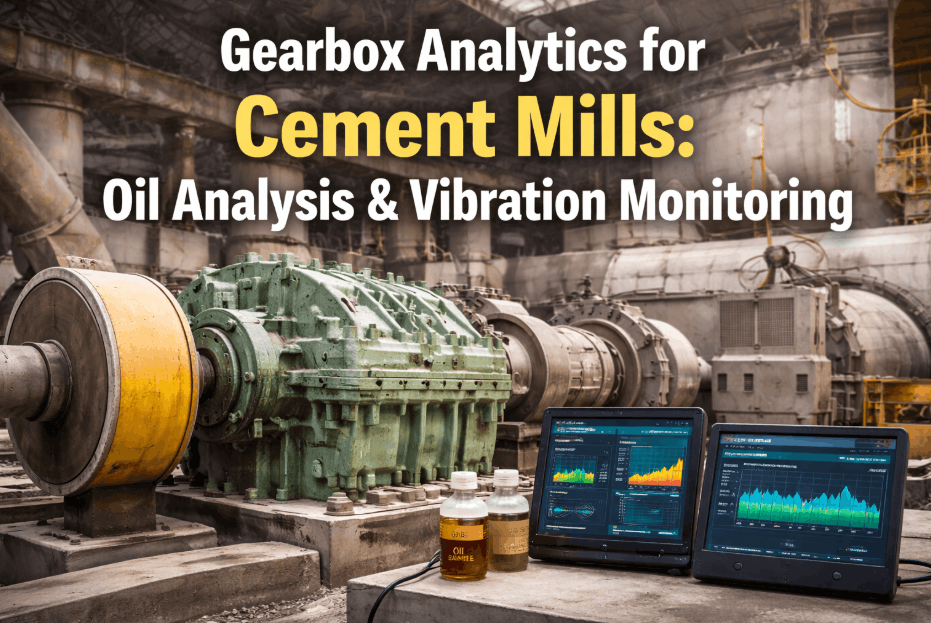
A gearbox rarely announces its failure with a single symptom — it degrades across three independent channels at once: the oil carries wear metal and additive breakdown evidence, the vibration spectrum carries gear mesh and bearing fault signatures, and the housing temperature carries the thermal cost of increasing friction. Most cement plants monitor one of these three channels, usually vibration, and miss the early warning that the other two would have provided weeks earlier. Book a session with the iFactory reliability team to see how combining all three channels into a single AI model catches gearbox degradation earlier than any single method alone.
Equipment Health · Gearbox Condition Monitoring
Gearbox Condition Monitoring: Oil Analysis, Vibration, and Temperature for Cement Plant Drives
Three data channels, one AI model. Gear wear detection, tooth damage identification, and lubrication degradation tracking for mill drives, kiln drives, and fan gearboxes — combined into a single health score your maintenance team can act on.
Three Independent Channels
Why Single-Channel Gearbox Monitoring Misses Failures the Other Two Channels Would Catch
Gearbox failure modes do not all announce themselves the same way. A gear tooth fracture shows up violently in vibration data but may show almost nothing in oil analysis until the fracture has already occurred. A slow additive depletion in the lubricant shows up clearly in oil analysis weeks before it produces any measurable vibration change. A bearing beginning to run hot from marginal lubrication shows up in temperature trending before either oil or vibration channels register a clear signature. Relying on one channel means accepting blindness to the failure modes that channel does not detect well.
Oil Analysis
Wear metal concentration — iron, copper, chromium particle trending identifies which component is wearing
Viscosity drift — additive shear or contamination changes lubricant film strength
Additive depletion — anti-wear and extreme-pressure additive levels predict remaining oil life
Particle counting — contamination ingress from seals or breathers detected before it damages gear surfaces
Vibration Analysis
Gear mesh frequency — sideband patterns identify tooth wear, pitting, or eccentricity
Bearing fault frequencies — inner race, outer race, and cage fault signatures within the gearbox housing
Shaft misalignment signature — harmonic patterns distinguish alignment issues from gear wear
Broadband trend — overall energy trend flags developing issues before frequency-specific diagnosis
Temperature Monitoring
Housing temperature trend — rising baseline temperature indicates increasing internal friction
Differential temperature — comparison across bearing positions isolates which bearing is degrading
Rate-of-rise alarming — a rapid temperature climb signals acute lubrication failure requiring immediate response
Ambient-normalised baseline — seasonal and load-driven temperature variation filtered out of the alarm logic
Data Fusion
How iFactory Combines Three Channels Into a Single Gearbox Health Score
Each channel alone produces a partial picture. iFactory's AI model does not report three separate scores for a maintenance planner to reconcile — it fuses oil, vibration, and temperature data into a single gearbox health score, weighted by which failure modes each channel detects best, and cross-validates findings across channels to reduce false positives.
01
Independent baseline per channel
Each gearbox establishes its own normal range for oil chemistry, vibration signature, and temperature profile based on its specific load, speed, and duty cycle — not a generic threshold shared across all gearboxes in the plant.
02
Cross-channel correlation
When two channels show correlated deviation — for example, rising iron particle count alongside a new gear mesh sideband — the model raises confidence in the diagnosis significantly higher than either signal alone would justify.
03
Failure mode classification
The combined signature is matched against known failure mode patterns — gear wear, bearing degradation, lubrication breakdown, or misalignment — so the work order generated names the likely cause, not just a generic health warning.
04
Unified health score
All three channels resolve into one score from 0 to 100 displayed on the maintenance dashboard, with the underlying channel data available on drill-down for anyone who wants to see which channel is driving the score.
See Your Gearbox Fleet Health Score
iFactory Connects Oil, Vibration, and Temperature Data From Your Existing Gearbox Monitoring Programme
If you already run periodic oil sampling and vibration routes, iFactory ingests that historical data alongside new continuous sensor feeds to build fused health scores for every monitored gearbox — mill drives, kiln drives, and fan gearboxes — without requiring you to abandon your existing lab relationships.
Failure Mode Library
The Gearbox Failure Modes Cement Plants Encounter Most Often — and Which Channel Catches Each One First
Not every gearbox failure mode is detected earliest by the same channel. Understanding which channel leads for each failure mode helps a reliability team interpret an early warning correctly and prioritise investigation.
| Failure Mode | Earliest Detecting Channel | Typical Root Cause |
|---|---|---|
| Gear tooth pitting | Vibration — gear mesh sidebands | Cyclic contact stress exceeding surface fatigue limit |
| Additive depletion | Oil analysis — additive package trend | Extended oil change interval or thermal degradation |
| Internal bearing wear | Vibration — bearing fault frequencies | Fatigue, contamination, or lubrication starvation |
| Marginal lubrication | Temperature — rising baseline trend | Low oil level, wrong viscosity, or degraded film strength |
| Contamination ingress | Oil analysis — particle count | Seal degradation or breather failure allowing dust entry |
| Shaft misalignment | Vibration — harmonic pattern | Installation error or foundation settling over time |
Sampling and Monitoring Cadence
How Often Each Channel Needs to Be Sampled for Effective Early Warning
Continuous monitoring is not equally necessary or cost-effective across all three channels. Vibration and temperature lend themselves to continuous sensor-based monitoring, while oil analysis is typically most cost-effective on a scheduled sampling interval supplemented by continuous online sensors for the most critical gearboxes.
Vibration
Continuous
Wired or wireless accelerometers stream data continuously, since gear mesh and bearing fault signatures can develop over a matter of days once initiated.
Temperature
Continuous
Temperature sensors are low-cost and continuous monitoring catches rapid rate-of-rise events that a periodic check would miss entirely.
Oil analysis (lab)
Monthly to quarterly
Scheduled lab sampling remains the standard for detailed additive and wear metal analysis on most gearboxes, balancing cost against detection speed.
Oil analysis (online sensor)
Continuous — critical assets only
Critical mill and kiln drive gearboxes justify online particle counting and moisture sensors for continuous coverage between lab samples.
From the Reliability Floor
The mistake I see most often is a plant treating oil analysis and vibration analysis as two separate programmes run by two separate people who barely talk to each other. The lab report goes to one inbox, the vibration route goes to another, and nobody is looking at both together for the same gearbox at the same time. The value is almost entirely in the correlation. I have seen a case where vibration showed a small, ambiguous change in the gear mesh sidebands that nobody would have acted on alone, but the oil sample from the same week showed a jump in iron particles that confirmed it was real tooth wear, not sensor noise. Neither report on its own would have triggered an inspection. Together, they triggered one within the week, and the inspection found a tooth chip that would have propagated to a full gear failure within another month or two of running.
Priya Venkataraghavan
Lead Reliability Engineer · Certified Lubrication Specialist and Vibration Analyst · 16 years in cement and heavy industry gearbox reliability · Former Reliability Manager, integrated cement manufacturing group
Reliability Team Questions
Gearbox Condition Monitoring — Frequently Asked
Do we need to replace our existing oil analysis lab provider to use iFactory's gearbox monitoring?
No. iFactory's platform is designed to ingest oil analysis results from your existing lab provider regardless of which laboratory you currently use, since most commercial oil labs provide results in standard formats that iFactory's data pipeline can consume directly. You continue your existing sampling schedule and lab relationship, and the results flow into the same fused health score alongside vibration and temperature data automatically, rather than sitting in a separate report that a technician has to manually cross-reference. If you are evaluating lab providers or want a recommendation, iFactory's team can suggest options with proven integration compatibility. Book a session with our team to review your current lab data format.
How does the system distinguish between normal wear metal presence and an actual developing failure?
All gearboxes generate some baseline level of wear metal in the lubricant during normal operation, and the meaningful signal is the rate of change and trend direction rather than the absolute particle count at any single sample point. iFactory's models establish a baseline wear rate specific to each gearbox based on its age, load profile, and historical sample history, then flag deviations from that established rate rather than applying a generic industry threshold that may be inappropriate for a specific gearbox's operating condition. This trend-based approach substantially reduces false alarms compared to single-sample threshold alerting, which is a common limitation of basic oil analysis reporting. Contact our support team for details on the baseline establishment methodology.
Can this monitoring approach identify which specific gear or bearing inside the gearbox is degrading, or only that the gearbox as a whole needs attention?
Vibration analysis frequency-domain data can typically isolate the specific gear mesh or bearing position responsible for a detected fault signature, since each gear pair and bearing position produces characteristic frequencies based on tooth count, shaft speed, and bearing geometry. When combined with sensor placement at multiple points on the gearbox housing, the model can localise the fault to a specific internal component with meaningful confidence, which significantly narrows the scope of any subsequent internal inspection or repair. Oil analysis wear metal type — for example, a specific alloy composition — can further corroborate which component is contributing debris to the lubricant. Book a demo to see fault localisation examples from comparable gearbox monitoring deployments.
What is the typical cost and timeline to deploy gearbox monitoring across our mill, kiln, and fan gearboxes?
Deployment timeline and cost depend on the number of gearboxes, current sensor infrastructure, and whether online oil sensors are added or lab sampling alone is used. A typical deployment across a plant's critical gearbox population — mill drive, kiln drive, and major fan gearboxes — can be sensor-installed and reporting fused health scores within two to four weeks, assuming vibration sensor hardware is either already present or straightforward to install on accessible housing locations. iFactory's deployment team conducts a site assessment to scope the specific sensor count, installation complexity, and integration requirements before providing a firm timeline and cost estimate. Reach out to our support team to schedule a site assessment for your gearbox fleet.
How far in advance does fused monitoring typically identify a gearbox problem compared to relying on vibration alone?
The advance warning improvement varies by failure mode, but lubrication-related degradation and contamination-driven wear are frequently identified through oil analysis and temperature trending weeks before they produce a vibration signature clear enough to act on with confidence. Conversely, some gear tooth failure modes produce a vibration signature before any meaningful oil or temperature change occurs, which is why the fused approach outperforms any single channel across the full range of failure modes a gearbox can experience, rather than only improving detection for one specific type of fault. Book a session with our reliability team to review advance-warning data from failure modes relevant to your specific gearbox fleet.
One Channel Tells Part of the Story. Three Channels Tell the Whole Story.
Fuse Oil, Vibration, and Temperature Data Into a Single Gearbox Health Score
iFactory connects your existing oil analysis programme, vibration sensors, and temperature monitoring into one AI model that catches gearbox degradation earlier than any single channel alone — with a unified health score your maintenance team can act on the same day it changes.