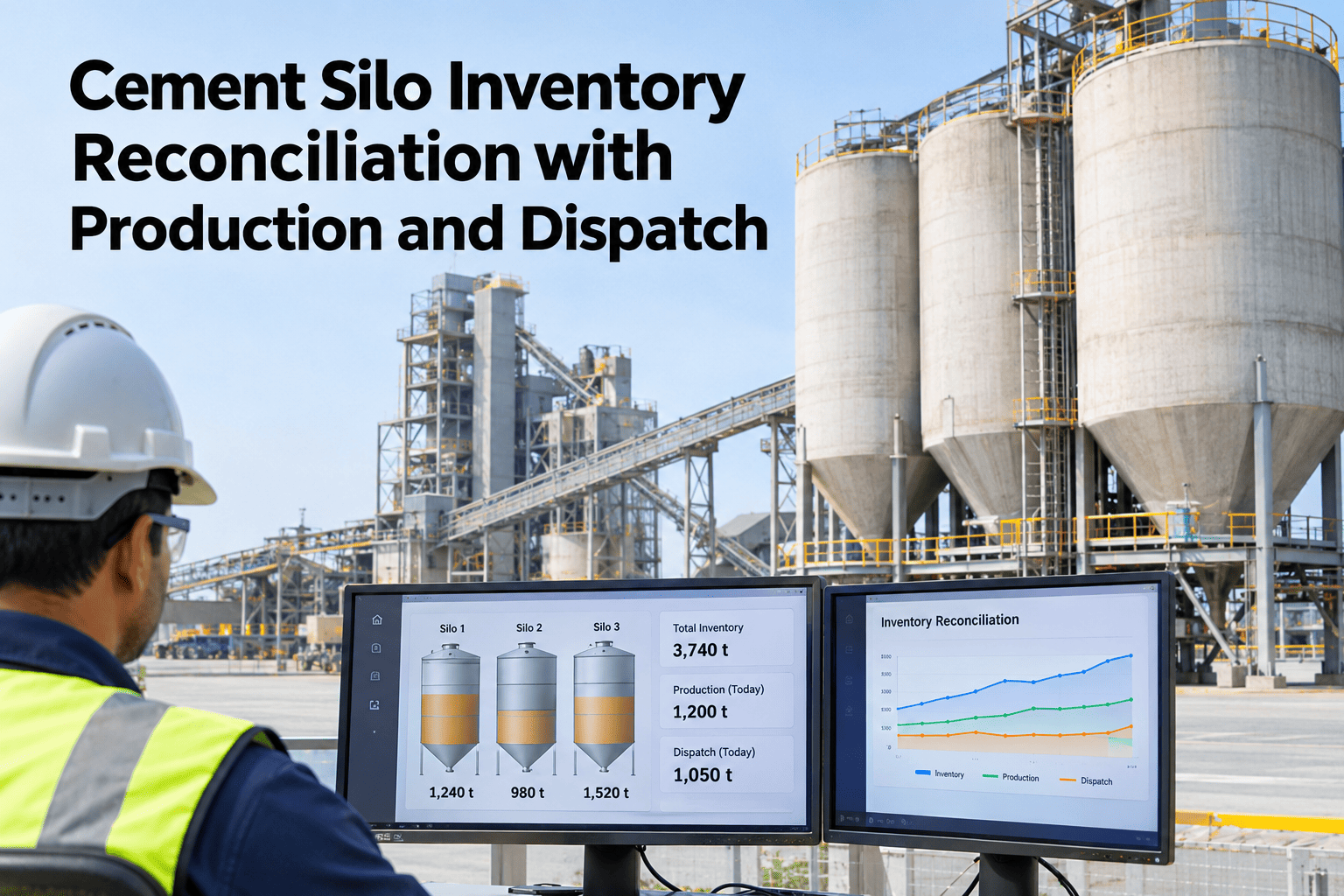
A cement silo's book balance and its measured balance rarely agree exactly, and the gap between them is where a plant's real inventory picture lives or dies. Production receipts land from the mill, dispatch issues leave by truck and rail, and somewhere between the two a silo level sensor, a weighbridge reading or a manual entry introduces a small error that compounds over weeks. Reconciling opening balance, receipts and issues against the measured closing balance, line by line, is what turns a silo log into a number finance can actually trust. Plant teams who want to see their own silo variance traced to its source can walk through a reconciliation review on real silo data with our team.
Know Exactly Where the Tonnes Went Missing
iFactory, an on-premise AI platform for cement operations, reconciles opening balance, production receipts and dispatch issues against the measured silo level every shift, and flags variance before it becomes a month-end surprise.
What Does a Clean Silo Reconciliation Actually Balance?
A reconciliation is arithmetic before it is anything else: opening balance plus everything that came in, minus everything that left, should equal the closing balance you actually measure. When it does not, the difference is the variance that needs an explanation, not a number to quietly carry forward. Plants that only reconcile at month end often find the variance has already grown large enough that tracing it back to a single shift or a single input is no longer realistic, which is exactly the situation a shift-level reconciliation is meant to prevent.
Ask our team how your current silo data sources map to this equation before changing anything about how levels are logged.
Where Each Number in the Reconciliation Comes From
| Input | Typical source | Common error source |
|---|---|---|
| Opening balance | Silo level sensor or manual dip reading | Sensor drift, inconsistent dip timing |
| Production receipts | Mill output and conveyor transfer records | Transfer timing lag against shift boundary |
| Silo transfers | Inter-silo pump or conveyor logs | Transfers logged on one silo but not the other |
| Dispatch issues | Weighbridge and loading records | Partial loads or re-weighs not reconciled |
| Closing balance | Silo level sensor or manual dip reading | Same drift as opening, compounding shift to shift |
See Where Your Own Silo Variance Is Actually Coming From
Share a month of silo logs and dispatch records, and we will show which input is driving the biggest gap.
Timing Lag vs Measurement Error vs Data Entry
Exception Handling: From Flagged Variance to Closed Record
Variance beyond the set tolerance is flagged automatically at shift close.
Each input — receipts, transfers, issues, measured levels — is checked in turn.
A confirmed error is corrected at its source record, not papered over at the total.
The reconciliation is closed with the correction and its reason attached.
A reconciliation closed without a reason attached is really just a reconciliation deferred — the same error is likely to recur next shift if nobody ever establishes why the numbers did not match the first time.
The Variance That Traced Back to One Mis-Timed Transfer
A silo showed a small but persistent negative variance for three straight shifts, consistent with measurement error rather than a one-time event. Investigation found a silo-to-silo transfer logged against the wrong silo code on one shift, which then carried forward uncorrected.
Why Reconciliation Needs to Run Across the Whole Fleet
A single silo's reconciliation is useful, but most plants move material between several silos as grades change and campaigns roll over, so a transfer that looks correct on one silo's books can still be wrong on the receiving end. Running reconciliation across the full fleet, not silo by silo in isolation, is what catches a transfer logged against the wrong destination before it quietly becomes two separate, unexplained variances instead of one traceable error.
One Reconciliation Record Across Every Silo
Automatic Reconciliation
Opening balance, receipts, transfers and issues are pulled and reconciled every shift.
Variance Alerting
A variance beyond tolerance is flagged immediately, not discovered at month end.
Input-Level Drill-Down
Each number in the equation is traceable back to its source record.
Turnkey On-Premise Deployment
Silo, production and dispatch data stay on your own server, with no outside cloud dependency.
What Plant Teams Ask About Silo Inventory Reconciliation
How often should silo balances be reconciled?
Most plants reconcile at least once per shift, since waiting until month end means a small, compounding error has far more time to grow before anyone notices it. Discuss a reconciliation cadence that fits your shift pattern.
What tolerance should trigger a variance flag?
Tolerance depends on silo size, sensor accuracy and how the plant uses the number downstream, so it is usually set per silo rather than as one plant-wide figure. Ask support how tolerance is typically set for your silo fleet.
Can reconciliation catch a silo level sensor that is slowly drifting?
Yes. A sensor drifting in one direction shows up as a variance that grows steadily shift after shift rather than resolving itself, which is a distinct pattern from a one-time timing or entry error. Review your own variance pattern with our team.
How does this connect to our ERP system?
Production receipts and dispatch issues typically already exist in the ERP, so reconciliation pulls from those records rather than duplicating entry, and discrepancies between silo and ERP data become visible rather than hidden. Ask about your specific ERP integration.
What happens when a variance cannot be explained?
An unexplained variance stays open and visible rather than being absorbed into the next period's opening balance, so it remains a known gap until a physical count or further investigation resolves it. Discuss how unresolved variances are tracked.
Stop Carrying Silo Variance Into the Next Shift
See opening balance, receipts and dispatch issues reconciled automatically against your own measured silo levels.