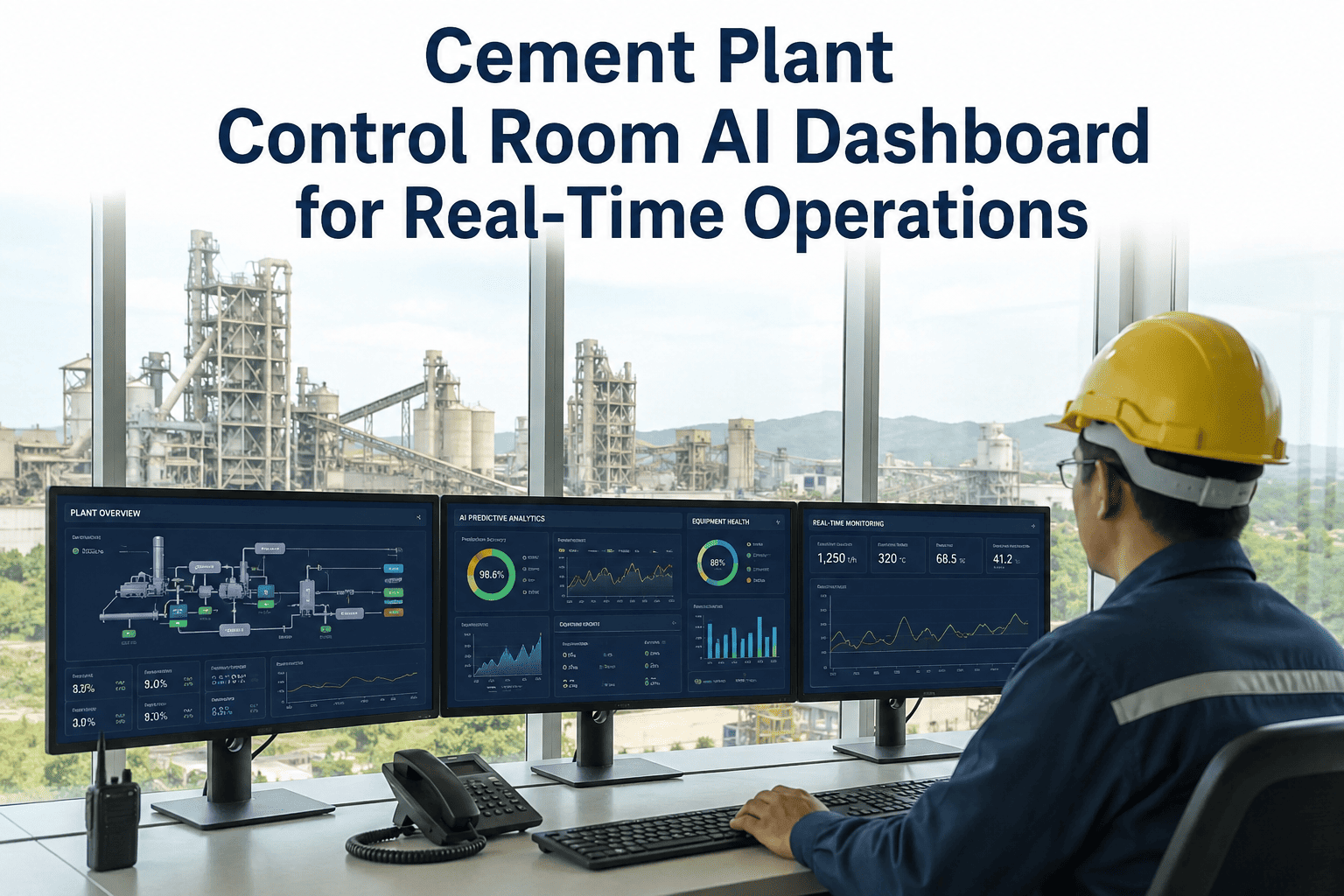
A single cement plant can throw off tens of thousands of sensor readings a minute across kilns, mills, and coolers, and two very different jobs depend on that stream. One job is a kiln control loop that has to react in milliseconds, long before any packet could round-trip to a distant server and back. The other is spotting a slow-drifting pattern across five plants that only shows up once months of history sit side by side. Routing everything through the cloud stalls the first job, and running everything locally starves the second one of the scale it needs. iFactory's cloud-edge architecture splits the work deliberately: real-time control stays on-site while enterprise-level intelligence runs in the cloud, and you can book a demo to see how that split maps onto your own plant network.
Digital Transformation · Cloud-Edge Architecture
Cloud-Edge Architecture for Cement Plant Data Processing
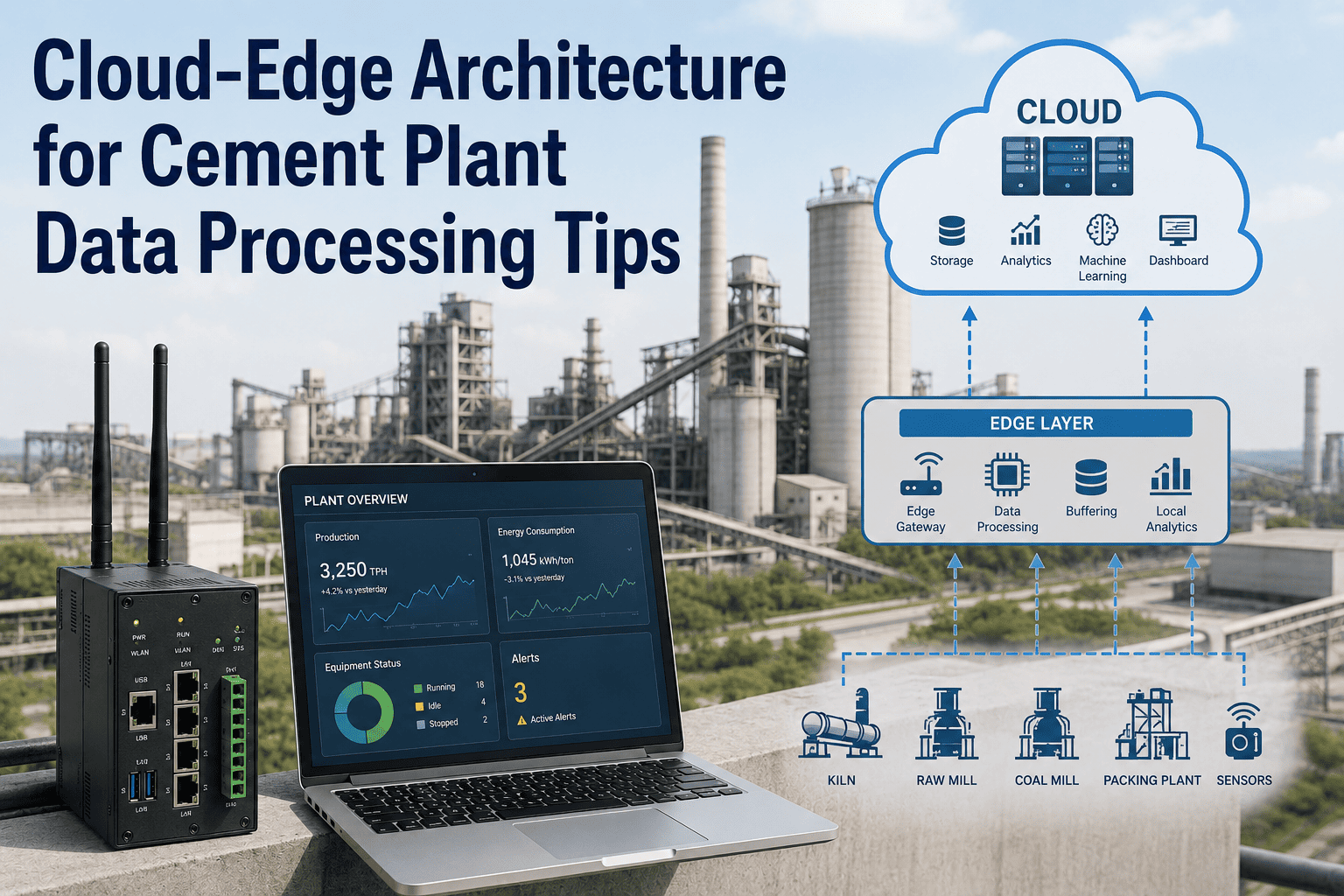
Not every reading needs the cloud, and not every decision can wait for it. iFactory places local edge computing next to the equipment that needs millisecond control, and reserves the cloud for the cross-plant analytics, historical modeling, and enterprise reporting that actually benefit from scale.
Where a decision actually gets made
Edge Layer — On-Site Response
Cloud-Only — Network Round Trip
For a kiln burner trim or a mill vibration cutoff, that gap is the difference between a correction and a trip.
The Core Design Question
Why One Layer Alone Can't Carry Both Jobs
Cloud-Only Approach
Too Slow for Control Loops
Sending every vibration sample or burner reading to a distant data center and waiting for a response adds latency that a kiln draft control or a mill trip logic cannot tolerate. A brief network hiccup during a critical moment turns into a missed correction or an unplanned stop.
Cloud-Only Approach
Fragile Under Poor Connectivity
Rural and industrial sites often run on limited or intermittent bandwidth. A design that depends on constant cloud connectivity for basic process decisions leaves the plant exposed every time that link degrades, and it usually degrades at the worst moment.
Edge-Only Approach
Blind to Cross-Plant Patterns
A controller sitting only on local hardware can react fast, but it has no visibility into what similar equipment at another plant is doing, and no room to run the heavier models that need months of history to train properly.
Edge-Only Approach
Hard to Scale and Maintain
Pushing every analytics workload onto local servers at each site means every model update, every dashboard change, and every new report has to be deployed and maintained plant by plant instead of centrally.
Where Each Workload Belongs
Matching the Decision to the Right Layer
| Function | Response Needed | Best Layer |
| Kiln burner and draft trim |
Under 100 milliseconds |
Edge |
| Mill vibration trip logic |
Under 100 milliseconds |
Edge |
| Inline vision quality check |
Seconds |
Edge |
| Shift-level KPI dashboards |
Minutes |
Cloud |
| Cross-plant benchmarking |
Hours to days |
Cloud |
| Model training on historical data |
Days to weeks |
Cloud |
| ERP and compliance reporting |
Scheduled |
Cloud |
The Two-Tier Design
How the Edge and Cloud Layers Split the Work
Cloud Layer
Model training, cross-plant benchmarking, long-horizon trend analysis, ERP and compliance reporting, and centralized dashboard delivery to every role that needs it.
Continuous, Bandwidth-Aware Sync
Edge Layer
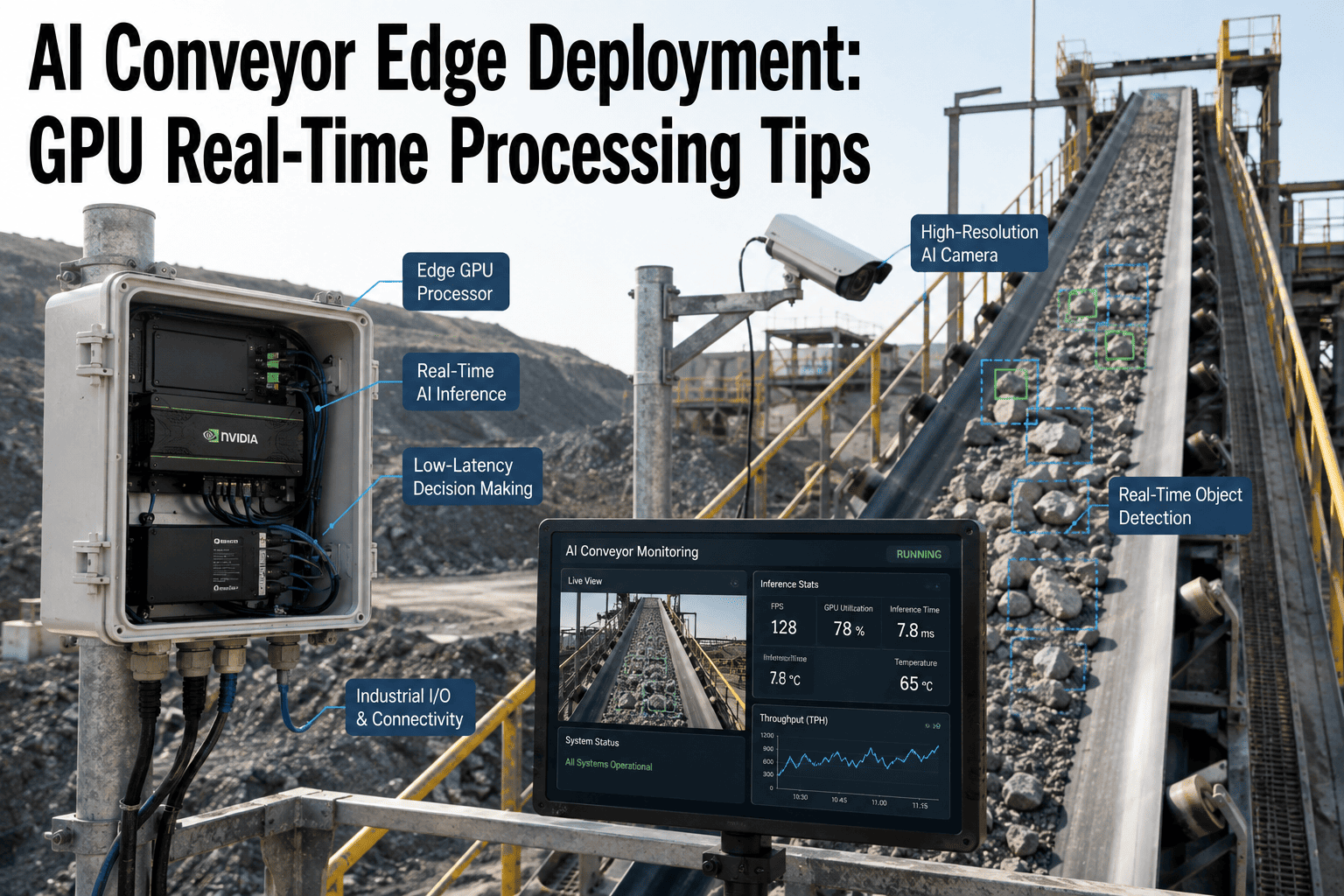
Local compute sitting next to the DCS and PLC network, running control-loop logic, vision inspection, and anomaly detection against live sensor streams with no dependency on an outside connection.
See the Split Against Your Own Plant
Map Your Control Loops and Reporting Needs to the Right Layer
Bring your current DCS, historian, and reporting stack to the call and we'll walk through which workloads should sit on-site and which belong in the cloud.
How Data Actually Moves
From a Sensor Reading to an Enterprise Model, and Back
1
Raw Signal Captured Locally
Vibration, temperature, pressure, and vision data are captured at full resolution by the edge layer, right where the equipment sits, with no dependency on outside connectivity to start processing.
2
Edge Logic Makes the Real-Time Call
Control logic and anomaly models running on local hardware evaluate the signal immediately and trigger a trim, an alert, or a hold — the decision that cannot wait for a network trip.
3
Relevant Data Synced to the Cloud
Instead of streaming raw data continuously, the edge layer forwards summarized readings, flagged events, and periodic snapshots — enough for enterprise analysis without saturating the link.
4
Cloud Layer Trains and Compares
The cloud layer aggregates data across every connected plant, retrains predictive models on the full history, and benchmarks equipment and process performance site to site.
5
Improved Models Pushed Back to the Edge
Updated thresholds and retrained models are pushed back down to the edge layer on a schedule, so local decisions keep improving without ever depending on a live cloud connection to make them.
Weighing the Options
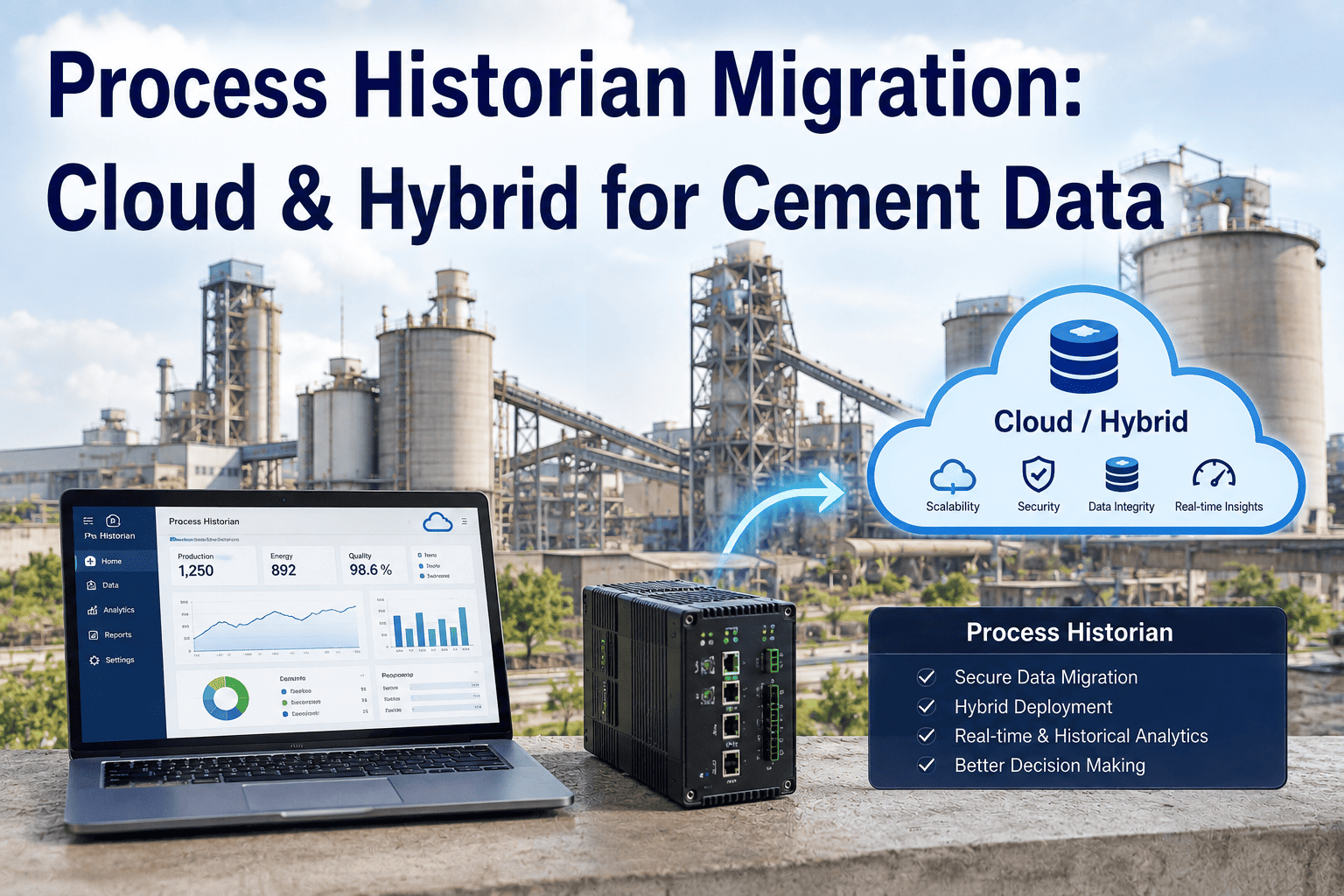
Edge-Only vs. Cloud-Only vs. Hybrid
| Dimension | Edge-Only | Cloud-Only | Hybrid (Edge + Cloud) |
| Control-loop latency |
Fast |
Too slow |
Fast |
| Works during network outages |
Yes |
No |
Yes, for local control |
| Cross-plant benchmarking |
Not possible |
Yes |
Yes |
| Model training on full history |
Limited by local hardware |
Yes |
Yes |
| Central deployment and updates |
Plant by plant |
Centralized |
Centralized, pushed to edge |
| Bandwidth dependency |
None |
Constant |
Only for periodic sync |
Where This Shows Up in Practice
Four Places the Split Actually Matters
Kiln and Mill Control Loops
Burner trim, draft control, and mill vibration cutoffs run on the edge layer, reacting to live sensor data in the same fraction of a second the process itself requires.
Inline Vision Quality Checks
Camera-based inspection of clinker, bag filling, or surface defects processes frames locally so a bad batch gets flagged before it moves further down the line, not after the fact.
Predictive Maintenance Model Training
Failure-prediction models improve fastest when trained on months of data across every asset of a given type, which is exactly the kind of workload the cloud layer is built to carry.
Cross-Plant Performance Benchmarking
Comparing kiln specific heat consumption or OEE across a multi-plant network only works when the data from every site lands in one place, which is the cloud layer's job, not the edge's.
Where Rollouts Go Wrong
Common Mistakes When Designing a Hybrid Architecture
Streaming Everything to the Cloud by Default
Sending raw, unfiltered sensor data to the cloud continuously wastes bandwidth and adds cost without adding value — the edge layer should decide what's worth forwarding.
Treating the Edge as a Permanent Silo
Local control logic that never syncs back to a central model stops improving and drifts away from what similar equipment elsewhere is learning.
No Plan for Intermittent Connectivity
A hybrid design still has to define exactly what happens to edge decisions and queued sync data when the link to the cloud drops for an hour, or a day.
Underestimating Edge Hardware Requirements
Running real-time vision or vibration models locally needs enough on-site compute to keep up with the data rate — sizing it for today's sensor count, not tomorrow's, causes problems fast.
A Composite Scenario
Three-Plant Cement Producer, One Reporting Layer
Before
Each plant ran its own local historian and control logic, with no shared view across sites. Corporate reporting meant exporting spreadsheets from three separate systems every month, and a burner-tuning improvement discovered at one plant had no way of reaching the other two except through an email and a phone call.
After
Edge controllers at each plant kept handling burner trim and mill trips locally, with zero added latency. Summarized performance data now syncs to a shared cloud layer that benchmarks all three kilns side by side, and a model improvement trained on one site's data gets pushed back to the other two on the next scheduled update.
Before You Start
Getting Ready to Design Your Hybrid Architecture
List every control loop and decision that currently depends on sub-second response, and confirm it stays on local hardware
Identify which reports and models genuinely need cross-plant or long-history data, since those are the cloud layer's job
Check current bandwidth and connectivity reliability at each site to size the sync schedule realistically
Define exactly what the edge layer should do on its own during a connectivity outage, and for how long
Common Questions
Cloud-Edge Architecture — FAQ
Does the plant still work if the cloud connection goes down?
Yes. Control loops, vision inspection, and any logic assigned to the edge layer keep running entirely on local hardware, because they were designed to never depend on an outside connection in the first place. What pauses during an outage is the sync of summarized data to the cloud and any centrally hosted dashboard — those simply catch up once the connection returns.
Talk to our team about how failover is handled for your specific network setup.
How much data actually needs to go to the cloud?
Far less than raw streaming would suggest. The edge layer filters, summarizes, and flags events locally, so what gets synced is a fraction of the total sensor volume — enough for training, benchmarking, and reporting, without the cost or fragility of streaming everything continuously over the plant's network link.
What hardware does the edge layer actually run on?
It depends on the number of sensors, cameras, and control loops in scope, but the edge layer is sized to sit close to the DCS and PLC network rather than requiring a full data center on-site. Most plants start with the highest-value control loops and expand edge coverage from there.
Can existing DCS and historian systems feed into this architecture?
Yes. The edge layer is built to sit alongside the systems already running the plant rather than replace them, pulling from the same DCS, historian, and PLC data those systems already produce, and adding the real-time and cloud-sync capability on top of what's already there.
How long does a hybrid rollout typically take?
Most plants begin with one or two high-value control loops or inspection points at the edge, paired with a basic cloud dashboard, and expand coverage in phases from there rather than deploying the full architecture at once.
Book a demo to scope a realistic timeline against your own plant network.
Stop Choosing Between Speed and Scale
Put Real-Time Control and Enterprise Intelligence on the Right Layer
iFactory's edge layer handles the decisions your process can't wait for, while the cloud layer turns that same data into cross-plant intelligence — one architecture, built for both.