In 2026, the cement industry's most critical challenge isn't just generating AI insights — it's acting on them fast enough to matter. Cloud-dependent AI systems introduce latency windows of 200ms to 2+ seconds between detecting an anomaly and triggering corrective action. On a rotary kiln operating at 1,450°C, a two-second delay isn't an inconvenience; it's the difference between a process correction and a catastrophic refractory failure. Edge AI inference — running computer vision and vibration analysis models locally on-premise NVIDIA GPUs — eliminates this gap entirely, delivering sub-50ms reaction times that cloud architectures can never match. Book a demo to see how iFactory's edge AI platform brings real-time machine intelligence directly to your cement plant floor.
Deploy Sub-50ms AI Inference at Your Cement Plant
iFactory's edge AI platform runs computer vision and vibration models locally on NVIDIA GPUs — no cloud dependency, no latency, no data exposure risk.
Why Cloud AI Latency Is a Fundamental Risk in Cement Manufacturing
Cement plants operate at the intersection of extreme temperatures, high-inertia mechanical systems, and tightly coupled process chemistry. When a VRM hydraulic pressure spike occurs, or a kiln shell scanner detects a hot spot, the window to intervene without incurring damage is measured in milliseconds — not seconds. Cloud AI architectures send raw sensor data to a remote server, run the inference model, and return a decision across a network that adds 200ms on a good day and several seconds during congestion or outage events.
This isn't a theoretical risk. Plants that rely entirely on cloud-based AI have reported missed intervention windows during kiln upsets simply because the response signal arrived too late for the distributed control system (DCS) to act. Edge AI inference permanently closes this vulnerability by moving the model execution to the plant network itself — on NVIDIA GPU hardware co-located with your SCADA systems — so the latency between "anomaly detected" and "control action triggered" becomes a single-digit millisecond operation. Facilities that want to understand the full technical architecture can book a demo with iFactory's deployment engineers.
How Edge AI Inference Works in a Cement Plant Environment
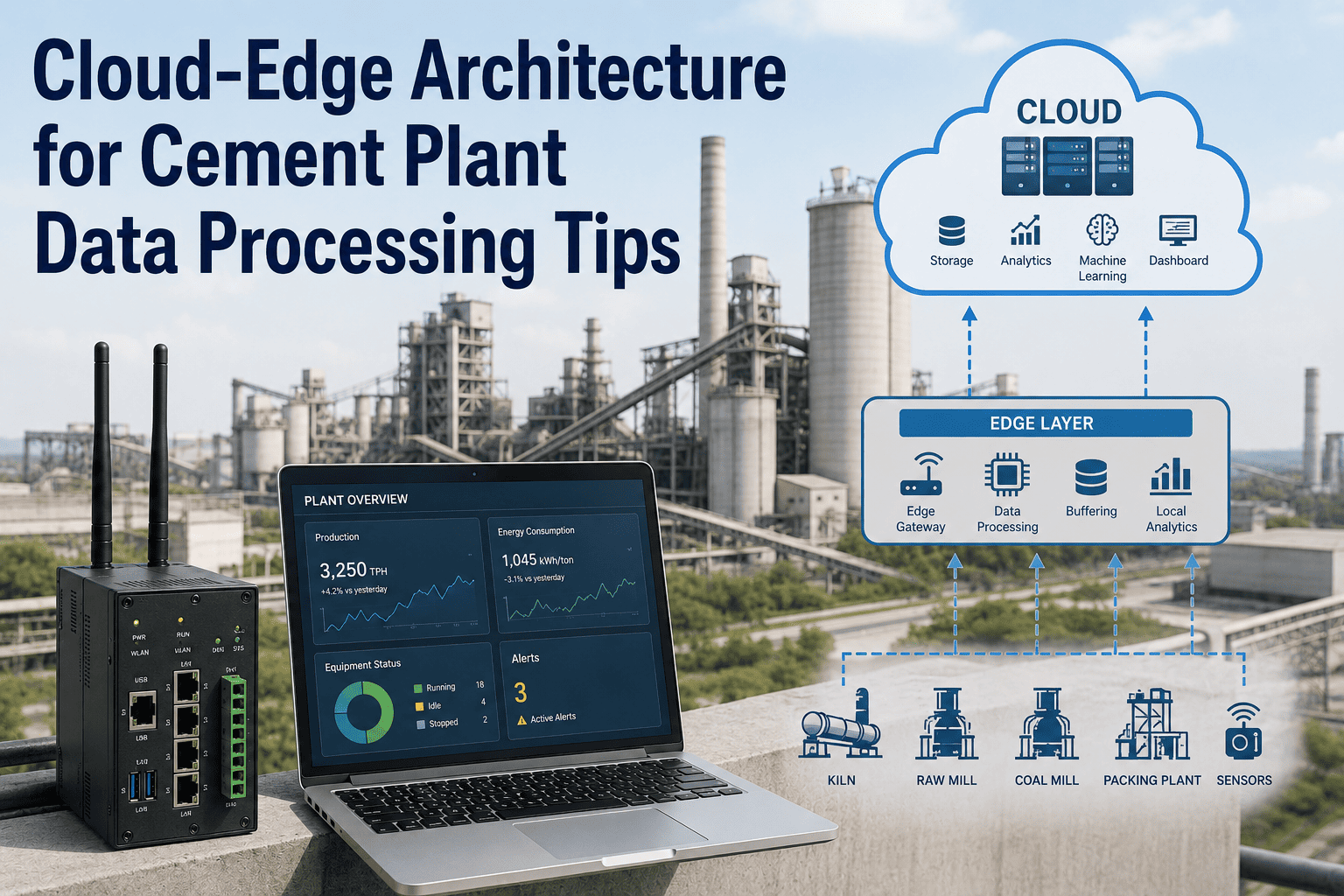
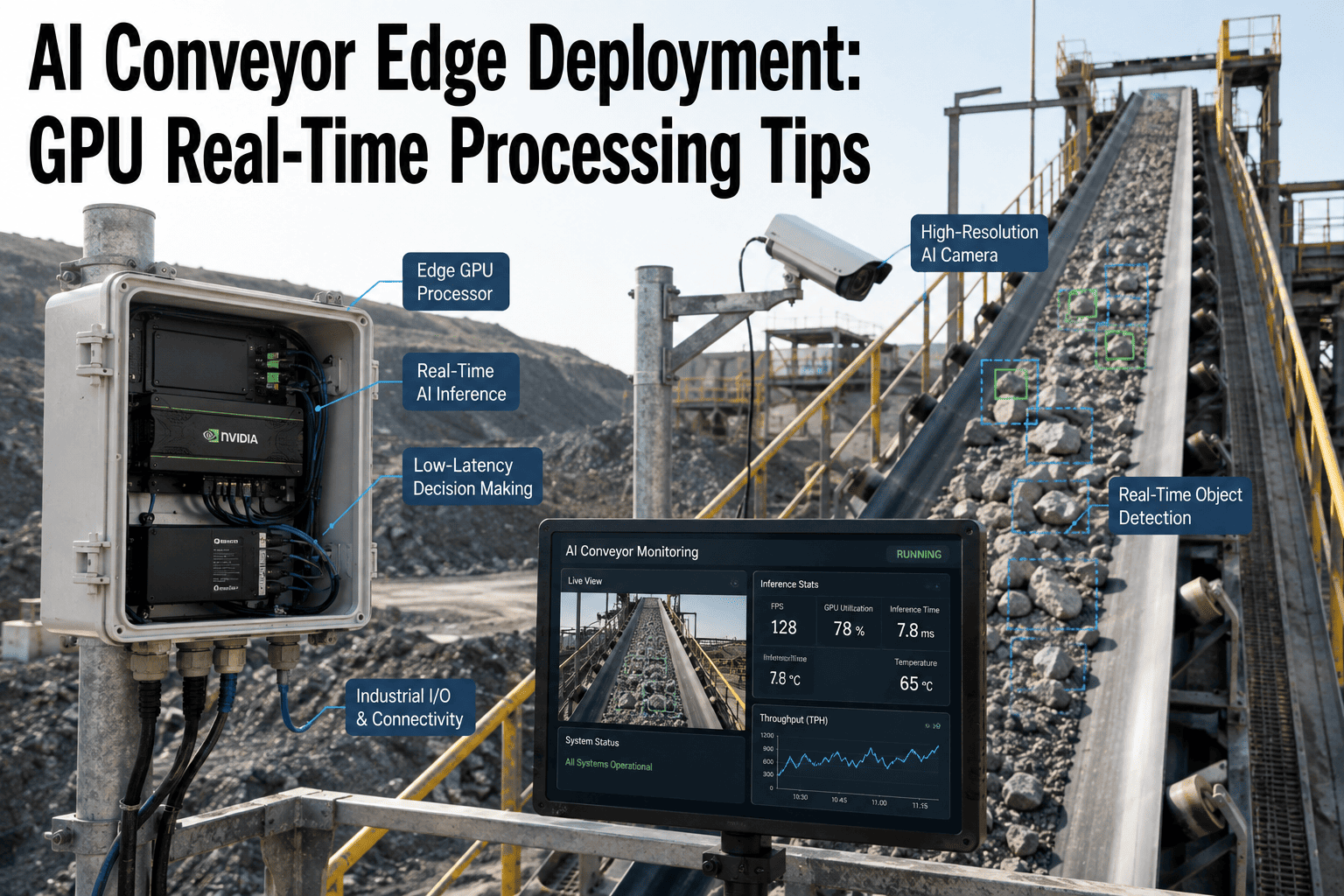
Edge inference is the practice of running trained machine learning models on local compute hardware — rather than sending data to a remote cloud server for processing. In a cement plant deployment, this means NVIDIA GPU nodes (typically T4, A2, or Jetson AGX Orin series depending on thermal environment) are installed in the control room or e-house adjacent to the process areas they serve.
High-Frequency Sensor Streaming
Vibration sensors, thermal cameras, shell scanners, and process transmitters stream data at up to 25kHz directly to the local edge GPU node over the plant's industrial Ethernet or OPC-UA network — never leaving the facility perimeter.
On-Premise AI Inference Engine
The iFactory inference runtime executes pre-trained models — computer vision for clinker quality, vibration FFT models for bearing health, thermal anomaly detection for refractory — directly on the NVIDIA GPU, producing a scored result in under 50 milliseconds.
Direct Control System Response
Inference results are written directly to your ABB, Siemens, or Rockwell DCS via OPC-UA or Modbus TCP. The control system receives a structured action signal — adjust kiln speed, trigger cooler fan override, alarm for bearing replacement — within the same control scan cycle.
Cloud Sync for Aggregated Analytics
Only anonymized, aggregated model outputs — not raw process data — are optionally synced to the cloud for enterprise-wide trend analysis and model retraining. The real-time control loop remains entirely local, regardless of internet availability.
Shell Temperature & Refractory Protection
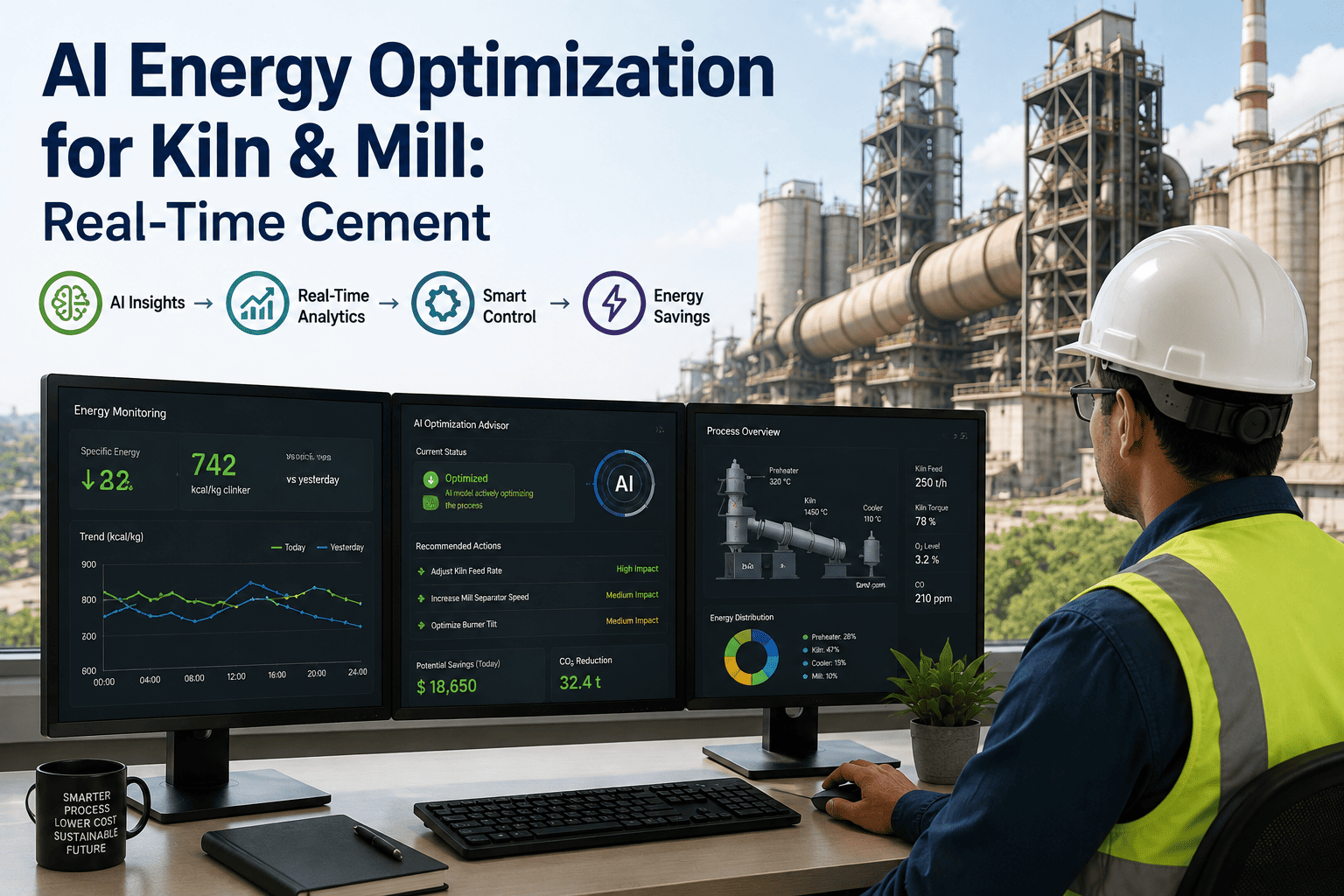
A kiln shell scanner generates thermal profiles at 10Hz across 50+ measurement points. Edge AI processes each frame locally, detecting "red spot" signatures — anomalous thermal gradients indicating refractory brick failure — and triggers a kiln speed reduction or fuel cutback within 40ms. Cloud latency at this speed means the shell has already rotated through several heat cycles before the response arrives.
Vibration Signature & Mill Stability Control
VRM "mill bumps" — sudden vibration events from unstable grinding bed conditions — occur in under 300ms and can cascade to hydraulic system damage within seconds. Edge AI models running on local GPUs continuously analyze vibration FFT data at 25kHz, detecting the spectral precursors of an impending mill bump and adjusting dam ring height setpoints or feed rate before the event reaches the DCS alarm threshold.
Grate Speed Optimization & Snowman Prevention
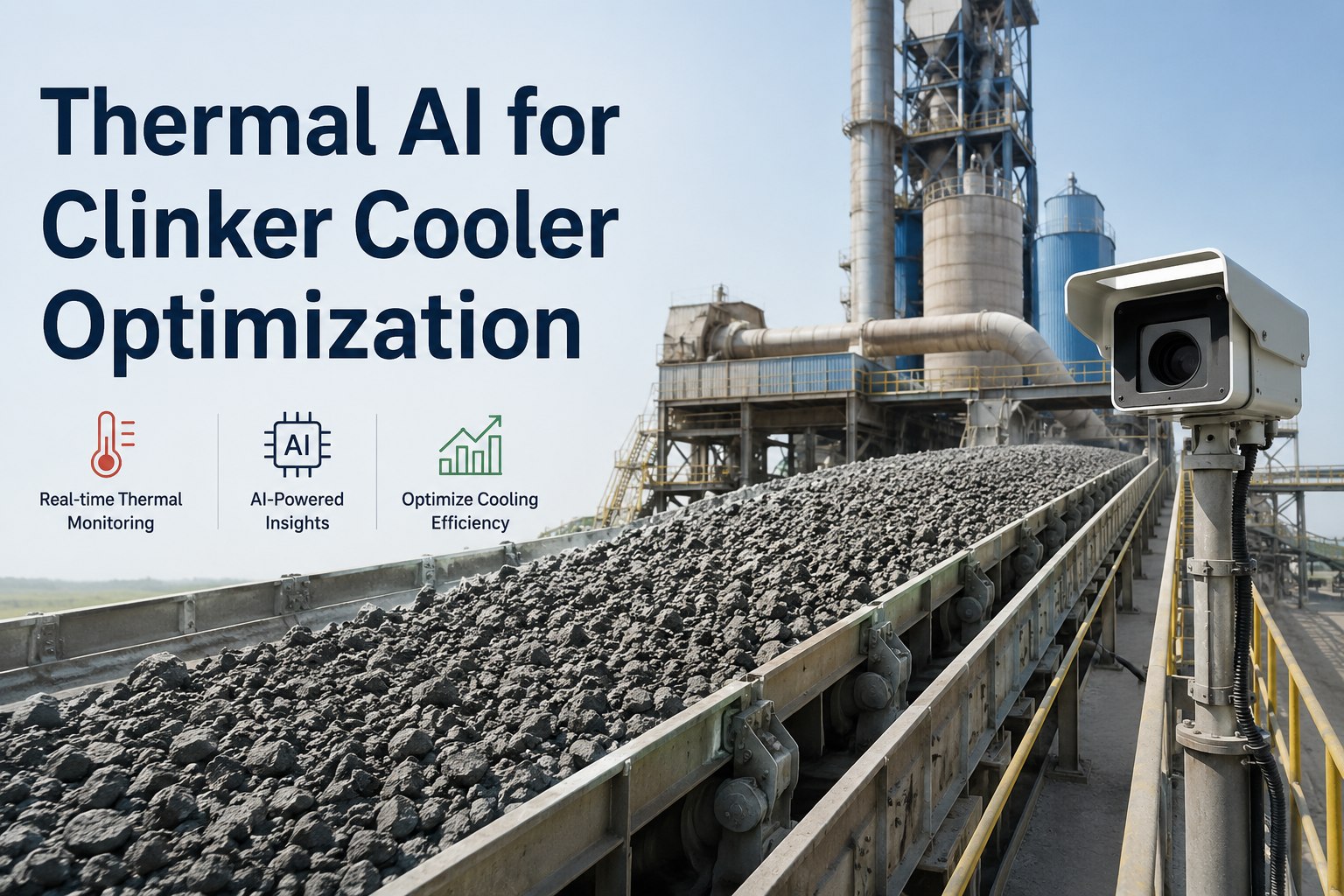
Clinker temperature at the cooler inlet fluctuates with kiln feed chemistry and flame shape. Edge AI models process thermal camera data from the kiln hood in real time, predicting the arriving clinker bed temperature profile and pre-adjusting cooler fan flows and grate speed before the hot clinker even lands on the grate — a feedforward control strategy that cloud AI physically cannot execute due to its latency profile.
Clinker Quality Grading & Flame Shape Analysis
High-resolution cameras mounted at the kiln inlet and cooler discharge generate up to 30 frames per second of visual data. Edge AI runs NVIDIA-accelerated computer vision models locally to classify clinker nodule size distribution, detect dusty clinker signatures indicating under-burning, and analyze burner flame shape in real time — feeding quality-corrective signals back to the fuel control system within a single camera frame interval.
Edge AI vs. Cloud AI: A Head-to-Head Architecture Comparison
The decision between edge and cloud AI is not a matter of preference — it is a matter of physics. The following comparison reflects real-world operational conditions in integrated cement plants running 24/7 production cycles.
| Capability Dimension | Cloud AI Architecture | iFactory Edge AI | Operational Consequence |
|---|---|---|---|
| Inference Latency | 200ms – 2,000ms (network dependent) | Under 50ms (local GPU execution) | Edge enables real-time closed-loop control; cloud cannot |
| Internet Dependency | Full — model unavailable during outage | None — operates fully offline | Edge delivers 99.7% AI availability vs. ~97% cloud SLA |
| Data Sovereignty | Raw process data leaves plant perimeter | All raw data stays on-site, always | Eliminates IP exposure and regulatory compliance risk |
| Control Integration | API-based; requires middleware layer | Direct OPC-UA / Modbus to DCS | Edge eliminates integration latency and failure points |
| Bandwidth Cost | High — continuous high-frequency data upload | Minimal — only aggregated outputs synced | Edge reduces data transfer costs by over 90% |
| Model Customization | Shared infrastructure; limited tuning | Plant-specific models on dedicated hardware | Edge models trained on your exact process signature |
| Cybersecurity Surface | Continuous external data transmission | Air-gapped operation capability | Edge supports OT network isolation requirements |
NVIDIA GPU Hardware Selection for Cement Plant Edge Deployments
Not all edge hardware performs equally in the harsh thermal, vibrationand EMI environment of a cement plant. iFactory qualifies three hardware tiers based on deployment zone and inference workload.
NVIDIA A2 / T4 Server Grade
Rackmount GPU servers installed in air-conditioned control rooms. Handles full-plant inference workloads: multi-camera computer vision, fleet-wide vibration analysis, and kiln shell thermal modeling simultaneously. Recommended for plants running 8+ concurrent AI models. Typical investment: $18,000 – $35,000 per node.
NVIDIA Jetson AGX Orin Industrial
Fanless, DIN-rail mountable GPU compute modules rated for industrial temperatures (0°C to 70°C operating). Ideal for zone-specific deployments — one unit per major process area (kiln, mill, cooler). Delivers 275 TOPS of AI performance in a dust-resistant enclosure. Typical investment: $3,500 – $6,000 per unit.
NVIDIA Jetson Orin NX Embedded
Ultra-compact modules integrated directly into smart sensor housings or camera enclosures. Processes computer vision inference at the point of capture — before data even enters the plant network. Best for single-asset applications: clinker quality cameras, conveyor belt tear detection, or hot bearing thermal imaging. Typical investment: $800 – $1,800 per unit.
Air-Gap & OT Network Isolation
All iFactory edge nodes support full air-gap operation — no inbound or outbound internet required for inference. Models are updated via secure USB transfer or isolated VLAN following IEC 62443 OT security standards. This makes edge AI compatible with even the most restrictive plant cybersecurity policies governing ICS/SCADA networks.
See Edge AI Inference Running Live on Cement Plant Data
Walk through a live demonstration of iFactory's edge inference platform processing kiln shell thermal data, VRM vibration signals, and clinker camera feeds — all locally, all in real time.
The 3-Phase Edge AI Deployment Roadmap
iFactory's edge inference deployments follow a structured commissioning process designed to minimize disruption to continuous kiln operations. Full production deployment is typically achieved within 8 weeks from hardware delivery.
Weeks 1–2
Network Assessment & Hardware Installation
iFactory engineers conduct an OT network topology review, identify OPC-UA data sources and DCS integration points, and commission GPU hardware in the control room or e-house. Sensor connectivity is validated against the 50ms latency target before any models are deployed.
Weeks 3–5
Model Training & Plant-Specific Calibration
Pre-trained foundation models are fine-tuned on 90 days of historical process data from the specific plant. Computer vision models are calibrated to local camera angles, lighting conditions, and clinker type. Vibration models are baseline-profiled against the plant's actual mechanical signature — not a generic cement plant template.
Weeks 6–8
Shadow Mode Validation & Production Go-Live
Models run in parallel with existing control logic for two weeks, with all inference outputs logged but not yet writing to DCS. The maintenance and process control team validates alert accuracy, refines confidence thresholds, and signs off on the production handover. Live control integration is activated in a single planned commissioning window during a scheduled maintenance stop.
Expert Review: Edge AI Inference in Practice
"We had a cloud-based AI system for kiln thermal monitoring that looked great in the demo. But in production, during peak grinding season when our WAN link was congested, the alert latency would balloon to 3–4 seconds. By the time the operator saw the refractory warning, the kiln had already rotated through the hot spot four more times. We moved to iFactory's edge inference and the first real red spot event it caught was acted on in under 45 milliseconds. The kiln never tripped. That one incident alone covered the cost of the entire edge deployment."
Frequently Asked Questions: Edge AI Inference for Cement Plants
Edge AI inference executes machine learning models on local GPU hardware inside the plant. Cloud AI sends data to a remote server for processing before returning a result. The physical round-trip of cloud data transmission — even over a fast connection — introduces 200ms to 2,000ms of latency that makes real-time closed-loop control impossible. Edge inference achieves sub-50ms response, enabling direct DCS integration for automated machine control decisions.
Yes — completely. iFactory's edge inference nodes execute all AI models from local GPU memory and connect only to the plant's internal OT network. There is no internet dependency for the real-time inference loop. Internet connectivity, when available, is used only for optional aggregated analytics sync and model update delivery — both of which are non-critical to the real-time control function.
iFactory edge nodes communicate with DCS systems via OPC-UA (the standard industrial protocol supported by all major DCS vendors) or Modbus TCP for legacy systems. Inference outputs are written to defined DCS tags as structured numeric or Boolean signals. The DCS treats the AI output exactly like any other process measurement — it can trigger alarms, feed control loops, or initiate interlock sequences. No DCS replacement or reprogramming is required.
Raw sensor data — vibration waveforms, thermal images, process variable time series — never leaves the plant under iFactory's edge architecture. The only data that optionally syncs to the cloud is aggregated model outputs: scored anomaly events, prediction confidence values, and performance metrics. This architecture is compliant with OT cybersecurity frameworks including IEC 62443 and NIST SP 800-82, and supports full air-gap operation for facilities with strict network isolation requirements.
Most cement plants achieve full ROI within 4 to 7 months of production go-live. The primary value driver is kiln trip prevention — a single avoided kiln stop at a typical U.S. integrated plant saves $85,000 to $200,000 in lost production, restart energy, and labor costs. Secondary savings from VRM mill bump reduction and cooler grate life extension typically add another $150,000 to $300,000 per year. Hardware and deployment costs for a full-plant edge AI deployment range from $45,000 to $120,000 depending on plant size and asset scope.
The competitive pressure on cement producers in 2026 — from carbon costs, energy prices, and margin compression — makes every unplanned kiln stop a strategic liability. Edge AI inference is not a future technology; it is a production-proven architecture that is already preventing failures, protecting margins, and enabling real-time process optimization at cement plants across North America and South Asia. The plants that deploy local GPU inference today are building the operational advantage that compounds over the next decade — while those still dependent on cloud latency remain one network outage away from a preventable catastrophe.
Bring Sub-50ms AI Inference Inside Your Plant
iFactory's edge AI platform runs locally on NVIDIA GPUs — no cloud dependency, no data exposure, and no latency window that costs you a kiln trip. Start with a live demo built around your process data.