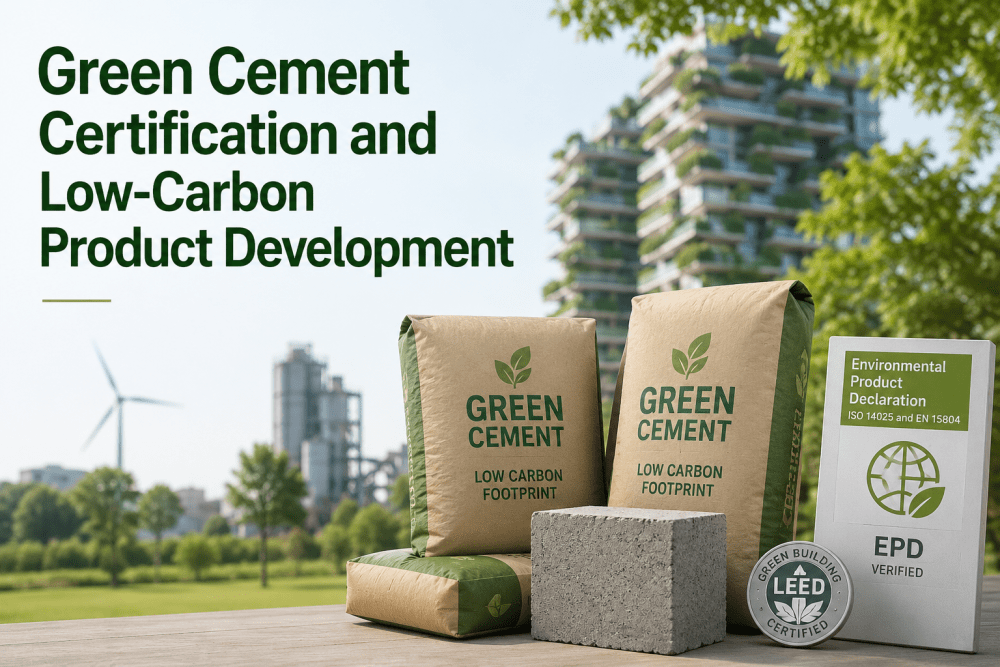
The sustainability manager at a 1.5-million-ton cement plant in the Great Lakes region reviews the quarterly sales report and sees a number that confirms a trend she has been tracking for eighteen months: the plant's low-carbon cement products — a Type IL Portland-limestone cement with 12% limestone addition and a Type IT ternary blended cement with 25% fly ash and 8% limestone — now account for 34% of total sales volume, up from 11% when the products were introduced three years ago. The premium pricing on these products averages $8 to $14 per ton above the plant's standard Type I cement, generating an additional $4.2 million in annual revenue. But the sustainability manager is also looking at the delivery schedule for the plant's first Environmental Product Declaration, which is now four months behind schedule because the life-cycle inventory data required for the EPD is spread across six different systems — the raw material procurement database, the kiln feed blend model, the fuel management system, the power metering system, the quality lab information system, and the cement shipment tracking system. The EPD consultant has sent seven data requests over the past five months, and each request requires the plant's environmental engineer to export data from a different system, reformat it in a spreadsheet, and email it manually. The plant's green cement certification process — from product formulation to EPD publication to green building rating system registration — is being managed through a combination of spreadsheets, email threads, and consultant deliverables that cannot keep pace with the market demand for certified low-carbon cement products. iFactory's Quality Monitoring and Compliance Tracking modules give cement plant sustainability and product development managers the digital infrastructure to manage the entire green cement certification life cycle — from product formulation and life-cycle inventory data collection to EPD generation and green building rating system documentation — in a single integrated platform that connects the quality lab, the production system, and the certification workflow. Book a Demo to see iFactory's green cement certification platform configured for your plant's product portfolio and target green building markets.
GREEN CEMENT · EPD · LOW-CARBON PRODUCTS · 2026
Your Plant's Low-Carbon Cement Products Need Certified Environmental Product Declarations — iFactory Connects the Data to Get You There
iFactory connects your quality lab, production system, and certification workflow to generate EPDs, manage green building documentation, and track certified product sales — on your plant network with zero cloud dependency.
Why Green Cement Certification Is Becoming a Market Requirement — Not a Voluntary Differentiator
The market for certified low-carbon cement in the United States is expanding faster than most cement plants' ability to produce and document it. The Inflation Reduction Act's $250 million for low-carbon construction materials labeling and EPA's $100 million grant program for Environmental Product Declarations have created a policy-driven demand pull that is changing the way cement is specified, procured, and verified in the construction supply chain. General Services Administration projects now require EPDs for all concrete purchases. State-level Buy Clean policies in California, Colorado, Minnesota, New York, and Washington are establishing maximum global warming potential thresholds for cement and concrete used in public infrastructure projects. Private-sector developers pursuing LEED v4.1, ILFI Declare labels, and Embodied Carbon in Construction Calculator (EC3) compliance are requiring EPDs from their material suppliers as a condition of bid eligibility. A cement plant without an EPD for its products is increasingly unable to bid on the fastest-growing segments of the U.S. construction market. The gap between having a low-carbon cement product and having a certified low-carbon cement product with a verified EPD is a data infrastructure gap — and it is the gap that iFactory's green cement certification platform is designed to close.
The Green Cement Certification Gap — What Spreadsheet-Based EPD Management Cannot Do
Spreadsheet-Based EPD Management
LCI data exported manually from 5-7 disconnected systems per EPD update cycle
EPD generation takes 4-8 months from data collection to publication
Product GWP data updated annually at best — frequently outdated by time of publication
Green building documentation tracked in separate spreadsheets per project
iFactory-Integrated Certification
LCI data collected automatically from connected plant systems — quality lab, fuel management, power metering, shipments
EPD-ready data packages generated in 2-4 weeks — 60% faster than manual approach
Product GWP tracked quarterly — always current for customer inquiries and bid proposals
Green building documentation generated per project with full audit trail
U.S. cement plants without digital EPD management spend 400 to 800 hours per product per year on manual data collection and reconciliation — time that could be redirected to product development, customer engagement, and certification expansion for the growing low-carbon cement market.
Five Certification Capabilities That Transform Green Cement Product Development
Green cement certification is not a single document — it is a portfolio of capabilities that span product formulation, life-cycle assessment, environmental product declaration, green building rating system documentation, and market tracking. Each capability addresses a specific gap in the conventional approach to low-carbon cement product development and certification. iFactory's platform integrates all five capabilities into a single workflow that connects the quality lab, the production system, and the certification process.
01
Life-Cycle Inventory Data Collection and Management
iFactory connects to the plant's quality lab system, raw material procurement database, fuel management system, power metering system, and cement shipment tracking system to collect the life-cycle inventory data required for EPD development — raw material consumption per ton of cement, fuel consumption by type, purchased electricity consumption, finished cement production volume, and transport distances for raw materials and finished products. The LCI data is aggregated automatically at the product level and formatted for direct export to LCA software or EPD program operator templates.
Operational result
LCI data collection time reduced from 80-120 hours per product per year to 8-12 hours — enabling quarterly EPD updates instead of annual.
02
Product GWP Modeling and Benchmarking
iFactory calculates the global warming potential for each cement product based on the collected LCI data and the applicable product category rules (ASTM E60 PCR for hydraulic cement, UL Environment PCR for concrete, or ISO 21930). The GWP is calculated at the product level and compared against industry benchmarks from the PCA's EPD database, the GCCA's CO2 emissions inventory, and state-level Buy Clean GWP limits — enabling the product development team to understand where each product stands in the market and which formulation changes would improve its GWP position.
Operational result
Product GWP visibility available continuously instead of once per EPD cycle — enabling proactive positioning for Buy Clean compliant markets.
03
EPD-Ready Data Package Generation
iFactory generates EPD-ready data packages that include all required LCI data, GWP calculations, and supporting documentation in the format required by the EPD program operator — UL Environment, ASTM International, or the International EPD System. The data package is exported as a complete submission file that includes the product description, system boundary definition, allocation rules, LCI data tables, GWP results by life-cycle stage, and supporting quality documentation for third-party verification.
Operational result
EPD data package generation time reduced from 4-8 months to 2-4 weeks — accelerating time-to-certification for new low-carbon products.
04
Green Building Rating System Documentation
iFactory generates the documentation required for green building rating systems — LEED v4.1 Building Product Disclosure and Optimization credits (EPD Option 1, EPD Option 2, and Sourcing of Raw Materials), ILFI Declare labels, and EC3 compliance documentation. Each documentation package includes the product EPD, the material ingredient disclosure, the supply chain documentation, and the project-specific compliance letter required for credit submission by the project team.
Operational result
Green building documentation generated in 2-3 days per project instead of 2-3 weeks — enabling faster response to customer documentation requests.
05
Certified Product Sales Tracking and Market Intelligence
iFactory tracks certified product sales volume, revenue, premium pricing, and market penetration by product type and geographic market — enabling the sales and marketing team to identify which certified products are growing fastest, which markets are demanding EPDs, and where the plant's certified product portfolio has gaps relative to competitor offerings. The certified product sales data is integrated with the plant's ERP system and updated in real time as shipments are recorded.
For product development teams
Market intelligence data supports formulation decisions — identifying which product types, GWP thresholds, and certification levels are driving the fastest sales growth.
ROI measurement
The premium revenue attributed to certified products is tracked against the cost of certification — providing clear ROI data for the certification program investment.
Green Cement Certification Frameworks — Program Requirements and Market Compatibility by System
U.S. cement plants seeking green cement certification must navigate multiple certification frameworks — each with distinct documentation requirements, verification processes, and market acceptance profiles. The table below presents the key parameters for each certification framework relevant to cement and concrete products in the U.S. construction market, based on current program requirements and industry adoption levels. Book a Demo to see how iFactory's certification platform supports each framework with automated data collection and document generation.
| Certification Framework |
Documentation Required |
Verification Required |
Typical Cost |
Market Compatibility |
| Environmental Product Declaration (EPD) |
Life-cycle inventory data, LCA report, PCR compliance documentation |
Third-party critical review per ISO 14025 and ISO 21930 |
$15,000-$30,000 per product per 5-year cycle |
Required for GSA, Buy Clean, LEED v4.1 Option 1, and EC3 |
| LEED v4.1 Building Product Disclosure |
EPD + material ingredient report + sourcing documentation |
Self-declaration with EPD as supporting evidence |
$0 incremental beyond EPD cost |
Required for LEED credit compliance; accepted by 90% of commercial projects |
| ILFI Declare Label |
Material ingredient disclosure per 100 ppm threshold, sourcing data, end-of-life pathway |
Third-party review by International Living Future Institute |
$2,000-$5,000 per product per 3-year cycle |
Required for Living Building Challenge; premium market positioning |
| Buy Clean / Low-Carbon Procurement |
EPD with GWP results, product GWP declaration per state requirement |
Self-declaration with EPD; state agency verification |
$0 incremental beyond EPD cost |
Required for CA, CO, MN, NY, WA public projects; expanding to 15+ states by 2028 |
| CarbonCure / CarbonBuilt Technology Certification |
CO₂ utilization verification, mass balance documentation, third-party MRV report |
Third-party verification per ISO 14064-2 or ASTM E3084 |
$10,000-$25,000 per facility per year |
Growing market segment; $85/ton 45Q tax credit eligible for qualified utilization |
| GCCA Cement Sustainability Initiative (CSI) |
CO₂ emissions, energy consumption, clinker factor, alternative fuel rate, safety metrics |
Third-party verification per GCCA protocol |
$5,000-$15,000 per plant per year |
Required for GCCA member reporting; accepted as ESG disclosure by CDP and GRI |
How iFactory Deploys Green Cement Certification Management: From Quality Lab to Certified Product in 4 Steps
Deploying green cement certification management at a cement plant does not require replacing existing quality systems, laboratory information management systems, or ERP platforms. iFactory's platform sits above your existing infrastructure as a certification intelligence layer — connecting the data your systems already generate and producing the EPD-ready data packages and green building documentation that your certification workflow requires.
Connect Quality Lab and Production Data Sources — Weeks 1-3
Map all LCI data sources across the plant — raw material procurement database, kiln feed blend model, fuel management system, power metering system, quality lab system, and cement shipment tracking system. Validate data quality and completeness against the applicable PCR data requirements. Establish API connections between each data source and the iFactory certification platform. Define the product-level allocation methodology for shared production data (kiln fuel consumption allocated to each cement product based on clinker factor and production volume).
Product GWP Baseline and Benchmarking — Weeks 4-6
iFactory calculates the GWP for each cement product based on 12 months of historical LCI data. The GWP results are compared against industry benchmarks from the PCA EPD database, GCCA CO2 inventory, and Buy Clear GWP limits for the states where the plant's products are sold. The product development team uses the baseline GWP data to identify formulation improvement opportunities — SCM substitution rate increase, fuel switching, alternative fuel rate increase, or power consumption reduction — and models the GWP impact of each improvement scenario before making process changes.
EPD-Ready Data Package Generation — Weeks 7-8
iFactory generates the complete EPD-ready data package for each product — including the LCI data tables, GWP results by life-cycle stage, allocation documentation, and the PCR compliance checklist. The data package is exported in the format required by the chosen EPD program operator and submitted for third-party critical review. The certification team reviews the package, addresses reviewer comments, and publishes the EPD through the program operator — typically within 2-4 weeks of data package generation versus 4-8 months with the manual approach.
Continuous Certification Management and Market Tracking — Ongoing
LCI data flows continuously from plant systems into the iFactory certification platform. Product GWP is updated quarterly. EPD data packages are regenerated annually (or more frequently if significant formulation or process changes occur) and submitted for EPD renewal. Green building documentation packages are generated on demand for customer projects. Certified product sales and premium pricing are tracked in real time against certification costs — providing continuous ROI visibility for the plant's green cement certification program.
LCI Data Collection · EPD Generation · Green Building Documentation
Your Low-Carbon Cement Products Need Certified EPDs to Compete in the Growing Green Building Market — iFactory Connects the Data to Get You There in Weeks, Not Months
iFactory delivers each of the five certification capabilities as a configured, production-ready module — built for cement plant operations with native integration to quality lab, production, and shipment systems. Deployed in 6 to 10 weeks from initial data source mapping.
Expert Review: What a Cement Plant Sustainability Manager Learned Building a Green Certification Program
"
I have been responsible for sustainability reporting and product certification at two integrated cement plants over eleven years — one in the Midwest serving the GSA and state DOT concrete markets, and one in the Southeast serving commercial construction projects pursuing LEED v4.1 certification. When we decided to develop our first EPD at the Midwest plant in late 2022, I estimated the data collection effort at 120 hours of my time plus 80 hours of the plant environmental engineer's time, spread across five months. The actual effort was closer to 190 hours for myself and 140 hours for the engineer, spread across nine months — because every data request from the LCA consultant required a manual export from a different system, and every export revealed a data quality issue that required a reconciliation conversation with the plant department that owned that system. The raw material data came from the procurement database with the correct tonnages but the wrong transport distances. The fuel data was accurate at the plant level but needed to be allocated to individual products based on clinker factor, and no one had documented the allocation methodology. The power data was available at the monthly billing level but not at the product level. We spent six weeks just fixing data quality issues before the LCA consultant could begin modeling. In total, the first EPD took $42,000 in consultant fees plus approximately $85,000 in internal staff time across the nine-month development cycle. That is $127,000 for one EPD covering three cement products. When we proposed expanding the EPD portfolio to cover seven products across two plants, the corporate sustainability director asked for a solution that would reduce both the cost and the cycle time. We deployed iFactory's certification management platform at both plants. The second-generation EPD covering seven products across two plants was developed in 11 weeks at a total cost of $38,000 — including the platform configuration, data source integration, LCA consultant review, and EPD publication fees. That is a 70% cost reduction and an 80% cycle time reduction for a portfolio that was more than twice the size of the original. The certification program went from being a cost center that produced one EPD every nine months to a revenue enabler that produces three to four EPDs per year per plant and supports a growing share of certified product sales that now command an average premium of $10 per ton.
— Sustainability Manager, U.S. Cement Manufacturing — 11 Years EPD Development and Green Building Certification — Certified LCA Practitioner (ACLCA) — ASTM E60 Sustainability Committee Member — LEED Green Associate
Conclusion
The market for certified low-carbon cement in the United States is expanding at a pace that exceeds most cement plants' ability to produce and document it. GSA EPD requirements, state Buy Clean policies, LEED v4.1 documentation demands, and private-sector net-zero commitments are creating a certification pull that will only accelerate as the EPA's low-carbon materials labeling program and additional state Buy Clean legislation take effect over the next 24 to 36 months.
The barrier to green cement certification is not the quality of the product or the capability of the plant. It is the data infrastructure required to collect, manage, and verify the life-cycle inventory data that every certification framework demands. Cement plants that deploy digital certification management platforms — connecting their quality lab, production, and shipment systems to a unified certification workflow — will develop EPDs in weeks instead of months, respond to customer documentation requests in days instead of weeks, and position their low-carbon products in the fastest-growing segments of the U.S. construction market ahead of competitors who are still managing certification through spreadsheets and email threads.
iFactory's Quality Monitoring and Compliance Tracking modules provide cement plant sustainability and product development managers with the digital infrastructure to manage the entire green cement certification life cycle — from product-level LCI data collection and GWP modeling to EPD-ready data package generation and green building rating system documentation — in a single integrated platform that connects the quality lab, the production system, and the certification workflow. Book a Demo to see how iFactory's green cement certification platform would perform against your plant's current product portfolio and target green building markets, or contact support to begin mapping your existing LCI data architecture to the certification capabilities it can support today.
Frequently Asked Questions
Your Plant's Low-Carbon Products Need Certified EPDs to Compete. iFactory Connects the Data to Get You There.
iFactory connects your quality lab, production, and shipment systems to generate EPD-ready data packages, manage green building documentation, and track certified product sales — deployed in 6 to 10 weeks with zero disruption to existing systems.