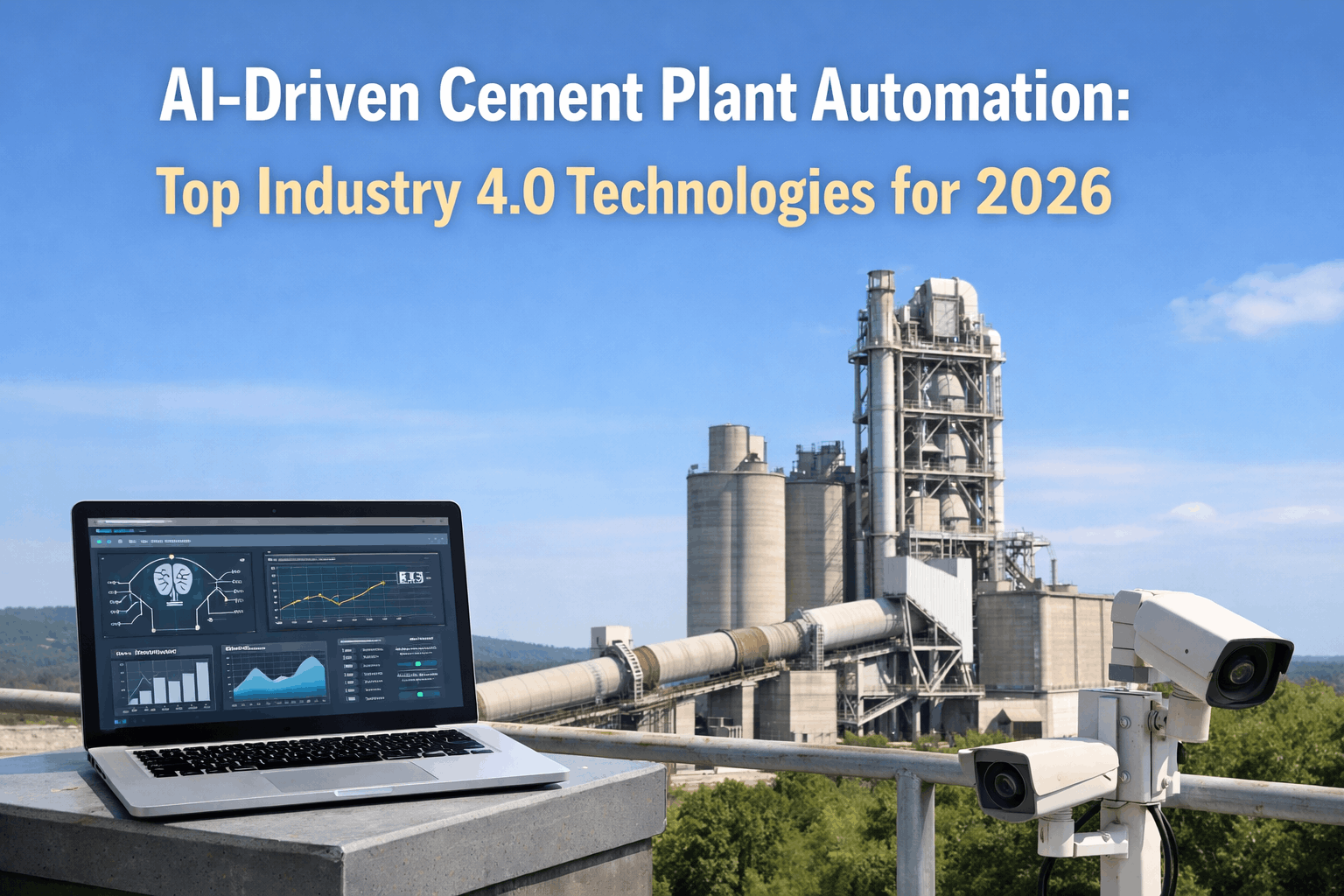
Japan and South Korea have emerged as global benchmarks for cement plant automation, driven by decades of investment in advanced process control, robotics, and data analytics. Japanese cement producers — led by Taiheiyo Cement, Ube-Mitsubishi, and Sumitomo Osaka — have deployed AI-driven kiln optimization, predictive maintenance on every major rotating asset, and robotics for packhouse and palletizing operations since the early 2010s. South Korean producers, anchored by Ssangyong C&E, Hanil Cement, and Sungshin Cement, matched this trajectory with aggressive Industry 4.0 programs that integrate real-time quality analytics, autonomous material handling, and digital twin platforms across entire plant networks. The result is a region where cement plants operate at 92–96% equipment availability, with unscheduled downtime below 3% and energy intensity 12–18% below global averages. iFactory's Advanced Automation and Zero-Downtime Analytics platform is purpose-built to help cement manufacturers worldwide adopt these proven Asian automation strategies — combining AI-powered predictive maintenance, real-time process analytics, and robotic integration into a unified plant-wide system. Book a Demo to see iFactory's advanced automation platform configured for your cement plant's equipment layout, process configuration, and production goals.
Achieve 92–96% Equipment Availability With AI-Driven Automation and Zero-Downtime Analytics
iFactory's Advanced Automation platform brings Japanese and South Korean cement plant best practices to your operation — predictive maintenance across every rotating asset, real-time quality analytics, and robotics integration — delivered as a unified plant-wide system with measurable results in the first quarter.
AI Kiln Optimization & Thermal Analytics
Japanese cement plants pioneered AI-driven kiln control that adjusts feed rate, fuel mix, fan speed, and cooler airflow in real time based on burning zone temperature, NOx emissions, and free lime analytics. The AI model learns from 10,000+ operating hours to maintain stable kiln operation through raw meal variability, fuel changes, and ambient conditions — reducing heat consumption by 3–7% and increasing refractory life by 15–25%.
Predictive Maintenance for All Rotating Assets
South Korean cement plants deploy vibration, temperature, and oil analysis sensors across every critical rotating asset — raw mill, kiln drive, clinker cooler fans, cement mill, and packhouse equipment — feeding a centralized AI platform that predicts bearing failures, gearbox degradation, and motor winding issues 30–60 days in advance. This zero-downtote analytics approach reduced unplanned stops by 70–85% across Hanil Cement's plant network.
Robotic Packhouse & Palletizing Automation
Both Japanese and Korean cement producers have automated packhouse operations with robotic bag palletizers, automatic truck loading systems, and AI-driven quality inspection stations that detect bag defects, weight deviations, and pallet stability issues in real time. These systems operate 24/7 with 99.5% uptime, eliminating manual handling injuries and reducing packhouse labor costs by 60–75%.
Real-Time Quality Analytics & Digital Twins
Digital twin platforms at Ssangyong and Taiheiyo plants create real-time virtual replicas of the entire cement production process — from raw material blending through clinker cooling to finish grinding. These twins run what-if scenarios, predict quality deviations before they occur, and recommend process adjustments to maintain consistent product quality while maximizing throughput and minimizing energy consumption.
Why Japan and South Korea Lead Global Cement Plant Automation — and What North American Plants Can Learn
The automation gap between Asian leaders and global peers is not primarily about capital investment — it is about strategic integration and data utilization. Japanese and Korean cement producers have invested consistently in four foundational capabilities that together create a self-reinforcing cycle of reliability, efficiency, and quality improvement. Each capability builds on the others, creating an automation ecosystem that delivers compounding returns over time rather than point solutions that deliver one-time gains.
Japanese and Korean plants average 3–5x more sensors per production line than the global average — typically 800–1,200 sensors per integrated cement line covering vibration, temperature, pressure, flow, current, and emissions parameters. This sensor density feeds AI models with the granular data needed to detect subtle degradation patterns and optimization opportunities that sparse sensor networks miss entirely.
Rather than deploying separate systems for predictive maintenance, process control, quality management, and robotics, Asian cement producers integrate all automation functions on a unified platform. This eliminates data silos, enables cross-functional AI models that optimize across process boundaries, and allows a single operations team to manage plant-wide automation from one dashboard rather than five.
Japanese cement companies treat AI models as living systems that require continuous retraining with new operating data, not as one-time deployments. Dedicated data engineering teams at each plant continuously update model parameters, incorporate new failure modes, and refine optimization algorithms based on actual production results — creating models that improve with age rather than degrading.
Bring Asian Cement Automation Best Practices to Your Plant With iFactory's Unified Platform
iFactory integrates AI predictive maintenance, real-time process analytics, robotic packhouse automation, and digital twin simulation into a single plant-wide system — exactly like the Japanese and Korean platforms that set the global standard for cement plant reliability and efficiency.
Cement Plant Automation Approaches — Manual, Semi-Automated, and AI-Driven Advanced Automation
| Automation Parameter | Manual / Basic Control | Semi-Automated / SCADA | iFactory AI Advanced Automation |
|---|---|---|---|
| Kiln control method | Operator-adjusted setpoints | PID loops with DCS | AI model with real-time feed, fuel, and airflow optimization |
| Maintenance strategy | Calendar-based PM | Vibration rounds with handheld data collectors | Continuous AI predictive with 30–60 day failure horizon |
| Quality management | Lab-sample based (4–8 hour delay) | Online analyzers with SPC charts | Real-time AI quality prediction with digital twin what-if |
| Packhouse operations | Manual bagging, palletizing, truck loading | Semi-automatic baggers with conveyor control | Full robotic palletizing with AI quality inspection |
| Energy management | Monthly utility bill tracking | Area-level submetering with dashboard | Machine-level AI energy optimization with 5–12% savings |
| Data integration | Siloed systems with manual data entry | SCADA + CMMS with limited integration | Unified platform: APM + CMMS + QMS + EMS + robotics |
| Unplanned downtime | 8–15% of operating time | 4–8% of operating time | <3% of operating time |
Advanced Automation Deployment — 5-Step Roadmap for Cement Plants
iFactory's advanced automation platform is deployed using a phased approach designed to deliver measurable results in the first 90 days while building toward full plant-wide integration. The roadmap below follows the proven implementation sequence used by Japanese and Korean cement plants that achieved 92–96% equipment availability within 18 months of deployment start.
Phase 1 — Sensor Infrastructure and Connectivity Audit (Days 1–45)
iFactory engineers conduct a comprehensive audit of your plant's existing sensor infrastructure, control system architecture, and network connectivity. The audit identifies sensor gaps, data integration points, and connectivity requirements. Based on findings, additional vibration, temperature, current, and emissions sensors are installed on critical assets — typically 200–400 sensors for a standard integrated cement line. All sensors are connected to the iFactory edge appliance via existing PLC or direct IO wiring.
Phase 2 — AI Model Deployment and Baseline Establishment (Days 46–120)
iFactory's pre-trained AI models — built on 15,000+ equipment-years of cement plant operating data — are deployed across your connected assets. Models cover kiln thermal analytics, vertical roller mill vibration analysis, clinker cooler performance optimization, cement mill particle size prediction, and rotating asset bearing failure prediction. A 60-day baseline period establishes asset-specific normal operating envelopes and failure signature libraries.
Phase 3 — Dashboard, Alerting, and Workflow Configuration (Days 121–160)
Operator dashboards are configured per role with real-time asset health, energy consumption, quality metrics, and production KPIs in a single pane of glass. Alert thresholds are set with three severity levels — advisory (14+ day horizon), warning (7–14 day horizon), and critical (<7 day horizon) — each with configured response workflows that auto-generate work orders in your CMMS and notify the appropriate team via mobile push, email, or SMS.
Phase 4 — Robotic Integration and Packhouse Automation (Days 161–220)
For plants with robotic automation scope, iFactory integrates with existing robotic bag palletizers, truck loading systems, and quality inspection stations — or specifies and deploys new robotic systems integrated with the iFactory platform. Integration enables real-time production scheduling, predictive maintenance on robotic systems themselves, and AI-driven quality inspection data flowing directly into the plant-wide quality management module.
Phase 5 — Digital Twin Deployment and Continuous Improvement (Days 221+)
The plant digital twin is deployed as a real-time virtual replica of the entire cement production process, integrating data from all AI models, robotic systems, quality analyzers, and energy meters. Operations teams use the twin for what-if scenario analysis, production planning optimization, and operator training. Monthly model retraining cycles ensure prediction accuracy continues to improve over time, and quarterly business reviews track automation ROI against baseline metrics.
"I spent eleven years leading automation projects across five Japanese cement plants and later consulted for two of Korea's largest producers. The single biggest difference between Asian cement automation leaders and their global peers is not the technology — it is the willingness to invest in sensor density and data infrastructure as a fundamental enabler rather than a discretionary cost. Japanese plants run with 800 to 1,200 sensors per line because they understand that you cannot optimize what you cannot measure. Every sensor is an input to an AI model that continuously improves operations. When I see North American plants trying to achieve advanced automation with 150 sensors per line and expecting the same results, I know they will be disappointed. The sensor infrastructure is not optional — it is the foundation upon which everything else is built. iFactory's platform recognizes this reality and provides a cost-effective path to build that sensor density without the custom engineering costs that have historically made Asian-style automation prohibitive outside the region."
Asian Cement Automation Leaders Did Not Get Lucky — They Invested in Sensor Density, Unified Platforms, and Continuous Improvement. iFactory Brings That Capability to Every Cement Plant.
Japan and South Korea have demonstrated that cement plant availability above 92% and unplanned downtime below 3% are achievable at commercially viable costs when automation is approached as an integrated, data-driven ecosystem rather than a collection of point solutions. The four pillars of their success — high sensor density, unified platform architecture, AI-powered predictive and prescriptive analytics, and continuous model improvement — are not proprietary technologies but proven methodologies that can be replicated in any cement plant with the right partner. iFactory's Advanced Automation and Zero-Downtime Analytics platform delivers all four pillars in a single, configurable system designed for rapid deployment and measurable results. For cement plant managers ready to close the automation gap and achieve Asian-league reliability and efficiency, book a demonstration with iFactory's cement automation engineering team to review your plant's current automation posture and build a phased deployment roadmap.
Cement Plant Advanced Automation — Frequently Asked Questions
Deploy Advanced Automation and Zero-Downtime Analytics Across Your Cement Plant with iFactory
iFactory's unified advanced automation platform brings Japanese and South Korean cement plant best practices to your operation — AI predictive maintenance on every rotating asset, real-time quality analytics with digital twin simulation, robotic packhouse automation, and unified plant-wide dashboards — delivered as a turnkey system with full installation, integration, and continuous improvement support.