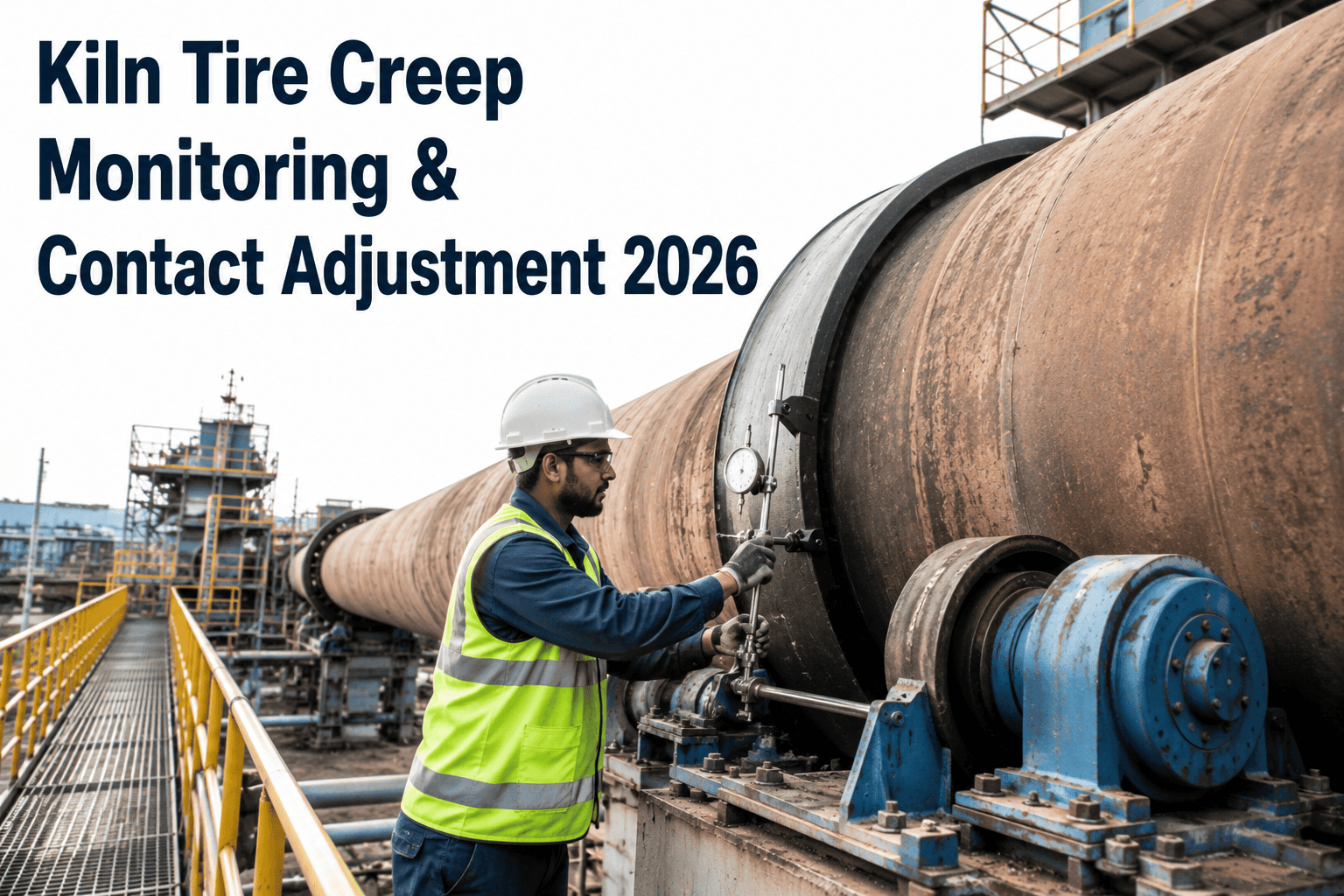
A rotary cement kiln is a 60 to 100 meter steel cylinder weighing between 1,000 and 2,500 metric tons, and it is only ever held in place by a handful of tire-and-roller stations doing the work of carrying that entire rotating mass. Tire creep, the small relative slip between the tire and the shell beneath it, is not a defect on its own. It is a designed-in behavior that accommodates the shell expanding faster than the tire as the kiln heats up, and the real question is never whether creep exists but whether it is staying inside the band that keeps that mass properly supported. Book a free kiln tire creep monitoring assessment.
Quick Answer
Kiln tire creep is the relative movement between a tire and the kiln shell caused by the shell's outside diameter expanding faster than the tire's inside diameter during heating. Healthy creep falls within a plant-specific band that keeps the tire properly seated; creep that is too low restricts shell expansion and risks plastic deformation, while creep that consistently exceeds roughly 50mm per revolution signals a fit or alignment problem that accelerates tire and roller wear. Continuous creep tracking against shell temperature, combined with roller skew and contact pattern checks, typically catches a developing problem weeks before it forces an unplanned kiln stop. Most of the underlying instrumentation a plant needs for this already exists; what is usually missing is the trend analysis that turns individual readings into an early warning.
Stop Chasing Creep Readings With a Chalk Mark and a Stopwatch
iFactory tracks tire creep continuously against shell temperature and roller skew, flagging drift toward the intervention threshold days before it shows up as a bearing temperature spike or a forced kiln stop. Every tire station gets its own baseline, so a reading is always judged against what is normal for that specific station rather than a generic industry figure.
Why This Deserves More Than a Once-a-Shift Glance
Tire creep is easy to deprioritize precisely because it rarely causes an immediate, obvious problem. A kiln can run for weeks with creep drifting slowly past its healthy band before anything downstream shows a visible symptom, and by the time a bearing temperature alarm or a visible wear pattern finally forces attention, the underlying fit or skew problem has usually been active for a considerable stretch of that time. The cost of catching that drift early is a roller skew adjustment that takes an afternoon. The cost of catching it late is frequently an emergency kiln stop, a multi-day repair, and downstream refractory damage from the added shell stress that accumulated while nobody was watching the trend line.
Why Tire Creep Happens in the First Place
Tire creep is not random mechanical slop. It is a direct, predictable consequence of how a kiln shell and its tires are built to different diameters on purpose, and understanding the sequence makes it far easier to tell healthy creep from a developing problem.
01
The tire is built with a larger inside diameter than the shell's outside diameter
This deliberate clearance exists to accommodate the different expansion rates of the shell and the tire as kiln temperature rises, and every tire is manufactured with a specific designed cold clearance to match this expected difference.
02
Shell temperature rises faster than tire temperature during heating
Kiln shell temperatures can range from around 200°C near the inlet to well over 400°C near the burning zone, and this heat reaches the shell well before it fully transfers through to the much thicker tire, creating a temperature differential that drives differential expansion.
03
The shell expands into the clearance, and the tire lags behind
Because the shell is rotating at a marginally different effective rate than the tire riding on it, the tire naturally migrates, or creeps, at a slightly slower rotational pace than the shell beneath it.
04
That lag is measurable as a gap that separates with every rotation
Marking the tire and the shell filler bar at the same circumferential position and watching the marks slowly separate over successive rotations is the classic manual method for witnessing this movement directly, and it is exactly what a continuous creep monitor automates. Worn filler bars or supports can allow excess gap at the shell's top position, which lets the shell plate flex more than intended as the drum rotates, adding a second variable on top of the expected thermal creep that a careful reading needs to account for.
Reading Your Creep Number: Three Bands That Matter
A single creep reading means very little on its own. What matters is where that reading sits relative to the healthy operating band for your specific tire and shell fit, and how consistently it stays there. Because cold clearance is designed per tire rather than standardized across a plant, two tire stations on the same kiln can have meaningfully different healthy ranges, which is exactly why comparing a raw reading against a generic industry number is less reliable than comparing it against that station's own established baseline.
Too Low or Absent
If tire creep is too low or non-existent during heating, the heating-up process needs to be slowed or interrupted until measurable relative movement is established. Without it, shell expansion is restricted by the tire, and the shell can be plastically deformed if the temperature difference between shell and tire exceeds the tire's designed maximum during the heating schedule. For this reason, creep can become the limiting factor that sets the pace of the entire heat-up.
Healthy Range
Forward and reverse cycling within the plant's established band indicates a healthy tire-shell fit and correctly set roller skew. This is the range every tire station should be trending toward and holding, and it is the baseline that all future readings should be compared against rather than a single inspection value taken in isolation.
Too High or Accelerating
Creep exceeding roughly 50mm per revolution is a widely used intervention threshold, since sustained creep at this level signals a fit, lubrication, or roller skew problem that is actively wearing down the contact surfaces. Left uncorrected over months, this level of creep shifts tire position axially on the shell, disrupting the designed load geometry and accelerating wear at the contact surface.
See Where Every Tire Station Sits Against Its Healthy Band, Right Now
iFactory trends creep, skew, and contact pattern data per tire station across every campaign, so a drift toward the intervention threshold shows up as a clear alert instead of a number buried in a shift log. Historical readings stay attached to each station, so a new reading is always compared against that station's own history rather than a plant-wide average.
How Tire Creep Is Actually Measured
Measurement approaches range from a five-minute manual check to a permanently installed sensor system, and each has a different trade-off between cost, precision, and how early it catches a developing problem. Choosing the right method for a given tire station usually comes down to how critical that station is and how much history of prior issues it has, rather than defaulting to the same approach across every kiln in a portfolio.
| Method |
How It Works |
Best For |
Main Limitation |
| Chalk or Soapstone Mark |
Mark tire and filler bar at the same position, measure separation over a set number of rotations |
Quick daily spot checks, under 5 minutes per reading |
Single data point, easy to miss short-term spikes |
| Obourg-Style Slip and Gap Device |
Plots the relationship between slip, gap, and ovality across a full rotation cycle |
Diagnosing ovality-related creep behavior in detail |
Requires specialized equipment and trained interpretation |
| Continuous Creep Monitor |
Compares girth gear rotation timing against tire rotation timing to calculate creep in mm per revolution |
Real-time tracking, including during heat-up before continuous rotation begins |
Needs permanent sensor installation and integration into monitoring workflows |
Building a Creep Monitoring Program That Actually Gets Used
The measurement methods above only add value if the readings go somewhere useful. A chalk-mark reading logged into a notebook that nobody revisits provides almost none of the protection that the same reading would provide if it were trended against a baseline and compared across shifts. A workable program does not need to start with a full sensor retrofit. It needs a consistent measurement interval per tire station, a defined healthy band for each station based on its own baseline rather than a generic industry number, and a clear escalation path the moment a reading crosses the intervention threshold. Plants that get this structure in place before investing in continuous sensors typically get more value from those sensors later, because the trending discipline is already established and the sensor data simply replaces manual readings rather than introducing a new workflow from scratch.
Contact Adjustment: Correcting Creep Once It Drifts
Once a reading confirms creep has moved outside the healthy band, correction usually comes down to one of a small number of adjustments. Getting the sequence right matters, since adjusting the wrong variable first can mask the real cause for weeks.
1
Confirm the reading with a second measurement method
Cross-check a manual chalk-mark reading against continuous monitor data where available, since a single anomalous reading can result from a temporary lubrication gap rather than a genuine fit problem.
2
Check roller skew before assuming a tire-shell fit problem
Roller skew controls the axial migration force on the kiln, and incorrect skew, whether too aggressive or set in the wrong direction, is a primary driver of the thrust bearing overload and tire wear that shows up as abnormal creep.
3
Inspect contact pattern across the full roller face width
When a roller contacts the tire across less than roughly 80% of its face width, load concentrates on the loaded edge, accelerating surface fatigue in a way that often shows up first as an abnormal creep trend rather than as visible surface damage.
4
Verify lubrication interval has not slipped
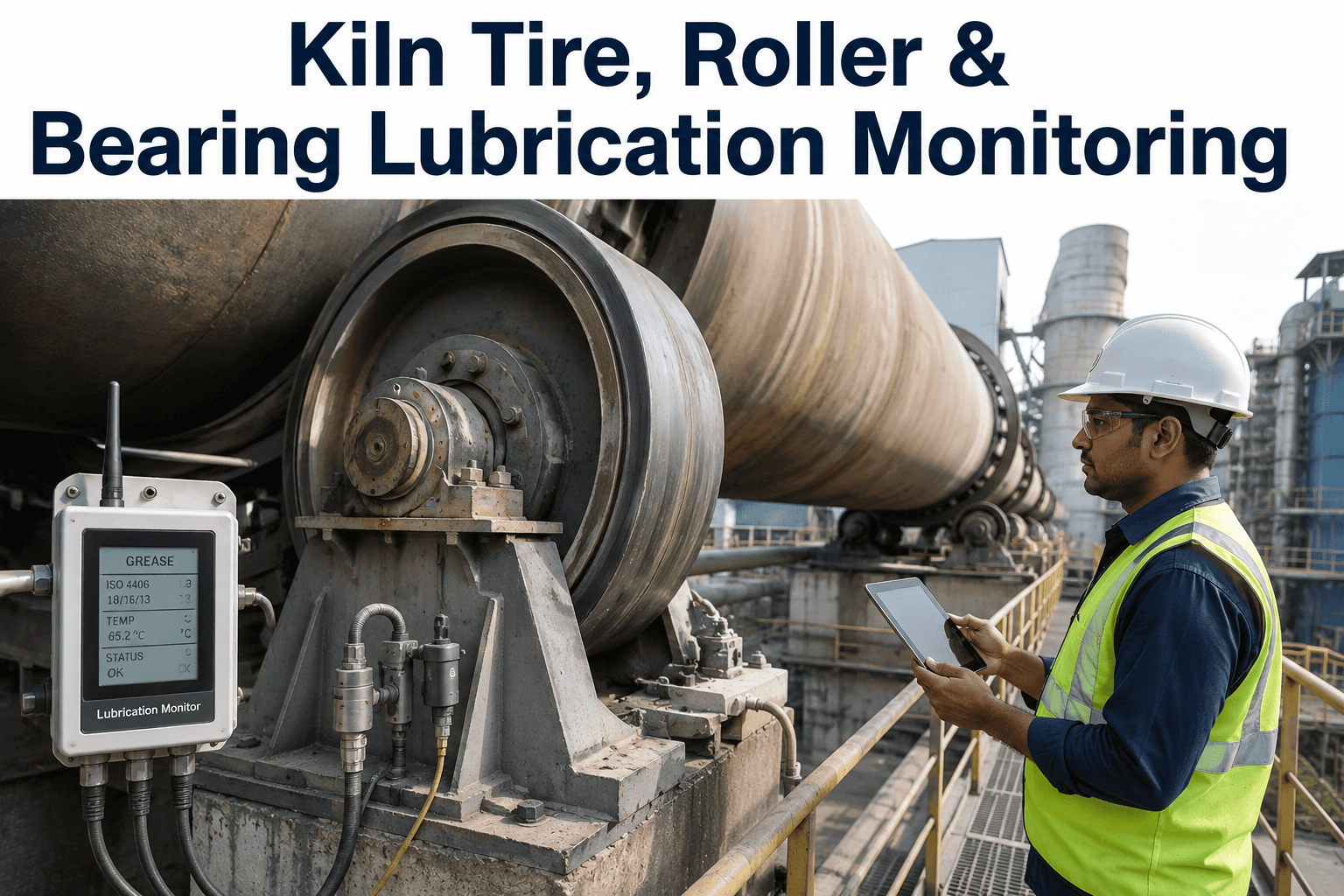
Graphite block or grease application extending beyond its scheduled interval, often during busy production periods, accelerates tire-to-shell seat wear and increases shell stress well before it becomes visible on a routine walk-through.
5
Adjust roller skew incrementally and re-measure
Make skew corrections in small increments and re-check creep trend over several days rather than one large adjustment, since overcorrecting skew can push creep from one problem band directly into the opposite one.
6
Document the adjustment and reset the baseline
Record the corrective action taken, the reading it was made in response to, and the post-adjustment trend for at least a full week, since a station that has just been corrected needs a fresh baseline rather than being compared against pre-adjustment readings going forward.
What Uncorrected Creep Leads To
Tire creep rarely causes damage on its own in the short term, which is exactly why it gets deprioritized. The damage accumulates slowly across the surrounding mechanical system until it surfaces as a much larger, much more expensive failure, and by the time it is visible without instrumentation, the repair scope has usually grown well beyond what a routine adjustment would have addressed. The four consequences below rarely appear in isolation; in most kilns that have gone through an emergency alignment event, two or three of them were developing in parallel by the time the problem finally became visible.
Shifted load geometry across the tire station
Uncorrected creep over months shifts tire position axially on the shell, disrupting the designed load geometry the station was built around and accelerating wear at the contact surface faster than the original engineering anticipated.
Thrust bearing overload and pier damage
Incorrect roller skew driving abnormal creep is a primary contributor to thrust bearing overload, and the resulting mechanical stress on retaining devices and piers compounds with every rotation until a bearing or pier failure forces an emergency stop.
Shell ovality and refractory stress
Shell ovality above roughly 0.3 percent of diameter compounds with tire fit problems, and the added thermomechanical stress on the shell shortens refractory campaign life on top of the mechanical wear already underway at the tire station.
Emergency alignment events instead of scheduled corrections
Kiln misalignment left to develop over six to eighteen months without a structured trending program is a common source of unplanned downtime that can run into six figures, largely because the underlying measurement gap was never closed early enough to plan around. Once a plant has been through one emergency alignment event, the case for continuous trending tends to make itself, but the cost of that first event is exactly what a structured program is designed to avoid.
50mm
Per-Revolution Creep Threshold Commonly Used to Trigger Intervention
0.5°
Roller Skew Level Beyond Which Correction Is Typically Required
0.3%
Shell Ovality as a Share of Diameter Considered a Warning Level
80%
Minimum Roller Face Contact Width to Avoid Edge Loading
60%+
Typical Reduction in Emergency Alignment Events With Structured Trending
6–18
Months Misalignment Can Develop Unnoticed Without Trending in Place
Creep checks used to be a chalk mark and a stopwatch, written into a logbook that nobody looked at again unless something had already gone wrong. We didn't realize how much drift we had missed until we put continuous trending in place and saw a tire station creeping past our threshold weeks before anyone would have caught it on the next scheduled walk-through. Correcting roller skew at that point took an afternoon. Waiting for a bearing temperature alarm would have cost us a week, and our reliability team no longer has to justify a shutdown request with a single spot-check reading, since the trend line makes the case on its own.
Mechanical Reliability Lead
5,400 TPD Cement Line — South India
Frequently Asked Questions
QIs tire creep always a bad sign, or is some amount of it normal and expected?
Some amount of creep is not just normal, it is a designed-in requirement. Tires are manufactured with a larger inside diameter than the shell's outside diameter specifically to accommodate the shell expanding faster than the tire during heating, and forward and reverse cycling within the established healthy band actually indicates a correctly fitted tire and correctly set roller skew. The problem only starts when creep is absent, when it is too low during heat-up, or when it consistently exceeds the intervention threshold.
Book a demo to see your creep trend against a healthy baseline.
QWhat happens if creep is too low or missing entirely during heat-up?
If measurable relative movement is not established during heating, the heating-up process needs to be slowed down or interrupted, because the shell's expansion is being restricted by the tire rather than accommodated by it. If the temperature difference between shell and tire exceeds the tire's specific designed maximum while this restriction continues, the shell below can be plastically deformed, which is a far more expensive problem than the delay caused by slowing the heat-up schedule to allow proper creep to establish.
QHow is roller skew related to tire creep, and which should we check first?
Roller skew controls the axial migration force on the kiln, which directly influences how the tire moves relative to the shell over time. Because incorrect skew, whether too aggressive or set in the wrong direction, is a primary driver of abnormal tire wear and thrust bearing overload, it is usually worth checking roller skew before assuming the problem is a tire-shell fit issue, since a skew correction is often simpler to make and can resolve creep drift without any change to the tire itself.
QCan tire creep be measured accurately without a permanently installed sensor system?
Yes, manual measurement remains a valid method for regular spot checks. Marking the tire and the shell filler bar at the same circumferential position and measuring how far the marks separate over a defined number of rotations gives a direct reading of the fit between the shell and the tire, and this check typically takes under five minutes to perform. The trade-off is that manual readings are single data points, so they can miss short-term spikes or slow drift that only becomes visible when readings are trended continuously over time. Once a manual reading crosses into a concerning range, the appropriate follow-up depends on what a closer check turns up: a roller skew adjustment is usually the fastest fix when the pattern points to axial thrust, while a genuine tire-shell fit problem may need a longer intervention such as shimming.
QWhat's the real cost of ignoring a slow creep drift instead of correcting it early?
The cost compounds well beyond the tire itself. Uncorrected creep shifts tire position axially over months, disrupting load geometry and accelerating wear, while the associated thrust load imbalance and shell ovality add thermomechanical stress that shortens refractory campaign life on top of the mechanical damage. Kiln misalignment problems left to develop over six to eighteen months without structured trending are a well-documented source of unplanned downtime, with costs that can run well into six figures once an emergency stop becomes necessary.
Talk to an expert about setting up trending for your tire stations.
Catch Creep Drift Before It Reaches the Intervention Threshold
iFactory tracks tire creep, roller skew, and contact pattern continuously across every tire station, turning a chalk-mark spot check into a trend line that flags problems weeks before an emergency stop does. Setup starts with your existing readings, so there is no need to wait for a sensor retrofit before getting a clearer picture of where each station stands today.
Continuous Creep Trending
Roller Skew Monitoring
Contact Pattern Tracking
Early Intervention Alerts