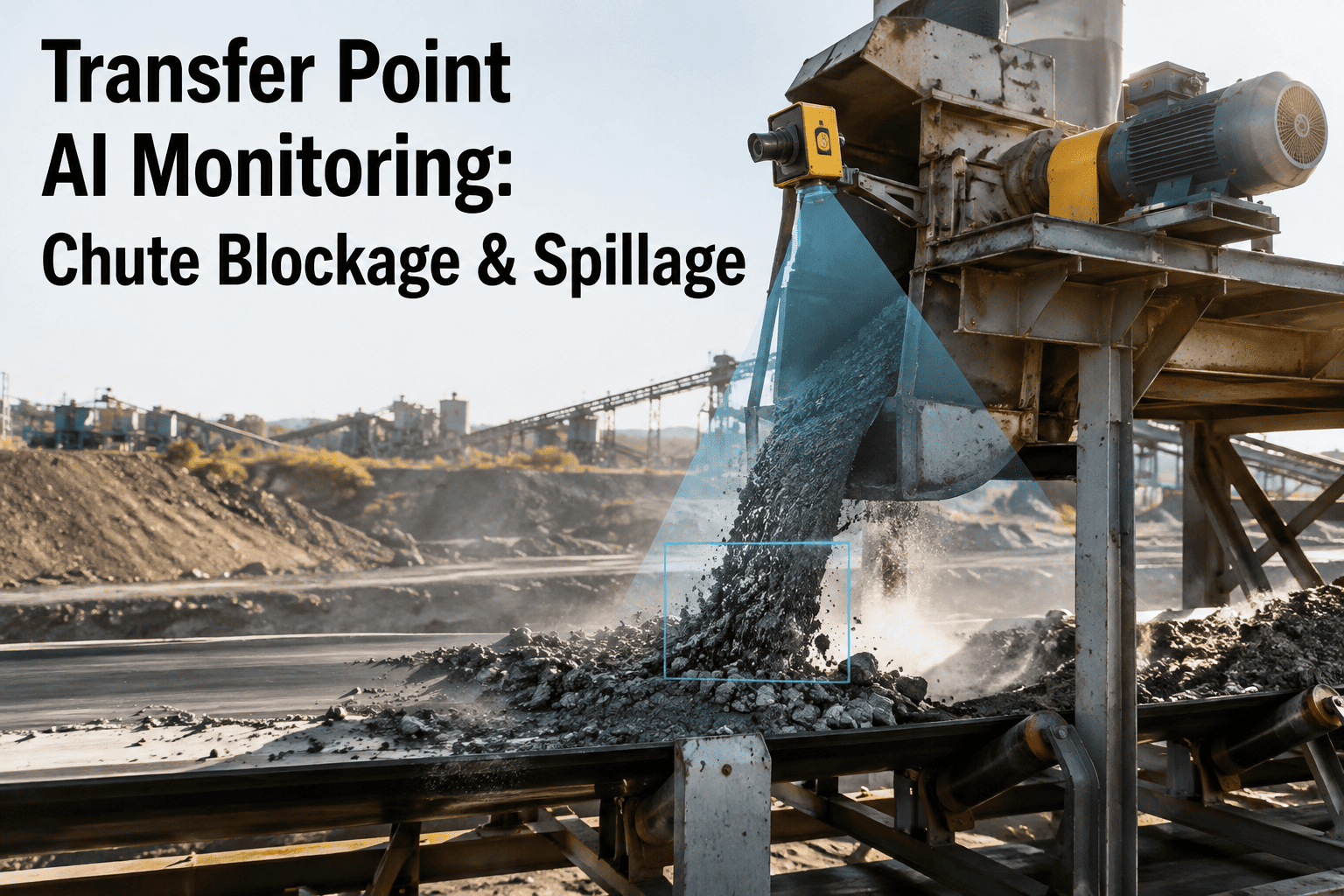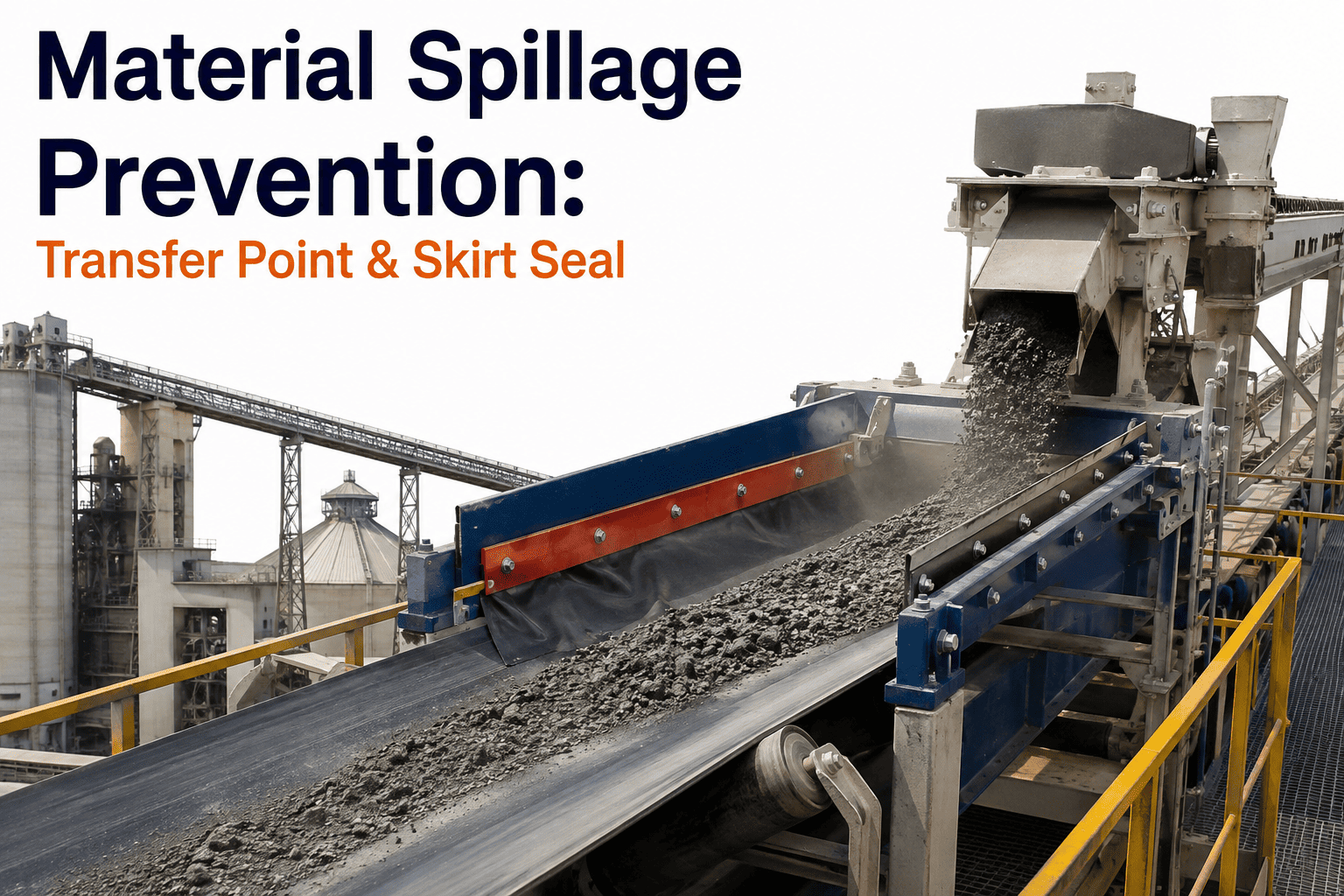
A cement plant running a single 1,200 mm belt at a poorly sealed transfer point can lose several tons of raw meal or clinker a day to spillage, and every ton on the ground is a ton someone has to shovel, sweep, or vacuum back into the process. The bigger cost rarely shows up on the maintenance report at all: idlers buried under fines wear out early, walkways turn into slip hazards, and housekeeping crews spend hours on cleanup that could go toward actual reliability work. Most of this is preventable with the right combination of skirt seal design, chute geometry, and belt cleaner maintenance, and a transfer point audit is usually the fastest way to find out where a specific plant is losing material.
Stop Feeding Material Onto the Floor at Every Transfer Point
Skirt seal selection, chute settling zone design, and belt cleaner tuning that keep material on the belt instead of under it, mapped against the transfer points actually driving your cleanup hours. Most plants find that two or three transfer points account for the majority of the spillage volume on the whole conveyor network, which means a targeted retrofit budget usually goes further than a plant-wide sweep.
What Spillage Actually Costs a Cement Plant
Spillage rarely gets tracked as its own line item, which is exactly why it stays unmanaged for years while cleanup labor, material loss, and premature component wear quietly add up in the background. Once a plant actually assigns a dollar figure to each of these categories, spillage tends to move from a housekeeping annoyance to a line item worth budgeting for.
of throughput commonly lost to spillage at poorly sealed transfer points on a conveyor system
per shift a housekeeping crew can spend shoveling and vacuuming fines at a plant with chronic spillage
faster idler bearing wear when fines are packed into the roller housings under a leaking skirtboard
typical payback period on a properly specified skirt seal and chute retrofit at a high-traffic transfer point
The Anatomy of a Transfer Point That Doesn't Leak
A transfer point is a system of five components working together, and a weakness in any single one undoes the other four. Most spillage complaints trace back to one specific component rather than the whole assembly.
Loading chute and headbox
Directs material from the discharge point onto the receiving belt. Chute angle and centering determine whether material lands in the middle of the belt or drifts toward one edge before it even reaches the skirtboard, and a poorly shaped headbox can send material bouncing hard enough to escape containment on the very first impact.
Impact bed or idlers
Absorbs the shock of falling material so the belt doesn't bounce or sag under the load. A worn or missing impact bed lets the belt flex away from the skirt seal exactly where sealing matters most, and the sag often shows up first as accelerated wear on the seal strip directly above the weak support.
Skirtboard and seal strip
The primary containment surface running along both edges of the belt through the loading and settling zones, holding material on the belt until it stabilizes into its running profile. Seal contact pressure needs to be firm enough to hold fines back without dragging hard enough to gouge the belt cover.
Settling zone
The length of skirted belt after the impact zone where turbulent, freshly loaded material settles into a stable center-of-belt profile before the skirting ends and the belt runs open. This distance scales with belt speed, so a plant that has sped up its conveyors since the original design will often need a longer settling zone than what was installed.
Dust curtain and cover
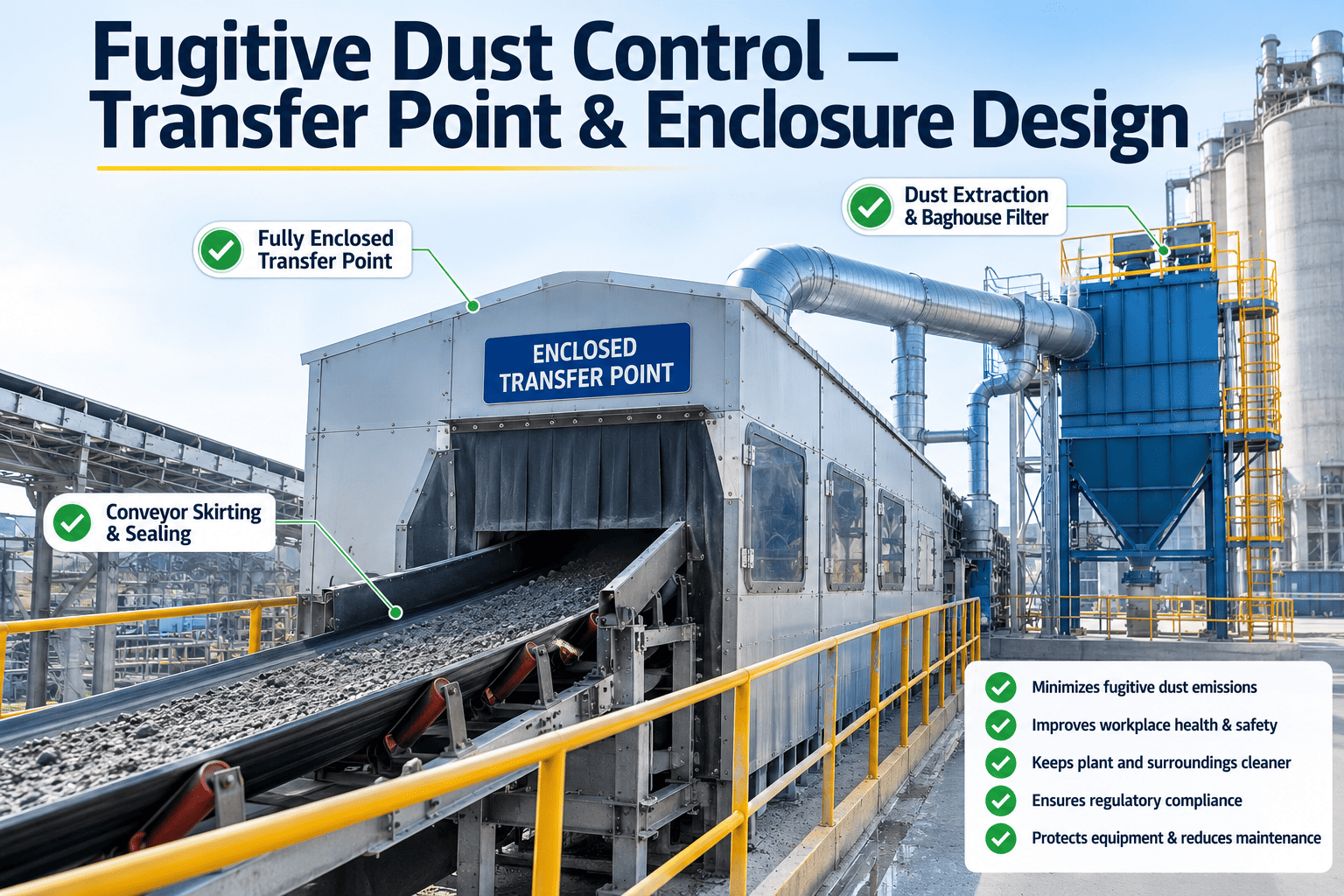
Contains the airborne fines displaced by falling material, preventing fugitive dust from settling on walkways and structural steel around the transfer point. A missing or torn curtain often shows up first as visible dust haze rather than material on the floor, making it an easy problem to miss during a quick walk-through.
Six Root Causes Behind Most Spillage Complaints
Operators tend to describe spillage as one problem, but it almost always traces back to one of these six specific failure points once someone actually inspects the transfer point.
Worn or hardened seal strip
Rubber seal material hardens and loses contact pressure over months of service, opening a gap along the belt edge that widens as the belt runs. Heat and abrasive dust both accelerate the process, which is why seal life at a cement plant is usually shorter than the manufacturer's general-purpose rating.
Undersized settling zone
Skirting that ends before material has settled leaves the belt still carrying a turbulent, uneven load right as it exits containment, so material spills right at the point where protection stops rather than further down the belt.
Belt mistracking
A belt running off-center pulls one edge away from its skirt seal while pressing the other edge too hard against the opposite seal, wearing out one side of the seal set far faster than the other and hiding the real cause behind what looks like a seal quality issue.
Poor chute centering
Material loaded off-center or at too steep an angle creates uneven belt loading before it ever reaches the skirtboard, so no amount of seal adjustment downstream can fully compensate for a badly aimed loading stream.
Skirtboard clamping wear
Clamp bars that have loosened or corroded allow the seal strip to vibrate away from the belt surface under normal operating load, a failure mode that is easy to miss visually since the seal strip itself can still look serviceable.
Belt cleaner neglect
A dull or missing primary cleaner leaves carryback material on the belt's return side, which then falls off at pulleys and idlers downstream, often creating a spillage pattern that gets misattributed to a transfer point nowhere near the actual source.
Choosing a Skirt Seal Type for the Application
Not every skirt seal fits every material or belt speed. The wrong seal type on an abrasive, high-speed application will wear out in weeks regardless of how well it was installed.
Find the Transfer Points Costing You the Most
iFactory maps spillage, cleanup hours, and belt cleaner condition against your actual conveyor network so the retrofit budget goes to the transfer points driving the most loss.
Five Design Principles for a Chute That Doesn't Cause Spillage Downstream
Chute geometry decided during original construction is often the actual root cause of a spillage problem that only shows up years later as skirt seal wear.
Match the loading angle to belt speed
Material should land moving in the same direction and at close to the same speed as the belt, reducing the impact and bounce that pushes fines past the seal. A steep drop onto a fast belt is one of the most common design mistakes found during a retrofit review.
Center the stream on the belt
An off-center chute loads one side of the belt heavier than the other, which is one of the most common and most overlooked causes of chronic edge spillage since the imbalance is often invisible from ground level.
Size the settling zone to belt speed
Faster belts need a longer skirted section for material to stabilize before the skirting ends, a dimension that is frequently undersized on retrofitted lines.
Support the belt through the impact zone
Impact idlers or an impact bed keep the belt flat against the skirt seal directly under the falling load, where sag is most likely to open a gap.
Seal the chute itself, not just the skirtboard
Gaps around the chute liner plates let dust escape before material even reaches the belt, undermining an otherwise well-sealed skirtboard downstream.
Belt Cleaner Maintenance: Where Carryback Turns Into Spillage
A transfer point can be perfectly sealed and still generate a mess further down the line if carryback material on the belt's return side isn't being cleaned off before the tail pulley.
Blade material matters as much as position. Polyurethane blades work well on lower-abrasion material and moderate belt speeds, while tungsten carbide-tipped blades hold an edge far longer against clinker and raw meal but cost more per set. Matching blade material to the specific material stream, rather than defaulting to whatever the original installer used, is usually the fastest way to cut carryback-related spillage without changing anything else about the transfer point.
Where the Cost of Spillage Actually Shows Up
None of these costs appear on a single line item, which is why spillage tends to get treated as a housekeeping nuisance rather than a reliability and safety issue with a real dollar figure attached.
Cleanup labor
Recurring shift hours spent shoveling and vacuuming fines that a properly sealed transfer point would never have dropped in the first place.
Material loss
Product on the floor is product that never reaches the kiln or the bag, a direct throughput loss that compounds across every hour of operation.
Component wear
Fines packed into idler housings and pulley bearings shorten component life well below its rated service interval.
Safety exposure
Spilled material on walkways and stairs around a transfer point is a recurring slip and trip hazard flagged in most plant safety audits.
Transfer Point Inspection Checklist
Seal strip checked for hardening, cracking, or gaps along the full length of the skirtboard
Settling zone length confirmed against current belt speed, not the original design speed
Belt tracking verified through the transfer point under loaded running conditions
Chute liner plates and dust curtain checked for gaps allowing airborne fines to escape
Primary, secondary, and tertiary belt cleaners inspected for blade wear and tension
Impact bed or impact idlers confirmed intact and properly supporting the belt under load
A Reliability Engineer's View on Chronic Spillage
We had a housekeeping crew treating one transfer point as a permanent fixture on their daily route, shoveling the same pile every shift for years. Once we actually measured the settling zone against our belt speed, it turned out to be almost a meter short of what it needed to be. Extending it and replacing the seal strip took that transfer point off the daily cleanup list entirely.
Frequently Asked Questions
How often should skirt seal strips be replaced?
Most rubber seal strips need replacement somewhere between three and twelve months depending on material abrasiveness, belt speed, and seal type, with single-durometer rubber wearing fastest and dual-durometer or UHMW-insert designs lasting considerably longer under the same conditions. The more reliable trigger than a calendar date is a visual gap check, since a hardened strip can still look intact while no longer maintaining contact pressure against the belt. Tracking wear against actual spillage incidents rather than a fixed interval usually produces a more accurate replacement schedule.
What is the right length for a settling zone?
Settling zone length depends on belt speed, with faster belts needing more skirted distance for freshly loaded material to stabilize into a stable running profile before the skirting ends. A zone sized for the original design speed can become undersized after a drive upgrade or capacity increase, which is one of the most common causes of spillage on lines that have been running fine for years and suddenly start losing material. A transfer point review can confirm whether current skirting length still matches actual operating speed.
Can belt mistracking cause spillage even with a good seal?
Yes, and it is one of the most frequently misdiagnosed causes of spillage. A belt that has drifted off-center presses too hard against one seal while pulling away from the other, so the seal itself can be in good condition and still fail to contain material because the belt is no longer running where it was designed to sit. Correcting the tracking issue at its source, whether that is a misaligned idler or an uneven load, usually resolves the spillage faster than repeatedly replacing the seal strip.
Does chute design really matter if the skirt seal is good?
Chute geometry sets the conditions the skirt seal then has to manage, so a poorly centered or steeply angled chute can overwhelm even a well-specified seal by loading the belt unevenly before it reaches the skirtboard. Matching the loading angle and material stream velocity to the belt reduces the bounce and turbulence that pushes fines past the seal in the first place, which is why chute geometry is usually reviewed alongside skirt seal selection rather than treated as a separate problem.
How does belt cleaner condition connect to spillage downstream?
Carryback material left on the belt's return side by a worn or missing primary cleaner eventually falls off at the tail pulley or return idlers, creating spillage well away from the original transfer point and making the source harder to trace. Checking primary, secondary, and tertiary cleaner condition as part of a transfer point inspection often explains spillage that inspectors initially assumed was coming from the skirtboard itself. Talk to a specialist about building belt cleaner checks into a standard conveyor inspection route.
Get a Transfer Point Audit for Your Conveyor Network
Book a 30-minute call and bring your worst spillage points. iFactory will show you which transfer points to fix first and what seal, chute, and cleaner changes will actually stop the losses.