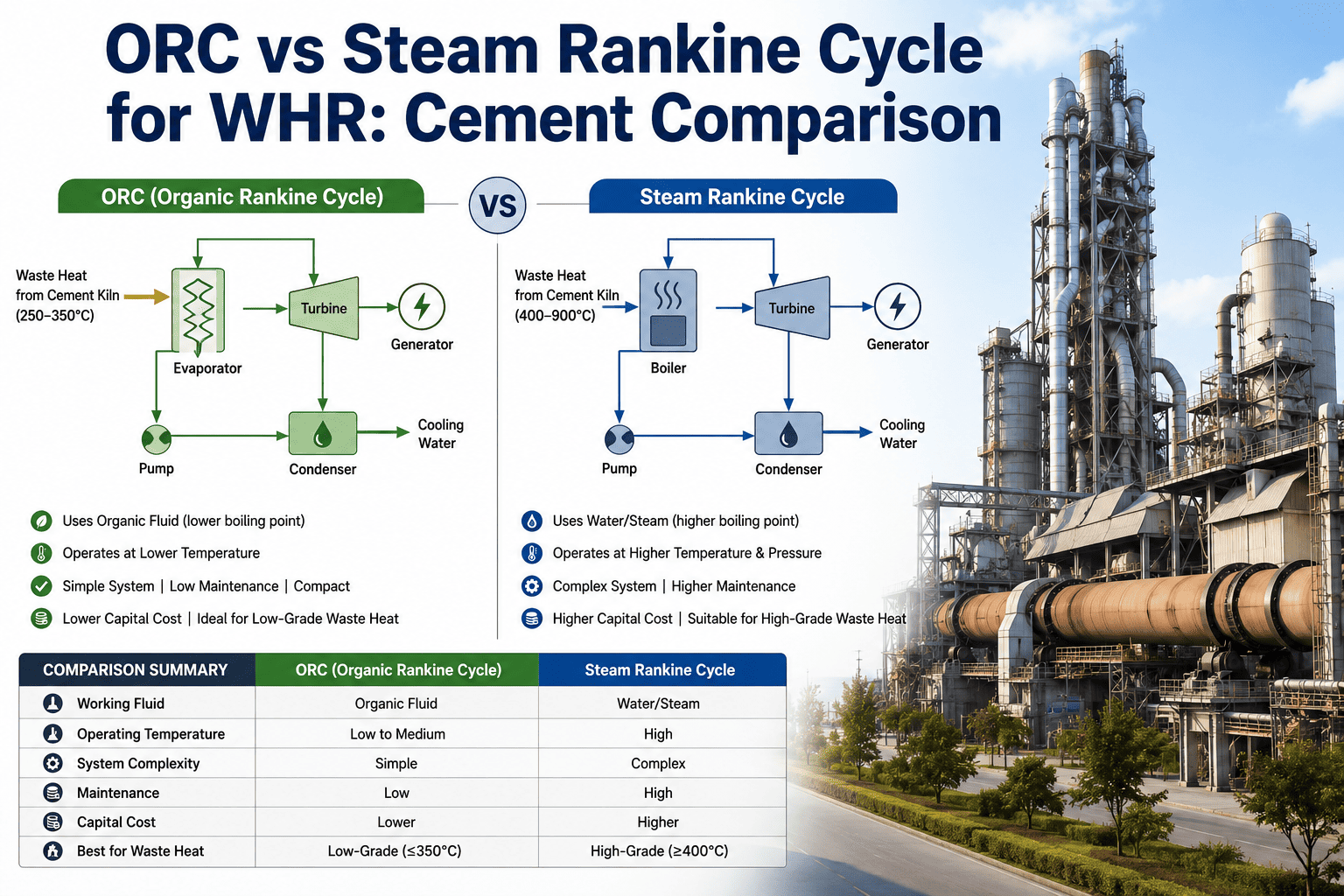
Every waste heat recovery project at a cement plant eventually comes down to one engineering decision that shapes everything after it: organic Rankine cycle or steam Rankine cycle. The two technologies pull power from the same preheater exhaust and clinker cooler air, but they do it with different working fluids, different equipment, and different economics, and picking the wrong one for a plant's actual exhaust gas temperature profile can leave a meaningful share of recoverable megawatts on the table for the next twenty years. This comparison walks through where each cycle wins on efficiency, capital cost, water use, and maintenance load, and a working session with our team can map the comparison against your own kiln's exhaust data.
Cement WHR · Technology Selection
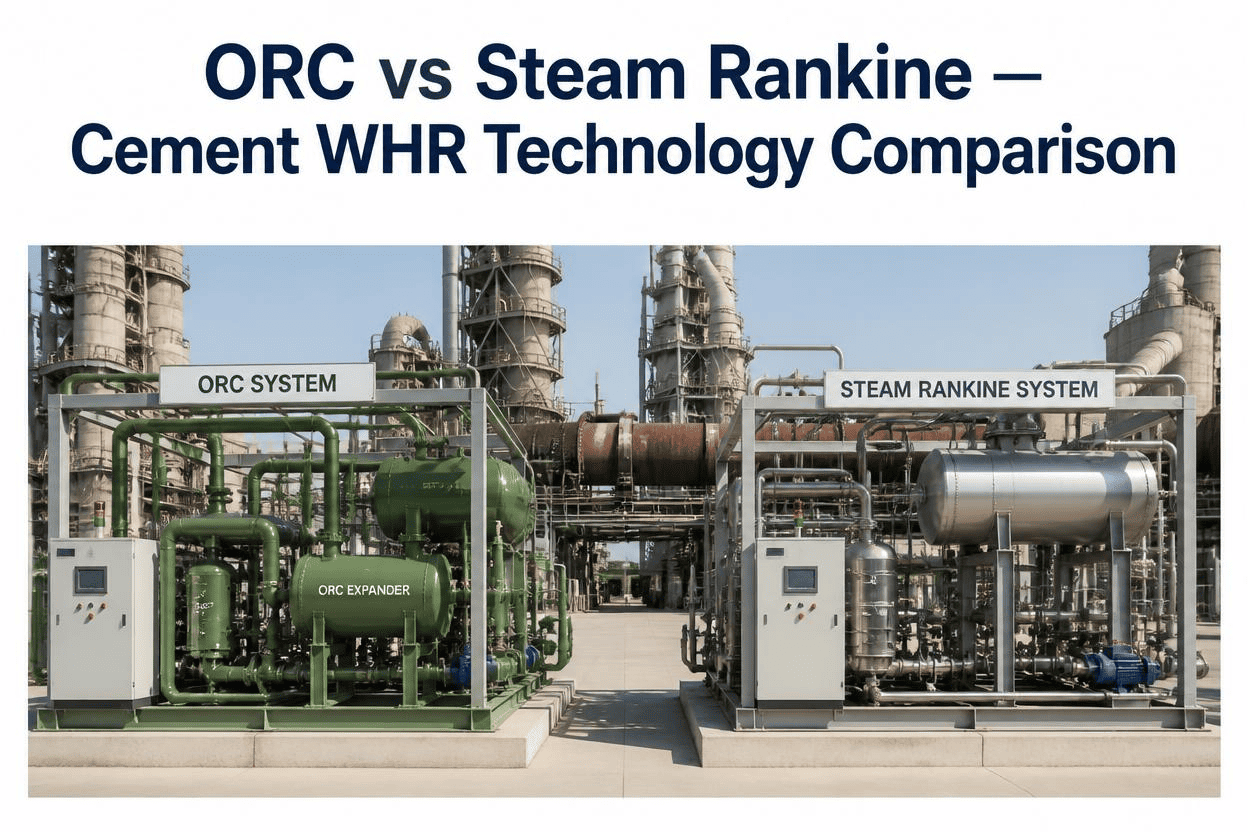
ORC vs Steam Rankine Cycle for Cement Plant Waste Heat Recovery
A side-by-side comparison of efficiency, capital cost, water demand, and maintenance load between organic Rankine cycle and steam Rankine cycle systems, built around the exhaust gas temperatures that actually decide which one performs better on your kiln line.
310°C
approximate crossover point where SRC starts outperforming ORC
14-30 mo
typical ORC payback window on retrofit projects
~40%
share of cement WHR installs worldwide already running ORC
Why This Decision Is Harder Than It Looks
Two Technologies, Same Exhaust Stream, Very Different Answers
A cement kiln line typically loses somewhere between a third and forty percent of its process heat through preheater exhaust and clinker cooler vent air, and both organic Rankine cycle and steam Rankine cycle systems exist to turn that lost heat into usable electricity. The confusion starts because vendors on either side tend to present their technology as the universal answer, when the research and the installed base both point to something more specific: the right choice depends heavily on the actual temperature of the exhaust gas available at your plant, the total power output you are targeting, and how much capital and O&M budget you have to work with. A plant with a hot, high-volume preheater exhaust well above 350°C is looking at a very different economic case than a plant whose recoverable heat sits mostly in the 180-250°C range from clinker cooler tertiary air. Getting the technology match wrong doesn't just mean a slightly lower efficiency number on paper, it means years of a turbine running well outside its designed sweet spot, quietly leaving recoverable megawatts unclaimed on every production run for the life of the asset.
Temperature Is the First Filter
Where Exhaust Gas Temperature Tips the Decision Toward ORC or Steam
Published thermodynamic comparisons on cement and similar heavy-industry waste streams converge on a rough dividing line: below roughly 310°C, the organic Rankine cycle tends to extract more usable power from the same waste heat because its working fluid vaporizes efficiently at lower temperatures and pressures. Above that threshold, and especially once exhaust climbs past 400°C, a conventional steam turbine starts to pull ahead because steam handles high-temperature, high-pressure conditions more efficiently than most organic fluids can tolerate. Very few cement plants sit neatly on one side of that line for their entire waste heat profile, which is exactly why the temperature zone your specific streams fall into should be the starting filter before capital cost or maintenance even enters the conversation.
Side-By-Side Comparison
ORC and Steam Rankine Cycle Across the Factors That Actually Drive Selection
Temperature sets the initial direction, but the full technology decision runs through several more factors that interact with each other, from how much water your site has available to how large a maintenance team you can dedicate to turbine upkeep. The table below lines up the two technologies against the criteria that most cement operators end up weighing during a WHR feasibility study.
| Factor | Organic Rankine Cycle (ORC) | Steam Rankine Cycle (SRC) |
|---|---|---|
| Ideal exhaust temperature | Roughly 150°C to 310°C | Above 310°C, strongest beyond 400°C |
| Net thermal efficiency | Lower in absolute terms, but higher within its temperature band | Can exceed 40% at high temperature and large scale |
| Working fluid | Organic fluid such as pentane isomers, closed loop, no boiler water | Water/steam, requires feedwater treatment |
| Water requirement | Minimal to none for the power cycle itself | Ongoing boiler feedwater and condenser cooling needs |
| Typical capital cost profile | Moderate, scales well for small and mid-size output | Higher upfront, more economical at large output |
| Typical payback window | Around 14 to 30 months on retrofit projects | Around 36 to 42 months on greenfield installs |
| Maintenance complexity | Fewer moving parts, more automated cycle control | More complex, water chemistry and feedwater upkeep |
| Best-fit plant scale | Small to mid-size lines, lower-grade heat streams | Large lines with high-volume, high-temperature exhaust |
Not Sure Which Side of the Line Your Kiln Falls On
A short technology review walks through your plant's actual preheater and clinker cooler exhaust data against both cycle types, so the decision is based on your numbers instead of a generic rule of thumb.
What Actually Changes Inside the Equipment
Working Fluid Is the Real Source of Every Other Difference on This Page
Every operational difference between these two technologies traces back to one design choice: what fluid carries the heat through the turbine. Steam Rankine systems pump water to high pressure, boil it into steam using the waste heat boiler, expand that steam through a turbine, and condense it back to water to repeat the cycle, which means the plant is managing feedwater chemistry, deaeration, and condenser cooling water for the life of the system. Organic Rankine systems replace water with an organic working fluid, commonly a pentane isomer or similar low-boiling-point compound, that vaporizes at much lower temperatures and pressures than water does. That single substitution is why ORC units run as sealed, closed-loop systems with no water treatment plant attached, why they tolerate partial loads and cycling exhaust temperatures more gracefully, and why they extract more usable power than steam does from waste heat streams under roughly 310°C where water simply won't generate enough vapor pressure to spin a turbine efficiently.
Steam Rankine Cycle
Water/steam working fluid, requires feedwater treatment, deaerator, and condenser cooling water; well proven at scale on large, hot exhaust streams.
Organic Rankine Cycle
Closed-loop organic fluid such as pentane or cyclopentane, no water treatment needed, vaporizes efficiently at lower temperatures and pressures.
Combined S-ORC
Cascades a steam stage and an organic stage together to capture both the high and low temperature bands from the same exhaust source.
Maintenance and Operating Load
What Your Team Is Actually Signing Up to Maintain
Capital cost gets most of the attention in a feasibility study, but the maintenance workload each technology puts on your team over a twenty-year asset life is just as consequential for total cost of ownership. Both technologies face the same enemy in cement dust fouling the heat exchanger tubes, but from there the maintenance profiles diverge fairly sharply based on how many moving parts and support systems each cycle depends on.
Boiler Tube Fouling
Cement dust accumulates on heat exchanger surfaces in both systems, reducing heat transfer until soot-blowing or cleaning restores it. Affects ORC and SRC roughly equally.
Water Chemistry Management
Steam systems need ongoing feedwater treatment, blowdown control, and corrosion monitoring. ORC systems skip this entirely since there is no boiler water loop.
Turbine Inspection Interval
Steam turbines generally need more frequent blade, bearing, and seal inspection given higher operating pressures and moisture carry-over risk from the steam cycle.
Working Fluid Monitoring
ORC systems require periodic checks of organic fluid inventory, purity, and thermal stability, since fluid degradation directly affects long-term cycle efficiency.
A Third Option Worth Knowing
Combined Steam-Organic Cycles Are Closing the Either-Or Debate
Comparative studies on cement plant waste heat have started testing a combined steam-organic Rankine cycle configuration, where the hot end of the exhaust stream drives a steam stage and the cooler downstream heat is then captured by an organic stage in cascade. Research on white cement applications found this combined configuration outperforming a standalone steam Rankine cycle by a wide margin in total power generation, because it captures usable energy across both the high and low temperature bands from the same exhaust source instead of forcing one technology to cover the entire range. This hybrid approach adds equipment complexity and capital cost compared to a single-technology system, so it tends to make the most sense on larger lines with a wide exhaust temperature spread, where neither ORC nor SRC alone is capturing the full recoverable heat on its own. For operators weighing the extra equipment against the power gain, the deciding question usually comes down to whether the exhaust profile actually spans both temperature bands in meaningful volume, since a narrow, single-band profile rarely justifies the added complexity of running two turbine trains instead of one.
Applied Example
How Two Similar-Looking Plants Landed on Opposite Technologies
Picture two cement lines of comparable clinker capacity evaluating WHR in the same feasibility cycle. The first plant runs an older, less efficient preheater tower, so its exhaust gas leaves at a relatively high temperature with a large volume of hot air also available from the clinker cooler's hottest zone. Once its engineering team modeled both technologies against that hotter, high-volume stream, a steam Rankine system came out ahead on total megawatts recovered, even with the larger upfront cost and the added feedwater treatment package, because the higher-temperature exhaust let the steam cycle run near its efficiency ceiling. The second plant runs a newer, more efficient preheater that already extracts more heat upstream, leaving a cooler, lower-volume exhaust stream in the 220°C to 260°C range. For that plant, an ORC system produced more usable power per dollar of capital and came with a materially faster payback, since the organic fluid's lower vaporization point matched the available heat far better than a steam cycle would have. Same general plant type, same feasibility process, opposite technology outcome, driven almost entirely by the exhaust temperature each one actually had to work with.
Before You Commission a Feasibility Study
What to Have Ready Before Comparing ORC and Steam Rankine Options
Walking into a technology comparison with this information already gathered turns a multi-month feasibility study into a much faster, sharper decision.
| Question | Why It Matters |
|---|---|
| What is the measured exhaust temperature at the preheater and AQC over a full production cycle? | Determines which side of the ORC/SRC crossover zone your plant sits on |
| How much water is reliably available on site year-round? | Steam systems need consistent feedwater and cooling water access |
| What total power output is the project targeting? | Larger targets shift the economics toward steam or a hybrid system |
| How much variation exists in exhaust temperature between kiln states? | ORC systems generally tolerate load and temperature swings better |
| What maintenance staffing and turbine expertise already exists on site? | Shapes which technology's ongoing O&M load your team can realistically absorb |
Common Questions
ORC vs Steam Rankine Cycle — Frequently Asked
These are the questions cement plant engineering and energy teams tend to raise first when a WHR feasibility study reaches the technology selection stage.
Is ORC always cheaper than a steam Rankine system?
Not always, though ORC tends to have a moderate capital cost that scales well for small and mid-size power output, which is a large part of why it dominates the smaller end of the cement WHR market. Steam Rankine systems carry a higher upfront cost but become more capital-efficient per megawatt as the target output grows, since the fixed cost of a large boiler and turbine train spreads across more generation capacity. The honest comparison has to be run against your specific target output and exhaust profile rather than assumed from general market pricing. Book a review to see the capital comparison modeled against your plant's numbers.
Can a cement plant run both ORC and steam Rankine at the same site?
Yes, and a growing number of installations do exactly this by routing the hottest exhaust segment through a steam stage and the cooler downstream heat through an organic stage in a combined configuration. Research on this cascaded approach has shown it capturing meaningfully more total power than a single steam cycle covering the full temperature range on its own. It adds complexity and cost compared to a single-technology system, so it tends to make sense mainly on larger lines with a wide temperature spread across their waste heat sources. Contact our team to talk through whether a hybrid setup fits your exhaust profile.
Why does water availability matter so much for this decision?
Steam Rankine systems depend on a continuous supply of treated feedwater and cooling water to keep the boiler-condenser loop running, and in water-scarce regions that requirement alone can rule the technology out or force costly water treatment and recycling infrastructure into the project. Organic Rankine systems run as a sealed loop with an organic fluid instead of water, so the power cycle itself needs little to no ongoing water input, which is a major reason ORC has become the default choice for plants in arid regions or locations with limited water rights. This factor alone has decided several technology selections independent of the temperature and efficiency numbers. Book a demo to review your site's water constraints against both options.
Does exhaust gas variability affect which technology performs better?
It does, and it is one of the more overlooked factors in a straight efficiency comparison. Kiln operations rarely hold a perfectly steady exhaust temperature, since kiln upsets, alternative fuel substitution, and production rate changes all shift the available heat throughout the day, and organic Rankine systems generally handle that kind of partial-load cycling and temperature swing more gracefully than steam turbines do. A plant with a highly stable, consistently hot exhaust profile is a stronger candidate for steam, while a plant with more variable operating conditions often gets more consistent output from an ORC system across the full range of kiln states. Ask our team about modeling your plant's actual exhaust variability.
How does ongoing monitoring differ between the two technologies once installed?
Steam systems need continuous tracking of feedwater chemistry, steam quality, and superheat levels to protect the turbine from moisture carry-over, alongside the fouling monitoring that both technologies share. Organic Rankine systems shift that monitoring focus toward working fluid inventory, purity, and thermal stability instead, since fluid degradation over time is the main long-term efficiency risk unique to ORC. Either way, the heat exchanger fouling from cement dust remains the most immediate and frequent maintenance driver on both sides of this comparison. Book a session to see how digital monitoring covers both technology paths.
Get a Technology Recommendation Built Around Your Exhaust Data
iFactory reviews your kiln's actual preheater and clinker cooler exhaust temperatures against both ORC and steam Rankine performance models, then tracks whichever system you install against fouling, efficiency drift, and output targets once it's running.