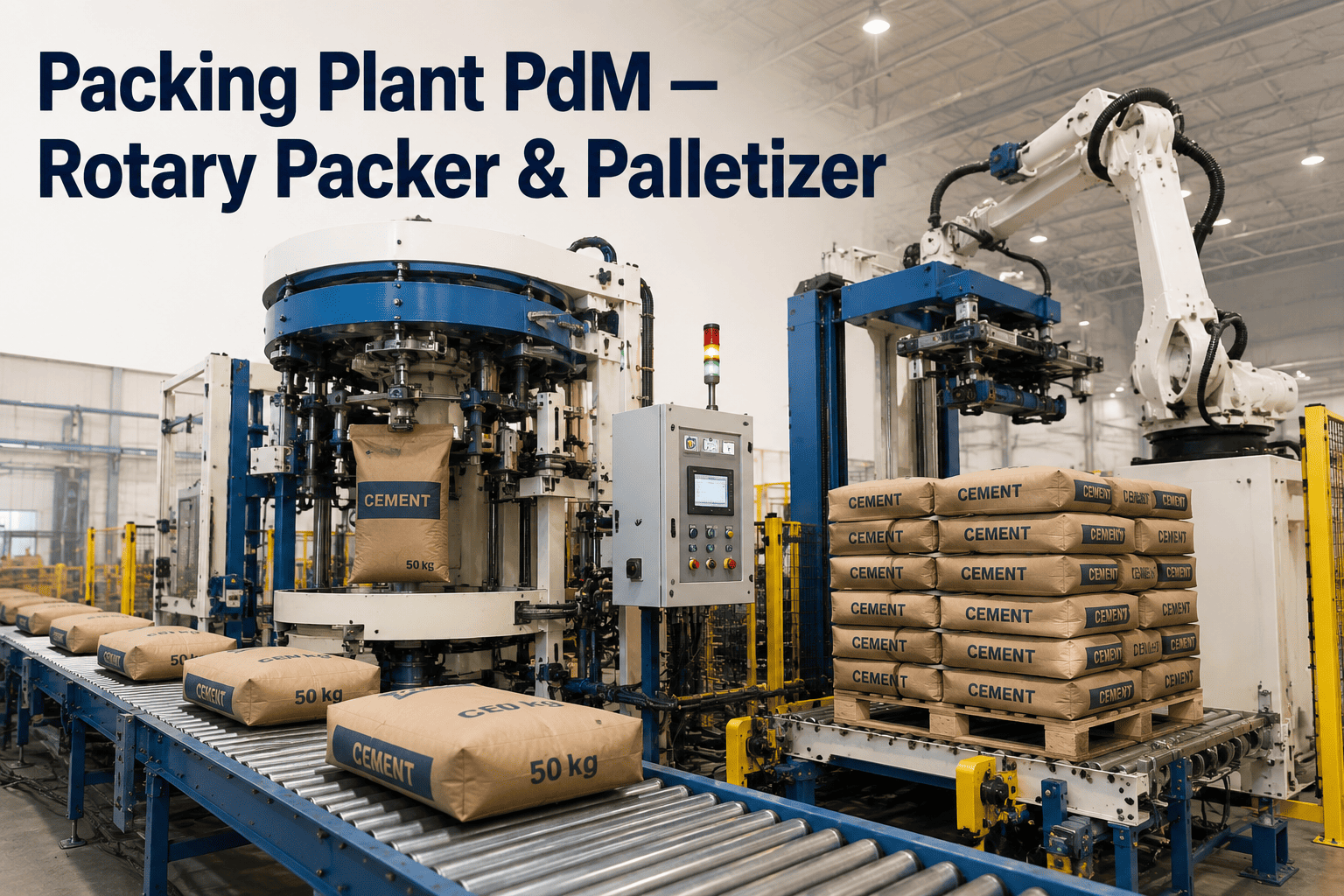
Cement packing plants are the final revenue gateway where every bag leaving the line is a sold product and every minute of downtime creates a logistics bottleneck that ripples through truck scheduling and customer delivery. A single rotary packer handles 2,000 to 10,000 bags per hour, and when it stops, the entire dispatch chain backs up within hours. Most packing plants still run on reactive maintenance, fixing packer impellers, palletizer servos, and bag placer cylinders only after they fail mid-shift and halt the line. Predictive maintenance changes this equation by monitoring vibration, temperature, and cycle time deviations to catch degradation days before it becomes a shutdown. Book a demo to see how iFactory monitors your entire packing line in real time.
Cement Packing Plant Intelligence
Your Packing Line Loses 22% of Capacity to Failures That Were Predictable Days Ago
Rotary packers, bag placers, palletizers, and truck loaders run at extreme cycle speeds. PdM catches the degradation that turns a $200 fix into a $50,000 dispatch penalty.
40%
Downtime Is Unplanned
12 hr
Monthly Unplanned Stops
Sources: FL Smidth Packing Systems Report, VDZ Cement Plant Benchmark, Siemens Industry Data
The 4 Machines That Control Your Cement Dispatch Rate
A packing line is a connected chain where the slowest or most unreliable machine sets the pace for everything downstream. When any link fails, the entire line stops and trucks queue at the gate. Understanding the failure profile of each machine is the first step toward building a predictive program that protects dispatch availability.
01
Rotary Packer
2,000-10,000 bags/hr
Impeller wear and erosion
Weighing system drift
Spout valve seat leakage
Critical
02
Bag Placer
Matches packer output
Vacuum cup degradation
Bag misalignment
Suction timing drift
High
03
Palletizer
1,000-3,000 bags/hr
Servo motor degradation
Chain and sprocket wear
Layer pattern errors
Critical
04
Truck Loader
50-200 tonnes/hr
Conveyor belt wear
Dust seal failure
Hopper bridge and jam
High
Inside the Rotary Packer: Where Failures Actually Originate
The rotary packer is the most complex and failure-prone machine on any packing line. It combines high-speed rotation, precise weighing, abrasive cement dust, and pneumatic actuation in a single compact unit. Predictive maintenance programs that focus on these four subsystems catch over 90% of packer failures before they stop the line.
Filling Spouts
8-16 per packer
Impeller wear monitoring — Cement abrasion reduces impeller diameter over time, lowering fill speed by 15-25% before operators notice the throughput drop
Nozzle pressure trending — Declining nozzle pressure indicates progressive clogging or erosion that leads to incomplete fills and bag rejection
Valve seat condition — Micro-leaks at valve seats cause weight drift and dust emission, detectable through fill time deviation analysis
Flow rate deviation — AI tracks fill time per spout against baseline, flagging any spout deviating more than 5% from group average
Weighing System
Load cells + controller
Load cell drift tracking — Thermal cycling and vibration cause gradual load cell drift that shifts fill weights outside specification, creating regulatory and customer complaints
Vibration interference detection — Packer rotation introduces vibration that degrades weighing accuracy. AI correlates vibration levels with weight precision to trigger isolation maintenance
Calibration interval optimization — Instead of fixed monthly calibrations, PdM data determines actual calibration need, reducing unnecessary stops while preventing out-of-spec fills
Fill accuracy trending — Standard deviation of fill weights across all spouts tracked continuously, with alerts when statistical control limits are approached
Drive and Rotation
Motor + gearbox + bearing
Main bearing vibration — The central rotating bearing carries the entire packer weight plus bag loads. Bearing degradation here is catastrophic and requires weeks of lead time for replacement
Gear reducer condition — Oil analysis and vibration monitoring detect gear wear before tooth failure. Reducer failure on a rotary packer typically requires 5-10 day shutdown for replacement
Motor current signature — MCSA detects rotor bar cracks, stator winding degradation, and air gap eccentricity months before motor failure
Rotation speed consistency — Speed variation between rotations indicates mechanical drag, bearing issues, or variable frequency drive problems
Discharge and Sealing
Chutes + clamps + dust seals
Bag clamp wear — Worn clamps release bags prematurely, causing spills and line stoppage. Cycle count tracking predicts replacement timing accurately
Chute liner abrasion — Cement flow erodes chute liners, creating rough surfaces that snag bags. Thickness monitoring prevents both snagging and liner perforation
Dust seal integrity — Failed dust seals spread cement dust into the packer mechanism, accelerating wear on bearings, electronics, and pneumatic components
Discharge flow rate — Changes in bag discharge timing indicate chute blockage or clamp timing issues that will escalate to jams if unaddressed
The $200-to-$50,000 Failure Cascade in Packing Lines
Every packing line failure starts small. The difference between a $200 scheduled repair and a $50,000 emergency shutdown is purely a matter of timing — whether the degradation was detected early enough to act on or discovered only after it cascaded through the production and logistics chain. This is the escalation pathway that predictive maintenance is designed to interrupt.
Early Detection — Worn Component Identified
Vibration or acoustic monitoring detects bearing degradation on a packer spout during routine data analysis. The component is added to the next planned maintenance window. No production impact. No overtime. No emergency procurement.
Missed — Unplanned 30-Minute Stoppage
Degradation progresses undetected. The bearing seizes mid-shift, jamming the spout and forcing an emergency stop. Maintenance team pulls from other tasks. Replacement part sourced from stores. Line restarts after 30 minutes of lost production.
Escalated — Shift Runs at Reduced Speed
The seized spout cannot be immediately repaired. The packer operates with one spout locked out, reducing output by 6-12% for the remainder of the shift. Downstream machines run below capacity. The shift misses its dispatch target by 80-120 tonnes.
Compounded — Truck Queue and Logistics Backup
Reduced output creates a loading bottleneck. Trucks queue at the plant gate, incurring demurrage charges. Scheduled deliveries to customers are delayed, requiring emergency logistics rescheduling. The morning shift inherits the backlog from the night before.
Catastrophic — Contractual Penalty and Lost Customer
Missed dispatch targets trigger contractual penalties with key distributors. A major customer misses their construction schedule and switches to a competitor for the next order. The total cost includes penalty payments, lost margin on the order, and the unmeasured cost of customer relationship damage.
When Do Packing Line Failures Actually Happen?
Failure patterns in packing plants are not random — they follow predictable patterns tied to shift cycles, equipment fatigue, and environmental conditions. Understanding when failures occur helps maintenance teams stage resources and monitoring intensity to match the actual risk profile of each shift.
Morning Shift (6AM - 2PM)
Afternoon Shift (2PM - 10PM)
Which Packing Machine Is Drifting Toward Failure Right Now?
iFactory connects vibration, acoustic, thermal, and cycle time data from every packing machine — ranking components by failure risk and generating work orders before the cascade begins.
PdM Technology Stack for Each Packing Machine
No single monitoring technology covers every failure mode across the packing line. The most effective programs layer multiple technologies, matching each one to the failure modes it detects best. The grid below shows the coverage strength of each technology for every packing machine — helping you prioritize where to invest first.
High — Primary detection method
Medium — Supporting detection
Frequently Asked Questions
What are the most critical components to monitor on a rotary cement packer?
The four highest-priority subsystems on a rotary packer are the main rotation bearing, the gear reducer, individual filling spout impellers, and the weighing load cells. The main bearing and gear reducer are single-point-of-failure components where degradation leads to extended shutdowns of 5-10 days for replacement. Individual spout impellers wear progressively and can be monitored through fill time deviation analysis, allowing replacement during planned stops. Load cell drift directly impacts fill weight accuracy and regulatory compliance.
Book a demo to see iFactory's packer monitoring dashboard.
How does predictive maintenance improve packing line availability and dispatch reliability?
Predictive maintenance improves packing line availability by converting unplanned breakdowns into scheduled maintenance activities. Plants with mature PdM programs typically reduce unplanned packing line downtime by 60-75%, which directly translates to higher dispatch reliability because maintenance stops can be scheduled between truck loading windows or during low-demand periods. The compound effect is significant: fewer emergency stops mean more consistent output, fewer truck queue backups, reduced demurrage charges, and improved on-time delivery performance to customers. Plants typically gain 5-8 OEE points in the first year from visibility alone.
Can predictive maintenance prevent bag quality issues like underfilling or spillage?
Yes, bag quality issues are often early symptoms of mechanical degradation that PdM detects before the quality impact becomes severe. Underfilling typically traces to load cell drift, impeller wear reducing fill flow rate, or valve seat leakage — all detectable through weighing accuracy trending and fill time analysis. Spillage usually results from bag clamp wear, discharge chute liner abrasion, or timing misalignment between the packer and bag placer — detectable through cycle time deviation and vision AI monitoring of the discharge point. By catching these conditions days or weeks before they produce out-of-spec bags, PdM protects both product quality and brand reputation.
Contact our support team for help setting up quality-related monitoring.
What is the ROI timeline for a packing plant predictive maintenance program?
Packing plant PdM typically delivers positive ROI within 60-90 days. The fastest return comes from avoided unplanned downtime — a single prevented packer breakdown saves $25,000-$50,000 in lost production, truck queue costs, and logistics disruption. The monitoring hardware and platform subscription for a typical 2-4 line packing plant costs $40,000-$80,000 annually, while the documented savings from reduced downtime, extended component life, optimized spare parts procurement, and improved bag quality typically total $300,000-$600,000 per year. Most plants recover their full annual investment within the first quarter.
Do we need to shut down the packing line to install PdM monitoring sensors?
Most PdM sensors for packing equipment can be installed during scheduled maintenance windows or brief 30-60 minute line stops. Vibration sensors on packer bearings and gear reducers require mounting on the machine housing, which takes 15-20 minutes per sensor point. Acoustic sensors for spout monitoring can be installed on the exterior of the spout housing without entering the dust-sensitive fill area. Current signature monitoring requires only CT clamps around motor power cables, which can be done without shutting down the motor. Vision AI cameras for bag placement and discharge monitoring are mounted externally and require no production interruption. A complete sensor installation across a 4-machine packing line typically needs 4-8 hours of total access time spread across 2-3 scheduled windows.
Every Shift Without PdM Is a Shift Betting Against a $50,000 Cascade
iFactory deploys on your existing packing line equipment in days — connecting vibration, acoustic, thermal, and cycle time monitoring into a single platform that ranks every component by failure risk and tells your team exactly what to fix and when.