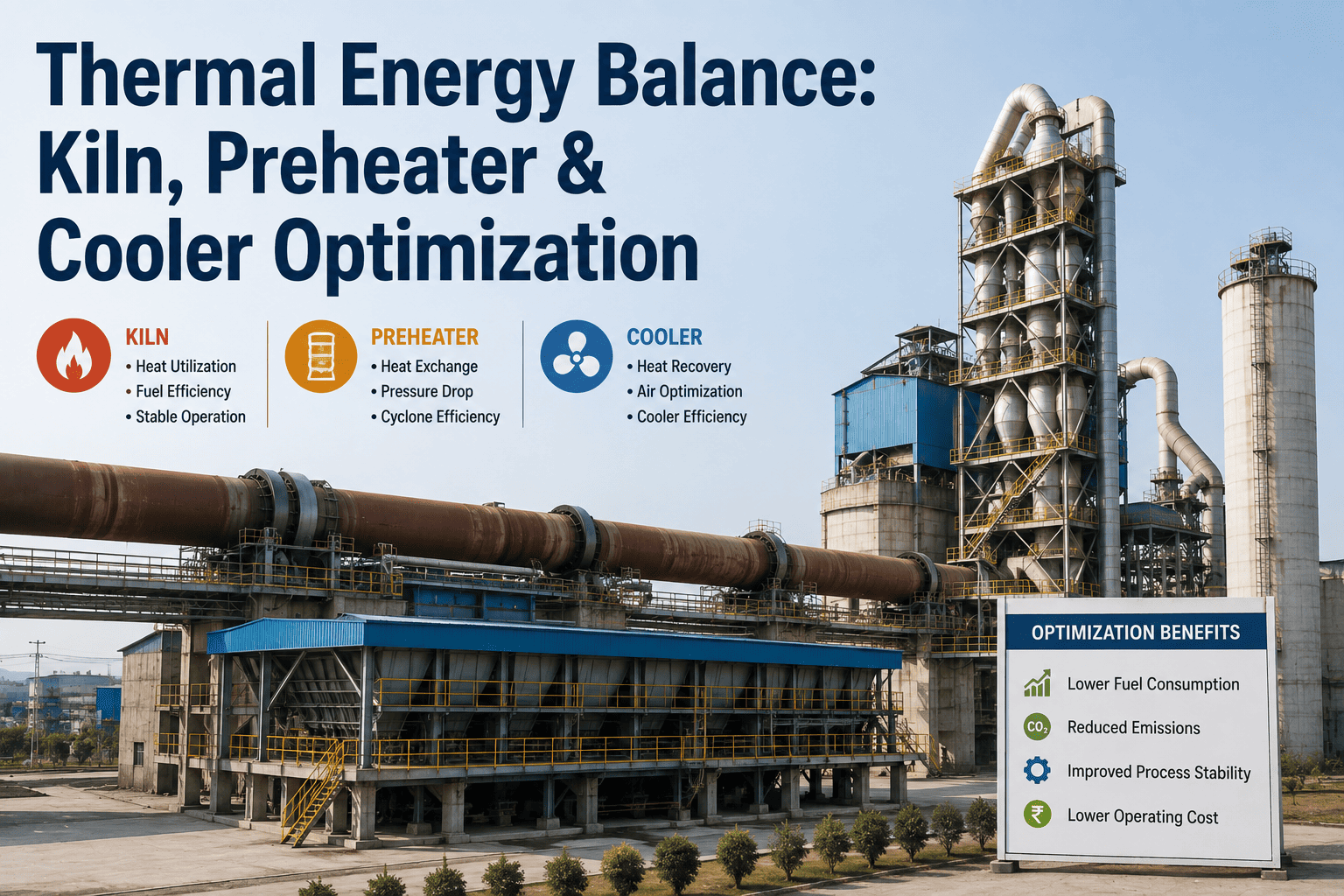
Every cubic meter of hot exhaust gas leaving a cement kiln's preheater tower has two competing claims on it. The raw mill wants it for drying wet raw material feed, and the waste heat recovery system wants it to generate steam and, ultimately, electricity. Both uses create real value, but they cannot both fully claim the same gas stream at the same time, and the split between them is rarely optimized deliberately — it is usually whatever the current damper position and mill operating schedule happen to produce. Plants that treat this as a genuine allocation decision, rather than an accident of current settings, consistently find additional combined value sitting in the gap between the two systems. Book a demo to see how heat allocation optimization is modeled against a live preheater gas balance.
One Gas Stream, Two Competing Demands
Preheater exhaust gas exits the tower carrying substantial thermal energy that the process has not yet fully extracted, and cement plants have historically routed that gas primarily to the raw mill, using its heat to dry wet raw material feed before grinding. As waste heat recovery systems have become standard equipment on new and retrofitted kilns, that same gas stream now has a second, competing destination: a boiler that converts the thermal energy into steam to drive a turbine generator, producing electricity the plant can use directly or export.
The tension between these two uses is structural, not incidental. Gas diverted to the raw mill for drying is gas the WHR boiler does not receive, and gas prioritized for WHR power generation is gas the mill cannot use for drying, forcing either a reduction in mill throughput or a shift to auxiliary hot air sources to make up the drying heat deficit. Because both systems draw from the same finite gas stream, the split between them is a genuine zero-sum allocation decision at any given moment, even though the two systems are usually operated by different teams with different performance targets and limited visibility into how their operating decisions affect the other system's output.
This organizational separation is often the real root cause behind a suboptimal allocation, more so than any technical limitation in the equipment itself. The raw mill operator is typically measured on mill throughput and feed moisture consistency, with little visibility into or accountability for WHR generation output. The WHR system operator, in turn, is typically measured on steam generation and power output, with limited insight into whether the current gas draw is constraining mill drying capacity in a way that is costing the plant more in reduced throughput than it is gaining in additional power. Each team is optimizing its own metric rationally, but neither has the full picture needed to find the allocation that maximizes combined plant value, and that gap in shared visibility is precisely what a unified view across both systems is designed to close.
Why the Default Split Is Rarely the Optimal One
Most plants arrived at their current gas allocation split through incremental history rather than deliberate design. The raw mill's damper and hot gas generator settings were tuned to dry the material feed reliably given typical moisture content, the WHR system was sized and commissioned to take whatever gas volume remained after mill demand was satisfied, and neither setting has necessarily been revisited since commissioning even as raw material moisture content, production rate, and electricity value have all shifted over the intervening years.
This default arrangement treats mill drying demand as the fixed, non-negotiable priority and WHR generation as the residual claimant on whatever gas is left over, which made reasonable sense when WHR systems were rare and grid electricity was comparatively inexpensive relative to today's rates. As electricity costs have risen and WHR system reliability has improved, the value of an additional unit of gas routed to power generation has, in many markets, grown to rival or exceed the value of that same gas unit's contribution to mill drying capacity, particularly when raw material moisture is on the lower end of the range the mill can handle without maximum heat input.
Factors That Should Drive the Allocation Decision
Optimizing the split between drying and power generation is not a one-time calculation — it is a decision that should respond to conditions that change shift to shift and season to season. The factors below are what actually determine which allocation delivers more combined value at any given time.
Building a Dynamic Allocation Approach
A static allocation split, however well it was chosen initially, leaves value on the table because raw material moisture, production schedule, and electricity value all shift independently of each other. The approach that captures the most combined value treats gas allocation as a variable to actively manage rather than a fixed setting, adjusting the balance in response to which factor is dominant at a given time.
Quantifying the Value on Each Side of the Tradeoff
Putting a genuine number on both sides of this allocation decision requires translating two very different physical outcomes into a common economic basis. On the mill side, the value of an additional unit of drying heat shows up as either increased mill throughput at a given moisture content, or the ability to process higher-moisture material that would otherwise require a slower feed rate or a moisture-related quality penalty. Estimating this value means understanding the mill's throughput-versus-drying-heat relationship at the current moisture level, which is typically available from mill performance curves already used for other optimization purposes.
On the WHR side, the value of an additional unit of gas is more straightforward to calculate once steam-to-power conversion efficiency and current electricity value are known, since it flows through a relatively linear chain from additional gas heat content to additional steam generation to additional turbine output. The complexity on this side comes less from the calculation itself and more from correctly capturing what the generated power is actually worth, which depends on whether the plant uses it to directly offset grid purchase at the prevailing tariff, exports it under a net metering arrangement at a different rate, or values it against a time-of-use structure where the same kilowatt-hour is worth substantially different amounts depending on when it is generated.
What Changes When Both Systems Share a Common View
Plants that successfully move from siloed operation to a shared allocation view typically describe the change less in terms of a single dramatic improvement and more as a steady accumulation of better day-to-day decisions. A shift supervisor who can see both current mill drying margin and current WHR generation value on the same screen is positioned to make a better real-time damper adjustment than one relying on a fixed standard operating procedure that does not account for today's specific moisture content or today's specific electricity value. Over a full year, these many small better decisions compound into a measurable improvement in combined value extracted from the same preheater exhaust gas stream that was always available, simply reallocated more deliberately than the default settings had been managing it.
The organizational shift required to get there is often smaller than it first appears. It does not require merging the mill and WHR teams into a single reporting structure, and it does not require replacing the performance metrics each team is already measured against. What it requires is a shared source of truth that both teams can see and reference when making operating decisions that affect the other system, and a standing forum, even something as lightweight as a brief weekly review, where allocation performance is discussed jointly rather than each team optimizing in isolation and discovering the friction only when a problem becomes visible enough to escalate. Plants that make this small structural change consistently report that most of the value comes not from any single dramatic reallocation, but from removing the everyday friction of two teams working against each other without realizing it.
The plants extracting the most combined value from their preheater exhaust gas are the ones treating this as an ongoing optimization rather than a setting nobody has revisited since commissioning. Book a demo to see how this tradeoff can be modeled continuously against your actual plant data.