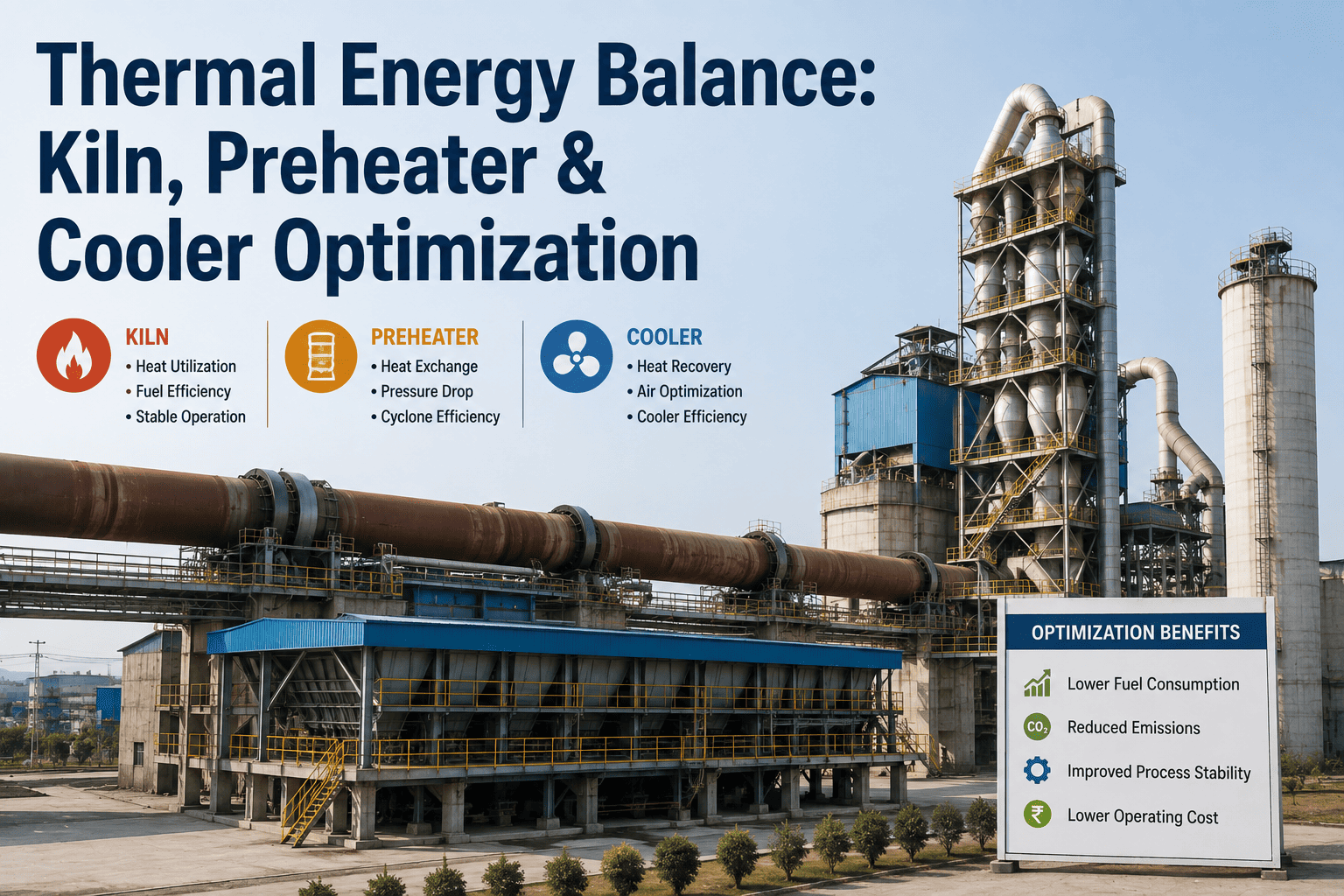
A kiln heat balance is nothing more than an accounting exercise: every kilocalorie that enters the kiln-preheater-cooler system as fuel or sensible heat has to leave it somewhere, and the job of a thermal energy balance is to find out exactly where. Most plants run reasonably close to their design fuel rate and assume that's good enough, until an audit shows the exhaust gas alone is carrying away a fifth of everything the burner puts in. The gap between a plant's actual fuel rate and its kiln's theoretical design figure is rarely one big problem; it's usually a handful of smaller streams that each look minor in isolation but add up once they're laid side by side. See how iFactory turns kiln, preheater, and cooler sensor data into a continuously updated balance through a Book a Demo.
Every Kilocalorie In Has To Leave Somewhere — Find Out Where Yours Is Going
iFactory builds a continuous input-output thermal energy balance across your kiln, preheater, and cooler system, turning scattered temperature, flow, and fuel readings into a ranked loss breakdown your team can actually act on, instead of a one-time audit report that's outdated within a quarter.
A Heat Balance Turns "The Kiln Feels Fine" Into A Number You Can Track
The theoretical minimum heat required to form clinker from raw meal, accounting for calcination and the endothermic reactions involved, sits around 2.9 gigajoules per tonne of clinker, which works out to roughly 692 kilocalories per kilogram. No real kiln ever hits that number, because some heat always escapes as exhaust gas, shell radiation, cooler stack loss, and a handful of smaller streams. A modern dry-process kiln with a well-maintained preheater typically runs in the 750-800 kcal/kg range, putting thermal efficiency around 52-55%. Plants running older or poorly maintained systems can consume anywhere from 1,300 to 1,800 kcal/kg, with thermal efficiency dropping to 25-35%. The gap between where a plant sits and where its kiln design says it should sit is the entire reason a thermal energy balance exists — it converts a vague sense that "the kiln runs hot" into a ranked, quantified list of exactly which loss stream is responsible and by how much. Without that number, two plants running at very different efficiencies can both describe their kiln as "running fine," because neither has a figure to compare against a design baseline or against where the same kiln sat a year earlier.
What Goes On Each Side Of The Balance
A kiln-preheater-cooler heat balance has exactly two sides, and every measurable stream in the system belongs to one or the other. The input side is dominated by fuel combustion heat, but it also includes the sensible heat already carried into the system by the raw meal, primary air, and any preheated combustion air. The output side splits between the heat that actually does useful work — forming clinker through calcination and sintering — and the heat that leaves the system without doing that work, which is what plants mean when they talk about "losses."
Input Side
- Heat of combustion from kiln and precalciner fuel
- Sensible heat of raw meal entering the preheater
- Sensible heat of primary and secondary combustion air
- Sensible heat of fuel itself, where preheated
Output Side
- Heat of clinker formation (the useful output)
- Preheater exhaust gas heat loss
- Cooler stack air heat loss
- Kiln shell radiation and convection loss
- Clinker discharge and dust losses
One Stacked Bar Rarely Tells The Whole Story On Its Own
Published kiln energy audits point to a consistent set of major loss streams, though the exact share each one carries varies with kiln design, refractory condition, and cooler generation. On a representative system, preheater exhaust gas accounts for roughly 21-22% of total heat input, kiln shell radiation for around 11-12%, and cooler stack air for about 7-8%, with the remainder split across clinker discharge heat, dust losses, and smaller unaccounted streams. The chart below represents a typical proportional split; a plant-specific balance is the only way to know your own numbers. Two kilns with near-identical design specifications can show meaningfully different splits once refractory wear, cooler generation, and preheater stage count are factored in, which is exactly why a benchmark chart is a starting reference rather than a substitute for measuring your own system.
Where Your Kiln Should Sit Against The Theoretical Minimum
These reference bands give a starting point for judging whether a measured heat balance points to a well-run system or a system with meaningful recovery potential still on the table.
| System Type | Specific Heat Consumption | Thermal Efficiency |
|---|---|---|
| Theoretical minimum | ~692 kcal/kg clinker (2.9 GJ/t) | 100% (reference basis) |
| Modern dry preheater/precalciner kiln | 750-800 kcal/kg clinker | 52-55% |
| Global industry average | 740-812 kcal/kg clinker (3.1-3.4 GJ/t) | Roughly 45-52% |
| Older / long-kiln / poorly maintained | 1,300-1,800 kcal/kg clinker | 25-35% |
The Variables That Push A Balance Off Design, One At A Time
A heat balance is only useful if it's tied to variables an operations team can actually influence. These are the relationships that show up consistently across kiln energy audits and give a sense of scale for each corrective action, and they're useful precisely because they translate a percentage or a temperature reading directly into a kcal/kg figure that can be compared against the cost of the fix.
Where A Heat Balance Calculation Quietly Goes Wrong
A heat balance is a simple concept in principle, but the practical execution has a handful of recurring failure points that undermine confidence in the result before anyone even gets to the loss-ranking stage.
Measuring During An Unstable Window
Data pulled during a kiln startup, a feed rate change, or a fuel switch produces a balance that doesn't reflect steady-state operation, and comparing it against a design figure calculated for stable running conditions will always look worse than reality.
Mixing Calibration Vintages
Flow meters, thermocouples, and gas analyzers drift over time, and a balance built from instruments calibrated at different points in the past produces a loss ranking that reflects instrument error as much as actual thermal performance.
Ignoring Ambient Conditions
Combustion air temperature and humidity shift the input-side sensible heat enough that a balance run in peak summer heat and one run in winter can show a real difference in fuel rate that has nothing to do with equipment condition.
Treating One Balance As The Final Word
A single measurement is a snapshot of one operating condition on one day; drawing a capital spending decision from it without at least a few repeat measurements risks funding a fix for a loss stream that was only temporarily elevated.
Five Steps To Build A Balance That Actually Holds Up
Our last full heat balance audit was done by an outside consultant two years earlier, and the exhaust gas loss figure we'd been quoting internally was from that report. Once we started pulling the balance from live preheater and cooler sensor data instead, the exhaust loss share had actually crept up by several points, almost entirely from a cracked expansion joint near the top cyclone that nobody had flagged because nothing about it looked urgent on a walk-through. We caught it in about six weeks instead of finding it at the next scheduled audit.
Not Every Loss Stream Deserves The Same Amount Of Capital
Once a balance identifies where heat is going, the harder question is which fix to fund first, and that decision usually comes down to weighing recoverable kcal/kg against capital cost and the length of the next planned outage window. These four categories cover most of the corrective actions plants weigh against each other, roughly ordered from fastest payback to largest capital commitment.
Sealing And False Air Control
Usually the fastest payback: cyclone flap valve replacement, duct joint resealing, and expansion joint repair recover measurable kcal/kg for relatively low capital outlay.
Refractory And Shell Coating
Targeted repair at hotspots identified by IR scanning recovers shell radiation loss without the cost of a full refractory replacement across the whole kiln length.
Cooler Grate And Air Beam Upgrades
Higher capital cost but addresses cooler stack loss directly, particularly valuable where the installed cooler generation is meaningfully behind current grate technology.
Preheater Stage Upgrades
The largest capital commitment on this list, typically justified only where exhaust gas loss remains the dominant stream even after sealing and refractory work are addressed.
Frequently Asked Questions
Q: How often should a kiln-preheater-cooler heat balance actually be run?
A full manual heat balance audit is typically an annual or semi-annual exercise because it requires coordinated data collection across fuel, air, and gas streams during a stable production window. That cadence is fine for benchmarking against design figures, but it's too slow to catch drift as it happens, since a cracked expansion joint or a slipping cooler grate plate can add measurable loss weeks before the next scheduled audit. iFactory builds the same balance continuously from live sensor feeds so the loss ranking updates every shift instead of once or twice a year. Reach out through Support Contact to see how your existing instrumentation maps to a continuous balance.
Q: What instrumentation do we need before we can build a reliable balance?
At minimum, a usable balance needs fuel flow and calorific value data, raw meal feed rate, preheater exit gas temperature and flow, cooler stack air temperature and flow, and a way to estimate kiln shell radiation, most commonly periodic or continuous infrared scanning. Most cement plants already have the bulk of this instrumentation in place for basic process control; the gap is usually in how consistently the readings are logged and normalized rather than in missing sensors outright. A Book a Demo session can walk through what your current instrumentation already supports.
Q: Why does our measured heat balance never quite add up to 100%?
Some gap between the input and output totals is normal and expected in any real-world balance, and it's usually reported as an "unaccounted losses" line rather than treated as an error. This gap comes from measurement uncertainty in flow meters and temperature probes, minor streams that aren't individually instrumented, and small timing mismatches between when input and output data points are logged. A well-run balance keeps this unaccounted share to a small percentage of total input; a gap that's unusually large is itself a signal that instrumentation calibration or data logging needs attention before the rest of the balance can be trusted. Tracking how that unaccounted share moves over time is often as informative as the named loss streams themselves, since a sudden jump usually means a sensor has drifted or failed rather than that the kiln itself changed.
Q: Is a heat balance the same thing as an energy audit?
They're closely related but not identical. A heat balance is the quantitative core of an energy audit — the input-output accounting that identifies and ranks loss streams. A full energy audit typically wraps that balance in broader context, including electrical energy consumption, comparison against best-available-technology benchmarks, and a prioritized capital improvement plan. In practice, most plants use "heat balance" to describe the thermal-only calculation and "energy audit" to describe the fuller report that includes it alongside recommendations and payback estimates.
Q: Can a continuous balance replace the need for periodic physical inspections?
No, and it isn't meant to. A continuous sensor-based balance is very good at telling you that a loss stream is growing and roughly how fast, but it can't always tell you which specific gasket, flap valve, or refractory panel is responsible. What it does well is narrow the search: instead of a maintenance team walking the full preheater string looking for problems, a rising exhaust loss trend points them toward the riser duct and cyclone seals specifically, cutting inspection time substantially compared to a blind walk-through. The most effective setups pair the two: continuous sensor-based tracking flags when and roughly where a loss stream is growing, and a scheduled physical inspection confirms the specific component and closes the loop with a work order.
Turn Your Next Heat Balance Into A Running Number, Not A Once-A-Year Report.
iFactory connects your kiln, preheater, and cooler instrumentation into one continuously updated thermal balance with losses ranked by recoverable value.