Electrical energy accounts for roughly a third of total cement manufacturing energy cost, and unlike thermal energy, which concentrates almost entirely in the kiln, electrical consumption spreads across dozens of individual motors, fans, mills, and compressors — which is exactly why it tends to get less coordinated attention than kiln fuel efficiency despite representing a comparably large cost category. A grinding mill running with worn liners, a fan operating against a partially closed damper instead of a variable speed drive, and a compressor cycling inefficiently at partial load are three unrelated inefficiencies that never appear together on any single report, yet together they can represent a meaningful share of avoidable electrical cost. Plants ready to see electrical consumption tracked by equipment class against efficiency benchmarks can Book a Demo to see how iFactory breaks down kWh per ton across major electrical consumers.
Mill Drives: Where the Largest Electrical Gains Concentrate
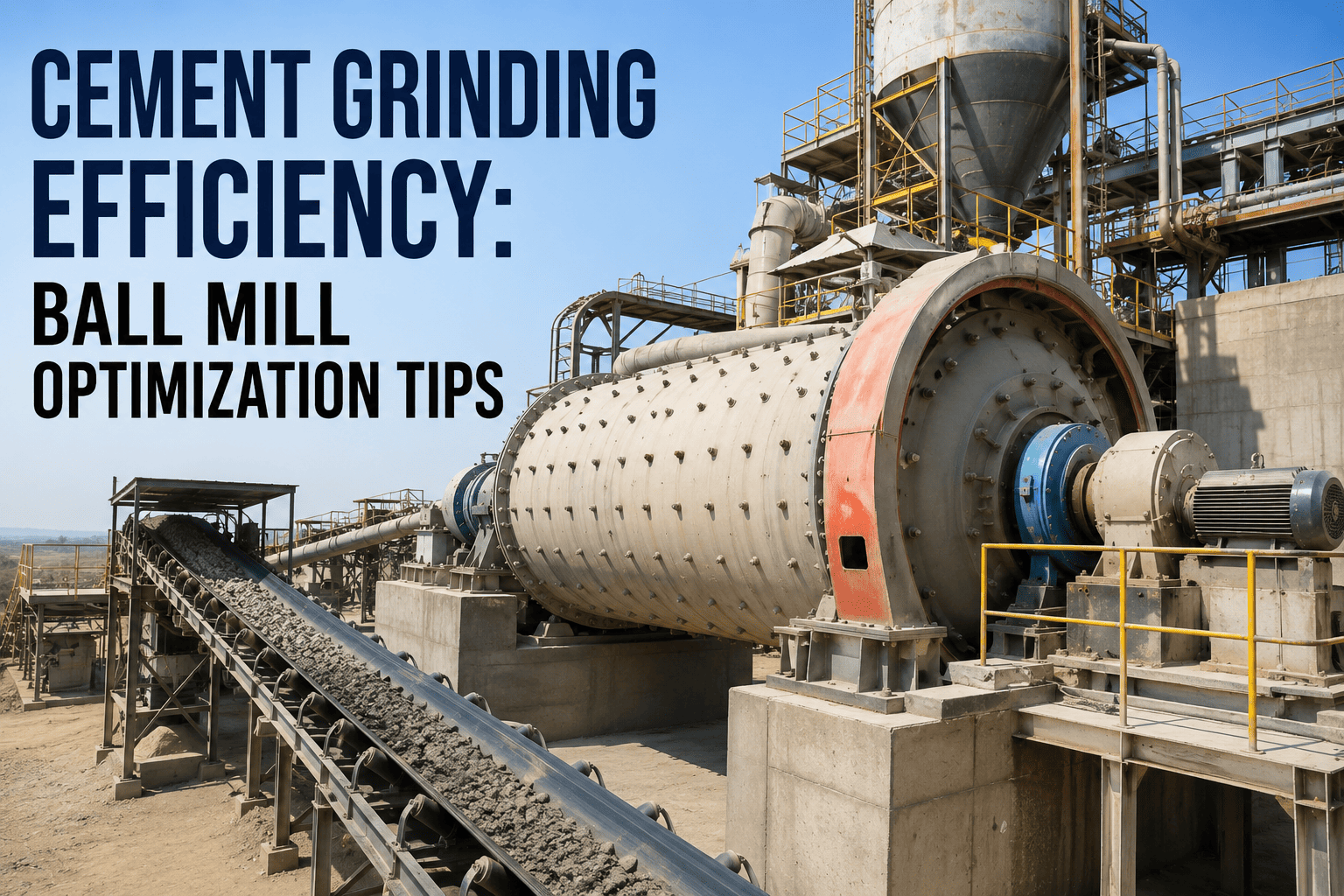
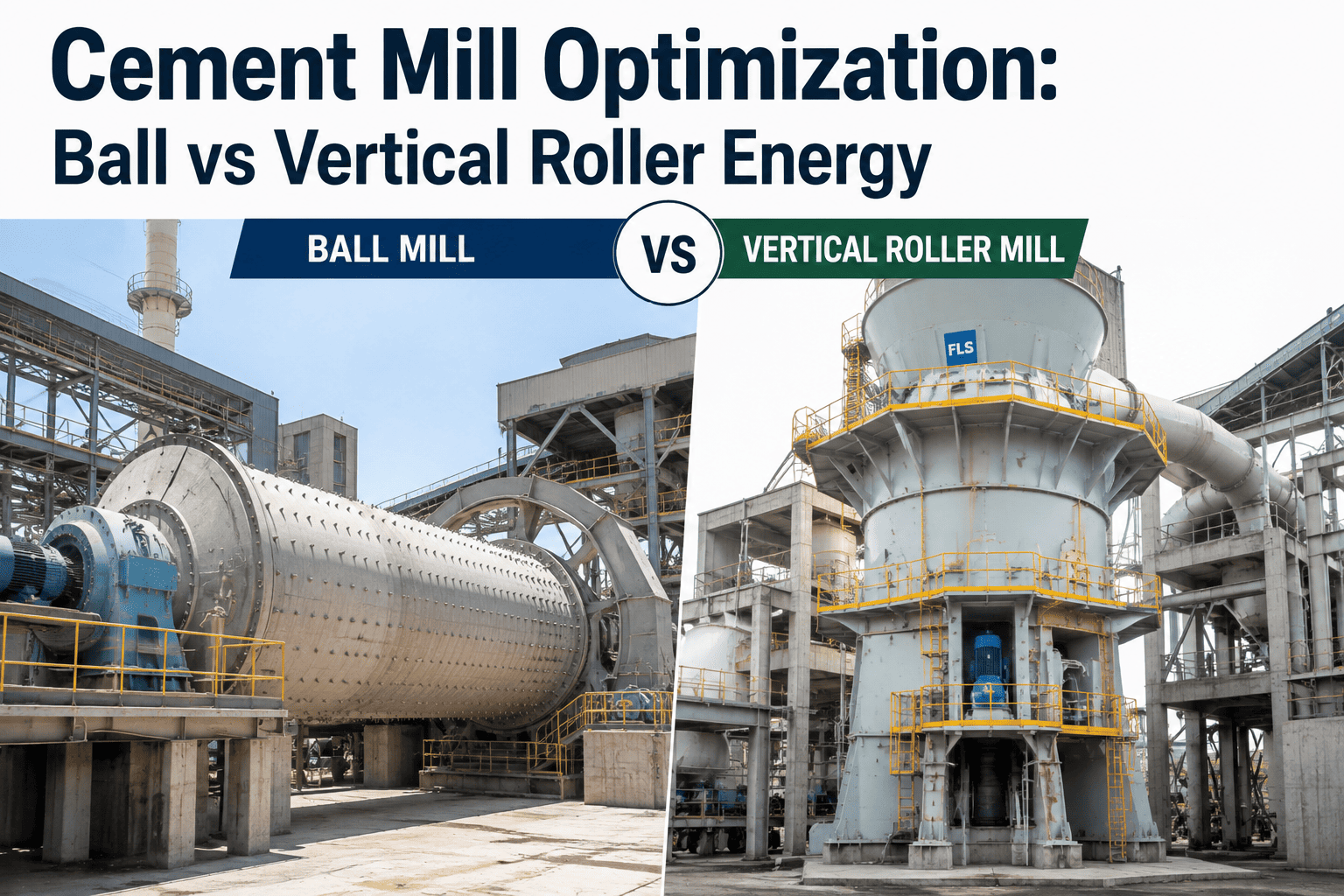
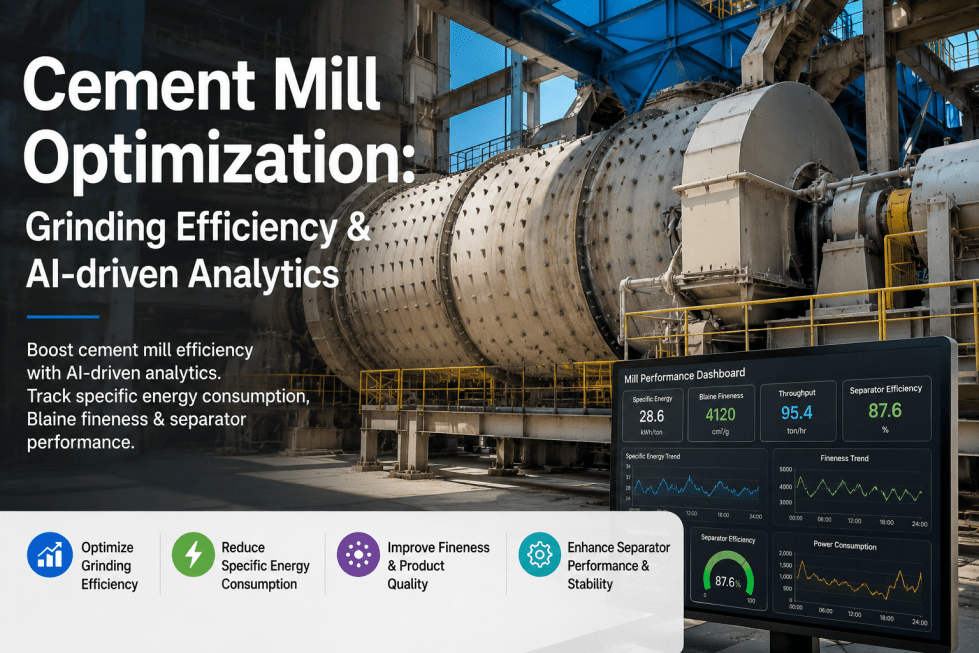
Grinding mill drives consume more electrical energy than any other single system in a cement plant, which means even small percentage improvements in mill electrical efficiency translate into meaningful absolute savings compared to equivalent percentage gains elsewhere. The dominant driver of mill electrical energy per ton is grinding efficiency — how much energy is required to achieve target fineness — and grinding efficiency is influenced heavily by factors that are often managed reactively rather than proactively: liner wear condition, grinding media charge and size distribution, and separator tuning.
Worn liners change the internal ball trajectory and impact pattern inside the mill, reducing grinding efficiency well before the wear becomes severe enough to trigger a maintenance work order under typical run-to-failure or fixed-interval replacement approaches. Grinding media that has not been re-charged or re-graded to compensate for wear over time produces a similar effect — the media still grinds material, but at meaningfully lower energy efficiency than a properly maintained charge. Separator tuning affects how much material is unnecessarily re-circulated through the mill rather than passing through to product on the first pass, and a separator drifting out of optimal tuning increases electrical energy per ton even when every other mill component is in good condition.
Fan Systems: The Hidden Cost of Damper-Based Flow Control
Many cement plant fan systems, particularly older installations, control air flow by partially closing a damper against a fan running at constant speed, rather than by adjusting fan speed directly to match required flow. This approach works functionally but wastes substantial electrical energy, since the fan motor continues consuming power to generate flow that is then deliberately restricted by the damper — energy spent generating flow that never actually moves air, dissipated instead as pressure drop across the throttled damper.
Variable speed drives replace this throttling approach by adjusting motor speed to match required flow directly, and the electrical savings from this change follow a favorable relationship where reducing fan speed by even a modest amount produces a disproportionately larger reduction in electrical power consumption, since fan power scales with speed at a steep exponential rate. A fan currently running at constant speed with a damper closed to reduce flow to seventy percent of maximum is consuming close to full power while delivering only seventy percent of the airflow — converting that same fan to variable speed control running at seventy percent speed for the same seventy percent flow typically cuts electrical consumption for that fan by a third or more, representing one of the more reliably calculable electrical savings opportunities in a cement plant.
Compressed Air: The Most Expensive Way to Move Energy
Compressed air is well known across industrial operations generally, and cement plants are no exception, as one of the least efficient ways to deliver energy for a given task, since the conversion from electrical energy to compressed air and back to mechanical work loses a substantial share of the original energy input at each conversion step. This does not mean compressed air should be eliminated — pneumatic conveying and instrument air remain genuinely necessary in many cement plant applications — but it does mean compressed air systems deserve closer efficiency scrutiny than their relatively modest share of total electrical consumption might suggest, since waste in this system is disproportionately expensive per unit of actual delivered work.
The most common and most correctable compressed air inefficiency is leakage, which in poorly maintained systems can account for a substantial share of total compressed air generation — air compressed at real cost and then lost entirely before reaching any productive use. A structured leak detection and repair program, typically using ultrasonic detection equipment during a plant walk-down, routinely identifies leak points that individually seem minor but collectively represent meaningful continuous electrical load, since the compressor must run to replace the lost air continuously rather than intermittently. Beyond leakage, matching compressor capacity to actual demand through appropriately sized equipment and control staging, rather than running oversized compressors at inefficient partial load, is the second major lever available without significant capital investment.
Motor Management: The System Most Plants Manage Least Actively
General-purpose motors across conveyors, pumps, and auxiliary systems collectively represent a meaningful share of total electrical consumption, yet individually each motor is often too small to attract dedicated efficiency attention, and the aggregate opportunity gets lost the same way minor equipment stops get lost in reliability reporting — each instance too small to matter, the total too large to ignore once actually quantified. Motor efficiency degrades gradually over years of operation through winding degradation and bearing wear, and a motor running at reduced efficiency draws more current for the same mechanical output without any obvious symptom that would prompt investigation.
A structured motor management program addresses this through two coordinated practices. First, a replace-on-failure policy that specifies high-efficiency motor standards for any replacement, rather than defaulting to whatever standard-efficiency motor is readily available, ensures the plant's motor population gradually upgrades over time without requiring a disruptive plant-wide replacement project. Second, periodic current draw monitoring on larger motors, compared against their rated baseline, can identify motors operating at degraded efficiency well before failure, giving maintenance teams a data-driven basis for prioritizing proactive motor replacement or rewinding rather than waiting for failure to force the decision under worse timing conditions.
Prioritizing Across Systems: Where to Start
With four distinct electrical systems each offering genuine improvement opportunity, plants without unlimited resources need a way to prioritize where to focus first. The most reliable prioritization approach combines two factors: the size of the system's contribution to total electrical consumption, and the ease of capturing improvement without major capital investment. Mill drive efficiency improvements through better liner and media management typically score highest on this combined basis, given the system's large share of total consumption and the fact that the primary interventions — wear-based maintenance scheduling and separator tuning — require operational discipline more than capital investment.
Fan variable speed drive conversion, while requiring capital investment unlike mill maintenance discipline, typically offers the most calculable and reliable return of any capital electrical project in a cement plant, given the well-understood relationship between reduced fan speed and disproportionately reduced power consumption discussed earlier. Compressed air leak repair offers the fastest payback of any of the four systems, often measured in months rather than years, since it requires minimal capital and produces immediate, measurable reduction in compressor run time. Motor management, while offering the smallest individual-system opportunity, compounds valuably over time as a standing policy rather than a one-time project, making it worth establishing even while other higher-priority initiatives are underway.
Power Factor and Demand Charges: The Cost Beyond Raw Consumption
Discussions of electrical energy optimization tend to focus entirely on kWh consumption, but many cement plants pay a meaningful share of their electrical bill through demand charges and power factor penalties that have little to do with total energy consumed and everything to do with how that consumption is shaped over time. A plant that reduces total kWh consumption through the mill, fan, compressor, and motor initiatives described above while leaving demand charge and power factor management unaddressed is capturing only part of the available electrical cost savings.
Demand charges are typically based on the plant's peak electrical draw during any short interval within the billing period, meaning a brief period where multiple large motors start simultaneously — several mills, major fans, and a compressor all drawing high inrush current within the same few minutes — can set a demand charge for the entire month based on that one peak, even if average consumption across the rest of the period was well managed. Staggering large motor starts, rather than allowing them to coincide, is a low-cost operational practice that can meaningfully reduce peak demand charges without requiring any change to total energy consumed.
Power factor penalties arise when a plant's electrical load draws a disproportionate amount of reactive power relative to real power, which is common in facilities with many large induction motors, as found throughout cement grinding and material handling systems. Power factor correction, typically through capacitor bank installation at appropriate points in the electrical distribution system, reduces or eliminates these penalties and is often one of the more straightforward electrical investments available, with utilities in many regions providing meaningful, well-documented cost avoidance once correction equipment is properly sized and installed for the plant's actual load profile.
Load Shifting: Aligning Consumption With Favorable Utility Rate Structures
Beyond reducing total consumption, many cement plants have meaningful opportunity to shift when electrical consumption occurs, taking advantage of time-of-use utility rate structures that charge substantially less for electricity consumed during off-peak periods compared to peak demand windows. This lever does not reduce total energy used but can meaningfully reduce total energy cost, and it is frequently underexploited because production scheduling is typically driven by output targets and delivery deadlines without explicit consideration of the utility rate structure.
Cement mills, given their large electrical draw and relative flexibility in exact production timing compared to continuous kiln operation, are often the best candidate for load shifting consideration. A plant with meaningful silo storage capacity has some latitude to weight cement mill operation toward off-peak hours where utility rate structures reward it, without disrupting overall monthly production targets or dispatch commitments. This requires coordination between production scheduling and whoever manages the utility relationship and rate structure understanding within the plant, since the opportunity is invisible to a scheduling process focused purely on meeting output and delivery targets without visibility into the underlying electrical cost structure across different times of day.
The magnitude of load shifting opportunity varies substantially by region and utility rate structure, so it is worth a specific analysis of the plant's actual rate schedule rather than assuming it applies universally. In regions with a meaningful peak-to-off-peak rate differential, however, plants that incorporate rate-structure awareness into mill scheduling alongside the other optimization levers in this framework routinely find measurable additional savings that would otherwise stay invisible inside a production schedule optimized purely for output.