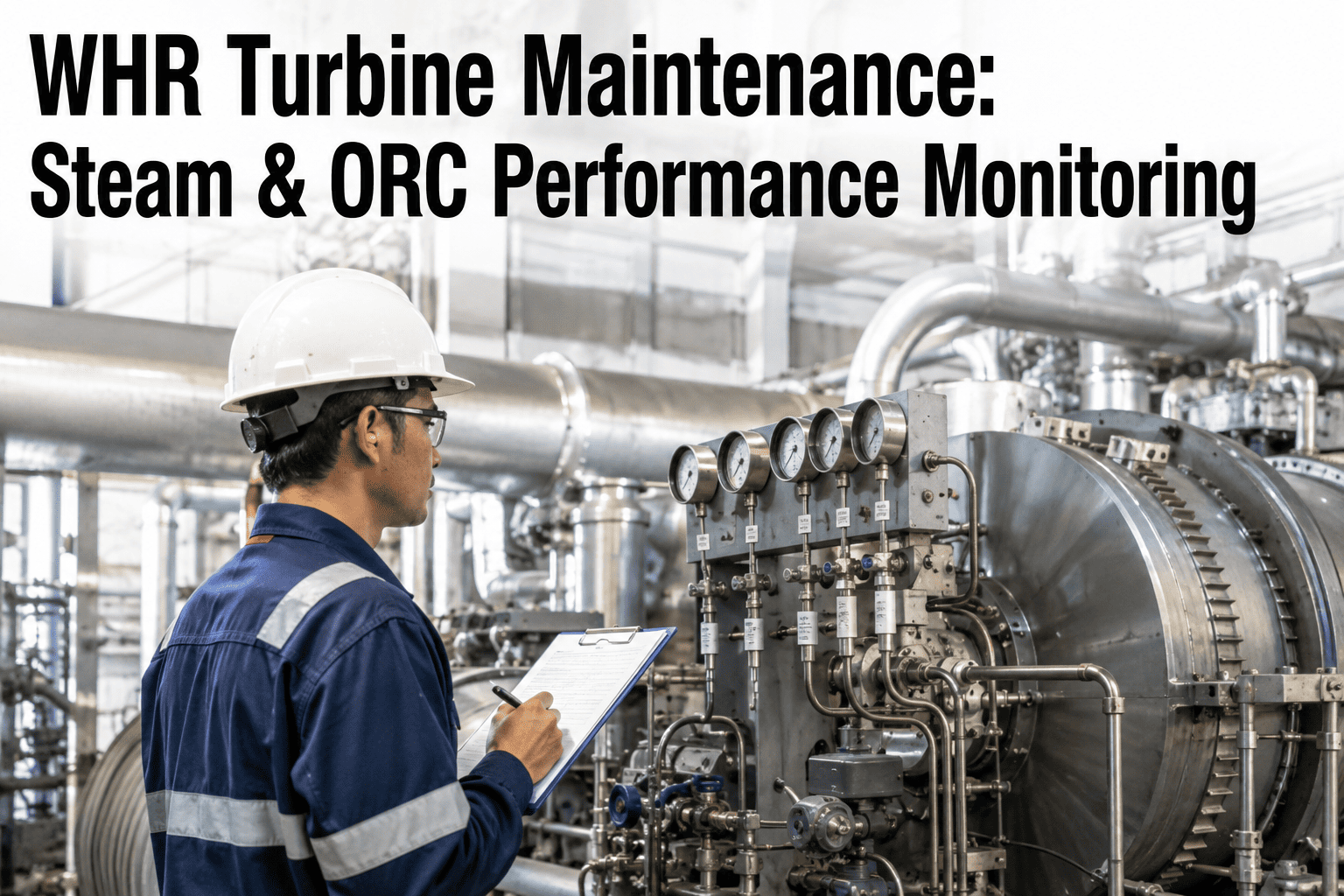
A waste heat recovery boiler on a 6,000 tonne-per-day cement line can shed four tonnes of steam generation an hour and nobody notices for months, because the drop shows up as half a percent of drift a week instead of an alarm. A turbine seal wears, a boiler tube gathers a dust cake, feedwater chemistry slides out of spec — none of it looks like a failure until the monthly power reconciliation shows the plant generating less than last quarter. By then it has already given back weeks of carbon-free power that should have covered close to a third of site load. WHR only pays off if maintenance treats it as seriously as the kiln, starting with knowing which failure modes are quietly eating steam generation — the exact gap iFactory's WHR reliability engineers get called in to close.
Keep Your WHR Plant Running at Design Efficiency, Not Nameplate Optimism
Cement kilns lose roughly 35–40% of the thermal energy fed into them through preheater exhaust and clinker cooler air. A properly maintained WHR system recovers enough of that to cover close to 30% of a plant's power draw. A poorly maintained one recovers a fraction of that number while the plant keeps paying full grid tariff and nobody can say exactly why.
The Five Failure Modes That Quietly Erode WHR Availability
Nearly every WHR shortfall traces back to one of five recurring problems, and every one of them develops gradually enough to hide inside normal operating variance for weeks before someone notices the megawatt-hour number is wrong.
Dust Fouling on Boiler Heat Transfer Surfaces
Kiln exhaust carries a heavy, abrasive dust load that settles on PH and AQC boiler tube banks. As the fouling layer thickens, heat transfer resistance climbs, flue gas exit temperature rises, and steam generation falls — often 2 to 5% per season if soot-blowing schedules slip, well before anyone schedules a tube inspection.
Turbine Seal and Blade Degradation
Labyrinth seal clearances open up and blade surfaces erode from wet steam and carryover, both of which bleed power output without tripping any protective device. A turbine can lose several percentage points of isentropic efficiency while every individual reading still looks like it's within its normal band.
Feedwater and Steam Chemistry Excursions
Dissolved oxygen creeping above spec, silica carryover, or a deaerator running below vacuum pressure all set up scale formation and corrosion inside boiler tubes and turbine blade paths — damage that is invisible until the next planned outage, by which point it is a repair job instead of a chemistry adjustment.
Bypass Damper and Duct Leakage
Every WHR boiler is fitted with a bypass gas duct and damper so the kiln can keep running if the power station trips. A damper that no longer seats fully bleeds hot gas around the boiler, quietly cutting the volume of exhaust actually available for heat recovery even while the kiln itself shows nothing abnormal.
Condenser and Cooling Water Scaling
Scaling on condenser tubes reduces vacuum, which reduces the pressure drop available to the turbine and therefore its work output — a slow, unannounced loss that shows up only as a lower megawatt reading against the same steam flow, easy to blame on ambient conditions instead of the real cause.
Not sure which of these five is driving your shortfall? Book a WHR diagnostic call and iFactory will walk your DCS trend data against all five failure signatures.
Symptom-to-Cause Troubleshooting Reference
When the WHR power output number disagrees with what the kiln operating conditions suggest it should be, the fastest path back to design efficiency is matching the symptom to its most likely root cause before opening anything up. This reference reflects the recurring patterns operators and reliability engineers report across steam Rankine and ORC installations alike.
| Observed Symptom | Most Likely Cause | Corrective Action | Urgency |
|---|---|---|---|
| Flue gas exit temperature rising, steam flow falling | Dust cake building on boiler tube banks | Trigger soot-blower sequence early; schedule manual tube cleaning if temperature keeps climbing | Medium |
| Power output down but steam flow and pressure normal | Turbine seal wear or blade erosion reducing isentropic efficiency | Log vibration and differential pressure trend; plan seal inspection at next available window | High |
| Condenser vacuum drifting worse over weeks | Cooling tube scaling or non-condensable gas ingress | Schedule condenser tube cleaning; check air ejector and vacuum pump performance | Medium |
| Water hammer or steam surge noise at turbine inlet | Priming or carryover from boiler drum during kiln upset | Check drum level control and boiler water chemistry immediately; do not ignore repeated events | Critical |
| Recovered gas volume lower than kiln conditions suggest | Bypass damper not seating fully, gas leaking around the boiler | Inspect damper seals and actuator calibration during next planned stop | Medium |
The Maintenance Cadence That Actually Prevents These Failures
WHR boilers and turbines are frequently maintained on the same fixed-interval schedule as any other energy utility, checked only during major outages. That approach misses months of slow degradation. A cadence built around the specific failure modes above catches the drift while it is still an adjustment, not a repair.
Feedwater and Steam Quality Parameters Worth Watching
Most turbine and boiler tube damage in a WHR system does not start as a mechanical fault — it starts as a water chemistry excursion that nobody flagged as urgent at the time. These are the parameters that matter most in a cement plant WHR loop.
Dissolved Oxygen Control
A vacuum-type deaerator running below its design vacuum lets dissolved oxygen back into the feedwater, accelerating pitting corrosion inside boiler tubes long before any leak becomes visible.
Turbine Blade Deposits
Silica carrying over with steam deposits on turbine blades, disrupting the aerodynamic profile and reducing efficiency in a way that looks identical to normal blade fouling on a trend chart.
Priming and Carryover
Sudden kiln load changes can trigger priming, where water enters the steam line and hammers the turbine. Tight drum level control during kiln upsets is the single most effective way to prevent it.
Tube Erosion Prevention
Steam soot blowers that condense mid-cycle eject water slugs that erode tubes over time; sonic or compressed-air cleaning avoids that mechanical stress while still clearing dust cake effectively.
Reliability Engineer Perspective
We used to treat the WHR plant as a utility, not a production asset — checked at the annual outage and otherwise left alone. The boiler was quietly losing efficiency for eight months before the finance team asked why the power reconciliation number had drifted. Once we started tracking fouling resistance and turbine differential pressure daily against a rolling baseline, we caught the next drift in under three weeks instead of eight months.
— Energy & Utilities Manager, integrated cement plant, 6,000 TPD kiln line
boiler efficiency lost per season when soot-blowing schedules slip behind actual fouling rate
reduction in tube erosion when soot blowing is triggered by need rather than a fixed timer
typical interval for major turbine and boiler overhauls when interim maintenance is properly tracked
What Disciplined WHR Maintenance Recovers
The value of catching these failure modes early is not abstract — it shows up directly in availability, in megawatt-hours generated per tonne of clinker, and in how much of the site's power draw the WHR plant actually covers against how much it was designed to cover.
WHR plant availability achievable with need-based soot blowing and daily trend monitoring, versus 75–80% under fixed-interval maintenance alone
how long a slow, one-percent-a-month boiler efficiency decline typically runs unnoticed without a rolling performance baseline in place
of total site power draw a well-maintained WHR system can realistically cover on a large kiln line
Want to see where your own WHR plant sits against these benchmarks? Book a 30-minute performance review and bring your last six months of power reconciliation data.
Stop Losing WHR Output to Failures That Never Trip an Alarm
iFactory tracks fouling resistance, turbine differential pressure, condenser vacuum, and feedwater chemistry against a rolling baseline — so degradation shows up as a trend line weeks before it shows up as a lost megawatt. Start with a single WHR line. Prove the recovered output. Then scale across the plant.
Frequently Asked Questions
How often should a cement plant WHR boiler actually be soot-blown?
There is no single correct interval, because fouling rate depends on dust load, sulphur content, and gas velocity, all of which shift with kiln operating conditions. During high-dust or high-sulphur campaigns, fouling can build up meaningfully within hours, while during clean campaigns a fixed frequent schedule wastes cleaning medium and accelerates tube erosion for no benefit. The more reliable approach is need-based blowing triggered by flue gas exit temperature or calculated fouling resistance rather than a calendar timer, which studies of similar boiler systems have shown reduces tube erosion by roughly 30% while keeping the boiler cleaner between planned outages.
What is the earliest warning sign of turbine seal or blade degradation?
The earliest sign is rarely a vibration alarm or a visible leak — it is a slow divergence between steam flow and power output that stays within each instrument's individually acceptable range. A turbine losing isentropic efficiency to seal wear or blade erosion will show falling megawatts against steady steam conditions weeks or months before any single reading crosses an alarm threshold. Tracking turbine differential pressure and power output together against a rolling baseline, rather than watching each parameter in isolation, is what surfaces this pattern early enough to plan an inspection instead of reacting to a failure.
Can WHR maintenance be handled through the same CMMS as the rest of the plant?
Yes, and it generally should be, since treating WHR equipment as a separate "energy utility" outside the plant's normal maintenance discipline is exactly what allows slow degradation to go untracked for months. Daily performance parameters — flue gas temperatures, steam flow, feedwater quality, power output — should feed the same CMMS as kiln and mill equipment, with fouling resistance and turbine efficiency trended against a rolling baseline rather than checked only at outages. iFactory's platform connects directly to existing CMMS and historian systems so WHR assets get the same visibility as production equipment.
What causes priming or carryover in a WHR boiler, and why is it dangerous?
Priming and carryover happen when water droplets enter the steam line along with the steam itself, most commonly during a sudden kiln load swing that upsets drum level control faster than the control loop can compensate. The risk is not just efficiency loss — water entering a turbine designed for dry steam can cause mechanical shock to blades and seals, and repeated events accelerate wear that would otherwise take years to develop. Tight drum level control during kiln upsets, along with monitoring for water hammer or surge noise at the turbine inlet, is the most effective way to catch this before it causes lasting damage.
How much WHR output is realistically lost to under-maintenance versus design limitations?
On a well-designed system, the gap between theoretical and actual output is almost entirely a maintenance and monitoring problem rather than a design limitation. A WHR plant achieving 92% or higher availability with need-based cleaning and daily trend monitoring, against 75 to 80% under fixed-interval maintenance alone, is not operating a fundamentally different boiler — it is simply catching the same five failure modes weeks earlier. Book a performance review to see where your specific installation sits against these benchmarks.